
AIIMS Pharmacist and Railway Pharmacist MCQs
Practice AIIMS Pharmacist and Railway Pharmacist MCQs and revision notes on renal disorders, diabetes, thyroid diseases, STDs, and cancer for GPAT, NIPER, AIIMS, SSC, ESIC, and pharmacist exams.
Dr. Alok Singh
7/9/20268 min read
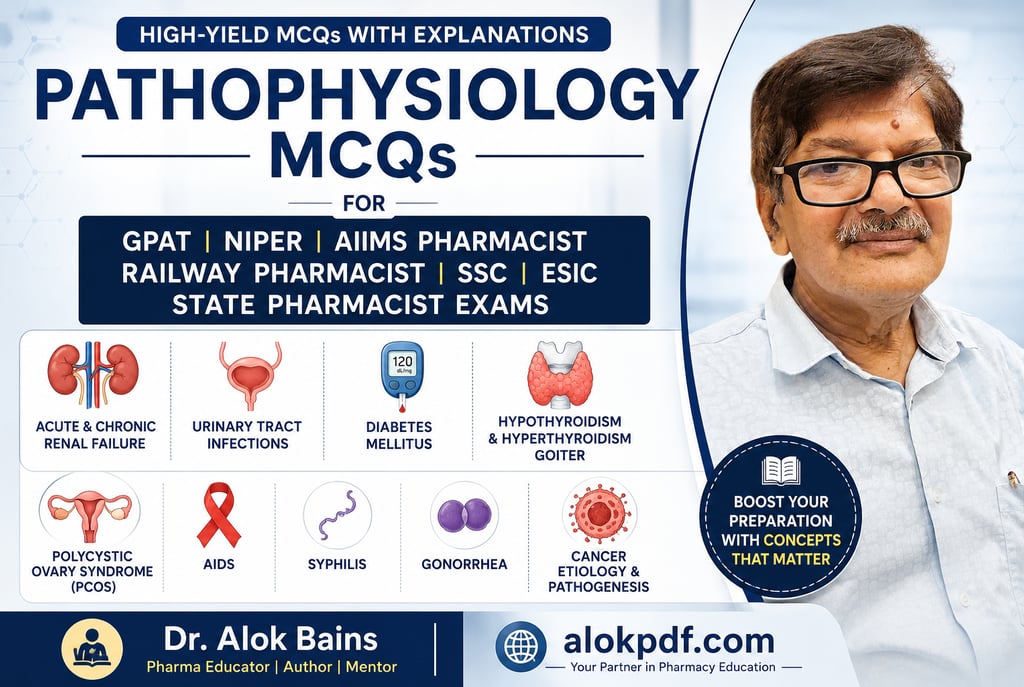
Renal Disorders, Endocrine Disorders, Sexually Transmitted Diseases, and Cancer. GPAT/NIPER, AIIMS Pharmacist, Railway Pharmacist, SSC, ESIC, and State Pharmacist examinations level MCQs with Explanations
Revision notes for quick recall before attempting MCQs
Quick Revision Notes for Competitive Examinations
1. Acute Kidney Injury (Acute Renal Failure)
Sudden decline in kidney function occurring over hours to days.
Characterized by increased serum creatinine and reduced urine output.
Causes are remembered as pre-renal, renal, and post-renal.
Prerenal: Reduced blood flow to kidneys (dehydration, shock).
Renal: Damage to kidney tissue (acute tubular necrosis, nephritis).
Post-renal: Obstruction to urine flow (stones, enlarged prostate).
Common complications: hyperkalemia, metabolic acidosis, fluid overload.
Memory Tip:
"PRP = Perfusion, renal tissue, and passage blockage."
2. Chronic Kidney Disease (Chronic Renal Failure)
Progressive and irreversible loss of nephron function for more than 3 months.
Most common causes:
Diabetes mellitus
Hypertension
Major complications:
Anemia (↓ erythropoietin)
Bone disease (↓ Vitamin D activation)
Hyperkalemia
Metabolic acidosis
Memory Tip:
"Kidney fails slowly: Blood, Bone, and Blood Pressure suffer."
3. Urinary Tract Infection
Infection anywhere in the urinary tract.
Most common organism: Escherichia coli.
Symptoms:
Dysuria
Frequency
Urgency
Suprapubic pain
Kidney involvement causes pyelonephritis with fever and flank pain.
Memory Tip:
"3 Fs of UTI: Frequency, Fever, Flank pain."
4. Diabetes Mellitus
Chronic disorder characterized by hyperglycemia.
Type 1: Autoimmune destruction of pancreatic beta cells.
Type 2: Insulin resistance with relative insulin deficiency.
Classical symptoms:
Polyuria
Polydipsia
Polyphagia
Memory Tip:
"Three Ps = Pee more, Drink more, Eat more."
Important complications:
Retinopathy
Nephropathy
Neuropathy
Exam Pearl:
HbA1c reflects average blood glucose over approximately 3 months.
5. Hypothyroidism
Deficiency of thyroid hormones.
Common features:
Weight gain
Cold intolerance
Constipation
Bradycardia
Fatigue
Memory Tip:
"Everything becomes SLOW in hypothyroidism."
6. Hyperthyroidism
Excess production of thyroid hormones.
Common features:
Weight loss
Heat intolerance
Tachycardia
Tremors
Anxiety
Memory Tip:
"Everything becomes FAST in hyperthyroidism."
7. Goiter
Enlargement of the thyroid gland.
Most common worldwide cause: iodine deficiency.
May occur with normal, low, or high thyroid hormone levels.
Memory Tip:
"Goiter = Growth of thyroid size."
8. Polycystic Ovary Syndrome
Common endocrine disorder in women of reproductive age.
Features:
Irregular menstruation
Hyperandrogenism
Multiple ovarian cysts
Infertility
Memory Tip:
"PCOS = Period problems + Cysts + Obesity + Hair growth."
Exam Point:
An increased LH:FSH ratio is commonly observed.
9. Human Immunodeficiency Virus Infection and AIDS
Caused by Human Immunodeficiency Virus (HIV).
Virus attacks CD4+ T lymphocytes leading to immunodeficiency.
Major routes of transmission:
Sexual contact
Blood transfusion
Needle sharing
Mother to child
Memory Tip:
"HIV attacks the body's COMMANDER cells — CD4 cells."
10. Syphilis
Caused by Treponema pallidum.
Disease progresses in stages:
Primary — painless chancre.
Secondary — rash and systemic symptoms.
Tertiary — cardiovascular and neurological involvement.
Memory Tip:
"Syphilis starts with a sore and may end with the heart and brain."
11. Gonorrhea
Caused by Neisseria gonorrhoeae.
Produces urethritis with purulent discharge and dysuria.
Organism is a Gram-negative intracellular diplococcus.
Memory Tip:
"GONO = Gonococcus causes Gonorrhea."
12. Cancer: Etiology and Pathogenesis
Cancer is uncontrolled and abnormal cell proliferation.
Development involves:
Initiation
Promotion
Progression
Important terms:
Oncogenes: Promote cell growth.
Tumor suppressor genes: Inhibit cell growth.
Metastasis: Spread of cancer to distant sites.
Angiogenesis: Formation of new blood vessels to feed tumors.
Memory Tip:
"Cancer survives by Growing, Spreading, and Feeding."
High-Yield Facts:
p53 = "Guardian of the Genome."
RB gene controls the G1-S checkpoint.
VEGF promotes angiogenesis.
Bcl-2 inhibits apoptosis.
Exam Points:
The two most frequently tested cancer concepts in GPAT and NIPER are p53 mutation and angiogenesis mediated by VEGF.
MCQs
1. Acute renal failure is currently referred to as
A. Chronic kidney disease
B. Acute kidney injury
C. Nephrotic syndrome
D. Glomerulonephritis
Answer: B
2. The most common cause of prerenal acute kidney injury is:
A. Urinary obstruction
B. Glomerulonephritis
C. Reduced renal perfusion
D. Nephrotoxic drugs
Answer: C
3. Which of the following is a postrenal cause of renal failure?
A. Severe dehydration
B. Acute tubular necrosis
C. Ureteric obstruction
D. Septic shock
Answer: C
4. The hallmark laboratory finding in chronic renal failure is:
A. Hypoglycemia
B. Elevated serum creatinine
C. Decreased blood urea
D. Hypercalcemia
Answer: B
5. The major pathological feature of chronic kidney disease is:
A. Reversible nephron injury
B. Progressive nephron loss and fibrosis
C. Increased erythropoietin production
D. Increased glomerular filtration rate
Answer: B
6. The most common causative organism of urinary tract infection is:
A. Staphylococcus aureus
B. Pseudomonas aeruginosa
C. Escherichia coli
D. Klebsiella pneumoniae
Answer: C
7. Painful urination is medically termed as
A. Hematuria
B. Dysuria
C. Polyuria
D. Oliguria
Answer: B
8. Infection involving the kidney parenchyma is called
A. Cystitis
B. Urethritis
C. Pyelonephritis
D. Nephrosis
Answer: C
9. Type 1 diabetes mellitus primarily results from:
A. Insulin resistance
B. Autoimmune destruction of beta cells
C. Excess glucagon secretion
D. Excess cortisol secretion
Answer: B
10. The classical triad of diabetes mellitus includes:
A. Polyuria, polydipsia, polyphagia
B. Bradycardia, edema, cyanosis
C. Fever, cough, dyspnea
D. Hematuria, dysuria, oliguria
Answer: A
11. The major defect in Type 2 diabetes mellitus is:
A. Autoimmune beta-cell destruction
B. Insulin resistance
C. Lack of glucagon
D. Excess thyroid hormone
Answer: B
12. Glycosylated hemoglobin used for long-term monitoring of diabetes is:
A. HbA1c
B. HbF
C. HbS
D. HbA2
Answer: A
13. The most common cause of hypothyroidism in iodine-sufficient regions is:
A. Graves' disease
B. Hashimoto thyroiditis
C. Pituitary adenoma
D. Thyroid carcinoma
Answer: B
14. Which symptom is commonly associated with hypothyroidism?
A. Weight loss
B. Heat intolerance
C. Bradycardia
D. Tremors
Answer: C
15. Graves' disease is a common cause of:
A. Hypothyroidism
B. Hyperthyroidism
C. Diabetes mellitus
D. Addison disease
Answer: B
16. Exophthalmos is characteristically seen in:
A. Hashimoto thyroiditis
B. Graves disease
C. Thyroid adenoma
D. Cretinism
Answer: B
17. The most common cause of endemic goiter worldwide is:
A. Selenium deficiency
B. Vitamin D deficiency
C. Iodine deficiency
D. Iron deficiency
Answer: C
18. Enlargement of the thyroid gland is termed:
A. Thyrotoxicosis
B. Goiter
C. Myxedema
D. Thyroiditis
Answer: B
19. PCOS is commonly associated with:
A. Hypoglycemia
B. Hyperandrogenism
C. Hypercalcemia
D. Hypotension
Answer: B
20. A characteristic ovarian finding in PCOS is:
A. Ovarian atrophy
B. Multiple immature follicles
C. Ovarian abscess
D. Corpus luteum cyst only
Answer: B
21. Which hormone is typically elevated in PCOS?
A. Testosterone
B. Aldosterone
C. Calcitonin
D. ADH
Answer: A
22. AIDS is caused by:
A. HBV
B. HIV
C. HPV
D. HCV
Answer: B
23. HIV primarily infects which cells?
A. Neutrophils
B. Eosinophils
C. CD4+ T lymphocytes
D. Platelets
Answer: C
24. The most common route of HIV transmission worldwide is:
A. Airborne spread
B. Sexual contact
C. Mosquito bite
D. Food contamination
Answer: B
25. Syphilis is caused by:
A. Neisseria gonorrhoeae
B. Treponema pallidum
C. Chlamydia trachomatis
D. Candida albicans
Answer: B
26. The primary lesion of syphilis is known as:
A. Chancre
B. Gumma
C. Papule
D. Vesicle
Answer: A
27. Gonorrhea is caused by:
A. Treponema pallidum
B. Neisseria gonorrhoeae
C. HIV
D. Herpes simplex virus
Answer: B
28. The typical microscopic appearance of Neisseria gonorrhoeae is:
A. Gram-positive cocci
B. Gram-negative diplococci
C. Gram-positive bacilli
D. Acid-fast bacilli
Answer: B
29. The uncontrolled proliferation of cells is known as:
A. Hyperplasia
B. Metaplasia
C. Neoplasia
D. Dysplasia
Answer: C
30. Genes that promote cell growth and may lead to cancer when mutated are called:
A. Tumor suppressor genes
B. Proto-oncogenes
C. Housekeeping genes
D. Repair genes
Answer: B
31. The tumor suppressor gene commonly called the "guardian of the genome" is:
A. BRCA1
B. APC
C. p53
D. MYC
Answer: C
32. Which virus is strongly associated with carcinoma of the cervix?
A. HIV
B. HBV
C. HPV
D. EBV
Answer: C
33. Tobacco smoking is a major risk factor for:
A. Cataract
B. Lung cancer
C. Peptic ulcer
D. Appendicitis
Answer: B
34. "Metastasis" refers to
A. Local inflammation
B. Spread of malignant cells to distant sites
C. Benign tumor formation
D. Tissue regeneration
Answer: B
35. The process by which new blood vessels are formed to support tumor growth is called:
A. Apoptosis
B. Angiogenesis
C. Necrosis
D. Fibrosis
Answer: B
36. Which of the following is NOT a complication of chronic renal failure?
A. Anemia
B. Hyperkalemia
C. Osteodystrophy
D. Polycythemia
Answer: D
37. The earliest pathological event in diabetic nephropathy is:
A. Tubular necrosis
B. Glomerular hyperfiltration
C. Ureteric obstruction
D. Renal infarction
Answer: B
38. Heat intolerance, tachycardia, and weight loss are characteristic of:
A. Hypothyroidism
B. Hyperthyroidism
C. Addison disease
D. Cushing syndrome
Answer: B
39. Opportunistic infections in AIDS occur mainly due to reduction in:
A. RBC count
B. Platelet count
C. CD4+ T cells
D. Neutrophils
Answer: C
40. The ability of cancer cells to invade surrounding tissues is primarily due to:
A. Increased insulin secretion
B. Loss of cell adhesion molecules
C. Increased hemoglobin synthesis
D. Reduced angiogenesis
Answer: B
41. Which mediator plays the most important role in the reduction of GFR during prerenal acute kidney injury?
A. Nitric oxide
B. Prostaglandins
C. Angiotensin II
D. Bradykinin
Answer: C
Explanation: Angiotensin II constricts efferent arterioles to maintain GFR during reduced renal perfusion.
42. Acute tubular necrosis is most commonly associated with injury to:
A. Distal convoluted tubule
B. Collecting duct
C. Proximal tubule and thick ascending limb
D. Bowman capsule
Answer: C
Explanation: These segments have high metabolic activity and are particularly susceptible to ischemia.
43. Muddy brown granular casts are characteristic of:
A. Glomerulonephritis
B. Nephrotic syndrome
C. Acute tubular necrosis
D. Pyelonephritis
Answer: C
Explanation: Granular casts are classical findings in acute tubular necrosis.
44. The most common cause of chronic kidney disease worldwide is:
A. Hypertension
B. Diabetes mellitus
C. Polycystic kidney disease
D. Glomerulonephritis
Answer: B
Explanation: Diabetic nephropathy is the leading cause of CKD globally.
45. Secondary hyperparathyroidism in CKD occurs primarily because of:
A. Hypercalcemia
B. Increased vitamin D activation
C. Hyperphosphatemia and hypocalcemia
D. Increased calcitonin secretion
Answer: C
Explanation: Reduced phosphate excretion and decreased vitamin D activation stimulate PTH release.
46. Which organism is most commonly responsible for recurrent UTI in women?
A. Proteus mirabilis
B. Escherichia coli with P fimbriae
C. Enterococcus faecalis
D. Staphylococcus epidermidis
Answer: B
Explanation: P fimbriae facilitate adherence to uroepithelial cells.
47. Urease production leading to struvite stone formation is characteristic of:
A. E. coli
B. Klebsiella
C. Proteus mirabilis
D. Enterococcus
Answer: C
Explanation: Urease raises urinary pH and promotes magnesium ammonium phosphate stone formation.
48. Vesicoureteral reflux predisposes primarily to:
A. Cystitis
B. Urethritis
C. Pyelonephritis
D. Nephrotic syndrome
Answer: C
49. The strongest genetic association with Type 1 diabetes is with:
A. HLA-B27
B. HLA-DR3 and HLA-DR4
C. HLA-B51
D. HLA-A3
Answer: B
50. Which autoantibody is commonly detected in Type 1 diabetes mellitus?
A. Anti-TPO antibody
B. Anti-dsDNA antibody
C. Anti-GAD antibody
D. Anti-CCP antibody
Answer: C
51. Hyperosmolar hyperglycemic state differs from diabetic ketoacidosis by the absence of significant:
A. Hyperglycemia
B. Dehydration
C. Ketosis
D. Hypernatremia
Answer: C
52. Diabetic microangiopathy results primarily from:
A. Lipid deposition
B. Nonenzymatic glycosylation of proteins
C. Autoimmune vasculitis
D. Increased glucagon levels
Answer: B
53. Kimmelstiel-Wilson lesions are characteristic of:
A. Acute pyelonephritis
B. Diabetic nephropathy
C. Lupus nephritis
D. Amyloidosis
Answer: B
54. The earliest detectable abnormality in diabetic nephropathy is:
A. Elevated serum creatinine
B. Proteinuria
C. Microalbuminuria
D. Hematuria
Answer: C
55. Graves' disease is classified as
A. Type I hypersensitivity
B. Type II hypersensitivity
C. Type III hypersensitivity
D. Type IV hypersensitivity
Answer: B
56. Thyroid storm is characterized by all except:
A. Hyperthermia
B. Tachycardia
C. Bradycardia
D. Delirium
Answer: C
57. The most common cause of hypothyroidism worldwide is:
A. Graves' disease
B. Hashimoto thyroiditis
C. Iodine deficiency
D. Pituitary adenoma
Answer: C
58. The most common cause of hypothyroidism in developed countries is:
A. Iodine deficiency
B. Hashimoto thyroiditis
C. Pituitary failure
D. Thyroid carcinoma
Answer: B
59. Which histological finding is characteristic of Hashimoto thyroiditis?
A. Psammoma bodies
B. Orphan Annie nuclei
C. Hurthle cells
D. Reed-Sternberg cells
Answer: C
60. Exophthalmos in Graves' disease occurs due to:
A. Increased TSH levels
B. Orbital fibroblast stimulation
C. Orbital infection
D. Pituitary enlargement
Answer: B
61. Endemic goiter is usually associated with a deficiency of
A. Zinc
B. Selenium
C. Iodine
D. Copper
Answer: C
62. Elevated LH:FSH ratio is commonly seen in:
A. Cushing syndrome
B. PCOS
C. Addison disease
D. Hyperprolactinemia
Answer: B
63. Insulin resistance contributes to PCOS by increasing ovarian production of:
A. Progesterone
B. Estrogen
C. Androgens
D. Prolactin
Answer: C
64. Which ultrasound appearance is typical of PCOS?
A. Honeycomb ovary
B. String of pearls appearance
C. Ground-glass ovary
D. Starry sky appearance
Answer: B
65. HIV primarily binds to which receptor?
A. CD8
B. CD4
C. CD19
D. CD34
Answer: B
66. The co-receptor commonly used by macrophage-tropic HIV strains is:
A. CXCR4
B. CCR5
C. CD28
D. ICAM-1
Answer: B
67. Which HIV enzyme converts viral RNA into DNA?
A. Integrase
B. Protease
C. Reverse transcriptase
D. Polymerase III
Answer: C
68. Kaposi sarcoma in AIDS is associated with infection by:
A. EBV
B. HPV
C. HHV-8
D. CMV
Answer: C
69. Pneumocystis jirovecii pneumonia generally occurs when the CD4 count falls below
A. 800 cells/mm³
B. 500 cells/mm³
C. 200 cells/mm³
D. 1000 cells/mm³
Answer: C
70. The diagnostic test commonly used for screening syphilis is:
A. FTA-ABS
B. VDRL
C. ELISA
D. PCR
Answer: B
71. The confirmatory test for syphilis is:
A. ESR
B. VDRL
C. FTA-ABS
D. Gram stain
Answer: C
72. Tertiary syphilis commonly affects:
A. Skin only
B. CNS and cardiovascular system
C. Liver only
D. Lungs only
Answer: B
73. Gonococci are best described as:
A. Gram-positive cocci in chains
B. Gram-negative intracellular diplococci
C. Acid-fast bacilli
D. Gram-positive rods
Answer: B
74. Which virulence factor helps Neisseria gonorrhoeae attach to mucosal cells?
A. Capsule
B. Pili
C. Flagella
D. Endospores
Answer: B
75. Mutation of which gene is most commonly associated with retinoblastoma?
A. BRCA1
B. APC
C. RB gene
D. MYC
Answer: C
76. The hallmark of malignant transformation is:
A. Hypertrophy
B. Loss of growth regulation
C. Atrophy
D. Hyperplasia alone
Answer: B
77. Which oncogene encodes a transcription factor?
A. RAS
B. MYC
C. ERBB2
D. ABL
Answer: B
78. The Philadelphia chromosome results from:
A. t(8; 14)
B. t(9;22)
C. t(11;14)
D. t(15;17)
Answer: B
79. Chronic myeloid leukemia is associated with activation of:
A. HER2
B. BCR-ABL tyrosine kinase
C. EGFR
D. VEGF
Answer: B
80. BRCA1 mutation significantly increases the risk of:
A. Liver cancer
B. Breast and ovarian cancer
C. Thyroid cancer
D. Brain tumors
Answer: B
81. Loss of E-cadherin expression promotes
A. Apoptosis
B. Metastasis
C. Angiogenesis inhibition
D. DNA repair
Answer: B
82. Tumor angiogenesis is primarily mediated by:
A. TNF-α
B. IL-1
C. VEGF
D. Histamine
Answer: C
83. Which carcinogen is strongly associated with hepatocellular carcinoma?
A. Benzene
B. Aflatoxin B1
C. Asbestos
D. Silica
Answer: B
84. Mesothelioma is classically associated with exposure to:
A. Coal dust
B. Silica
C. Asbestos
D. Cotton dust
Answer: C
85. Which DNA repair defect is associated with xeroderma pigmentosum?
A. Base excision repair defect
B. Mismatch repair defect
C. Nucleotide excision repair defect
D. Double-strand repair defect
Answer: C
86. The most common mechanism of activation of proto-oncogenes is:
A. Deletion
B. Point mutation
C. Hypermethylation
D. Histone deacetylation
Answer: B
87. Which tumor suppressor gene regulates the G1-S checkpoint?
A. RB
B. MYC
C. RAS
D. HER2
Answer: A
88. The ability of cancer cells to evade apoptosis is often mediated through overexpression of:
A. Bax
B. Caspase-3
C. Bcl-2
D. p53
Answer: C
89. Warburg effect refers to:
A. Increased fatty acid oxidation in tumors
B. Preference for aerobic glycolysis in cancer cells
C. Increased ketogenesis
D. Increased gluconeogenesis
Answer: B
90. Which of the following is considered a hallmark of cancer according to Hanahan and Weinberg?
A. Increased erythropoiesis
B. Sustained proliferative signaling
C. Increased bile production
D. Increased insulin sensitivity
Answer: B
Explanation: Sustained proliferative signaling is one of the fundamental hallmarks of cancer cells.
Dr. Alok Singh