Amino Acids MCQs
Practice challenging Proteins, Plasma Proteins, and Amino Acids MCQs with answers, explanations, and brief notes for GPAT, NIPER, AIIMS, Railway, SSC, ESIC & State Pharmacy exams.
Dr. Alok Singh
7/20/20269 min read
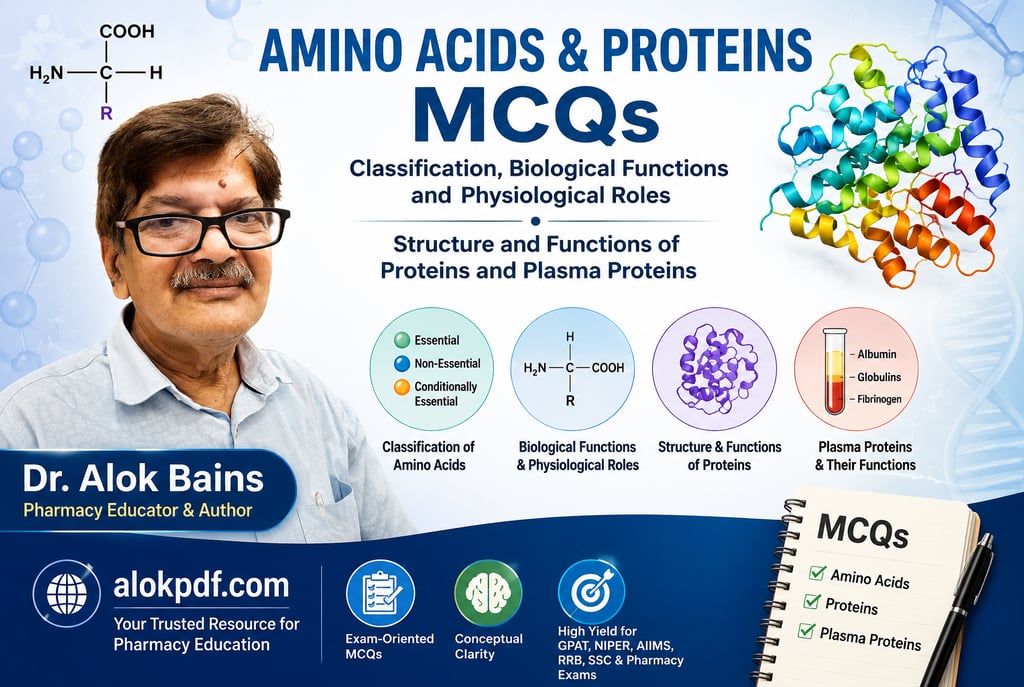
MCQs on Amino Acids, Proteins, and Plasma Proteins
(GPAT, NIPER, AIIMS Pharmacist, Railway Pharmacist, SSC, ESIC & State Pharmacist Exams)
Quick Revision Notes: Classification and Biological Functions of Amino Acids, Proteins, and Plasma Proteins
Before attempting the MCQs, take a few minutes to revise these important concepts.
Amino Acids
Amino acids are the building blocks of proteins. Each amino acid contains an amino group (–NH₂), a carboxyl group (–COOH), a hydrogen atom, and a variable side chain (R group) attached to the α-carbon.
Classification of Amino Acids
Amino acids can be classified in several ways:
Based on nutritional requirement: Essential, non-essential, and conditionally essential amino acids.
Based on side-chain polarity: Non-polar, polar uncharged, acidic (negatively charged), and basic (positively charged).
Based on metabolic fate: Glucogenic, ketogenic, and both glucogenic and ketogenic amino acids.
Based on chemical structure: Aliphatic, aromatic, sulphur-containing, hydroxy, acidic, basic, and imino amino acids.
Physiological Roles of Amino Acids
Amino acids are not only used for protein synthesis but also perform many important functions:
Build and repair body tissues.
Form enzymes, hormones, antibodies, and neurotransmitters.
Help in growth, immunity, and wound healing.
Act as precursors of biologically important compounds such as serotonin, dopamine, nitric oxide, histamine, and thyroid hormones.
Participate in energy production during fasting and prolonged exercise.
Structure of Proteins
Proteins are long chains of amino acids linked by peptide bonds. Their structure is organized into four levels:
Primary structure: Sequence of amino acids.
Secondary structure: α-Helix and β-pleated sheet formed by hydrogen bonding.
Tertiary structure: Three-dimensional folding of a single polypeptide chain.
Quaternary structure: Association of two or more polypeptide chains (e.g., hemoglobin).
Functions of Proteins
Proteins perform a wide variety of functions in the body:
Catalyze biochemical reactions (enzymes).
Provide structural support (collagen, keratin).
Transport molecules (hemoglobin, transferrin).
Regulate body functions (insulin and other hormones).
Protect against infections (immunoglobulins).
Enable muscle contraction (actin and myosin).
Store nutrients and maintain normal growth and repair.
Plasma Proteins
Plasma proteins are mainly synthesized in the liver, except immunoglobulins, which are produced by plasma cells. The three major plasma proteins are:
Albumin: Maintains plasma oncotic pressure and transports drugs, fatty acids, bilirubin, calcium, and hormones.
Globulins: Include transport proteins and antibodies (γ-globulins) that provide immunity.
Fibrinogen: Essential for blood clotting and is converted into fibrin during coagulation.
Quick Memory Tips
Glycine: Smallest and only achiral amino acid.
Proline: Contains a secondary amino (imino) group.
Leucine & Lysine: Only exclusively ketogenic amino acids.
Albumin: Most abundant plasma protein; maintains oncotic pressure.
Transferrin: Transports iron.
Ceruloplasmin: Transports copper.
Fibrinogen: Blood clotting protein; absent in serum.
Hemoglobin: Example of a protein with quaternary structure.
Denaturation: Alters secondary, tertiary, and quaternary structures but generally does not break peptide bonds.
Exam Tip: Competitive exams often test amino acid classification, physiological roles, essential vs. non-essential amino acids, levels of protein structure, and the functions of plasma proteins through conceptual, assertion–reason, and clinical case-based questions. Understanding these concepts will help you solve even tricky MCQs with confidence.
1.Which one of the following amino acids is both ketogenic and glucogenic?
A. Leucine
B. Lysine
C. Isoleucine
D. Alanine
Answer: C. Isoleucine
Explanation: Only leucine and lysine are exclusively ketogenic. Isoleucine is both ketogenic and glucogenic.
Which amino acid contains a secondary amino group?
A. Glycine
B. Alanine
C. Proline
D. Lysine
Answer: C. Proline
Explanation: Proline possesses an imino (secondary amino) group, making it structurally unique.
The amino acid responsible for the formation of disulfide bonds in proteins is
A. Methionine
B. Cysteine
C. Serine
D. Tyrosine
Answer: B. Cysteine
Explanation: Two cysteine residues form cystine via disulfide bonds, stabilizing protein structure.
Which amino acid is the major precursor for the synthesis of nitric oxide (NO)?
A. Histidine
B. Arginine
C. Lysine
D. Glycine
Answer: B. Arginine
Explanation: Nitric oxide synthase converts arginine into nitric oxide and citrulline.
The amino acid that lacks a chiral carbon is
A. Alanine
B. Valine
C. Glycine
D. Threonine
Answer: C. Glycine
Explanation: Glycine has two hydrogen atoms attached to the α-carbon and is therefore achiral.
Which amino acid is classified as an aromatic amino acid?
A. Valine
B. Methionine
C. Phenylalanine
D. Arginine
Answer: C. Phenylalanine
7. The essential amino acid among the following is
A. Tyrosine
B. Glycine
C. Lysine
D. Alanine
Answer: C. Lysine
Which amino acid serves as the principal precursor for serotonin?
A. Tyrosine
B. Histidine
C. Tryptophan
D. Phenylalanine
Answer: C. Tryptophan
Phenylalanine is converted into
A. Tyrosine
B. Histidine
C. Methionine
D. Valine
Answer: A. Tyrosine
Histamine is synthesized from
A. Histidine
B. Tryptophan
C. Glycine
D. Arginine
Answer: A. Histidine
The peptide bond possesses
A. Free rotation
B. Partial double bond character
C. Triple bond character
D. Ionic bond
Answer: B. Partial double bond character
The primary structure of proteins refers to
A. Folding of α-helices
B. Amino acid sequence
C. Three-dimensional shape
D. Association of subunits
Answer: B. Amino acid sequence
The α-helix is stabilized mainly by
A. Ionic bonds
B. Hydrogen bonds
C. Peptide bonds
D. Hydrophobic bonds
Answer: B. Hydrogen bonds
β-Pleated sheets are stabilized by
A. Hydrogen bonds
B. Covalent bonds
C. Ionic bonds
D. Phosphodiester bonds
Answer: A. Hydrogen bonds
Disulfide bonds contribute mainly to
A. Primary structure
B. Secondary structure
C. Tertiary structure
D. Genetic structure
Answer: C. Tertiary structure
The quaternary structure of proteins is best exemplified by
A. Myoglobin
B. Albumin
C. Hemoglobin
D. Insulin
Answer: C. Hemoglobin
Which level of protein structure is absent in myoglobin?
A. Primary
B. Secondary
C. Tertiary
D. Quaternary
Answer: D. Quaternary
Denaturation of proteins primarily affects
A. Peptide bonds
B. Primary structure
C. Secondary and tertiary structures
D. Amino acid composition
Answer: C. Secondary and tertiary structures
Which protein is rich in α-helical structure?
A. Silk fibroin
B. Keratin
C. Collagen
D. Elastin
Answer: B. Keratin
20.Silk fibroin mainly contains
A. α-Helix
B. β-Pleated sheet
C. Triple helix
D. Random coil
Answer: B. β-Pleated sheet
The major transport protein for iron in plasma is
A. Albumin
B. Ceruloplasmin
C. Transferrin
D. Ferritin
Answer: C. Transferrin
The oxygen storage protein in skeletal muscle is
A. Hemoglobin
B. Albumin
C. Myoglobin
D. Ferritin
Answer: C. Myoglobin
Insulin is classified as
A. Structural protein
B. Hormonal protein
C. Storage protein
D. Transport protein
Answer: B. Hormonal protein
The principal structural protein in connective tissue is
A. Elastin
B. Actin
C. Collagen
D. Keratin
Answer: C. Collagen
Which protein acts as the body's major intracellular contractile protein?
A. Myosin
B. Albumin
C. Collagen
D. Fibrinogen
Answer: A. Myosin
The most abundant plasma protein is
A. Albumin
B. Globulin
C. Fibrinogen
D. Transferrin
Answer: A. Albumin
The major function of plasma albumin is
A. Blood clotting
B. Immune defense
C. Maintenance of colloidal osmotic pressure
D. Oxygen transport
Answer: C. Maintenance of colloidal osmotic pressure
Which plasma protein is absent in serum?
A. Albumin
B. Globulin
C. Fibrinogen
D. Immunoglobulin
Answer: C. Fibrinogen
Fibrinogen is synthesized mainly in
A. Kidney
B. Liver
C. Bone marrow
D. Spleen
Answer: B. Liver
The plasma proteins primarily responsible for humoral immunity are
A. Albumin
B. α-Globulins
C. β-Globulins
D. γ-Globulins
Answer: D. γ-Globulins
Ceruloplasmin primarily transports
A. Iron
B. Zinc
C. Copper
D. Calcium
Answer: C. Copper
Haptoglobin binds
A. Bilirubin
B. Free hemoglobin
C. Iron
D. Copper
Answer: B. Free hemoglobin
The plasma protein responsible for transporting thyroid hormones is
A. Albumin only
B. Transferrin
C. Thyroxine-binding globulin
D. Fibrinogen
Answer: C. Thyroxine-binding globulin
Which plasma protein acts as an acute-phase reactant?
A. Albumin
B. C-reactive protein
C. Myoglobin
D. Actin
Answer: B. C-reactive protein
Edema in severe protein malnutrition primarily results from decreased
A. Hemoglobin
B. Albumin
C. Immunoglobulin
D. Fibrinogen
Answer: B. Albumin
36.
Assertion (A): Albumin contributes significantly to plasma oncotic pressure.
Reason (R): Albumin is the most abundant plasma protein.
A. Both A and R are true, and R is the correct explanation.
B. Both A and R are true, but R is not the correct explanation.
C. A is true, R is false.
D. A is false, R is true.
Answer: A
37.
Assertion (A): Glycine is optically inactive.
Reason (R): Glycine lacks an asymmetric carbon atom.
A. Both A and R are true, and R is the correct explanation.
B. Both are true, but R is not the explanation.
C. A is true, R is false.
D. Both are false.
Answer: A
38.
Assertion (A): Haemoglobin exhibits quaternary structure.
Reason (R): Haemoglobin consists of four polypeptide chains.
A. Both A and R are true, and R is the correct explanation.
B. Both are true, but R is not the explanation.
C. A is true, R is false.
D. Both are false.
Answer: A
Match the Following
39.
List I List II
A. Albumin 1. Copper transport
B. Ceruloplasmin 2. Colloid osmotic pressure
C. Transferrin 3. Iron transport
D. Fibrinogen 4. Blood coagulation
A. A-2, B-1, C-3, D-4
B. A-1, B-2, C-3, D-4
C. A-3, B-1, C-2, D-4
D. A-2, B-3, C-1, D-4
Answer: A
Clinical Case-Based MCQ
A patient with severe liver cirrhosis develops generalized edema. Laboratory investigations reveal marked hypoalbuminemia, while immunoglobulin levels remain normal. The edema is mainly due to
A. Increased plasma viscosity
B. Reduced plasma oncotic pressure
C. Increased fibrinogen synthesis
D. Increased globulin concentration
Answer: B. Reduced plasma oncotic pressure
Explanation: Albumin is the major determinant of plasma colloid osmotic (oncotic) pressure. A decrease in albumin reduces plasma oncotic pressure, leading to fluid movement into the interstitial space and causing edema.
Frequently Asked in GPAT/NIPER & Pharmacist Exams)
Exclusively ketogenic amino acids: Leucine, Lysine.
Achiral amino acid: Glycine.
Secondary amino acid: Proline.
Disulphide bond formation: Cysteine.
Precursor of nitric oxide: Arginine.
Precursor of serotonin and melatonin: Tryptophan.
Precursor of catecholamines: Tyrosine.
Most abundant plasma protein: Albumin.
Plasma protein absent in serum: Fibrinogen.
Major plasma iron transporter: Transferrin.
Major copper transporter: Ceruloplasmin.
Free hemoglobin-binding protein: Haptoglobin.
Acute-phase reactant: C-reactive protein (CRP).
Protein with quaternary structure: Hemoglobin.
Myoglobin lacks quaternary structure.
Denaturation disrupts secondary, tertiary, and quaternary structures but generally does not break peptide bonds (primary structure).
41. Which of the following amino acids contains a sulfur atom but does not participate in disulfide bond formation?
A. Cysteine
B. Methionine
C. Cystine
D. Homocysteine
Answer: B. Methionine
Explanation: Methionine contains sulfur in a thioether (-S-) group, which cannot form disulfide bonds. Cysteine forms disulfide bonds by oxidation to cystine.
42. Which amino acid is classified as both glucogenic and ketogenic?
A. Leucine
B. Lysine
C. Isoleucine
D. Alanine
Answer: C. Isoleucine
Explanation: Isoleucine is metabolized to acetyl-CoA (ketogenic) and succinyl-CoA (glucogenic). Leucine and lysine are exclusively ketogenic.
The amino acid most important for maintaining acid-base balance in the kidney through ammonia production is
A. Glycine
B. Glutamine
C. Aspartate
D. Valine
Answer: B. Glutamine
Explanation: Renal cells metabolize glutamine to produce ammonia (NH₃), which buffers urinary H⁺ ions and helps maintain acid-base balance.
Histamine is synthesized directly from
A. Histidine
B. Tyrosine
C. Tryptophan
D. Phenylalanine
Answer: A. Histidine
Explanation: Histidine undergoes decarboxylation by histidine decarboxylase to form histamine.
Which amino acid is responsible for the yellow color observed in the xanthoproteic test?
A. Glycine
B. Tyrosine
C. Alanine
D. Proline
Answer: B. Tyrosine
Explanation: Aromatic amino acids, particularly tyrosine and tryptophan, undergo nitration with concentrated nitric acid producing a yellow color.
Which amino acid disrupts α-helix formation due to its rigid cyclic structure?
A. Glycine
B. Valine
C. Proline
D. Serine
Answer: C. Proline
Explanation: Proline lacks the amide hydrogen required for hydrogen bonding and introduces bends in protein chains.
The peptide bond is best described as having
A. Complete single bond character
B. Complete double bond character
C. Partial double bond character
D. Ionic bond character
Answer: C. Partial double bond character
Explanation: Resonance gives peptide bonds partial double-bond character, restricting rotation and making proteins more stable.
The strongest interaction stabilizing the primary structure of proteins is
A. Hydrogen bond
B. Peptide bond
C. Hydrophobic interaction
D. Ionic interaction
Answer: B. Peptide bond
Explanation: Primary structure is maintained by covalent peptide bonds linking amino acids.
Which level of protein structure is directly stabilised by disulphide bonds between cysteine residues?
A. Primary only
B. Secondary only
C. Tertiary
D. Quaternary only
Answer: C. Tertiary
Explanation: Disulfide bonds stabilise tertiary structure and may also contribute to quaternary structure.
The oxygen-binding curve of hemoglobin is sigmoidal because of
A. High affinity for oxygen
B. Cooperative binding
C. Presence of iron
D. Presence of globin chains
Answer: B. Cooperative binding
Explanation: Binding of one oxygen molecule increases the affinity of remaining subunits for oxygen.
The major plasma protein responsible for maintaining colloidal osmotic pressure is
A. Fibrinogen
B. Albumin
C. Transferrin
D. Globulin
Answer: B. Albumin
Explanation: Albumin contributes about 75–80% of plasma oncotic pressure.
Which plasma protein is absent in serum?
A. Albumin
B. Immunoglobulin
C. Fibrinogen
D. Transferrin
Answer: C. Fibrinogen
Explanation: Serum is plasma without clotting factors, particularly fibrinogen.
Which plasma protein primarily transports iron?
A. Albumin
B. Ceruloplasmin
C. Transferrin
D. Ferritin
Answer: C. Transferrin
Explanation: Transferrin binds ferric iron (Fe³⁺) and transports it in the blood.
Wilson's disease is associated with a deficiency of
A. Albumin
B. Ceruloplasmin
C. Haptoglobin
D. Transferrin
Answer: B. Ceruloplasmin
Explanation: Ceruloplasmin transports copper. Its deficiency is characteristic of Wilson's disease.
The plasma protein responsible for binding free hemoglobin released during intravascular hemolysis is
A. Albumin
B. Haptoglobin
C. Fibrinogen
D. α₂-Macroglobulin
Answer: B. Haptoglobin
Explanation: Haptoglobin binds free haemoglobin and prevents renal loss of iron.
Which amino acid lacks an asymmetric carbon atom?
A. Alanine
B. Glycine
C. Valine
D. Serine
Answer: B. Glycine
Explanation: Glycine has two hydrogen atoms attached to its α-carbon and is therefore optically inactive.
Which amino acid serves as the precursor for nitric oxide?
A. Arginine
B. Lysine
C. Histidine
D. Ornithine
Answer: A. Arginine
Explanation: Nitric oxide synthase converts arginine into nitric oxide and citrulline.
Denaturation of proteins generally does not affect
A. Primary structure
B. Secondary structure
C. Tertiary structure
D. Quaternary structure
Answer: A. Primary structure
Explanation: Denaturation disrupts non-covalent interactions while peptide bonds remain intact.
Which of the following is a conjugated protein?
A. Albumin
B. Collagen
C. Hemoglobin
D. Elastin
Answer: C. Hemoglobin
Explanation: Haemoglobin contains a non-protein haem prosthetic group, making it a conjugated protein.
Which plasma protein is synthesized almost exclusively by plasma cells?
A. Albumin
B. Fibrinogen
C. Immunoglobulin
D. Transferrin
Answer: C. Immunoglobulin
Explanation: Immunoglobulins (antibodies) are synthesized by plasma cells, whereas most other plasma proteins are produced by the liver.
61.
Assertion (A): Albumin is the major transport protein in plasma.
Reason (R): Albumin possesses multiple binding sites for endogenous and exogenous substances.
A. Both A and R are true, and R is the correct explanation.
B. Both A and R are true, but R is not the correct explanation.
C. A is true, R is false.
D. A is false, R is true.
Answer: A
Explanation: Albumin binds bilirubin, fatty acids, calcium, hormones, and many drugs due to its multiple binding sites.
62.
Assertion (A): Collagen is a fibrous protein.
Reason (R): Collagen functions primarily as an enzyme.
A. Both A and R are true.
B. Both A and R are false.
C. A is true, R is false.
D. A is false, R is true.
Answer: C
Explanation: Collagen is a structural fibrous protein and does not function as an enzyme.
Match the Following
List I List II
A. Albumin 1. Iron transport
B. Transferrin 2. Copper transport
C. Ceruloplasmin 3. Osmotic pressure
D. Haptoglobin 4. Hemoglobin binding
Options:
A. A-3, B-1, C-2, D-4
B. A-1, B-3, C-2, D-4
C. A-2, B-1, C-3, D-4
D. A-3, B-4, C-1, D-2
Answer: A
Explanation: Albumin maintains oncotic pressure; transferrin transports iron; ceruloplasmin transports copper; haptoglobin binds free haemoglobin.
A patient with severe liver cirrhosis develops generalised oedema despite normal renal function. The most likely biochemical explanation is
A. Increased fibrinogen synthesis
B. Reduced albumin synthesis
C. Increased immunoglobulin production
D. Reduced ceruloplasmin synthesis
Answer: B
Explanation: Liver cirrhosis decreases albumin synthesis, lowering plasma oncotic pressure and causing edema.
Which amino acid acts as the precursor for all of the following except one: melanin, catecholamines, and thyroid hormones?
A. Tyrosine
B. Tryptophan
C. Histidine
D. Phenylalanine
Answer: A. Tyrosine
Explanation: Tyrosine is converted into melanin, dopamine, norepinephrine, epinephrine, and thyroid hormones. Phenylalanine must first be converted to tyrosine before entering these pathways.
Dr. Alok Singh