
Bioenergetics MCQs for pharmacist exams GPAT and NIPER
Practice Bioenergetics MCQs for pharmacist exams GPAT and NIPER AIIMS Pharmacist, Railway Pharmacist, SSC, ESIC, and State Pharmacist exams.covering free energy, entropy, enthalpy, redox potential, ATP, GTP, and energy-rich compounds for
Dr. Alok Singh
7/14/20267 min read
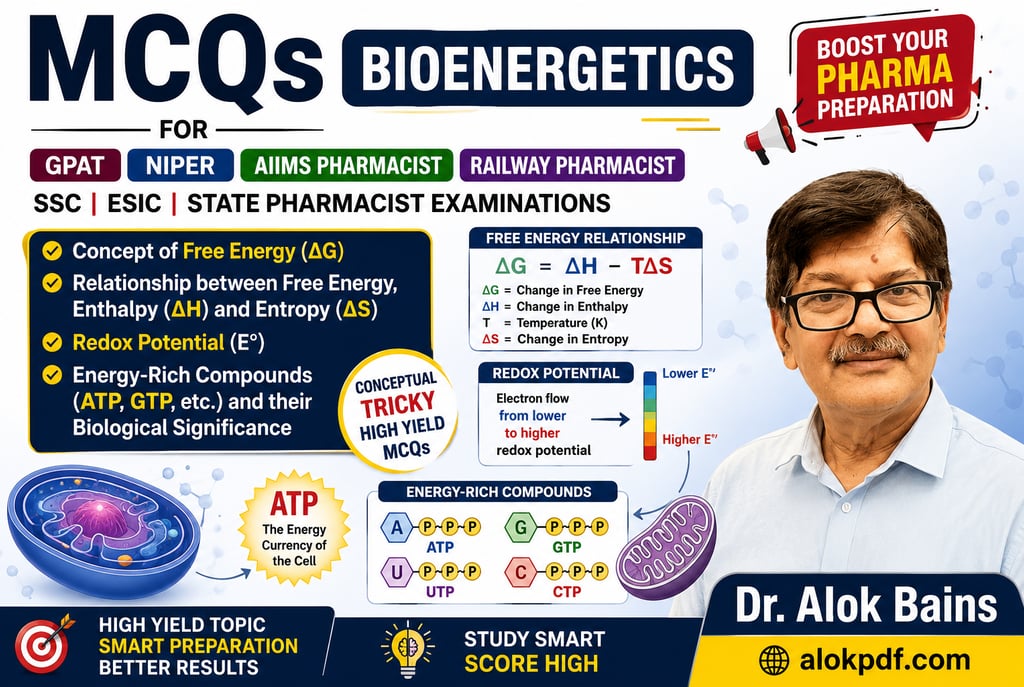
Bioenergetics MCQs for GPAT, NIPER, AIIMS Pharmacist, Railway Pharmacist, SSC, ESIC, and State Pharmacist Examinations.
Short Notes on Bioenergetics
Bioenergetics
Bioenergetics is the branch of biochemistry that studies how living organisms obtain, store, transfer, and utilize energy for various biological processes such as muscle contraction, active transport, biosynthesis, and nerve conduction.
1. Free Energy (Gibbs Free Energy, G)
Free energy is the amount of energy available to perform useful work in a biological system.
It determines whether a reaction occurs spontaneously or not.
Represented by ΔG (change in free energy).
Interpretation of ΔG
ΔG < 0 → Reaction is spontaneous (Exergonic reaction).
ΔG > 0 → Reaction requires energy input (Endergonic reaction).
ΔG = 0 → Reaction is at equilibrium.
2. Relationship Between Free Energy, Enthalpy, and Entropy
The relationship is given by ΔG = ΔH − TΔS
Where:
ΔG = Change in free energy
ΔH = Change in enthalpy (heat energy)
T = Absolute temperature (Kelvin)
ΔS = Change in entropy (disorder)
Enthalpy (ΔH)
Enthalpy represents the heat content of a system.
ΔH < 0 → Heat released (Exothermic reaction)
ΔH > 0 → Heat absorbed (Endothermic reaction)
Entropy (ΔS)
Entropy is the measure of randomness or disorder in a system.
ΔS > 0 → Disorder increases
ΔS < 0 → Disorder decreases
Important Examination Point
A reaction is most favorable when:
ΔH is negative, and
ΔS is positive
Such reactions are spontaneous at all temperatures.
3. Redox Potential (Reduction Potential, E°)
Redox potential measures the tendency of a substance to gain electrons and become reduced.
Expressed in volts (V) or millivolts (mV).
Molecules with more positive redox potential readily accept electrons.
Molecules with more negative redox potential readily donate electrons.
In the Electron Transport Chain
Electrons flow from:
Lower redox potential → Higher redox potential
The final electron acceptor is oxygen, which has a very high reduction potential.
Memory Trick
Positive E° = Electron Acceptor
4. Energy-Rich Compounds
Energy-rich compounds contain high-energy phosphate bonds that release large amounts of energy upon hydrolysis.
Important High-Energy Compounds
ATP (Adenosine Triphosphate)
GTP (Guanosine Triphosphate)
UTP (Uridine Triphosphate)
CTP (Cytidine Triphosphate)
Creatine Phosphate
Phosphoenolpyruvate (PEP)
1,3-Bisphosphoglycerate
5. ATP – The Energy Currency of the Cell
ATP is the universal energy carrier of living cells.
Functions of ATP
Muscle contraction
Active transport across membranes
Biosynthesis of proteins, lipids, and nucleic acids
Cell signaling
Nerve impulse transmission
Hydrolysis reaction:
ATP + H₂O → ADP + Pi + Energy
Standard free energy released:
ΔG°' ≈ −30.5 kJ/mol (−7.3 kcal/mol)
Why ATP Releases Energy
Energy is released because ADP and inorganic phosphate are more stable than ATP after hydrolysis.
6. Biological Significance of Other Nucleotide Triphosphates
GTP (Guanosine Triphosphate)
Required for protein synthesis (translation).
Involved in signal transduction through G-proteins.
Remember:
GTP = Growth of proteins
UTP (Uridine Triphosphate)
Required for glycogen synthesis.
Forms UDP-glucose, the activated intermediate.
Remember:
UTP = Used in glycogen synthesis
CTP (Cytidine Triphosphate)
Required for phospholipid synthesis.
Forms activated intermediates such as CDP-choline.
Remember:
CTP = Cell membrane phospholipids
7. High-Yield Examination Facts
ΔG < 0 → Spontaneous reaction.
ΔG > 0 → Non-spontaneous reaction.
ΔG = 0 → Equilibrium.
Oxygen is the final electron acceptor in the ETC.
PEP has a higher phosphoryl transfer potential than ATP.
ATP is the energy currency of the cell.
GTP is mainly involved in protein synthesis.
UTP is involved in glycogen synthesis.
CTP is involved in phospholipid synthesis.
Electrons flow from lower to higher redox potential.
One-Line Revision
ATP for energy, GTP for proteins, UTP for glycogen, and CTP for cell membranes.
These questions focus on conceptual understanding, numerical reasoning, and tricky applications commonly seen in competitive pharmacy examinations.
MCQs
For a biochemical reaction occurring at constant temperature and pressure:
ΔG=ΔH−TΔS
A reaction will proceed spontaneously when:
A. ΔG > 0
B. ΔG = 0
C. ΔG < 0
D. ΔH > 0 and ΔS < 0
Answer: C. ΔG < 0
Explanation:
Negative Gibbs free energy indicates a spontaneous (exergonic) process. Positive ΔG indicates a non-spontaneous reaction requiring energy input.
Which combination always guarantees a spontaneous reaction at all temperatures?
A. ΔH > 0 and ΔS > 0
B. ΔH < 0 and ΔS < 0
C. ΔH < 0 and ΔS > 0
D. ΔH > 0 and ΔS < 0
Answer: C. ΔH < 0 and ΔS > 0
Explanation:
A negative enthalpy change and positive entropy change both favor spontaneity, making ΔG negative irrespective of temperature.
A reaction has:
ΔH = +40 kJ/mol
ΔS = +200 J/mol·K
At what temperature will the reaction become spontaneous?
A. Above 100 K
B. Above 200 K
C. Above 300 K
D. Above 400 K
Answer: B. Above 200 K
Explanation:
Convert entropy:
ΔS=0.2 kJ/mol⋅K
At equilibrium:
ΔG=0
T= ΔH/ΔS = 40/0.2 = 200K
The reaction becomes spontaneous above 200 K.
At equilibrium, the value of Gibbs free energy change is:
A. Positive
B. Negative
C. Zero
D. Equal to enthalpy
Answer: C. Zero
Explanation:
At equilibrium, there is no driving force for reaction progress.
ΔG=0
5. Which statement regarding ATP hydrolysis is correct?
A. ATP contains unstable covalent bonds that explode on hydrolysis.
B. ATP hydrolysis releases energy because products are more stable than reactants.
C. ATP hydrolysis is endergonic.
D. ATP stores energy in phosphate atoms.
Answer: B. ATP hydrolysis releases energy because products are more stable than reactants.
Explanation:
Energy is released because ADP and inorganic phosphate are more stable due to resonance stabilization and reduced electrostatic repulsion.
MCQ 6 The standard free energy change for ATP hydrolysis under physiological conditions is approximately:
A. −7.3 kcal/mol
B. +7.3 kcal/mol
C. −73 kcal/mol
D. +73 kcal/mol
Answer: A. −7.3 kcal/mol
Explanation: The standard free energy of ATP hydrolysis is approximately −30.5 kJ/mol.
MCQ 7 Which of the following has the highest phosphoryl group transfer potential?
A. Glucose-6-phosphate
B. ATP
C. Phosphoenolpyruvate
D. Glycerol-3-phosphate
Answer: C. Phosphoenolpyruvate
Explanation:
PEP has an extremely high free energy of hydrolysis (~−61.9 kJ/mol), greater than ATP.
Order:
PEP > Creatine phosphate > ATP > Glucose-6-phosphate
MCQ 8. Which compound can directly phosphorylate ADP to ATP during glycolysis?
A. Glucose-6-phosphate
B. Phosphoenolpyruvate
C. Fructose-6-phosphate
D. Ribose-5-phosphate
Answer: B. Phosphoenolpyruvate
Explanation:
PEP transfers phosphate to ADP via the pyruvate kinase reaction.
Which nucleotide triphosphate is primarily used in protein synthesis?
A. ATP
B. GTP
C. CTP
D. UTP
Answer: B. GTP
Explanation: GTP provides energy during initiation, elongation, and translocation steps of translation.
UTP is mainly involved in:
A. Protein synthesis
B. Glycogen synthesis
C. Oxidative phosphorylation
D. DNA replication
Answer: B. Glycogen synthesis
Explanation:
UTP forms UDP-glucose, the activated intermediate required for glycogen synthesis.
Which nucleotide triphosphate is primarily required for phospholipid synthesis?
A. ATP
B. GTP
C. CTP
D. TTP
Answer: C. CTP Explanation:
CTP forms activated intermediates such as CDP-choline and CDP-diacylglycerol in phospholipid synthesis.
The oxidizing agent in a redox reaction is the substance that:
A. Loses electrons
B. Gains electrons
C. Donates hydrogen
D. Undergoes oxidation
Answer: B. Gains electrons
Explanation: Oxidizing agents accept electrons and themselves become reduced.
MCQ 13. A redox couple with a more positive reduction potential tends to:
A. Donate electrons readily
B. Accept electrons readily
C. Remain chemically inert
D. Undergo oxidation
Answer: B. Accept electrons readily
Explanation: The more positive the reduction potential, the greater the tendency to accept electrons.
Electron flow in the electron transport chain occurs from:
A. Higher reduction potential to lower reduction potential
B. Lower reduction potential to higher reduction potential
C. ATP to NADH
D. Oxygen to NADH
Answer: B. Lower reduction potential to higher reduction potential
Explanation: Electrons move spontaneously toward increasingly positive reduction potentials, ultimately reaching oxygen.
Which component has the highest reduction potential in the electron transport chain?
A. NADH
B. FMN
C. Cytochrome c
D. Oxygen
Answer: D. Oxygen
Explanation: Oxygen has the highest reduction potential and acts as the final electron acceptor.
If ΔG for a reaction is positive, the reaction can still proceed if:
A. Temperature decreases
B. Coupled to ATP hydrolysis
C. Entropy decreases
D. Enthalpy increases
Answer: B. Coupled to ATP hydrolysis
Explanation:
Cells drive unfavorable reactions by coupling them to highly favorable ATP hydrolysis.
Which of the following is an example of an endergonic process?
A. ATP hydrolysis
B. Oxidation of glucose
C. Glycogen synthesis
D. Electron transport
Answer: C. Glycogen synthesis
Explanation: Glycogen synthesis requires energy input and is therefore endergonic.
The major reason ATP is considered the "energy currency" of the cell is that:
A. It contains the highest-energy phosphate bond known in biology.
B. It can couple exergonic and endergonic reactions efficiently.
C. It is present only in mitochondria.
D. ATP is more stable than ADP.
Answer: B. It can couple exergonic and endergonic reactions efficiently.
Explanation: ATP acts as an intermediate energy carrier linking catabolism with anabolism.
Which statement regarding entropy is correct?
A. Entropy is the measure of energy content.
B. Entropy measures the degree of disorder or randomness.
C. Entropy is always negative in biological systems.
D. Entropy is independent of temperature.
Answer: B. Entropy measures the degree of disorder or randomness.
Explanation: Higher entropy corresponds to greater molecular disorder and energy dispersal.
During ATP hydrolysis:
ATP + H₂O → ADP + Pi
The reaction is:
A. Oxidation reaction only
B. Reduction reaction only
C. Hydrolysis reaction with negative free energy change
D. Condensation reaction
Answer: C. Hydrolysis reaction with negative free energy change
Explanation: ATP hydrolysis is an exergonic hydrolysis reaction with a negative ΔG.
21. Which statement is TRUE regarding free energy and equilibrium constant?
A. ΔG°' and K_eq are unrelated.
B. A large K_eq corresponds to a positive ΔG°'.
C. A large K_eq corresponds to negative ΔG°'.
D. K_eq is independent of free energy.
Answer: C. A large K_eq corresponds to negative ΔG°'.
Which pair is correctly matched?
A. ATP: Glycogen synthesis
B. GTP: Translation
C. CTP: Muscle contraction
D. UTP: Electron transport chain
Answer: B. GTP: Translation
Explanation:
ATP → General energy currency
GTP → Protein synthesis
UTP → Glycogen synthesis
CTP → Phospholipid synthesis
A reaction has:
ΔH = −50 kJ/mol
ΔS = −100 J/mol·K
This reaction is:
A. Spontaneous at all temperatures
B. Never spontaneous
C. Spontaneous only at low temperatures
D. Spontaneous only at high temperatures
Answer: C. Spontaneous only at low temperatures
Explanation:
Since both ΔH and TΔS are negative:
At high temperature, the positive value of −TΔS becomes large and may make ΔG positive.
Which statement is FALSE?
A. ATP hydrolysis is exergonic.
B. Oxygen has a high reduction potential.
C. ATP has the highest phosphoryl transfer potential in the cell.
D. GTP participates in protein synthesis.
Answer: C. ATP has the highest phosphoryl transfer potential in the cell.
Explanation:
Several compounds possess higher phosphoryl transfer potential than ATP, including:
Phosphoenolpyruvate
Creatine phosphate
1,3-Bisphosphoglycerate
Which of the following is classified as a high-energy phosphate compound?
A. Glucose
B. AMP
C. Creatine phosphate
D. Ribose
Answer: C. Creatine phosphate
Explanation: Creatine phosphate serves as a rapid reserve of high-energy phosphate in skeletal muscle and can regenerate ATP via the creatine kinase reaction.
Dr. Alok Singh
Exam Booster Box: Bioenergetics Quick Revision for competitive exams
A reaction with ΔG = 0 is at equilibrium — there is no net energy available to do work.
A positive ΔS favors spontaneity because nature prefers greater disorder.
Increasing temperature favors reactions with positive entropy change (ΔS > 0).
Reduction means gain of electrons; oxidation means loss of electrons (LEO says GER).
The greater the difference in redox potential between two redox couples, the greater the energy released during electron transfer.
NADH is a strong electron donor because it has a relatively negative reduction potential.
Creatine phosphate acts as an immediate energy buffer in skeletal and cardiac muscle.
ATP is not the highest-energy phosphate compound in the cell; it occupies an intermediate position in the phosphoryl transfer scale.
Substrate-level phosphorylation produces ATP directly without involvement of the electron transport chain.
Cells maintain ATP concentration nearly constant by continuously regenerating ATP from ADP and Pi.