Biological Oxidation MCQs
Prepare for GPAT, NIPER, AIIMS Pharmacist, Railway Pharmacist, SSC, ESIC, and State exams with Biological Oxidation MCQs covering ETC, oxidative phosphorylation, ATP synthesis, mitochondrial dysfunction, and oxidative stress.
Dr. Alok Singh
7/17/20267 min read
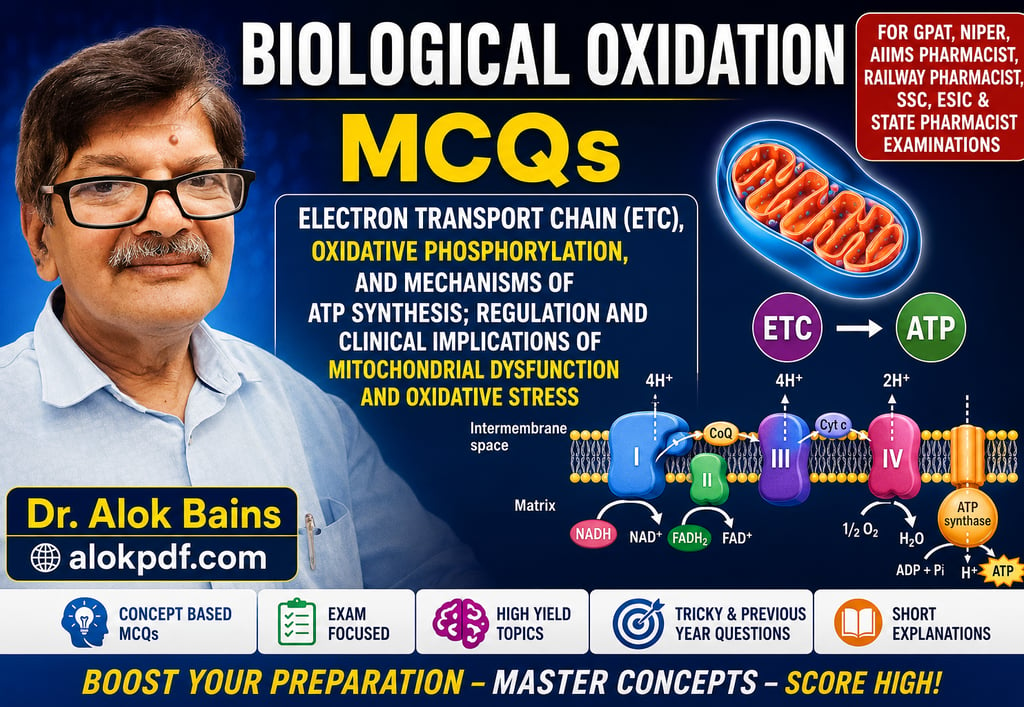
MCQs on Biological Oxidation and Oxidative Phosphorylation.
Quick Revision Notes:
1. Biological Oxidation
Biological oxidation is the process by which nutrients are oxidized inside cells to release energy in the form of ATP. Most of this energy production occurs inside the mitochondria, which are therefore called the powerhouses of the cell.
Key Points
Oxidation involves loss of electrons or hydrogen.
Reduction involves gain of electrons or hydrogen.
Electrons released during oxidation are carried by NAD⁺ and FAD, forming NADH and FADH₂.
These reduced coenzymes donate electrons to the Electron Transport Chain (ETC) for ATP production.
Memory Tip:
"NAD and FAD carry fuel to the mitochondrial power station."
2. Electron Transport Chain (ETC)
The ETC is located in the inner mitochondrial membrane and consists of four enzyme complexes and two mobile electron carriers.
Components of ETC
Complex I – NADH dehydrogenase
Complex II – Succinate dehydrogenase
Coenzyme Q (Ubiquinone) – Mobile lipid-soluble carrier
Complex III – Cytochrome bc1 complex
Cytochrome c – Mobile protein carrier
Complex IV – Cytochrome oxidase
Electrons flow in the following sequence:
NADH → Complex I → CoQ → Complex III → Cytochrome c → Complex IV → O₂
Oxygen acts as the final electron acceptor and is reduced to water.
Proton Pumping Complexes
Complex I
Complex III
Complex IV
Complex II ✘
Exam Favorite:
Complex II is the only ETC complex that does not pump protons.
Memory Trick:
"1, 3 and 4 pump; 2 simply jumps."
3. Oxidative Phosphorylation
Oxidative phosphorylation is the synthesis of ATP using energy released during electron transport.
The movement of electrons through the ETC creates a proton gradient across the inner mitochondrial membrane.
This proton gradient is called the Proton Motive Force (PMF).
ATP synthase uses this energy to convert:
ADP + Pi → ATP
4. ATP Synthase
ATP synthase consists of two parts:
F₀ portion: Embedded in the membrane and forms the proton channel.
F₁ portion: Projects into the matrix and synthesizes ATP.
High Yield Fact
Protons move through F₀.
ATP is formed in F₁.
Memory Trick:
"F₀ forms the hole, F₁ forms ATP."
5. Chemiosmotic Theory
Proposed by Peter Mitchell, this theory explains ATP formation by the proton gradient generated during electron transport.
According to the theory:
Electrons pass through ETC complexes.
Protons are pumped into the intermembrane space.
Protons return through ATP synthase.
ATP is produced.
Important: ATP synthesis is driven by the proton gradient, not directly by electron transfer.
6. ATP Yield from NADH and FADH₂
MoleculeApproximate ATP ProducedNADH2.5 ATPFADH₂1.5 ATP
FADH₂ produces less ATP because it enters the ETC at Complex II, bypassing Complex I.
Memory Trick:
"NADH enters first and earns more."
7. ETC Inhibitors
Certain poisons and drugs inhibit specific ETC complexes.
InhibitorSite of ActionRotenoneComplex IMalonateComplex IIAntimycin AComplex IIICyanideComplex IVCarbon monoxideComplex IVOligomycinATP synthase
Clinical Importance
Cyanide poisoning rapidly stops cellular respiration and can be fatal due to failure of ATP production.
Memory Trick:
"Rotenone-1, Antimycin-3, Cyanide-4."
8. Uncouplers of Oxidative Phosphorylation
Uncouplers destroy the proton gradient without inhibiting electron transport.
As a result:
Oxygen consumption increases.
ATP production decreases.
Heat production increases.
Examples
2,4-Dinitrophenol (DNP)
Thermogenin (UCP-1)
Thermogenin is found in brown adipose tissue of infants and helps maintain body temperature.
9. Mitochondrial Dysfunction
Mitochondrial diseases primarily affect tissues requiring large amounts of energy.
Commonly Affected Organs
Brain
Heart
Skeletal muscles
Retina
Important Disorders
Leber Hereditary Optic Neuropathy (LHON)
MELAS syndrome
Parkinson's disease
Alzheimer's disease
High Yield Fact
Mitochondrial DNA is inherited only from the mother.
Memory Trick:
"Mitochondria come from mother."
10. Oxidative Stress
Oxidative stress occurs when the production of reactive oxygen species (ROS) exceeds the antioxidant defense system.
Major Reactive Oxygen Species
Superoxide radical (O₂•⁻)
Hydrogen peroxide (H₂O₂)
Hydroxyl radical (•OH)
Among these, the hydroxyl radical is the most damaging.
11. Antioxidant Defense System
The body protects itself from ROS using antioxidant enzymes.
EnzymeFunctionSuperoxide dismutaseConverts superoxide to hydrogen peroxideCatalaseConverts hydrogen peroxide to water and oxygenGlutathione peroxidaseRemoves hydrogen peroxide and lipid peroxides
Important Point
Glutathione peroxidase requires selenium as a cofactor.
12. Clinical Importance of Oxidative Stress
Excess ROS contributes to:
Atherosclerosis
Diabetes mellitus
Cancer
Alzheimer's disease
Parkinson's disease
Myocardial reperfusion injury
Aging
Reperfusion injury after myocardial infarction is a classic example of ROS-mediated tissue damage.
Exam Boosters
✔ Complex II does not pump protons.
✔ Oxygen is the final electron acceptor.
✔ Coenzyme Q carries 2 electrons; Cytochrome c carries 1 electron.
✔ NADH yields 2.5 ATP; FADH₂ yields 1.5 ATP.
✔ Oligomycin inhibits ATP synthase.
✔ DNP increases heat production.
✔ Cyanide inhibits Complex IV.
✔ Mitochondrial DNA is maternally inherited.
✔ Hydroxyl radical is the most damaging ROS.
✔ Selenium is required for glutathione peroxidase activity.
MCQs
1. Which complex of the Electron Transport Chain does not directly contribute to proton pumping across the inner mitochondrial membrane?
A. Complex I
B. Complex II
C. Complex III
D. Complex IV
Answer: B. Complex II
Explanation: Complex II (Succinate dehydrogenase) transfers electrons from FADH₂ to CoQ but does not pump protons, making it unique among ETC complexes involved in electron transfer.
2. Rotenone poisoning primarily inhibits electron transfer between:
A. Cytochrome b and c1
B. NADH and Coenzyme Q
C. Cytochrome c and oxygen
D. FADH₂ and Coenzyme Q
Answer: B. NADH and Coenzyme Q
Explanation: Rotenone inhibits Complex I, blocking electron transfer from NADH dehydrogenase to ubiquinone (CoQ).
3. The immediate driving force for ATP synthesis in mitochondria is:
A. Electron flow through cytochrome oxidase
B. Oxidation of NADH
C. Proton motive force
D. Formation of water
Answer: C. Proton motive force
Explanation: According to Mitchell's chemiosmotic theory, ATP synthase utilizes the electrochemical proton gradient rather than direct energy from electron transfer.
genui{"biology_cellular_molecular_metabolism_learning_block":{"type_id":"CHEMIOSMOSIS"}}
4. Which statement regarding ATP synthase is correct?
A. ATP synthesis occurs in the F₀ portion.
B. Proton movement occurs through F₁ subunit.
C. F₀ forms the proton channel.
D. ATP synthase is located in the outer mitochondrial membrane.
Answer: C. F₀ forms the proton channel.
Explanation: The F₀ component is membrane embedded and acts as a proton channel, whereas F₁ contains catalytic sites for ATP formation.
5. An inhibitor that blocks ATP synthase but allows electron transport to continue initially is:
A. Cyanide
B. Antimycin A
C. Oligomycin
D. Rotenone
Answer: C. Oligomycin
Explanation: Oligomycin binds the F₀ subunit of ATP synthase and prevents proton re-entry, thereby inhibiting ATP production.
6. Which ETC inhibitor causes the greatest immediate decrease in oxygen consumption?
A. Oligomycin
B. Cyanide
C. Rotenone
D. Malonate
Answer: B. Cyanide
Explanation: Cyanide inhibits Complex IV (cytochrome oxidase), preventing reduction of oxygen to water and causing oxygen utilization to cease immediately.
7. Which component of ETC is lipid soluble and freely diffusible within the inner mitochondrial membrane?
A. Cytochrome c
B. FMN
C. Coenzyme Q
D. Iron-sulfur protein
Answer: C. Coenzyme Q
Explanation: Coenzyme Q (ubiquinone) is the only lipid-soluble mobile electron carrier within the inner mitochondrial membrane.
8. Cytochrome c differs from Coenzyme Q because cytochrome c:
A. Carries two electrons simultaneously.
B. Is membrane-bound.
C. Is a peripheral membrane protein carrying one electron.
D. Participates in Complex II only.
Answer: C. Is a peripheral membrane protein carrying one electron.
Explanation: Cytochrome c is a water-soluble peripheral protein located on the outer surface of the inner membrane and transfers one electron at a time.
9. The P/O ratio for oxidation of NADH under normal conditions is approximately:
A. 1 ATP
B. 1.5 ATP
C. 2.5 ATP
D. 4 ATP
Answer: C. 2.5 ATP
Explanation: Oxidation of one NADH produces approximately 2.5 ATP, whereas one FADH₂ yields about 1.5 ATP.
10. Why does FADH₂ generate less ATP than NADH?
A. FADH₂ enters at Complex II.
B. FADH₂ donates fewer electrons.
C. FADH₂ cannot reduce oxygen.
D. FADH₂ bypasses ATP synthase.
Answer: A. FADH₂ enters at Complex II.
Explanation: Since Complex II does not pump protons, fewer protons cross the membrane, resulting in lower ATP production.
11. Uncouplers increase oxygen consumption because they:
A. Inhibit ATP synthase.
B. Increase proton gradient.
C. Dissipate proton gradient.
D. Inhibit Complex IV.
Answer: C. Dissipate proton gradient.
Explanation: Uncouplers such as DNP collapse the proton gradient, forcing ETC to work faster in an attempt to restore it, thereby increasing oxygen consumption.
12. Which of the following is a physiological uncoupling protein?
A. Cytochrome oxidase
B. ATP synthase
C. UCP-1 (Thermogenin)
D. Coenzyme Q
Answer: C. UCP-1 (Thermogenin)
Explanation: Thermogenin in brown adipose tissue produces heat by allowing protons to re-enter mitochondria without ATP synthesis.
13. A patient poisoned with dinitrophenol is expected to show:
A. Decreased body temperature
B. Increased ATP synthesis
C. Hyperthermia with increased oxygen consumption
D. Complete inhibition of ETC
Answer: C. Hyperthermia with increased oxygen consumption
Explanation: DNP uncouples oxidative phosphorylation causing energy to be released as heat instead of ATP.
14. Which molecule acts as the final electron acceptor in aerobic respiration?
A. NAD⁺
B. Coenzyme Q
C. Cytochrome c
D. Oxygen
Answer: D. Oxygen
Explanation: Oxygen accepts electrons at Complex IV and is reduced to water.
15. During ischemia, ATP production decreases primarily because:
A. Glycolysis stops.
B. Oxygen is unavailable for Complex IV.
C. NADH synthesis ceases.
D. Complex II becomes overactive.
Answer: B. Oxygen is unavailable for Complex IV.
Explanation: Oxygen deficiency blocks electron transfer at Complex IV, causing ETC and oxidative phosphorylation to halt.
16. Which mitochondrial DNA mutation is most likely to affect organs with high energy demand?
A. Skin
B. Bone
C. Brain and skeletal muscle
D. Adipose tissue
Answer: C. Brain and skeletal muscle
Explanation: High ATP-demand tissues are most susceptible to mitochondrial dysfunction.
17. Leber hereditary optic neuropathy results from defects in:
A. Lysosomes
B. Mitochondrial DNA encoding ETC proteins
C. Cytoplasmic ribosomes
D. Peroxisomes
Answer: B. Mitochondrial DNA encoding ETC proteins
Explanation: LHON results from mutations in mitochondrial genes coding for Complex I subunits.
18. Which reactive oxygen species is generated directly by one-electron reduction of oxygen?
A. Hydroxyl radical
B. Superoxide radical
C. Hydrogen peroxide
D. Singlet oxygen
Answer: B. Superoxide radical
Explanation: The first ROS formed during incomplete oxygen reduction is superoxide (O₂•⁻).
19. Superoxide dismutase converts superoxide into:
A. Water only
B. Hydroxyl radical
C. Hydrogen peroxide and oxygen
D. Nitric oxide
Answer: C. Hydrogen peroxide and oxygen
Explanation: SOD catalyzes:
2O₂•⁻ + 2H⁺ → H₂O₂ + O₂
20. Which antioxidant enzyme requires selenium as a cofactor?
A. Catalase
B. Glutathione peroxidase
C. Superoxide dismutase
D. Peroxidase
Answer: B. Glutathione peroxidase
Explanation: Selenium is essential for glutathione peroxidase activity in detoxifying hydrogen peroxide.
21. Reperfusion injury following myocardial infarction is primarily due to:
A. ATP depletion
B. Excessive ROS formation
C. Increased glycolysis
D. Increased glycogen synthesis
Answer: B. Excessive ROS formation
Explanation: Restoration of blood flow generates large amounts of ROS, leading to lipid peroxidation and tissue injury.
22. Lipid peroxidation predominantly damages:
A. DNA only
B. Proteins only
C. Membrane phospholipids
D. Glycogen
Answer: C. Membrane phospholipids
Explanation: ROS attack polyunsaturated fatty acids of cell membranes, impairing membrane integrity.
23. Which vitamin acts as the major lipid-soluble antioxidant in membranes?
A. Vitamin C
B. Vitamin B12
C. Vitamin E
D. Folic acid
Answer: C. Vitamin E
Explanation: Vitamin E protects membrane lipids from peroxidation by scavenging free radicals.
24. The strongest oxidizing agent generated during oxidative stress is:
A. Superoxide
B. Hydrogen peroxide
C. Hydroxyl radical
D. Nitric oxide
Answer: C. Hydroxyl radical
Explanation: Hydroxyl radical (•OH) is highly reactive and causes severe cellular damage.
25. Which condition is LEAST likely to involve mitochondrial dysfunction?
A. Parkinson's disease
B. Alzheimer's disease
C. MELAS syndrome
D. Hemophilia
Answer: D. Hemophilia
Explanation: Hemophilia is a coagulation disorder unrelated to mitochondrial function, unlike neurodegenerative diseases and mitochondrial syndromes.
Exam Booster Facts (Frequently Asked in GPAT/NIPER)
Complex II is the only ETC complex that does not pump protons.
Coenzyme Q carries 2 electrons; Cytochrome c carries 1 electron.
NADH: 2.5 ATP; FADH₂ → 1.5 ATP.
Rotenone: Complex I inhibitor.
Antimycin A: Complex III inhibitor.
Cyanide and CO: Complex IV inhibitors.
Oligomycin inhibits ATP synthase.
DNP and thermogenin are uncouplers.
Mitochondrial DNA is maternally inherited.
Reperfusion injury is a classic ROS-mediated pathology.
Dr. Alok Singh