MCQs on Body Fluids & Blood Composition for GPAT
Enhance your GPAT preparation with focused MCQs on body fluids, blood composition, hemopoiesis, hemoglobin formation, and blood coagulation. Ideal for NIPER, AIIMS, and other pharmacist exams. Start practicing today!
Dr. Alok Singh
6/21/20264 min read
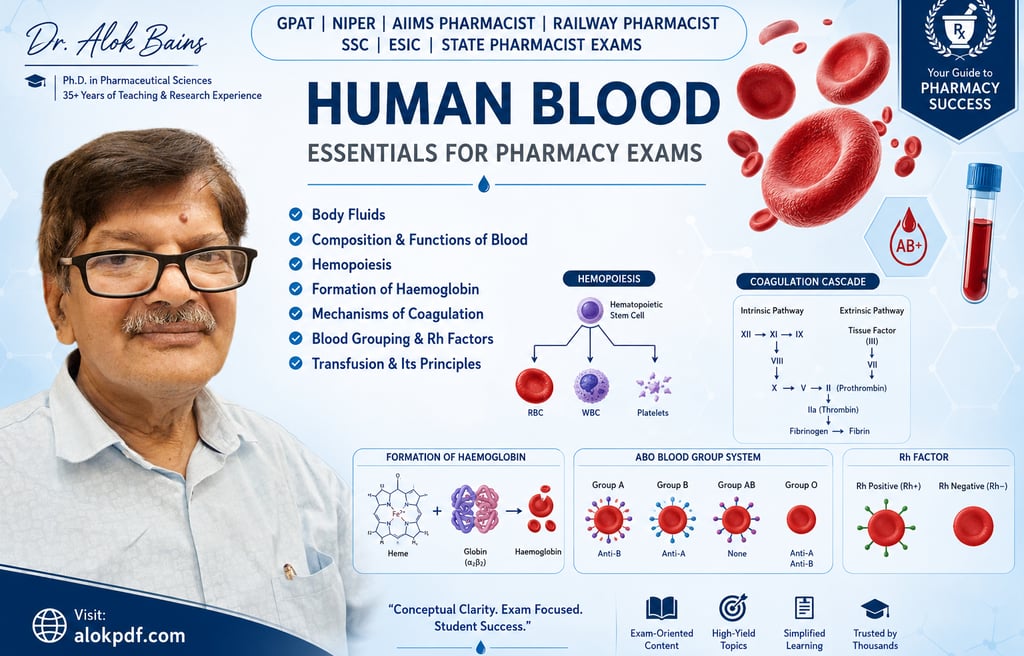
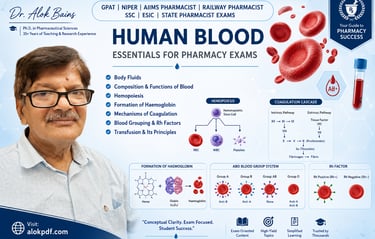
MCQs: Body Fluids, Blood, Hemopoiesis, Hemoglobin Formation, Coagulation, Blood Grouping, Rh Factor & Transfusion
1. Total body water in a healthy adult male constitutes approximately
A. 40% of body weight
B. 50% of body weight
C. 60% of body weight
D. 70% of body weight
Answer: C. 60% of body weight
2. Which compartment contains the largest fraction of total body water?
A. Plasma
B. Interstitial fluid
C. Intracellular fluid
D. Transcellular fluid
Answer: C. Intracellular fluid
3. The major cation of intracellular fluid is
A. Sodium
B. Potassium
C. Calcium
D. Magnesium
Answer: B. Potassium
4. Which ion is the principal extracellular cation?
A. Potassium
B. Magnesium
C. Sodium
D. Calcium
Answer: C. Sodium
5. The normal hematocrit value in an adult male is approximately
A. 20–25%
B. 30–35%
C. 40–50%
D. 55–65%
Answer: C. 40–50%
6. Which plasma protein is primarily responsible for maintaining colloidal osmotic pressure?
A. Globulin
B. Fibrinogen
C. Albumin
D. Prothrombin
Answer: C. Albumin
7. A patient with severe liver disease develops generalized edema mainly due to decreased
A. Fibrinogen
B. Albumin
C. Platelets
D. Hemoglobin
Answer: B. Albumin
8. Which leukocyte is most abundant in normal peripheral blood?
A. Eosinophils
B. Basophils
C. Monocytes
D. Neutrophils
Answer: D. Neutrophils
9. Increased eosinophil count is most commonly associated with:
A. Viral infections
B. Allergic disorders and parasitic infestations
C. Bacterial infections
D. Anemia
Answer: B. Allergic disorders and parasitic infestations
10. The lifespan of a circulating erythrocyte is approximately
A. 30 days
B. 60 days
C. 90 days
D. 120 days
Answer: D. 120 days
11. Erythropoietin is primarily produced by
A. Liver
B. Bone marrow
C. Kidney
D. Spleen
Answer: C. Kidney
12. Which vitamin is essential for DNA synthesis during erythropoiesis?
A. Vitamin C
B. Vitamin K
C. Vitamin B12
D. Vitamin E
Answer: C. Vitamin B12
13. Deficiency of intrinsic factor results in impaired absorption of
A. Iron
B. Vitamin B12
C. Folic acid
D. Vitamin K
Answer: B. Vitamin B12
14. The first committed precursor in erythropoiesis is
A. Hemocytoblast
B. Proerythroblast
C. Reticulocyte
D. Normoblast
Answer: B. Proerythroblast
15. Reticulocytes differ from mature RBCs because they
A. Contain nuclei
B. Contain residual RNA
C. Synthesize antibodies
D. Produce clotting factors
Answer: B. Contain residual RNA
16. Which element forms the central atom of the heme molecule?
A. Copper
B. Zinc
C. Iron
D. Magnesium
Answer: C. Iron
17. Hemoglobin synthesis requires all except
A. Iron
B. Vitamin B12
C. Amino acids
D. Vitamin K
Answer: D. Vitamin K
18. One molecule of hemoglobin can maximally bind
A. 1 oxygen molecule
B. 2 oxygen molecules
C. 4 oxygen molecules
D. 8 oxygen molecules
Answer: C. 4 oxygen molecules
19. The normal hemoglobin concentration in adult males is approximately
A. 8–10 g/dL
B. 10–12 g/dL
C. 13–18 g/dL
D. 20–25 g/dL
Answer: C. 13–18 g/dL
20. Which clotting factor is known as the Hageman factor?
A. Factor VIII
B. Factor IX
C. Factor X
D. Factor XII
Answer: D. Factor XII
21. The intrinsic pathway of coagulation is initiated by activation of
A. Factor III
B. Factor VII
C. Factor XII
D. Factor X
Answer: C. Factor XII
22. Tissue thromboplastin is another name for
A. Factor II
B. Factor III
C. Factor V
D. Factor VIII
Answer: B. Factor III
23. Conversion of fibrinogen into fibrin is catalyzed by
A. Prothrombin
B. Thrombin
C. Factor VII
D. Plasmin
Answer: B. Thrombin
24. Which vitamin is essential for hepatic synthesis of prothrombin?
A. Vitamin A
B. Vitamin D
C. Vitamin E
D. Vitamin K
Answer: D. Vitamin K
25. Calcium ions participate in
A. Intrinsic pathway only
B. Extrinsic pathway only
C. Common pathway only
D. Multiple steps of coagulation
Answer: D. Multiple steps of coagulation
26. The final stable product of blood coagulation is
A. Prothrombin
B. Thrombin
C. Fibrin meshwork
D. Platelet plug
Answer: C. Fibrin meshwork
27. Which blood group is called the universal donor for packed red cells?
A. A negative
B. B negative
C. AB negative
D. O negative
Answer: D. O negative
28. Which blood group is considered the universal recipient for packed red cells?
A. O positive
B. A positive
C. AB positive
D. B positive
Answer: C. AB positive
29. An individual with blood group A possesses
A. A antigen and anti-A antibody
B. A antigen and anti-B antibody
C. B antigen and anti-A antibody
D. No antigen and anti-A antibody
Answer: B. A-antigen and an anti-B antibody
30. A person with blood group O has
A. Both A and B antigens
B. Only A antigen
C. Only B antigen
D. Neither A nor B antigens
Answer: D. Neither A nor B antigens
31. Which blood group contains both anti-A and anti-B antibodies?
A. A
B. B
C. AB
D. O
Answer: D. O
32. Agglutination during blood grouping occurs due to interaction between
A. Antigen and enzyme
B. Antigen and antibody
C. Hemoglobin and antibody
D. Platelet and fibrinogen
Answer: B. Antigen and antibody
33. The Rh factor was first discovered in
A. Rabbits
B. Monkeys
C. Sheep
D. Dogs
Answer: B. Monkeys
34. The most immunogenic Rh antigen is
A. C antigen
B. c antigen
C. D antigen
D. E antigen
Answer: C. D antigen
35. An Rh-negative mother carrying an Rh-positive fetus is at greatest risk of producing anti-Rh antibodies
A. During first pregnancy before delivery
B. During first pregnancy after sensitization at delivery
C. Before conception
D. During implantation only
Answer: B. During first pregnancy after sensitization at delivery
36. Hemolytic disease of the newborn is primarily caused by maternal
A. IgM antibodies against ABO antigens
B. IgG antibodies against the Rh antigen
C. IgA antibodies against RBCs
D. Complement deficiency
Answer: B. IgG antibodies against the Rh antigen
37. Administration of anti-D immunoglobulin to an Rh-negative mother prevents
A. ABO incompatibility
B. Platelet destruction
C. Rh sensitization
D. Iron deficiency
Answer: C. Rh sensitization
38. Which antibody class can readily cross the placenta?
A. IgA
B. IgD
C. IgE
D. IgG
Answer: D. IgG
39. Cross-matching before blood transfusion is primarily performed to
A. Determine hemoglobin concentration
B. Assess clotting time
C. Detect donor-recipient incompatibility
D. Count leukocytes
Answer: C. Detect donor-recipient incompatibility
40. Immediate transfusion reaction due to ABO incompatibility is mainly characterized by
A. Enhanced erythropoiesis
B. Acute intravascular hemolysis
C. Leukocytosis
D. Polycythemia
Answer: B. Acute intravascular hemolysis
41. A patient has blood group AB negative. Which of the following packed RBC units is safest in an emergency?
A. A positive
B. B positive
C. O negative
D. AB positive
Answer: C. O negative
Concept: Rh-negative recipients should ideally receive Rh-negative blood; O-negative blood lacks A, B, and Rh antigens.
42. Which sequence correctly represents the intrinsic coagulation pathway?
A. XII → XI → IX → VIII → X
B. XII → IX → XI → VIII → X
C. VII → X → V → II
D. III → VII → X → II
Answer: A. XII → XI → IX → VIII → X
43. Iron deficiency anemia primarily impairs synthesis of
A. Globin chains
B. Plasma proteins
C. Heme portion of hemoglobin
D. Erythropoietin
Answer: C. Heme portion of hemoglobin
44. Which cell type ultimately gives rise to all formed elements of blood?
A. Proerythroblast
B. Megakaryocyte
C. Hemocytoblast
D. Reticulocyte
Answer: C. Hemocytoblast
45. A patient has blood group B. His plasma contains
A. Anti-A antibodies only
B. Anti-B antibodies only
C. Anti-A and anti-B antibodies
D. No antibodies
Answer: A. Anti-A antibodies only
Exam POINTS TO
Remember:
ICF = K⁺ rich; ECF = Na⁺ rich
Albumin maintains oncotic pressure
Kidney → Erythropoietin
Factor XII starts the intrinsic pathway
Factor III (Tissue thromboplastin) starts the extrinsic pathway
Factor II = Prothrombin
Factor I = Fibrinogen
O⁻ = Universal donor
AB⁺ = Universal recipient
Rh incompatibility → Hemolytic disease of the newborn.
Dr Alok Singh