
Capsule filling methods MCQs for GPAT & Pharmacist Exams (HSSC, AIIMS ESIC, Railway)
Capsule filling methods MCQs for GPAT, and Pharmacist recruitment (AIIMS, HSSC, ESIC, & railway exams). Practice dosator, tamping pin & rotary die with high-level questions for GPAT.
Dr. Alok Bains
4/26/20264 min read
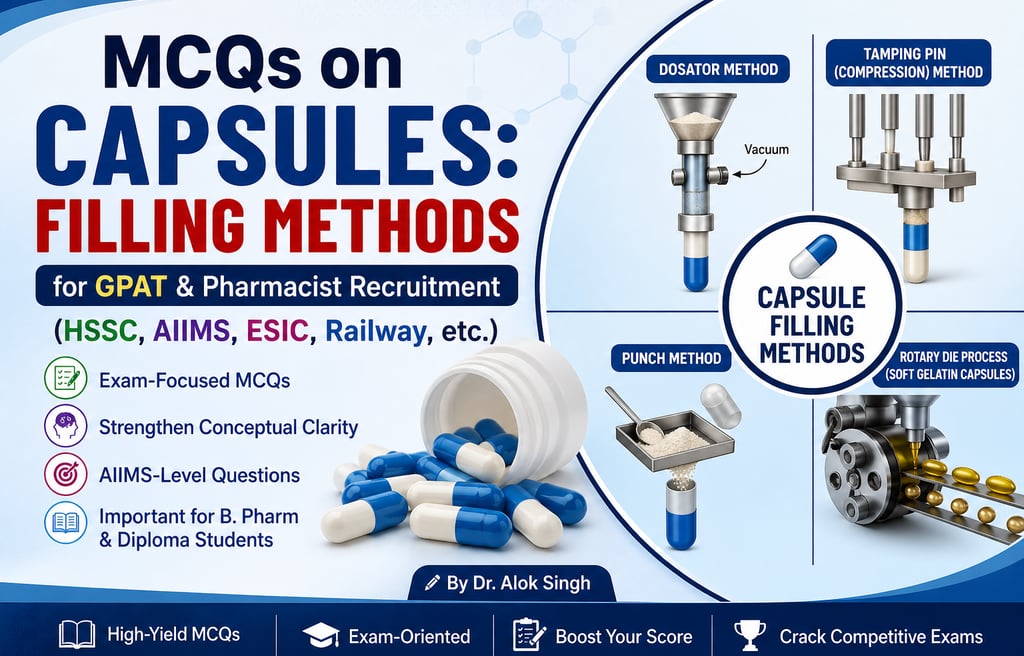
GPAT, Pharmacist Recruitment (HSSC, ESIC, AIIMS, Railway, etc.) level Capsule Filling Methods MCQs.
1. The most commonly used method for filling hard gelatin capsules in industry is:
A. Hand filling
B. Punch method
C. Dosator method
D. Injection molding
Correct Answer: C. Dosator method
2. The punch method is primarily used for:
A. Industrial scale filling
B. Liquid filling
C. Small-scale or extemporaneous compounding
D. Soft gelatin capsule production
Correct Answer: C. Small-scale or extemporaneous compounding
3. In the dosator method, powder is filled into capsules in the form of:
A. Granules
B. Slugs
C. Powder plugs
D. Pellets
Correct Answer: C. Powder plugs
4. Which method uses a vacuum to fill powder into capsules?
A. Punch method
B. Dosator method
C. Compression method
D. Fusion method
Correct Answer: B. Dosator method
5. The tamping pin method is also known as:
A. Plug method
B. Compression filling method
C. Injection method
D. Rotary die method
Correct Answer: B. Compression filling method
6. In the tamping pin method, powder is filled by:
A. Pouring into the capsule body
B. Compressing powder into plugs using pins
C. Injecting liquid
D. Melting gelatin
Correct Answer: B. Compressing powder into plugs using pins
7. Which filling method is suitable for poorly flowing powders?
A. Hand filling
B. Dosator method
C. Tamping pin method
D. Fusion method
Correct Answer: C. Tamping pin method
8. The rotary die process is used for:
A. Hard gelatin capsules
B. Soft gelatin capsules
C. Pellet filling
D. Tablet compression
Correct Answer: B. Soft gelatin capsules
9. In the rotary die process, fill material is
A. Injected between two gelatin ribbons
B. Compressed into slugs
C. Poured manually
D. Vacuum filled
Correct Answer: A. Injected between two gelatin ribbons
10. Which method is NOT used for hard gelatin capsule filling?
A. Dosator method
B. Tamping pin method
C. Punch method
D. Rotary die method
Correct Answer: D. Rotary die method
11. Capsule filling by hand involves:
A. Automatic filling machine
B. Capsule filling plate
C. Rotary die
D. Vacuum pump
Correct Answer: B. Capsule filling plate
12. Which method forms a compacted powder plug before filling?
A. Dosator method
B. Punch method
C. Tamping pin method
D. Fusion method
Correct Answer: C. Tamping pin method
13. In the dosator method, powder enters the tube due to:
A. Pressure
B. Gravity and vacuum
C. Heat
D. Centrifugal force
Correct Answer: B. Gravity and vacuum
14. The filling of pellets into capsules is usually done by:
A. Rotary die
B. Dosator modification
C. Manual pouring
D. Injection
Correct Answer: B. Dosator modification
15. Which method provides better weight uniformity for powders?
A. Punch method
B. Hand filling
C. Tamping pin method
D. Spatula method
Correct Answer: C. Tamping pin method
16. Which process is used for liquid filling in hard gelatin capsules?
A. Rotary die
B. Fusion sealing method
C. Tamping pin method
D. Punch method
Correct Answer: B. Fusion sealing method
17. The main limitation of the punch method is:
A. High cost
B. Low accuracy and poor uniformity
C. Complex machinery
D. High speed
Correct Answer: B. Low accuracy and poor uniformity
18. In soft gelatin capsule manufacturing, sealing occurs by:
A. Heat fusion
B. Compression
C. Adhesion of gelatin ribbons
D. Chemical reaction
Correct Answer: C. Adhesion of gelatin ribbons
19. Capsule-filling machines used in industry are generally
A. Manual
B. Semi-automatic
C. Automatic
D. Hand-operated
Correct Answer: C. Automatic
20. Which method is best suited for high-dose powders?
A. Dosator method
B. Punch method
C. Tamping pin method
D. Hand filling
Correct Answer: C. Tamping pin method
For GPAT + AIIMS + HSSC + ESIC, repeatedly asked concepts:
Dosator → vacuum + powder plug
Tamping pin → compression + multiple pins
Punch method → small scale
Rotary die → soft gelatin capsules
Poor flow → prefer tamping pin method
Pellet filling → modified dosator
Dr. Alok Bains
Assertion–Reason MCQ set on capsule filling methods, designed for GPAT / pharmacist exams. These focus on mechanism-based reasoning, traps, and cause–and–effect logic.
Directions:
Choose the correct option:
A. Both Assertion (A) and Reason (R) are true, and R is the correct explanation of A
B. Both A and R are true, but R is NOT the correct explanation of A
C. A is true, but R is false
D. A is false, but R is true
1.
Assertion (A): The dosator method is widely used in automatic capsule filling machines.
Reason (R): It allows precise filling of powder plugs using vacuum assistance.
Answer: A
2.
Assertion (A): The punch method is unsuitable for large-scale production.
Reason (R): It lacks automation and gives poor weight uniformity.
Answer: A
3.
Assertion (A): The tamping pin method improves weight variation control.
Reason (R): Powder is compressed into plugs using multiple tamping pins.
Answer: A
4.
Assertion (A): The dosator method is preferred for poorly flowing powders.
Reason (R): It compresses powder mechanically into slugs.
Answer: D
(A tamping pin is preferred; a dosator relies more on flow + vacuum.)
5.
Assertion (A): The rotary die process is used in soft gelatin capsule manufacturing.
Reason (R): It simultaneously forms, fills, and seals capsules.
Answer: A
6.
Assertion (A): In the dosator method, powder enters the tube due to a vacuum.
Reason (R): Vacuum helps draw powder into the dosator tube.
Answer: A
7.
Assertion (A): The tamping pin method is suitable for high-dose formulations.
Reason (R): It allows multiple compression steps to accommodate more powder.
Answer: A
8.
Assertion (A): The rotary die method is used for hard gelatin capsules.
Reason (R): It uses gelatin ribbons for encapsulation.
Answer: D
9.
Assertion (A): Pellet filling into capsules can be done using modified dosator systems.
Reason (R): Dosator systems can be adapted for multiparticulate filling.
Answer: A
10.
Assertion (A): Capsule filling by hand provides high accuracy.
Reason (R): Manual methods ensure precise control over each capsule.
Answer: D
11.
Assertion (A): Fusion sealing is used for liquid-filled hard gelatin capsules.
Reason (R): It prevents leakage by sealing capsule joints.
Answer: A
12.
Assertion (A): The tamping pin method is also called compression filling.
Reason (R): Powder is densified before being filled into capsules.
Answer: A
13.
Assertion (A): The dosator method forms powder plugs before filling.
Reason (R): Powder is lightly compacted inside the dosator tube.
Answer: A
14.
Assertion (A): The rotary die process cannot handle liquid fill materials.
Reason (R): Liquids cannot be injected between gelatin ribbons.
Answer: D
15.
Assertion (A): Capsule filling machines improve production efficiency.
Reason (R): They operate at high speed with consistent fill weight.
Answer: A
16.
Assertion (A): Poor flow of powder affects dosator filling efficiency.
Reason (R): Dosator relies on uniform powder flow into the tube.
Answer: A
17.
Assertion (A): The tamping pin method reduces air entrapment in powder.
Reason (R): Compression removes void spaces in the powder bed.
Answer: A
18.
Assertion (A): Rotary die process produces hermetically sealed capsules.
Reason (R): Gelatin ribbons fuse during the process.
Answer: A
19.
Assertion (A): The dosator method is unsuitable for low-dose drugs.
Reason (R): It cannot provide accurate small quantities.
Answer: C
(The dosator can handle low doses with precision.)
20.
Assertion (A): Tamping pin machines use multiple stations for compression.
Reason (R): Multiple pins gradually increase powder density.
Answer: A
To crack these:
Focus on the mechanism difference
Dosator = vacuum + plug
Tamping = compression + pinsIdentify trap statements
“Dosator for poor flow” ❌Understand why a method is used, not just what
Dr. Alok Bains