Capsules Shell Composition MCQs
GPAT and pharmacist recruitment exams (HSSC, AIIMS, ESIC, Railway, etc.) MCQ sets on Capsules: Shell Composition. Designed to boost your preparation with high-quality. This post covers gelatin types, plasticizers, additives, hard vs. soft capsules, and previous-year pattern-based questions. Perfect for quick revision, concept clarity, and exam-oriented practice.
Dr. Alok Bains
4/26/20264 min read
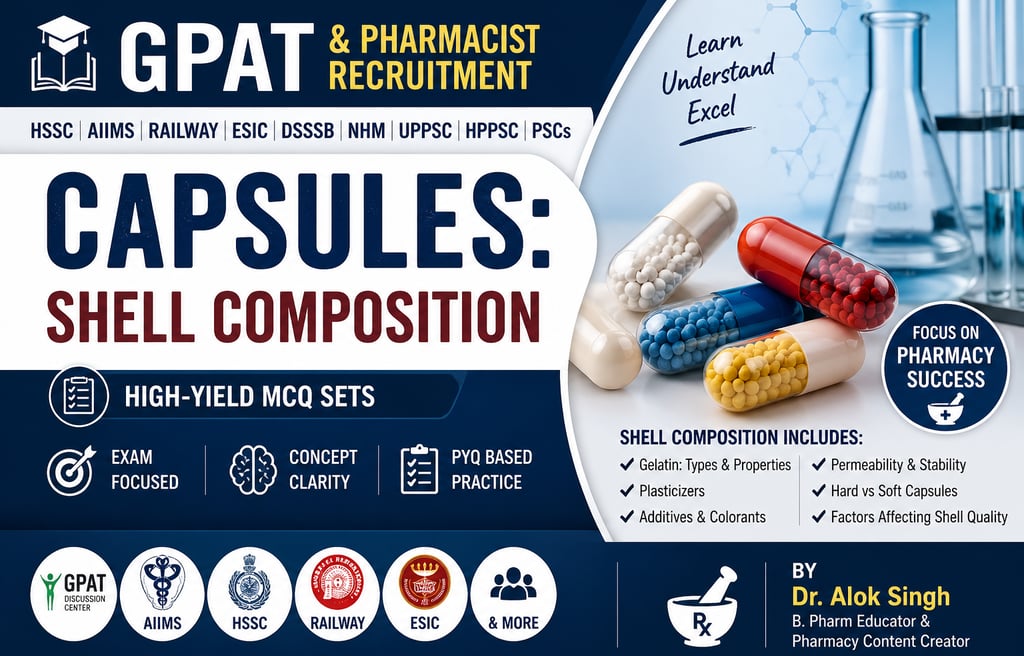
GPAT + Pharmacist Recruitment (HSSC, AIIMS, Railway, etc.) level MCQ set focused on Capsules: Shell Composition.
1. The primary component of hard gelatin capsule shells is:
A. Cellulose acetate
B. Gelatin
C. Polyvinyl alcohol
D. Starch
Correct Answer: B. Gelatin
2. Gelatin used in capsule shells is derived from:
A. Cellulose
B. Collagen
C. Elastin
D. Keratin
Correct Answer: B. Collagen
3. The plasticizer used in soft gelatin capsules is mainly
A. Talc
B. Titanium dioxide
C. Glycerin
D. Lactose
Correct Answer: C. Glycerin
4. Which of the following acts as a plasticizer in capsule shells?
A. Methyl paraben
B. Sorbitol
C. Titanium dioxide
D. Sodium lauryl sulfate
Correct Answer: B. Sorbitol
5. The approximate moisture content in hard gelatin capsule shells is:
A. 2–4%
B. 5–8%
C. 13–16%
D. 20–25%
Correct Answer: C. 13–16%
6. Which of the following is used as an opacifying agent in capsule shells?
A. Gelatin
B. Titanium dioxide
C. Glycerin
D. Sorbitol
Correct Answer: B. Titanium dioxide
7. Preservatives used in capsule shell formulation include
A. Benzalkonium chloride
B. Methyl paraben
C. Sodium starch glycolate
D. Magnesium stearate
Correct Answer: B. Methyl paraben
8. Which capsule type requires higher plasticizer content?
A. Hard gelatin capsule
B. Soft gelatin capsule
C. Enteric-coated capsule
D. HPMC capsule
Correct Answer: B. Soft gelatin capsule
9. The bloom strength of gelatin indicates
A. Viscosity
B. Gel strength
C. Moisture content
D. Elasticity
Correct Answer: B. Gel strength
10. Which of the following is a coloring agent used in capsule shells?
A. Iron oxides
B. Magnesium stearate
C. Talc
D. Lactose
Correct Answer: A. Iron oxides
11. Non-gelatin capsules are primarily made of:
A. Starch
B. Hydroxypropyl methylcellulose
C. Polyethylene glycol
D. Polyvinylpyrrolidone
Correct Answer: B. Hydroxypropyl methylcellulose
12. Which material is used to reduce brittleness in capsule shells?
A. Plasticizer
B. Diluent
C. Lubricant
D. Disintegrant
Correct Answer: A. Plasticizer
13. The function of titanium dioxide in the capsule shell is:
A. Plasticizer
B. Preservative
C. Opacifier
D. Lubricant
Correct Answer: C. Opacifier
14. Which of the following is NOT a component of a capsule shell?
A. Gelatin
B. Glycerin
C. Starch
D. Magnesium stearate
Correct Answer: D. Magnesium stearate
15. The ratio of plasticizer to gelatin in soft gelatin capsules is approximately:
A. 1:10
B. 1:5
C. 1:1
D. 1:20
Correct Answer: C. 1:1
16. Which factor affects the flexibility of capsule shells?
A. Lubricant
B. Plasticizer concentration
C. Binder
D. Disintegrant
Correct Answer: B. Plasticizer concentration
17. Which of the following is used as a preservative in gelatin solution?
A. Propyl paraben
B. Talc
C. Titanium dioxide
D. Sodium chloride
Correct Answer: A. Propyl paraben
18. Hard gelatin capsules become brittle due to:
A. High humidity
B. Low moisture content
C. High plasticizer content
D. High temperature
Correct Answer: B. Low moisture content
19. Which component provides elasticity to soft gelatin capsules?
A. Gelatin
B. Plasticizer
C. Water
D. Colorant
Correct Answer: B. Plasticizer
20. Which of the following is TRUE regarding HPMC capsules?
A. Derived from animal source
B. Sensitive to humidity
C. Suitable for vegetarian use
D. Requires high moisture
Correct Answer: C. Suitable for vegetarian use
Dr. Alok Bains
Assertion–reason MCQ set on capsule shell composition, designed specifically for AIIMS / GPAT / high-competition exams.
Directions:
Choose the correct option:
A. Both Assertion (A) and Reason (R) are true, and R is the correct explanation of A
B. Both A and R are true, but R is NOT the correct explanation of A
C. A is true, but R is false
D. A is false, but R is true
1.
Assertion (A): Soft gelatin capsules are more elastic than hard gelatin capsules.
Reason (R): Soft gelatin capsules contain a higher proportion of plasticizer.
Answer: A
2.
Assertion (A): Hard gelatin capsules become brittle in low-humidity conditions.
Reason (R): Loss of moisture reduces the flexibility of the gelatin shell.
Answer: A
3.
Assertion (A): Titanium dioxide is added to capsule shells to improve stability.
Reason (R): Titanium dioxide acts as an opacifying agent that protects contents from light.
Answer: A
4.
Assertion (A): HPMC capsules are preferred for moisture-sensitive drugs.
Reason (R): HPMC capsules have lower moisture content compared to gelatin capsules.
Answer: A
5.
Assertion (A): Gelatin used in capsules is obtained from collagen.
Reason (R): Collagen undergoes hydrolysis to form gelatin.
Answer: A
6.
Assertion (A): Sorbitol can replace glycerin in soft gelatin capsules.
Reason (R): Both act as plasticizers.
Answer: A
7.
Assertion (A): Hard gelatin capsules do not require plasticizers.
Reason (R): Their rigidity is due to lower moisture content.
Answer: D
(Hard gelatin capsules do contain small amounts of plasticizer/moisture; reasoning is partially misleading.)
8.
Assertion (A): Bloom strength determines the gel strength of gelatin.
Reason (R): Higher bloom strength indicates stronger and more rigid gels.
Answer: A
9.
Assertion (A): Preservatives are added to the capsule shell formulation.
Reason (R): Gelatin is susceptible to microbial growth.
Answer: A
10.
Assertion (A): Iron oxides are used in capsule shells.
Reason (R): They provide color to capsule shells.
Answer: A
11.
Assertion (A): Soft gelatin capsules contain more water than hard gelatin capsules.
Reason (R): Water acts as a plasticizer along with glycerin.
Answer: A
12.
Assertion (A): Capsule shells can be made opaque.
Reason (R): Opacity helps in protecting photosensitive drugs.
Answer: A
13.
Assertion (A): HPMC capsules are suitable for vegetarian patients.
Reason (R): They are derived from plant cellulose.
Answer: A
14.
Assertion (A): Excessive plasticizer can make capsule shells sticky.
Reason (R): Plasticizers increase flexibility and reduce intermolecular forces.
Answer: B
(Both true, but R does not fully explain stickiness.)
15.
Assertion (A): Low bloom strength gelatin produces stronger capsules.
Reason (R): Bloom strength is inversely proportional to gel strength.
Answer: D
16.
Assertion (A): Capsule shells may contain preservatives like parabens.
Reason (R): Capsule shells are completely resistant to microbial attack.
Answer: C
17.
Assertion (A): Moisture acts as a plasticizer in gelatin capsules.
Reason (R): It reduces intermolecular attraction between gelatin chains.
Answer: A
18.
Assertion (A): Soft gelatin capsules are not suitable for aqueous drug solutions.
Reason (R): Water may diffuse into the shell and destabilize it.
Answer: A
19.
Assertion (A): Hard gelatin capsules contain approximately 13–16% moisture.
Reason (R): This moisture is essential for maintaining shell flexibility.
Answer: A
20.
Assertion (A): Titanium dioxide improves the mechanical strength of capsules.
Reason (R): It acts as a reinforcing agent in a gelatin matrix.
Answer: D
Dr Alok Bains