
Carbohydrates Lipids Proteins Nucleic Acids MCQs
Master tricky Carbohydrates Lipids Proteins Nucleic Acids MCQs for for GPAT, NIPER, AIIMS Pharmacist, Railway Pharmacist, SSC, ESIC, and State Pharmacist exams with answers and explanations.
7/13/20267 min read
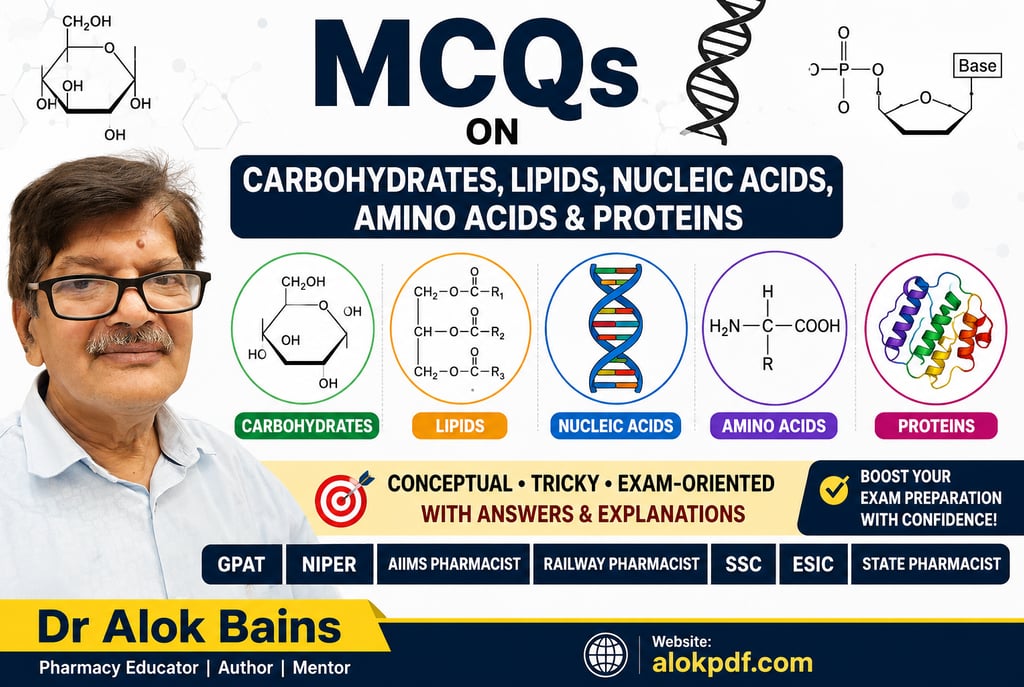
Conceptual and Tricky MCQs on Carbohydrates, Lipids, Nucleic Acids, Amino Acids, and Proteins
Suitable for GPAT, NIPER, AIIMS Pharmacist, Railway Pharmacist, SSC, ESIC, and State Pharmacist examinations.
Short Notes: Carbohydrates, Lipids, Nucleic Acids, Amino Acids, and Proteins
Carbohydrates
Carbohydrates are organic compounds composed of carbon, hydrogen, and oxygen, generally following the formula (CH₂O)ₙ.. They are the primary source of energy in the human body and provide approximately 4 kcal/g of energy. Carbohydrates are classified into monosaccharides (glucose and fructose), disaccharides (sucrose, lactose, and maltose), oligosaccharides, and polysaccharides (starch, glycogen, and cellulose). Glucose is the major fuel for the brain and red blood cells. Glycogen serves as the storage form of carbohydrate in animals, while starch is the storage form in plants.
Lipids
Lipids are a heterogeneous group of hydrophobic organic compounds that are insoluble in water but soluble in organic solvents. They provide the highest energy yield among nutrients, supplying approximately 9 kcal/g. Lipids include triglycerides, phospholipids, steroids, and waxes. Triglycerides serve as energy reserves, phospholipids form the structural basis of cell membranes, and cholesterol acts as a precursor for steroid hormones, bile acids, and vitamin D. Essential fatty acids such as linoleic acid and α-linolenic acid must be obtained from the diet.
Amino Acids
Amino acids are the basic structural units of proteins and contain both amino (-NH₂) and carboxyl (-COOH) functional groups attached to the same carbon atom. Twenty standard amino acids are involved in protein synthesis. Amino acids are classified as essential, non-essential, acidic, basic, polar, and non-polar amino acids. Glycine is the only amino acid without an asymmetric carbon atom and is therefore optically inactive. Essential amino acids cannot be synthesised by the body and must be supplied through food.
Proteins
Proteins are polymers of amino acids linked together by peptide bonds. They perform numerous biological functions, including enzymatic catalysis, transport, immunity, muscle contraction, and hormone regulation. Proteins possess four levels of structure: primary, secondary, tertiary, and quaternary. Denaturation caused by heat, pH changes, or chemicals disrupts secondary and tertiary structures but generally leaves the primary structure intact. Most enzymes in the human body are proteins.
Nucleic Acids
Nucleic acids are polymers of nucleotides responsible for storing and transmitting genetic information. The two major types are DNA (deoxyribonucleic acid) and RNA (ribonucleic acid). DNA contains the sugar deoxyribose and the bases adenine, guanine, cytosine, and thymine, whereas RNA contains ribose and uracil instead of thymine. Nucleotides are connected by phosphodiester bonds. According to Chargaff's rule, adenine equals thymine and guanine equals cytosine in double-stranded DNA.
Points for Competitive Examinations
• Sucrose is a non-reducing sugar, whereas lactose and maltose are reducing sugars.
• Glycogen is the storage carbohydrate of animals; starch is the storage carbohydrate of plants.
• Phospholipids are amphipathic molecules and form biological membranes.
• Linoleic acid and α-linolenic acid are essential fatty acids.
• Glycine is optically inactive due to the absence of a chiral carbon atom.
• Methionine contains sulphur but cannot form disulphide bonds.
• Peptide bonds join amino acids, while phosphodiester bonds join nucleotides.
• DNA contains thymine, whereas RNA contains uracil.
• Denaturation usually does not affect the primary structure of proteins.
Exam Tips
1. Carbohydrates
Remember the Reducing Sugars Rule:
"All common disaccharides are reducing except sucrose."
Reducing sugars:
Glucose
Fructose
Lactose
Maltose
Non-reducing sugar:
Sucrose
Storage Polysaccharides:
Plants Store Starch
Animals Gather Glycogen
Think: "Plants Store, Animals Gather."
Glycogen vs Amylopectin
Glycogen → More branching (every 8–12 glucose units)
Amylopectin → Less branching (every 24–30 glucose units)
Competitive exams frequently ask this comparison.
Structural Polysaccharides
Cellulose → Plant cell wall
Chitin → Fungal cell wall and insect exoskeleton
Peptidoglycan → Bacterial cell wall
2. Lipids
Energy Yield Tip
Carbohydrates = 4 kcal/g
Proteins = 4 kcal/g
Lipids = 9 kcal/g
Remember:
"Fat gives more than double the energy."
Essential Fatty Acids
Remember:
"LiLi are life essentials."
Linoleic acid
Linolenic acid
These cannot be synthesised by humans.
Saturated vs Unsaturated Fatty Acids
Saturated fatty acids → No double bonds
Unsaturated fatty acids → One or more double bonds
More double bonds = greater susceptibility to oxidation and rancidity.
3. Amino Acids
Optically Inactive Amino Acid
Remember:
"Glycine Goes Alone."
Glycine is the only amino acid without a chiral carbon and therefore is optically inactive.
Sulfur-Containing Amino Acids
Methionine
Cysteine
Important distinction:
Cysteine forms disulfide bonds.
Methionine does not form disulfide bonds.
Imino Acid
Only Proline contains a secondary amino group and is often called an imino acid.
4. Proteins
Levels of Protein Structure
Remember:
"Primary Students Take Questions"
Primary structure
Secondary structure
Tertiary structure
Quaternary structure
Denaturation Rule
Denaturation affects:
Secondary structure
Tertiary structure
Quaternary structure
Denaturation usually does not affect:
Primary structure
This is among the most frequently repeated GPAT and NIPER concepts.
Protein Bond Types
Peptide bond → Joins amino acids
Hydrogen bond → Stabilizes secondary structure
Disulfide bond → Stabilizes tertiary structure
5. Nucleic Acids
DNA vs RNA Trick
Feature DNA RNA
Sugar Deoxyribose Ribose
Pyrimidine Base Thymine Uracil
Structure Double stranded Usually, single stranded
Remember:
"DNA has Thymine, RNA has Uracil."
Chargaff's Rule Shortcut
In double-stranded DNA:
A = T
G = C
If Adenine is 30%:
Thymine = 30%
Guanine = 20%
Cytosine = 20%
Nucleoside vs Nucleotide
Nucleoside = Base + Sugar
Nucleotide = Base + Sugar + Phosphate
Remember:
"Phosphate makes the difference."
Frequently Asked Previous-Year topics
Reducing and non-reducing sugar
Essential fatty acids
Glycine as optically inactive amino acid
Methionine versus cysteine
Protein denaturation
DNA-RNA differences
Chargaff's rule
Peptide and phosphodiester bonds
Glycogen and amylopectin branching pattern
Cholesterol is a precursor of steroid hormones, bile acids, and vitamin D
These facts are repeated because they are among the most frequently tested concepts in biochemistry, human anatomy, and physiology.
1. Which carbohydrate gives a positive Benedict's test but does NOT undergo mutarotation?
A. Glucose
B. Maltose
C. Lactose
D. Fructose
✅ Answer: D. Fructose
Explanation:
Fructose is a reducing sugar and therefore gives a positive Benedict's test. It exists mainly as a ketose and shows very limited mutarotation compared with aldoses, making it a favorite conceptual question in GPAT and NIPER examinations.
2. Which of the following carbohydrates is NOT a reducing sugar?
A. Lactose
B. Maltose
C. Sucrose
D. Cellobiose
✅ Answer: C. Sucrose
Explanation:
In sucrose, both anomeric carbons participate in glycosidic bond formation, leaving no free aldehyde or ketone group available for reduction.
3. Glycogen differs from amylopectin primarily because glycogen possesses:
A. α(1→4) linkages only
B. β(1→4) linkages
C. More frequent α(1→6) branching
D. Fewer glucose residues
✅ Answer: C. More frequent α(1→6) branching
Explanation:
Glycogen has branches every 8–12 glucose residues, whereas amylopectin branches every 24–30 residues.
4. Which polysaccharide forms the major structural component of the bacterial cell wall?
A. Cellulose
B. Chitin
C. Glycogen
D. Peptidoglycan
✅ Answer: D. Peptidoglycan
Explanation:
Peptidoglycan consists of alternating N-acetylglucosamine and N-acetylmuramic acid residues.
5. Which statement regarding cellulose is correct?
A. It contains α(1→4) glycosidic bonds.
B. Humans digest it using cellulase.
C. It consists of β-D-glucose units linked by β(1→4) bonds.
D. It is a branched polysaccharide.
✅ Answer: C. It consists of β-D-glucose units linked by β(1→4) bonds.
Explanation:
Humans lack cellulase enzyme and therefore cannot digest cellulose.
Lipids
6. Which lipid is amphipathic and forms the structural basis of biological membranes?
A. Triglycerides
B. Waxes
C. Phospholipids
D. Cholesterol esters
✅ Answer: C. Phospholipids
Explanation:
Phospholipids possess both hydrophilic and hydrophobic regions, allowing bilayer formation.
7. Which fatty acid contains the maximum number of double bonds?
A. Oleic acid
B. Linoleic acid
C. Linolenic acid
D. Stearic acid
✅ Answer: C. Linolenic acid
Explanation:
Oleic acid = 1 double bond, Linoleic acid = 2, Linolenic acid = 3.
8. Which of the following is an essential fatty acid?
A. Palmitic acid
B. Oleic acid
C. Linoleic acid
D. Stearic acid
✅ Answer: C. Linoleic acid
Explanation:
Humans cannot synthesize linoleic and α-linolenic acids and must obtain them from the diet.
9. Rancidity of fats occurs mainly due to:
A. Hydrolysis
B. Oxidation of unsaturated fatty acids
C. Reduction
D. Polymerization
✅ Answer: B. Oxidation of unsaturated fatty acids
Explanation:
Double bonds in unsaturated fatty acids are susceptible to oxidation, producing unpleasant odors.
10. Cholesterol serves as a precursor for all EXCEPT:
A. Steroid hormones
B. Bile salts
C. Vitamin D
D. Vitamin C
✅ Answer: D. Vitamin C
Explanation:
Cholesterol is the precursor of steroid hormones, bile acids, and vitamin D.
Amino Acids and Proteins
11. Which amino acid lacks an asymmetric carbon atom?
A. Alanine
B. Glycine
C. Valine
D. Serine
✅ Answer: B. Glycine
Explanation:
Glycine contains two hydrogen atoms attached to the α-carbon, making it optically inactive.
12. Which amino acid is classified as an imino acid rather than an amino acid?
A. Lysine
B. Proline
C. Methionine
D. Histidine
✅ Answer: B. Proline
Explanation:
Proline contains a secondary amino group incorporated into a pyrrolidine ring.
13. Which amino acid contains sulfur but cannot form disulfide bonds?
A. Cysteine
B. Methionine
C. Tyrosine
D. Histidine
✅ Answer: B. Methionine
Explanation:
Cysteine forms disulfide bonds due to its sulfhydryl group, whereas methionine contains sulfur in a thioether linkage.
14. Denaturation of proteins generally does NOT affect:
A. Primary structure
B. Secondary structure
C. Tertiary structure
D. Quaternary structure
✅ Answer: A. Primary structure
Explanation:
Denaturation disrupts non-covalent interactions but usually leaves peptide bonds intact.
15. The peptide bond is best described as:
A. An ester bond
B. An amide bond
C. A hydrogen bond
D. A phosphodiester bond
✅ Answer: B. An amide bond
Explanation:
Peptide bonds are formed between the carboxyl group of one amino acid and the amino group of another.
16. Which level of protein structure is stabilized primarily by hydrogen bonding between peptide groups?
A. Primary
B. Secondary
C. Tertiary
D. Quaternary
✅ Answer: B. Secondary
Explanation:
α-Helix and β-pleated sheets are stabilized mainly by hydrogen bonds.
Nucleic Acids
17. Which nitrogenous base is present in RNA but absent in DNA?
A. Adenine
B. Guanine
C. Cytosine
D. Uracil
✅ Answer: D. Uracil
Explanation:
RNA contains uracil instead of thymine.
18. The sugar present in DNA differs from that in RNA by the absence of:
A. Carbon atom at 5' position
B. Hydroxyl group at 2' position
C. Oxygen atom at 3' position
D. Phosphate group
✅ Answer: B. Hydroxyl group at 2' position
Explanation:
DNA contains deoxyribose, lacking the 2'-OH group present in ribose.
19. Which bond links nucleotides together in nucleic acids?
A. Peptide bond
B. Glycosidic bond
C. Phosphodiester bond
D. Hydrogen bond
✅ Answer: C. Phosphodiester bond
Explanation:
The 3'-OH of one nucleotide links with the 5'-phosphate of the next nucleotide.
20. According to Chargaff's rule, if DNA contains 20% adenine, the percentage of cytosine will be:
A. 20%
B. 30%
C. 40%
D. 60%
✅ Answer: B. 30%
Explanation:
A = T = 20%, therefore A + T = 40%. The remaining 60% consists of G + C, so C = 30%.
21. Which nitrogenous base forms three hydrogen bonds with its complementary base?
A. Adenine
B. Thymine
C. Cytosine
D. Uracil
✅ Answer: C. Cytosine
Explanation:
Cytosine pairs with guanine through three hydrogen bonds, increasing DNA stability.
22. Which of the following is a nucleoside and not a nucleotide?
A. AMP
B. ATP
C. Adenosine
D. cAMP
✅ Answer: C. Adenosine
Explanation:
A nucleoside consists of a nitrogenous base plus sugar only, whereas nucleotides additionally contain phosphate groups.
23. Which biomolecule can act both as an energy source and as a structural component?
A. Cholesterol
B. Glycogen
C. Cellulose
D. Glucose
✅ Answer: D. Glucose
Explanation:
Glucose serves as the primary energy source and also acts as a precursor for structural polysaccharides.
24. Which statement is TRUE regarding biological macromolecules?
A. All proteins are enzymes.
B. All carbohydrates are reducing sugars.
C. All lipids are hydrophobic.
D. All enzymes are proteins in humans.
✅ Answer: D. All enzymes are proteins in humans.
Explanation:
Human enzymes are proteins, whereas some viral catalytic molecules are RNA (ribozymes).
25. Which of the following pairs is incorrectly matched?
A. Glycogen — Storage polysaccharide in animals
B. Cellulose — Structural polysaccharide in plants
C. Chitin — Storage polysaccharide in animals
D. Starch — Storage polysaccharide in plants
✅ Answer: C. Chitin — Storage polysaccharide in animals
Explanation:
Chitin is a structural polysaccharide found in fungal cell walls and arthropod exoskeletons.
Examination Points
Sucrose is non-reducing; lactose and maltose are reducing sugars.
Glycine is optically inactive.
Methionine contains sulphur but does not form disulphide bonds.
DNA contains thymine; RNA contains uracil.
Phosphodiester bonds join nucleotides, while peptide bonds join amino acids.
Linoleic and α-linolenic acids are essential fatty acids.
Denaturation affects secondary, tertiary, and quaternary structures but usually spares primary structure.
Dr Alok Singh