
Cardiovascular System MCQs
Practice Cardiovascular System MCQs on hypertension, cardiac arrhythmias, congestive heart failure, angina, myocardial infarction, atherosclerosis, and coronary artery disease. Concept-based questions with detailed explanations for GPAT, NIPER, AIIMS Pharmacist, Railway Pharmacist
Dr. Alok Singh
6/29/20264 min read
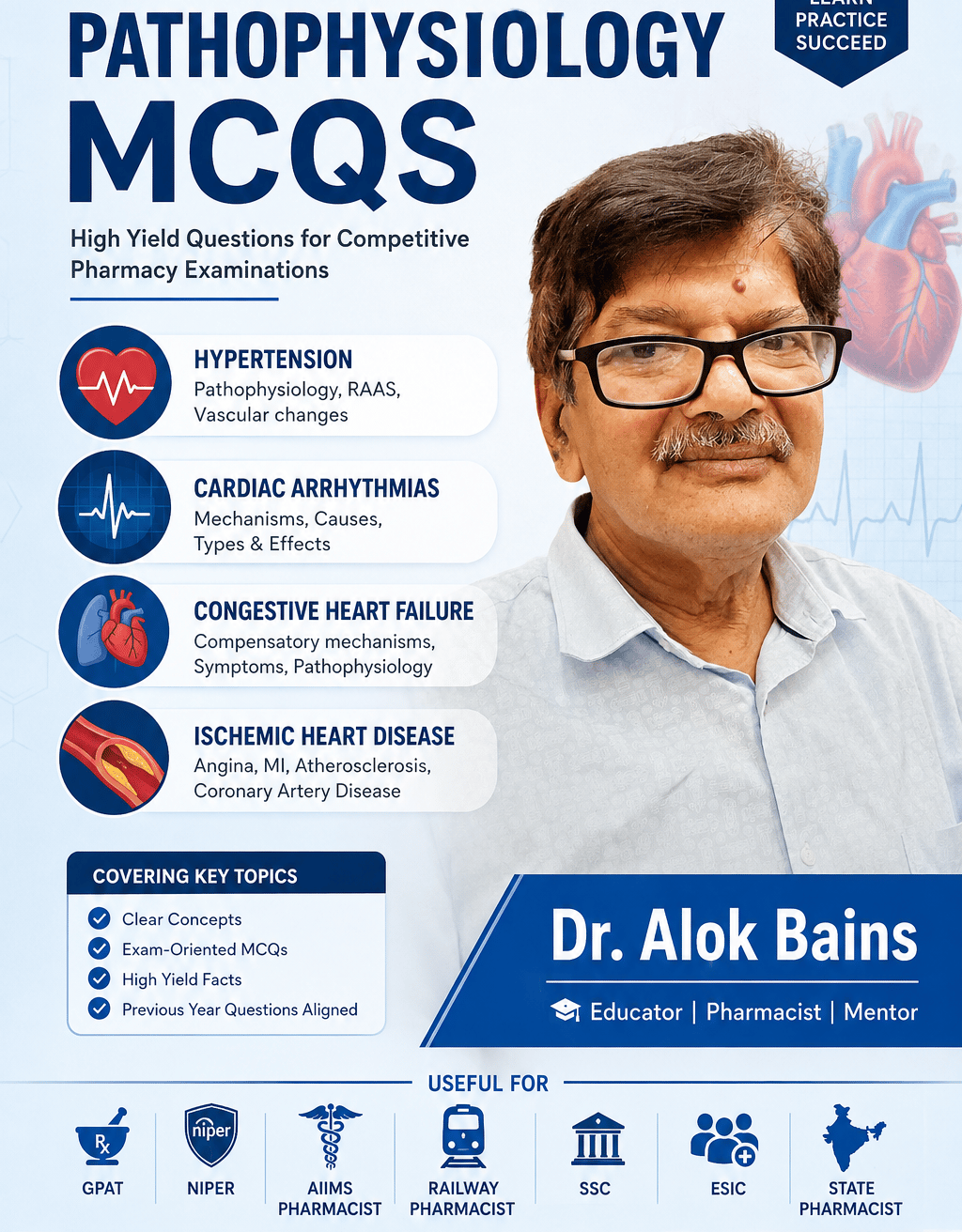
MCQs on Cardiovascular Pathophysiology, For GPAT, NIPER, AIIMS Pharmacist, Railway Pharmacist, SSC, ESIC & State Pharmacist Examinations
1. The earliest pathological event in the development of essential hypertension is:
A. Left ventricular hypertrophy
B. Endothelial dysfunction with increased peripheral vascular resistance
C. Renal artery stenosis
D. Myocardial fibrosis
Answer: B
Explanation: Essential hypertension begins with endothelial dysfunction, increased sympathetic activity, RAAS activation, and increased peripheral vascular resistance.
2. Persistent hypertension leads to left ventricular hypertrophy primarily because of:
A. Increased preload
B. Increased afterload
C. Increased heart rate
D. Increased venous return
Answer: B
Explanation: Chronic elevation of systemic vascular resistance increases afterload, causing concentric left ventricular hypertrophy.
3. Which factor contributes most directly to vascular remodeling in chronic hypertension?
A. Decreased collagen deposition
B. Angiotensin II-induced smooth muscle hypertrophy
C. Reduced sympathetic activity
D. Increased nitric oxide production
Answer: B
Explanation: Angiotensin II stimulates vascular smooth muscle hypertrophy and fibrosis, increasing vascular stiffness.
4. A patient has hypertension with suppressed plasma renin activity. Which mechanism is most likely responsible?
A. Renal artery stenosis
B. Primary hyperaldosteronism
C. Congestive heart failure
D. Hypovolemia
Answer: B
Explanation: Excess aldosterone suppresses renin secretion through negative feedback.
5. The major determinant of systolic blood pressure is:
A. Peripheral vascular resistance
B. Cardiac output
C. Venous pressure
D. Blood viscosity alone
Answer: B
Explanation: Systolic pressure mainly depends on stroke volume and cardiac output.
6. Pulse pressure is increased in:
A. Severe shock
B. Aortic regurgitation
C. Cardiac tamponade
D. Mitral stenosis
Answer: B
Explanation: Increased stroke volume and rapid diastolic runoff widen pulse pressure.
7. Which ECG finding is most characteristic of atrial fibrillation?
A. Regular rhythm with narrow QRS
B. Saw-tooth P waves
C. Irregularly irregular rhythm with absent P waves
D. Prolonged PR interval
Answer: C
8. Ventricular fibrillation immediately results in:
A. Increased stroke volume
B. Complete loss of effective cardiac output
C. Increased cardiac contractility
D. Increased coronary perfusion
Answer: B
9. Which arrhythmia carries the highest immediate risk of sudden cardiac death?
A. Sinus bradycardia
B. Atrial flutter
C. Ventricular fibrillation
D. First-degree AV block
Answer: C
10. A patient develops Torsades de Pointes after receiving a drug that prolongs the QT interval. The arrhythmia is primarily due to:
A. Enhanced sodium influx
B. Delayed ventricular repolarization
C. Increased AV nodal conduction
D. Increased vagal tone
Answer: B
11. Which electrolyte abnormality most commonly predisposes to ventricular arrhythmias?
A. Hypercalcemia
B. Hypokalemia
C. Hypernatremia
D. Hypermagnesemia
Answer: B
12. Complete heart block is characterized by:
A. Every P wave is followed by QRS
B. Independent atrial and ventricular activity
C. Only ventricular ectopic beats
D. Shortened PR interval
Answer: B
13. Congestive heart failure develops primarily because
A. Increased myocardial efficiency
B. Inability of the heart to maintain adequate cardiac output
C. Increased venous compliance
D. Reduced blood volume
Answer: B
14. Which compensatory mechanism initially helps maintain cardiac output in heart failure?
A. Reduced sympathetic activity
B. Activation of RAAS
C. Decreased preload
D. Reduced ADH secretion
Answer: B
15. Which hormone opposes the effects of RAAS in heart failure?
A. Cortisol
B. Natriuretic peptides (ANP/BNP)
C. Aldosterone
D. Renin
Answer: B
16. Elevated BNP levels indicate:
A. Liver dysfunction
B. Ventricular wall stretch
C. Hyperthyroidism
D. Pulmonary fibrosis
Answer: B
17. Pulmonary edema in left-sided heart failure is caused by:
A. Increased pulmonary arterial pressure alone
B. Elevated pulmonary capillary hydrostatic pressure
C. Reduced plasma proteins
D. Increased lymphatic drainage
Answer: B
18. Peripheral edema in right-sided heart failure occurs primarily due to
A. Reduced oncotic pressure
B. Increased systemic venous pressure
C. Decreased capillary permeability
D. Hypernatremia
Answer: B
19. Which finding is more specific for right-sided heart failure?
A. Pulmonary edema
B. Orthopnea
C. Raised jugular venous pressure
D. Basal crepitations
Answer: C
20. The Frank-Starling mechanism initially improves cardiac performance by
A. Increasing heart rate
B. Increasing force of contraction with increased ventricular filling
C. Reducing afterload
D. Reducing preload
Answer: B
21. Stable angina is usually caused by
A. Coronary vasospasm alone
B. Fixed atherosclerotic narrowing of the coronary arteries
C. Complete coronary occlusion
D. Myocarditis
Answer: B
22. Variant (Prinzmetal) angina occurs primarily because of:
A. Coronary artery spasm
B. Severe anemia
C. Tachycardia
D. Aortic stenosis
Answer: A
23. Unstable angina differs from stable angina because it involves:
A. Fixed coronary obstruction only
B. Plaque rupture with platelet aggregation
C. Coronary vasodilation
D. Complete myocardial necrosis
Answer: B
24. The irreversible injury in myocardial infarction begins after approximately:
A. 1–2 minutes
B. 20–40 minutes
C. 8–10 hours
D. 24 hours
Answer: B
25. Which cardiac biomarker remains elevated for the longest duration after myocardial infarction?
A. Myoglobin
B. CK-MB
C. Cardiac Troponin T
D. LDH-1
Answer: C
26. The earliest biomarker to rise after myocardial infarction is:
A. Troponin I
B. CK-MB
C. Myoglobin
D. LDH
Answer: C
27. CK-MB is particularly useful for detecting
A. Old myocardial infarction
B. Reinfarction
C. Stable angina
D. Hypertension
Answer: B
28. Which event initiates atherosclerosis?
A. Calcification
B. Endothelial injury
C. Smooth muscle necrosis
D. Complete thrombus formation
Answer: B
29. Foam cells in atherosclerotic plaques are derived from:
A. Fibroblasts
B. Macrophages containing oxidized LDL
C. Platelets
D. Endothelial cells
Answer: B
30. Which lipoprotein has the greatest role in atherogenesis?
A. HDL
B. LDL
C. Chylomicrons
D. VLDL remnants only
Answer: B
31. Which lipoprotein is considered anti-atherogenic?
A. LDL
B. HDL
C. VLDL
D. IDL
Answer: B
32. The most dangerous complication of an atherosclerotic plaque is
A. Calcification
B. Plaque rupture with thrombosis
C. Fatty streak formation
D. Smooth muscle proliferation
Answer: B
33. Coronary artery disease most commonly results from
A. Congenital heart defects
B. Atherosclerosis
C. Viral myocarditis
D. Rheumatic fever
Answer: B
34. Which coronary artery is most commonly involved in myocardial infarction?
A. Right coronary artery
B. Left anterior descending artery
C. Left circumflex artery
D. Posterior descending artery
Answer: B
35. A patient develops chest pain during exercise that disappears within 5 minutes of rest. The most likely diagnosis is
A. Myocardial infarction
B. Stable angina
C. Unstable angina
D. Pericarditis
Answer: B
36. Which factor most increases myocardial oxygen demand?
A. Bradycardia
B. Increased heart rate
C. Decreased preload
D. Hypothermia
Answer: B
37. Which condition decreases myocardial oxygen supply?
A. Coronary artery stenosis
B. Exercise
C. Anxiety
D. Hyperthyroidism
Answer: A
38. Which pathological change is characteristic of chronic uncontrolled hypertension?
A. Eccentric ventricular hypertrophy
B. Concentric left ventricular hypertrophy
C. Right ventricular dilation
D. Mitral valve prolapse
Answer: B
39. Which of the following best explains pulmonary congestion in left ventricular failure?
A. Reduced systemic venous pressure
B. Increased left atrial pressure transmitted to pulmonary veins
C. Increased plasma protein concentration
D. Reduced pulmonary capillary pressure
Answer: B
40. Which sequence correctly represents the pathogenesis of acute myocardial infarction?
A. Vasospasm → Plaque rupture → Thrombosis → Necrosis
B. Endothelial injury → Plaque formation → Plaque rupture → Coronary thrombosis → Myocardial ischemia → Necrosis
C. Coronary thrombosis → Endothelial injury → Necrosis
D. Myocardial necrosis → Plaque rupture → Coronary thrombosis
Answer: B
Explanation: The sequence begins with endothelial injury, followed by atherosclerotic plaque formation. Plaque rupture exposes thrombogenic material, leading to coronary thrombosis, prolonged ischemia, and finally irreversible myocardial necrosis.
Examination Points
Essential hypertension: Increased peripheral vascular resistance is the hallmark.
Left ventricular hypertrophy: Consequence of chronic increased afterload.
Atrial fibrillation: Irregularly irregular rhythm; absent P waves.
Ventricular fibrillation: The most common cause of sudden cardiac death.
Heart failure: RAAS activation initially compensates but later worsens the disease.
BNP: Marker of ventricular stretch and heart failure severity.
Stable angina: Fixed coronary stenosis.
Unstable angina: Plaque rupture with partial thrombosis.
Prinzmetal angina: Coronary vasospasm.
Myocardial infarction: Irreversible injury begins after about 20–40 minutes of severe ischemia.
Earliest MI marker: Myoglobin.
Most specific MI marker: Cardiac troponins.
CK-MB: Best for diagnosing reinfarction.
Atherosclerosis: Initiated by endothelial dysfunction and oxidized LDL.
Foam cells: Lipid-laden macrophages.
Most commonly occluded coronary artery: Left anterior descending (LAD) artery.
Most dangerous plaque complication: Plaque rupture followed by thrombosis.
Dr. Alok Singh