
Cellular Injury Pathogenesis
Master Cell Injury and adaptation with exam-oriented MCQs covering feedback systems, causes of cellular injury pathogenesis, adaptive changes, intracellular accumulations, necrosis, and apoptosis for GPAT, NIPER, AIIMS Pharmacist, Railway Pharmacist, SSC, ESIC, and B.Pharm exams.
Dr. Alok Singh
6/16/20264 min read
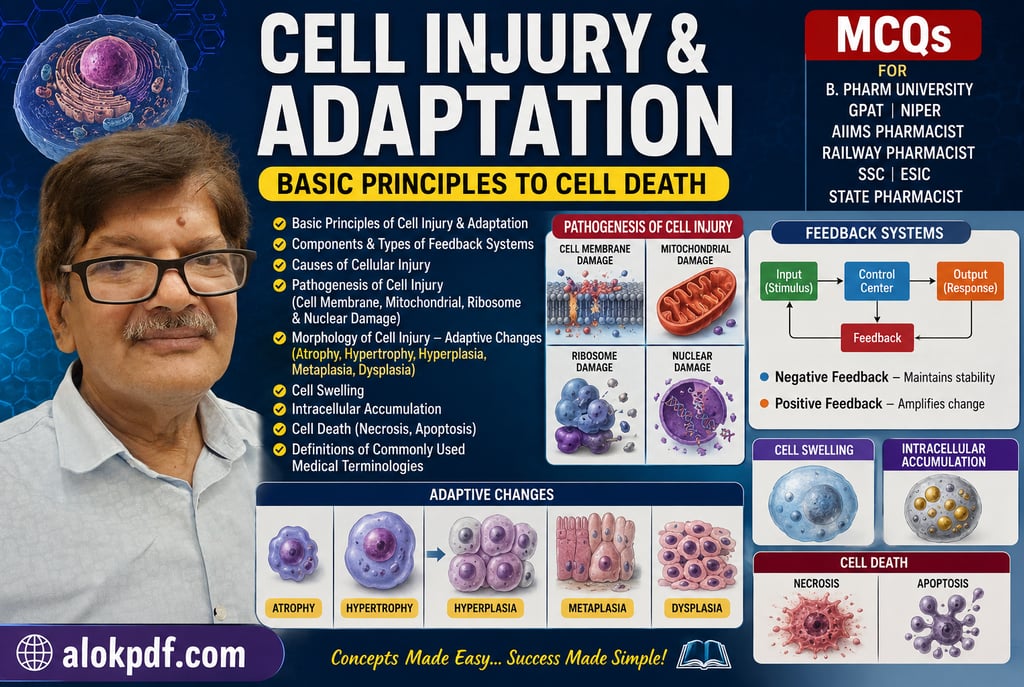
MCQs on Cell Injury, Adaptation, Feedback Systems, and Cell Death. (GPAT, NIPER, AIIMS Pharmacist, Railway Pharmacist, SSC, ESIC, State Pharmacist & B.Pharm University Exams)
1. A typical feedback system consists of:
A. Receptor, control center, effector
B. Neuron, muscle, gland
C. Stimulus, hormone, enzyme
D. Cell, tissue, organ
Answer: A. Receptor, control center, effector
2. Which is the best example of a negative feedback mechanism?
A. Blood clotting
B. Parturition
C. Regulation of blood glucose by insulin
D. Oxytocin secretion during labor
Answer: C. Regulation of blood glucose by insulin
3. Positive feedback differs from negative feedback because it:
A. Opposes the initial stimulus
B. Amplifies the initial stimulus
C. Maintains homeostasis directly
D. Requires hormones only
Answer: B. Amplifies the initial stimulus
4. Which process operates through positive feedback?
A. Thermoregulation
B. Blood pressure regulation
C. Blood clotting cascade
D. Blood glucose regulation
Answer: C. Blood clotting cascade
Causes of Cellular Injury
5. The most common cause of cell injury is:
A. Infection
B. Ischemia and hypoxia
C. Autoimmunity
D. Radiation
Answer: B. Ischemia and hypoxia
6. Which of the following is NOT a cause of cellular injury?
A. Nutritional imbalance
B. Genetic defects
C. Homeostasis
D. Physical agents
Answer: C. Homeostasis
7. Ionizing radiation primarily damages cells by:
A. Increasing ATP synthesis
B. Generating free radicals
C. Activating ribosomes
D. Enhancing DNA repair
Answer: B. Generating free radicals
8. Carbon monoxide causes cell injury mainly by:
A. DNA mutation
B. Ribosomal inhibition
C. Tissue hypoxia
D. Protein synthesis
Answer: C. Tissue hypoxia
9. The earliest consequence of plasma membrane damage is:
A. DNA fragmentation
B. Loss of ionic homeostasis
C. Increased protein synthesis
D. Chromosome condensation
Answer: B. Loss of ionic homeostasis
10. Increased intracellular calcium following membrane injury activates:
A. ATP synthesis
B. Phospholipases and proteases
C. Ribosomes
D. DNA replication
Answer: B. Phospholipases and proteases
11. Free radicals damage cell membranes mainly through:
A. Glycolysis
B. Lipid peroxidation
C. Protein synthesis
D. Transcription
Answer: B. Lipid peroxidation
12. The most important consequence of mitochondrial injury is:
A. Increased ATP production
B. ATP depletion
C. Increased mitosis
D. Hyperplasia
Answer: B. ATP depletion
13. Opening of mitochondrial permeability transition pores results in:
A. Enhanced oxidative phosphorylation
B. Loss of membrane potential
C. Increased ATP generation
D. Ribosomal activation
Answer: B. Loss of membrane potential
14. Release of cytochrome c from mitochondria triggers:
A. Hypertrophy
B. Apoptosis
C. Hyperplasia
D. Metaplasia
Answer: B. Apoptosis
15. Detachment of ribosomes from the rough endoplasmic reticulum leads to:
A. Increased protein synthesis
B. Reduced protein synthesis
C. DNA damage
D. Cell division
Answer: B. Reduced protein synthesis
16. Ribosomal damage particularly affects the synthesis of:
A. Structural and secretory proteins
B. ATP
C. DNA
D. Lipids only
Answer: A. Structural and secretory proteins.
17. Pyknosis refers to:
A. Nuclear swelling
B. Nuclear shrinkage and chromatin condensation
C. Nuclear fragmentation
D. Nuclear dissolution
Answer: B. Nuclear shrinkage and chromatin condensation
18. Fragmentation of the nucleus is known as:
A. Karyolysis
B. Pyknosis
C. Karyorrhexis
D. Metaplasia
Answer: C. Karyorrhexis
19. Complete dissolution of the nucleus is called:
A. Karyolysis
B. Pyknosis
C. Karyorrhexis
D. Dysplasia
Answer: A. Karyolysis
Cellular Adaptations
20. A decrease in cell size is termed:
A. Atrophy
B. Hypertrophy
C. Hyperplasia
D. Dysplasia
Answer: A. Atrophy
21. An increase in cell size without an increase in cell number is
A. Hyperplasia
B. Dysplasia
C. Hypertrophy
D. Metaplasia
Answer: C. Hypertrophy
22. Enlargement of skeletal muscles after exercise is an example of:
A. Hyperplasia
B. Hypertrophy
C. Metaplasia
D. Dysplasia
Answer: B. Hypertrophy
23. Increase in the number of cells is called:
A. Hyperplasia
B. Hypertrophy
C. Atrophy
D. Metaplasia
Answer: A. Hyperplasia
24. Which adaptation occurs in the endometrium during the menstrual cycle?
A. Atrophy
B. Hyperplasia
C. Dysplasia
D. Necrosis
Answer: B. Hyperplasia
25. Replacement of one mature cell type by another mature cell type is:
A. Dysplasia
B. Hyperplasia
C. Metaplasia
D. Neoplasia
Answer: C. Metaplasia
26. Squamous metaplasia commonly occurs in:
A. Smokers' bronchi
B. Liver
C. Heart
D. Kidney glomeruli
Answer: A. Smokers' bronchi
27. Dysplasia is characterized by:
A. Increased cell size only
B. Abnormal cellular growth and maturation
C. Cell death
D. Cell swelling
Answer: B. Abnormal cellular growth and maturation
28. Dysplasia is considered:
A. Always reversible normal adaptation
B. Potentially precancerous lesion
C. Cell death
D. Physiological adaptation
Answer: B. Potentially precancerous lesion
29. Cell swelling is the hallmark of:
A. Irreversible injury
B. Reversible injury
C. Hyperplasia
D. Apoptosis
Answer: B. Reversible injury
30. Cell swelling primarily results from:
A. Increased ATP production
B. Failure of Na⁺/K⁺ pump
C. Increased protein synthesis
D. DNA replication
Answer: B. Failure of Na⁺/K⁺ pump
31. Hydropic change is another term for:
A. Necrosis
B. Cell swelling
C. Hyperplasia
D. Metaplasia
Answer: B. Cell swelling
Intracellular Accumulations
32. Fatty change (steatosis) most commonly affects the:
A. Brain
B. Liver
C. Bone
D. Cartilage
Answer: B. Liver
33. Accumulation of triglycerides within hepatocytes is called:
A. Amyloidosis
B. Steatosis
C. Calcification
D. Hypertrophy
Answer: B. Steatosis
34. Lipofuscin pigment is known as:
A. Wear-and-tear pigment
B. Bile pigment
C. Melanin
D. Hemosiderin
Answer: A. Wear-and-tear pigment
35. Hemosiderin accumulation indicates excess storage of:
A. Calcium
B. Iron
C. Lipids
D. Glycogen
Answer: B. Iron
Cell Death
36. Necrosis is characterized by:
A. Programmed cell death
B. Inflammation of surrounding tissue
C. Intact plasma membrane
D. Energy-dependent process
Answer: B. Inflammation of surrounding tissue
37. Apoptosis is:
A. Always pathological
B. Unregulated cell death
C. Programmed cell death
D. Accompanied by marked inflammation
Answer: C. Programmed cell death
38. Which feature distinguishes apoptosis from necrosis?
A. Cell swelling
B. Membrane rupture
C. Absence of inflammation
D. ATP depletion
Answer: C. Absence of inflammation
39. Caspases are primarily involved in:
A. Necrosis
B. Apoptosis
C. Hyperplasia
D. Hypertrophy
Answer: B. Apoptosis
40. Which type of necrosis is classically associated with tuberculosis?
A. Coagulative necrosis
B. Fat necrosis
C. Fibrinoid necrosis
D. Caseous necrosis
Answer: D. Caseous necrosis
GPAT/NIPER High-Level Concept Questions
41. The sequence of nuclear changes in necrosis is:
A. Karyolysis → Pyknosis → Karyorrhexis
B. Pyknosis → Karyorrhexis → Karyolysis
C. Karyorrhexis → Pyknosis → Karyolysis
D. Pyknosis → Karyolysis → Karyorrhexis
Answer: B. Pyknosis → Karyorrhexis → Karyolysis
42. ATP depletion first affects:
A. DNA replication
B. Na⁺/K⁺ ATPase activity
C. Chromosome segregation
D. Cytokinesis
Answer: B. Na⁺/K⁺ ATPase activity
43. Which cellular adaptation may progress to malignancy if persistent?
A. Hypertrophy
B. Hyperplasia
C. Dysplasia
D. Atrophy
Answer: C. Dysplasia
44. Reversible cell injury is characterized by:
A. Membrane rupture
B. Massive calcium influx
C. Cell swelling and fatty change
D. Nuclear dissolution
Answer: C. Cell swelling and fatty change
45. The principal target of free radical injury in cell membranes is:
A. Cholesterol
B. DNA
C. Membrane lipids
D. Glycogen
Answer: C. Membrane lipids
Rapid Revision Pearls
Negative feedback: Homeostasis.
Positive feedback: Amplifies response (blood clotting, labor).
Hypoxia/ischemia: The most common cause of cell injury.
ATP depletion: Earliest biochemical event.
Cell swelling: Reversible injury.
Atrophy = ↓ cell size.
Hypertrophy = ↑ cell size.
Hyperplasia = ↑ cell number.
Metaplasia = Replacement of one mature cell type by another.
Dysplasia = Disordered growth; precancerous.
Pyknosis, karyorrhexis, and karyolysis.
Necrosis: Inflammation present.
Apoptosis: Caspase-mediated, no inflammation.
Caseous necrosis: Tuberculosis.
Cytochrome c release: Apoptosis.