
Drugs and Cosmetics Act 1940 MCQs
Practice challenging MCQs on the Drugs and Cosmetics Act 1940 MCQs definitions, schedules, CDSCO, import, export, manufacturing, new drugs, loan, repacking licenses, and regulatory provisions for GPAT, NIPER, AIIMS Pharmacist, Railway Pharmacist, SSC, ESIC, and State Pharmacist exams.
Dr. Alok Singh
7/26/202616 min read
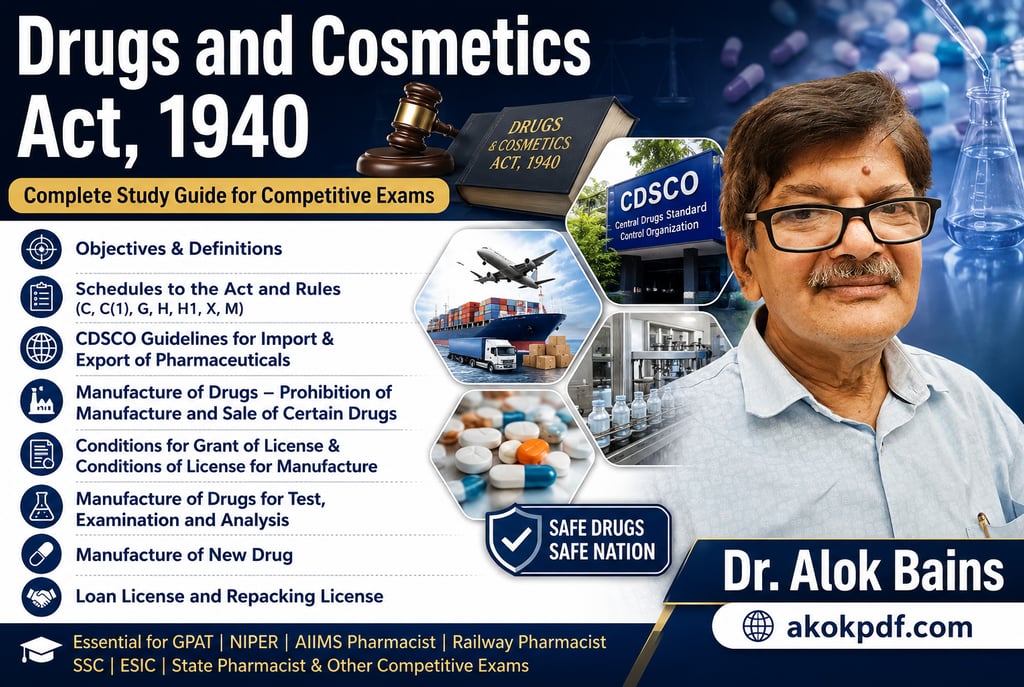
Drugs and Cosmetics Act, 1940 & Rules — Advanced MCQs
Short Notes for Competitive Exams
1. Objectives of the Drugs and Cosmetics Act, 1940
The Drugs and Cosmetics Act, 1940 is the main law regulating drugs and cosmetics in India.
Main Objectives
To regulate the import, manufacture, distribution and sale of drugs and cosmetics.
To ensure the quality, safety and efficacy of drugs.
To prevent the manufacture and sale of misbranded, adulterated and spurious drugs.
To prescribe standards for drugs and cosmetics.
To establish regulatory control through Central and State Drug Control Authorities.
Remember:
I-M-D-S = Import → Manufacture → Distribution → Sale
2. Important Definitions
Drug
The term "drug" broadly includes
Medicines and substances used for diagnosis, treatment, mitigation, or prevention of diseases or disorders in humans or animals.
Substances intended to affect the structure or function of the human body.
Certain substances used for destruction of insects or vermin that cause disease.
Components of drugs, including empty gelatin capsules and certain medical devices notified under the Act.
Cosmetic
A cosmetic is an article intended to be rubbed, poured, sprinkled, or sprayed on; introduced into; or otherwise applied to the human body for:
Cleansing
Beautifying
Promoting attractiveness
Altering appearance
Easy memory:
Drug = Treats/Prevents
Cosmetic = Cleanses/Beautifies
3. CDSCO and Import of Pharmaceuticals
CDSCO = Central Drugs Standard Control Organization
It functions under the Directorate General of Health Services (DGHS), Ministry of Health and Family Welfare, Government of India.
Important Functions
Regulation of import of drugs and cosmetics.
Approval of certain new drugs.
Regulatory oversight of clinical trials.
Coordination with State Drug Control Authorities.
Setting and enforcing standards for specified categories of drugs.
Import of Drugs — Key Points
Before pharmaceutical products are imported into India, the importer must comply with applicable regulatory requirements, which may include:
Registration/permission requirements, wherever applicable.
Valid import license.
Compliance with prescribed quality standards.
Proper labeling and packaging.
Required documentation and regulatory submissions.
Compliance with applicable CDSCO requirements.
Remember:
Import = Permission + License + Quality + Labeling
4. Export of Pharmaceuticals
Pharmaceutical exports from India must comply with:
Applicable Indian drug laws and regulatory requirements.
Requirements of the destination/importing country.
Quality and manufacturing standards.
Proper documentation and labeling.
Important Point
The importing country may have additional requirements regarding:
Product registration
Certificate of Pharmaceutical Product (where applicable)
Good Manufacturing Practices (GMP)
Stability data
Product specifications
Labeling
Exam Point:
Export regulation = Indian requirements + Importing country's requirements
5. Prohibition of Manufacture and Sale of Certain Drugs
The Act prohibits the manufacture for sale or distribution and sale/distribution of certain categories of drugs, including:
Misbranded drugs
Adulterated drugs
Spurious drugs
Drugs manufactured or sold in contravention of applicable legal provisions.
Drugs that do not meet prescribed standards of quality.
Drugs manufactured without the required license.
Easy Memory
M-A-S = Misbranded → Adulterated → Spurious
Misbranded Drug
Mainly associated with false, misleading or improper labeling or presentation.
Adulterated Drug
The drug's quality or purity is compromised, such as through contamination, substitution, or insanitary conditions.
Spurious Drug
The drug is associated with false identity, imitation, or deceptive representation.
Quick Trick:
Misbranded = Label problem
Adulterated = Quality/Purity problem
Spurious = Identity problem
6. Conditions for Grant of Manufacturing License
A manufacturing license is granted only when the applicant fulfills prescribed requirements.
Important requirements include:
Suitable premises and facilities.
Adequate and appropriate equipment.
Qualified and competent technical staff.
Compliance with applicable Good Manufacturing Practices (GMP).
Adequate arrangements for quality control and testing.
Compliance with prescribed standards and statutory requirements.
Inspection and satisfaction of the licensing authority.
Easy Memory
P-E-P-Q
P = Premises
E = Equipment
P = Personnel
Q = Quality Control
7. Conditions of Manufacturing License
After obtaining a license, the manufacturer must:
Manufacture only the drugs authorized under the license.
Maintain prescribed standards of quality and purity.
Follow applicable GMP requirements.
Maintain required manufacturing and testing records.
Allow inspection by authorized regulatory officers.
Maintain proper testing and quality-control systems.
Comply with labeling and packaging requirements.
Inform the licensing authority about relevant changes as required.
Not manufacture or sell drugs in violation of the act and rules.
Remember:
License = Permission + Compliance + Inspection + Records
A manufacturing license is not an unrestricted permission to manufacture every type of drug.
8. Manufacture of Drugs for Test, Examination and Analysis
The Rules permit the manufacture of drugs in specified circumstances for purposes such as:
Test
Examination
Analysis
Research or related scientific purposes, as permitted.
Key Points
Such manufacture is subject to specific authorization and conditions.
The quantity and purpose are controlled.
Products manufactured for testing or analysis should not be diverted for unauthorized commercial sale or distribution.
Proper records and labeling must be maintained as applicable.
Exam Trick:
Test batch ≠ Commercial batch
9. Manufacture of New Drug
A new drug is subject to additional regulatory scrutiny before it can be legally marketed.
Important Requirements
Regulatory approval as applicable.
Evaluation of quality, safety, and efficacy.
Submission of required scientific and technical data.
Compliance with applicable CDSCO requirements.
Necessary permissions for manufacture and marketing.
Important Concept
A company cannot assume that an ordinary manufacturing license automatically permits the manufacture and marketing of every new drug.
Remember:
New Drug = New Regulatory Evaluation
10. Loan License
Definition
A loan license allows an applicant to manufacture a drug by using the manufacturing facilities of another licensed manufacturer, subject to prescribed conditions.
Key Features
Applicant may not have adequate independent manufacturing facilities.
Manufacturing is carried out using another manufacturer's approved facilities.
The facility used must meet prescribed regulatory requirements.
The licensee must comply with applicable conditions and quality requirements.
Easy Memory
Loan License = Borrowed Manufacturing Facility
Important Difference:
The license is not a loan of money; it relates to the use of manufacturing facilities.
11. Repacking License
Repacking generally involves changing the packaging of a drug into another container or pack under prescribed conditions.
Key Points
Repacking is a regulated activity.
Proper premises and equipment are required.
Correct labeling must be maintained.
Quality and identity of the drug must be preserved.
Appropriate records must be maintained.
The activity must be performed under the required authorization/license.
Easy Memory
Repacking = Change of Pack, Not Creation of Drug
One-Minute Revision Chart
Topic Remember This
Drugs & Cosmetics Act, 1940 Regulates import, manufacture, distribution and sale
Drug Diagnosis, treatment, mitigation, prevention
Cosmetic Cleansing, beautifying, appearance
CDSCO Central regulatory organization
Misbranded Label/presentation problem
Adulterated Quality/purity problem
Spurious Identity/false representation problem
Manufacturing License Permission subject to conditions
GMP Quality manufacturing requirements
Test/Analysis Manufacture For specified scientific/testing purposes
New Drug Requires additional regulatory evaluation
Loan License Use another manufacturer's facilities
Repacking Change of packaging under prescribed conditions
Super-Fast Memory Formula
D&C Act → I-M-D-S
Drug → Treat/Prevent
Cosmetic → Clean/Beautify
MAS → Misbranded–Adulterated–Spurious
Manufacturing License → P-E-P-Q
New Drug → Quality + Safety + Efficacy
Loan License → Borrow Facility
Repacking → Change Pack
Below is an advanced, concept-focused MCQ set designed in the style of GPAT, NIPER, AIIMS Pharmacist, Railway Pharmacist, SSC, ESIC, and State Pharmacist examinations. The questions emphasize application of legal provisions, distinctions between licenses, schedules, manufacturing requirements, import/export controls, and regulatory interpretation rather than simple recall.
1. The primary legislative objective of the Drugs and Cosmetics Act, 1940, is to:
A. Regulate only the pricing of medicines
B. Ensure the safety, quality and standard of drugs and cosmetics
C. Promote pharmaceutical exports exclusively
D. Regulate medical education and pharmacy practice
Answer: B. Ensure the safety, quality and standard of drugs and cosmetics
Explanation: The Act primarily regulates the import, manufacture, distribution, and sale of drugs and cosmetics to ensure that products available to the public meet prescribed standards of quality, safety, and efficacy.
2. Under the Drugs and Cosmetics Act, a "drug" includes:
A. Only substances used internally for treatment
B. Only finished pharmaceutical formulations
C. Substances intended for diagnosis, treatment, mitigation or prevention of disease or disorder in humans or animals
D. Only substances recognized in the Indian Pharmacopoeia
Answer: C. Substances intended for diagnosis, treatment, mitigation or prevention of disease or disorder in humans or animals
Explanation: The statutory definition of "drug" is broad and covers substances and preparations intended for diagnosis, treatment, mitigation, or prevention of disease or disorder, including certain specified categories such as substances affecting body functions.
3. Which of the following best distinguishes a "drug" from a "cosmetic" under the Act?
A. A cosmetic must always be administered orally
B. A drug is primarily intended for therapeutic or diagnostic purposes, whereas a cosmetic is intended for cleansing, beautifying, or altering appearance
C. Cosmetics are not regulated under the act.
D. Drugs are always prescription-only products
Answer: B. A drug is primarily intended for therapeutic or diagnostic purposes, whereas a cosmetic is intended for cleansing, beautifying or altering appearance
Explanation: The intended purpose is a key conceptual distinction. Cosmetics are primarily intended for cleansing, beautifying, promoting attractiveness, or altering appearance, whereas drugs have therapeutic, diagnostic, or preventive purposes.
4. A pharmaceutical product imported into India is found to be of substandard quality. Which regulatory framework is primarily applicable to controlling such an import?
A. Drugs and Cosmetics Act, 1940, and Rules, 1945
B. Pharmacy Act, 1948 alone
C. Medical Termination of Pregnancy Act alone
D. Narcotic Drugs and Psychotropic Substances Act alone
Answer: A. Drugs and Cosmetics Act, 1940 and Rules, 1945
Explanation: The Drugs and Cosmetics Act and Rules provide the principal regulatory framework governing the import and quality standards of drugs and cosmetics in India.
5. Which authority is primarily responsible for regulating the import of drugs into India under the Drugs and Cosmetics regulatory framework?
A. Central Drugs Standard Control Organization (CDSCO)
B. State Pharmacy Council
C. University Grants Commission
D. National Medical Commission
Answer: A. Central Drugs Standard Control Organization (CDSCO)
Explanation: CDSCO, headed by the Drugs Controller General (India), performs central regulatory functions, including important responsibilities relating to drug imports, new drugs and specified categories of products.
6. The legal prohibition against the manufacture or sale of certain drugs primarily aims to prevent:
A. Only expensive medicines from entering the market
B. Sale and manufacture of drugs that fail to meet prescribed quality, safety or legal requirements
C. Pharmaceutical advertising
D. Import of all foreign medicines
Answer: B. Sale and manufacture of drugs that fail to meet prescribed quality, safety or legal requirements
Explanation: The Act prohibits the manufacture and sale of categories such as misbranded, adulterated, and spurious drugs, as well as drugs manufactured or sold in contravention of statutory requirements.
7. A drug is deliberately presented with a false identity or manufactured so as to imitate another drug. It is most appropriately classified as:
A. Misbranded drug
B. Adulterated drug
C. Spurious drug
D. Schedule H drug
Answer: C. Spurious drug
Explanation: A spurious drug is associated with false identity, imitation, substitution, or deceptive representation, including situations where the product purports to be manufactured by another manufacturer.
8. A drug contains an ingredient that may reduce its quality or strength because of contamination or unhygienic conditions. This situation most directly relates to:
A. Adulteration
B. Misbranding
C. Loan licensing
D. Repacking
Answer: A. Adulteration
Explanation: Adulterated drugs are those whose quality or purity has been compromised through contamination, substitution, insanitary conditions, or other specified circumstances.
9. Which situation most strongly indicates a "misbranded drug"?
A. The drug contains a harmful contaminant
B. The drug is manufactured in an insanitary environment
C. The label contains false or misleading information
D. The drug is manufactured under a loan license
Answer: C. The label contains false or misleading information
Explanation: Misbranding primarily concerns false, misleading, or improperly presented labeling and appearance of the drug.
10. A manufacturer wishes to manufacture a drug for commercial sale. Which combination is most essential from a regulatory perspective?
A. Manufacturing premises, prescribed equipment, competent technical staff and valid manufacturing license
B. Only a pharmacist registration certificate
C. Only a wholesale drug license
D. Only GST registration
Answer: A. Manufacturing premises, prescribed equipment, competent technical staff and valid manufacturing license
Explanation: A valid manufacturing license is granted only when prescribed requirements relating to premises, equipment, staff, facilities, documentation, and compliance with Good Manufacturing Practices are fulfilled.
11. Which of the following is a key condition for the grant of a manufacturing license?
A. Manufacture may be carried out in any residential premises
B. The applicant must comply with prescribed requirements concerning premises, equipment and competent technical personnel
C. No inspection is required
D. The manufacturer need not maintain records
Answer: B. The applicant must comply with prescribed requirements concerning premises, equipment and competent technical personnel
Explanation: Regulatory authorities assess whether the proposed manufacturing facility meets the required standards before granting the license.
12. The main purpose of imposing conditions on a drug manufacturing license is to:
A. Increase the market price of medicines
B. Ensure continued compliance with quality and manufacturing requirements
C. Prevent all pharmaceutical research
D. Eliminate competition
Answer: B. Ensure continued compliance with quality and manufacturing requirements
Explanation: Licensing is not merely a one-time approval. The licensee must continuously comply with prescribed conditions, including quality systems, records, inspections, and manufacturing standards.
13. If a licensed manufacturer substantially violates the conditions of a manufacturing license, the licensing authority may:
A. Ignore the violation
B. Take regulatory action, including suspension or cancellation as applicable
C. Automatically transfer the license to another company
D. Convert the license into a loan license
Answer: B. Take regulatory action, including suspension or cancellation as applicable
Explanation: Failure to comply with licensing conditions can lead to regulatory action, including suspension or cancellation, subject to applicable legal procedures.
14. A company has no independent manufacturing facility but wants to manufacture a drug using the manufacturing facilities of another licensed manufacturer. The most appropriate regulatory mechanism is
A. Repacking license
B. Loan license
C. Wholesale license
D. Import license
Answer: B. Loan license
Explanation: A loan license allows an applicant who does not have their own manufacturing arrangements to use the manufacturing facilities of another licensed manufacturer, subject to prescribed conditions.
15. Which statement correctly differentiates a loan license from a repacking license?
A. Loan license involves use of another licensed manufacturer's facilities; repacking license concerns repacking drugs under prescribed conditions
B. Both licenses have exactly the same purpose
C. Repacking license permits manufacture of new active pharmaceutical ingredients
D. Loan license is exclusively an import authorization
Answer: A. Loan license involves use of another licensed manufacturer's facilities; repacking license concerns repacking drugs under prescribed conditions
Explanation: The distinction is based on the activity authorized. A loan license facilitates manufacturing through another licensed facility, while repacking authorization applies to the repacking of drugs under regulatory controls.
16. Which of the following best describes repacking of a drug in the context of pharmaceutical regulation?
A. Manufacturing the active pharmaceutical ingredient from raw materials
B. Breaking up or changing the packing of a drug into different containers with appropriate labeling under prescribed conditions
C. Importing a drug from another country
D. Conducting clinical trials
Answer: B. Breaking up or changing the packing of a drug into different containers with appropriate labeling under prescribed conditions
Explanation: Repacking involves changing the packaging configuration of a drug without undertaking the type of manufacturing process associated with producing the drug itself.
17. A pharmaceutical company wants to manufacture a drug exclusively for laboratory testing and examination and not for commercial sale. Which regulatory provision is particularly relevant?
A. Manufacture for examination, test or analysis under prescribed authorization
B. Wholesale drug license
C. Cosmetic manufacturing license
D. Retail pharmacy license
Answer: A. Manufacture for examination, test or analysis under prescribed authorization
Explanation: The Rules provide specific provisions for manufacture of drugs in small quantities for examination, test or analysis, subject to applicable permissions and conditions.
18. The principal regulatory concern when a drug is manufactured solely for test or analysis is:
A. Commercial marketing
B. Prevention of unauthorized distribution or sale of such batches
C. Maximization of production
D. Advertising approval
Answer: B. Prevention of unauthorized distribution or sale of such batches
Explanation: Such manufacture is permitted for specific scientific or analytical purposes. The resulting material is not intended for ordinary commercial distribution.
19. A new drug is proposed for manufacture and marketing in India. Which regulatory principle is most appropriate?
A. It can automatically be manufactured under any existing drug license
B. It is subject to specific regulatory approval requirements before marketing
C. Only the State Drug Controller can approve all new drugs independently
D. No safety or efficacy evaluation is necessary
Answer: B. It is subject to specific regulatory approval requirements before marketing
Explanation: New drugs are subject to additional regulatory requirements involving evaluation of quality, safety and efficacy, with central regulatory oversight as applicable.
20. Which of the following is the most important reason for separate regulatory scrutiny of a new drug?
A. It always has a higher price
B. Its safety and efficacy profile may not yet be adequately established for the intended use
C. It must always be imported
D. It cannot be manufactured in India
Answer: B. Its safety and efficacy profile may not yet be adequately established for the intended use
Explanation: Regulatory scrutiny of new drugs is designed to ensure that adequate evidence supports their quality, safety and therapeutic efficacy before marketing.
21. A drug manufacturer wants to import a pharmaceutical product for commercial distribution in India. Which regulatory sequence is most appropriate?
A. Import without approval → sell → apply for license
B. Obtain applicable regulatory permissions and comply with import requirements before lawful distribution
C. Obtain only a pharmacy registration certificate
D. Obtain only a GST number
Answer: B. Obtain applicable regulatory permissions and comply with import requirements before lawful distribution
Explanation: Pharmaceutical imports are regulated and must comply with applicable requirements regarding registration/permissions, import licensing, quality standards, labeling and documentation.
22. In the context of pharmaceutical exports, which statement is most accurate?
A. Exporting a drug automatically exempts the manufacturer from all Indian manufacturing requirements
B. Export activities may be subject to specific regulatory requirements and documentation, depending on the product and destination
C. Exported drugs never require quality control
D. CDSCO has no regulatory relevance to pharmaceutical exports
Answer: B. Export activities may be subject to specific regulatory requirements and documentation, depending on the product and destination
Explanation: Pharmaceutical exports involve compliance with applicable Indian regulations as well as requirements of the importing country. Regulatory documentation and product-specific conditions may apply.
23. Which of the following represents the most important regulatory distinction between import and manufacture of drugs?
A. Import is controlled primarily at the point of entry, whereas manufacture is controlled through licensing and compliance at manufacturing premises
B. Manufacture is completely unregulated
C. Import requires no quality standards
D. Both are regulated by pharmacy colleges
Answer: A. Import is controlled primarily at the point of entry, whereas manufacture is controlled through licensing and compliance at manufacturing premises
Explanation: Import regulation focuses on legal entry, quality, and compliance of imported products, while manufacturing regulation emphasizes licensed premises, personnel, equipment, processes, and quality systems.
24. Which of the following is NOT a logical condition for maintaining a valid manufacturing license?
A. Compliance with prescribed standards
B. Maintenance of required records
C. Compliance with inspection requirements
D. Freedom to manufacture any drug regardless of the scope of the license
Answer: D. Freedom to manufacture any drug regardless of the scope of the license
Explanation: A manufacturing license authorizes the manufacture only of the specified categories/products and under prescribed conditions. It does not provide unrestricted manufacturing authority.
25. A manufacturer has a valid license for manufacturing tablets but begins manufacturing an injectable formulation without obtaining the required authorization. The most appropriate interpretation is:
A. Permissible because both are drugs
B. Permissible if the same active ingredient is used
C. A violation because manufacturing authorization is product- and category-specific
D. Permissible if the company has a wholesale license
Answer: C. A violation because manufacturing authorization is product- and category-specific
Explanation: A manufacturing license does not automatically cover every dosage form. Injectables, biological products, and other specialized categories may have additional requirements.
26. Which regulatory concept best explains why certain drug categories require special schedules under the Drugs and Cosmetics Rules?
A. To classify medicines according to regulatory controls and conditions of sale, labeling or record keeping
B. To determine their market price
C. To establish the company's tax liability
D. To determine the color of the dosage form
Answer: A. To classify medicines according to regulatory controls and conditions of sale, labeling, or record keeping
Explanation: Schedules prescribe specific regulatory requirements relating to manufacturing standards, labeling, sale, storage, prescription control, records, and other conditions, depending on the schedule.
27. Schedule C under the Drugs and Cosmetics Rules is primarily associated with:
A. Biological and special products
B. Cosmetics only
C. Medical devices exclusively
D. Veterinary feed additives only
Answer: A. Biological and special products
Explanation: Schedule C covers specified biological and special products, which require additional regulatory controls because of their nature and potential risks.
28. Schedule C(1) is broadly associated with:
A. Other special products
B. Cosmetics
C. Surgical instruments only
D. Household disinfectants only
Answer: A. Other special products
Explanation: Schedule C(1) covers specified other special products, distinct from the biological and special products listed under Schedule C.
29. Schedule G primarily relates to drugs that:
A. Require a cautionary statement regarding medical supervision
B. Are freely available without any restrictions
C. Are exclusively cosmetics
D. Are prohibited from manufacture
Answer: A. Require a cautionary statement regarding medical supervision
Explanation: Drugs under Schedule G carry the prescribed caution that they should be used under medical supervision, as specified by the Rules.
30. Schedule H drugs are primarily associated with:
A. Prescription control
B. Cosmetic products
C. Veterinary feed
D. Food additives
Answer: A. Prescription control
Explanation: Schedule H contains prescription drugs that are subject to specified labeling and sale requirements and generally require a prescription from a registered medical practitioner.
31. Schedule H1 was introduced primarily to strengthen regulatory control over
A. Certain drugs requiring stricter record-keeping and prescription controls
B. Cosmetic products
C. Surgical dressings only
D. All vitamins
Answer: A. Certain drugs requiring stricter record-keeping and prescription controls
Explanation: Schedule H1 includes specified medicines requiring enhanced controls, including record maintenance and restrictions on sale, due to concerns such as antimicrobial resistance and misuse.
32. Schedule X drugs are subject to:
A. More stringent controls concerning sale, storage and record keeping
B. No prescription requirements
C. Cosmetic labeling requirements only
D. Export-only restrictions
Answer: A. More stringent controls concerning sale, storage and record keeping
Explanation: Schedule X drugs are subject to particularly stringent regulatory requirements concerning prescription, storage, sale and maintenance of records.
33. Which of the following pairs is correctly matched?
A. Schedule H — Prescription drugs
B. Schedule X — Cosmetics
C. Schedule G — Surgical instruments
D. Schedule C — Food products
Answer: A. Schedule H — Prescription drugs
Explanation: Schedule H is associated with prescription-controlled drugs. The other pairs are incorrect.
34. A drug is listed under a schedule that requires specific standards of Good Manufacturing Practices. The manufacturer should understand that:
A. Schedule classification may impose additional manufacturing and quality requirements
B. The schedule has no legal relevance
C. The manufacturer can ignore GMP requirements
D. Only the marketing department is responsible for compliance
Answer: A. Schedule classification may impose additional manufacturing and quality requirements
Explanation: Certain schedules, particularly those specifying GMP and premises requirements, impose detailed standards that manufacturers must follow.
35. Schedule M is most closely associated with:
A. Good Manufacturing Practices and requirements of premises and plant
B. Prescription-only medicines
C. Cosmetics ingredients
D. Drug advertisements
Answer: A. Good Manufacturing Practices and requirements of premises and plant
Explanation: Schedule M specifies requirements relating to Good Manufacturing Practices (GMP) and requirements for premises and plants used in pharmaceutical manufacturing.
36. Which statement about a manufacturing license is conceptually CORRECT?
A. It is an unrestricted permanent authorization
B. It authorizes manufacture subject to specified conditions and continuing compliance
C. It replaces the need for quality control
D. It permits manufacture of all drugs
Answer: B. It authorizes manufacture subject to specified conditions and continuing compliance
Explanation: A manufacturing license is a conditional regulatory authorization. The licensee must continue to comply with the applicable provisions and conditions.
37. The fundamental purpose of inspection of a drug manufacturing premises is to:
A. Evaluate compliance with statutory and quality requirements
B. Determine the company's advertising budget
C. Fix retail prices
D. Recruit pharmacists
Answer: A. Evaluate compliance with statutory and quality requirements
Explanation: Inspections help regulatory authorities verify compliance with manufacturing standards, GMP, facilities, equipment, personnel, records and quality systems.
38. Which scenario most clearly requires a loan license rather than a conventional manufacturing license?
A. A company owns a fully compliant manufacturing facility
B. A company wants to manufacture using the facilities of another licensed manufacturer
C. A company wants to import a drug
D. A retailer wants to sell medicines
Answer: B. A company wants to manufacture using the facilities of another licensed manufacturer
Explanation: The defining characteristic of a loan license is the use of another licensed manufacturer's manufacturing facilities.
39. A pharmaceutical company purchases bulk drug product and divides it into smaller containers with appropriate labeling. This activity is most closely associated with:
A. Repacking
B. New drug discovery
C. Clinical trial
D. Pharmacovigilance
Answer: A. Repacking
Explanation: Repacking involves changing the container or packaging configuration of a drug under prescribed regulatory conditions.
40. Which statement best describes the relationship between CDSCO and state drug control authorities?
A. Only CDSCO regulates every aspect of every drug transaction
B. Regulatory responsibilities are divided between central and state authorities under the legal framework
C. State authorities have no role in drug regulation
D. CDSCO regulates only pharmacy education
Answer: B. Regulatory responsibilities are divided between central and state authorities under the legal framework
Explanation: India's drug regulatory system involves both central and state regulatory authorities, with responsibilities distributed according to the Drugs and Cosmetics Act and Rules.
High-Yield Exam Revision Table
Concept Key Point
Drugs and Cosmetics Act, 1940 Regulates import, manufacture, distribution and sale of drugs and cosmetics
Drugs and Cosmetics Rules, 1945 Provides detailed regulatory requirements and schedules
CDSCO Central regulatory authority for specified drug-related functions
Misbranded drug Primarily concerns misleading/false labeling or presentation
Adulterated drug Quality/purity compromised by contamination, substitution, insanitary conditions, etc.
Spurious drug False identity, imitation or deceptive representation
Schedule C Biological and special products
Schedule C(1) Other special products
Schedule G Drugs requiring medical supervision/caution statement
Schedule H Prescription drugs
Schedule H1 Specified drugs with enhanced prescription and record controls
Schedule X Drugs under stringent sale, storage and record requirements
Schedule M GMP and requirements of premises and plant
Loan License Manufacture using facilities of another licensed manufacturer
Repacking License Authorization for prescribed repacking activities
Test/Analysis Manufacture Small-scale manufacture for examination, test or analysis under prescribed conditions
New Drug Subject to additional regulatory evaluation and approval requirements
Manufacturing License Conditional authorization subject to prescribed requirements and continuing compliance
Exam Tip
For competitive exams, the most frequently tested conceptual distinctions are misbranded vs adulterated vs spurious, loan license vs repacking license, manufacturing license vs import license, and the regulatory significance of Schedules C, C(1), G, H, H1, X and M. Questions often present a practical scenario and ask you to identify the applicable legal category or regulatory mechanism.