
Drugs and Cosmetics Rules 1945 MCQs
Practice 60 challenging MCQs on the Drugs and Cosmetics Rules 1945 MCQs, covering important schedules, drug sale and licensing, labeling, penalties, Drug Inspectors, DTAB, DCC, CDL, and Government Analysts for GPAT, NIPER, AIIMS Pharmacist, SSC, ESIC, and other pharma
Dr. Alok Singh
7/28/202617 min read
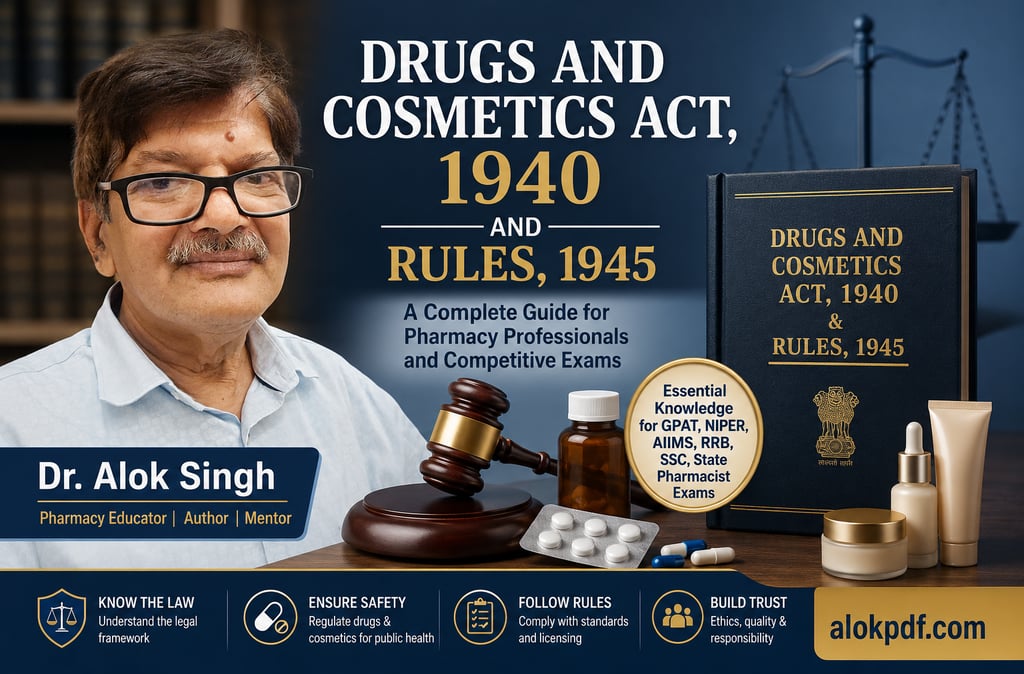
Drugs and Cosmetics Act, 1940 & Rules, 1945
Short, Easy-to-Remember Notes
The Drugs and Cosmetics Act, 1940 is the main legislation governing the import, manufacture, distribution and sale of drugs and cosmetics in India. The Drugs and Cosmetics Rules, 1945 provide detailed regulatory requirements. Always verify the latest amended provisions for current examinations.
1. Important Schedules — Quick Revision
Schedule Easy Memory Key Point
G G = Guidance needed Drugs requiring a cautionary statement regarding medical supervision
H H = Hospital prescription Prescription drugs
H1 H1 = H + Higher control Certain prescription drugs with additional record-keeping requirements
M M = Manufacturing GMP GMP requirements for pharmaceutical manufacturing
N N = Necessary pharmacy setup Minimum requirements for premises and equipment of a pharmacy
P P = Period Life period/shelf life of drugs
T T = Traditional GMP GMP requirements for Ayurvedic, Siddha and Unani medicines
U U = Units/records Manufacturing records and related documentation
V V = Value/standards Standards for patent or proprietary medicines
X X = Extra control Drugs under stringent prescription, sale, storage and record requirements
Y Y = New drugs Historically associated with new drug and clinical trial requirements
Sch. F F = Biologicals Requirements for biological and special products
Part XII-B B = Beauty Requirements relating to manufacture of cosmetics
Memory Trick:
"G H H1 → Prescription; M N → Manufacturing & Pharmacy; P → Period; T → Traditional; U → Units/Records; V → Proprietary; X → Extra control; Y → New drugs."
16. Important License Forms — Exam Revision
The exact form depends on the category of drug and nature of sale.
License/Form Broad Association
Form 20 Retail sale of specified drugs
Form 20-B Wholesale sale of specified drugs
Form 21 Retail sale of specified Schedule C/C(1) drugs
Form 21-B Wholesale sale of specified Schedule C/C(1) drugs
Restricted licenses Sale of specified drugs under prescribed restrictions
Exam Tip:
Do not memorize forms alone. Competitive exams often ask "Which form is used for retail/wholesale sale of a particular category?"
Drug Inspector
A Drug Inspector is an important enforcement officer under the regulatory system.
Major Functions:
Inspect licensed premises
Inspect manufacturing facilities
Inspect sale premises
Take statutory samples
Investigate complaints
Examine records
Detect violations
Initiate regulatory/legal action
Check compliance with license conditions
Assist in enforcement of the Act and Rules
Memory:
Drug Inspector = Inspect + Sample + Investigate + Enforce
Government Analyst
A Government Analyst is primarily concerned with analysis and examination of drug/cosmetic samples submitted according to statutory procedures.
Function:
Receives samples
Performs analysis
Determines compliance with prescribed standards
Issues analytical report
Memory:
Inspector collects → Analyst analyzes
Regulatory Authorities — One-Glance Revision
Authority Main Function
DTAB Technical advice
DCC: Uniformity in administration
CDL Central analytical/testing functions
Government Analyst Analysis of statutory samples
Licensing Authority Granting/regulating licenses
Controlling Authority Supervisory control
Drug Inspector Inspection, sampling and enforcement
Most Important Exam Comparisons
Schedule M vs Schedule N
M → Manufacturing GMP
N → Pharmacy premises/equipment
Schedule H vs H1 vs X
H → Prescription
H1 → Prescription + additional record control
X → Extra stringent controls
DTAB vs DCC
DTAB → Technical advice
DCC → Uniform administration
Drug Inspector vs Government Analyst
Inspector → Collects/inspects/investigates
Analyst → Analyzes/reports
Licensing Authority vs Controlling Authority
Licensing → Grants license
Controlling → Supervises/control
Drugs and Cosmetics Act, 1940 & Rules, 1945 — MCQs
1. A drug is required to be sold only on the prescription of a Registered Medical Practitioner and is subject to special record-keeping requirements under the Rules. Which Schedule is most directly relevant?
A. Schedule G
B. Schedule H
C. Schedule H1
D. Schedule X
Answer: C. Schedule H1
Explanation: Schedule H1 drugs are prescription medicines with additional controls, including specific record-keeping requirements. Schedule X drugs are also specially controlled but have distinct licensing and storage requirements.
2. Which of the following best differentiates Schedule H1 drugs from ordinary Schedule H drugs?
A. H1 drugs can be sold without prescription
B. H1 drugs require additional sale records to be maintained
C. H1 drugs are exclusively veterinary medicines
D. H1 drugs are exempt from labeling requirements
Answer: B. H1 drugs require additional sale records to be maintained
Explanation: Schedule H1 was introduced to strengthen control over certain drugs, particularly those associated with antimicrobial resistance and misuse. The supply must be recorded in a separate register with specified details.
3. Which Schedule primarily prescribes requirements relating to Good Manufacturing Practices (GMP) and requirements of premises and plant for pharmaceutical manufacturing?
A. Schedule M
B. Schedule N
C. Schedule P
D. Schedule U
Answer: A. Schedule M
Explanation: Schedule M deals with GMP requirements and requirements of premises, plant and equipment for pharmaceutical products. It is a critical schedule for manufacturing compliance.
4. A pharmacy wants to establish minimum requirements for premises and equipment necessary for the efficient functioning of a pharmacy. Which Schedule should be consulted?
A. Schedule M
B. Schedule N
C. Schedule T
D. Schedule U
Answer: B. Schedule N
Explanation: Schedule N specifies the minimum requirements of premises and equipment for the efficient running of a pharmacy.
5. Which Schedule is primarily associated with the life period or shelf life of drugs?
A. Schedule P
B. Schedule V
C. Schedule X
D. Schedule Y
Answer: A. Schedule P
Explanation: Schedule P specifies the life period of drugs, i.e., the period during which a drug is expected to retain its prescribed quality under specified storage conditions.
6. A manufacturer is reviewing the requirements for biological and special products, including standards relating to certain vaccines and sera. Which Schedule is particularly relevant?
A. Schedule C
B. Schedule F
C. Schedule T
D. Schedule U
Answer: B. Schedule F
Explanation: Schedule F contains requirements and standards for biological and special products. It is divided into different parts dealing with specific biological products and related requirements.
7. Schedule T is most closely associated with:
A. GMP requirements for Ayurvedic, Siddha and Unani medicines
B. GMP requirements for allopathic medicines
C. Clinical trials of new drugs
D. Requirements for retail pharmacies
Answer: A. GMP requirements for Ayurvedic, Siddha and Unani medicines
Explanation: Schedule T prescribes GMP requirements for Ayurvedic, Siddha and Unani drugs.
8. Which Schedule deals primarily with requirements for maintaining records and registers by manufacturers?
A. Schedule U
B. Schedule V
C. Schedule N
D. Schedule P
Answer: A. Schedule U
Explanation: Schedule U specifies requirements regarding manufacturing records and other records to be maintained by manufacturers.
9. A pharmaceutical company is examining the standards for patent or proprietary medicines. Which Schedule is most relevant?
A. Schedule V
B. Schedule Y
C. Schedule X
D. Schedule M
Answer: A. Schedule V
Explanation: Schedule V prescribes standards for patent or proprietary medicines.
10. Schedule X drugs are subject to more stringent controls primarily because they:
A. Are exclusively veterinary preparations
B. Have potential for abuse and require special control
C. Are always biological products
D. Are exempt from prescription requirements
Answer: B. Have potential for abuse and require special control
Explanation: Schedule X drugs are subject to stringent controls concerning sale, storage, prescription and record maintenance because of their potential for misuse or abuse.
11. Which statement concerning Schedule X drugs is most appropriate?
A. They may be sold by any retailer without a license
B. Their sale is subject to special licensing and record requirements
C. They are exempt from labeling requirements
D. They can be freely advertised to the public
Answer: B. Their sale is subject to special licensing and record requirements
Explanation: Schedule X drugs are subject to special regulatory controls, including licensing, prescription and record-keeping provisions.
12. Schedule Y is historically associated primarily with:
A. GMP
B. Clinical trials and requirements for new drugs
C. Pharmacy premises
D. Drug labeling colors
Answer: B. Clinical trials and requirements for new drugs
Explanation: Schedule Y historically prescribed requirements and guidelines related to clinical trials and approval of new drugs, including data requirements. Regulatory provisions have evolved over time under the New Drugs and Clinical Trials Rules.
13. Which of the following schedules is most directly associated with poisonous substances and cautionary labeling?
A. Schedule G
B. Schedule H
C. Schedule P
D. Schedule N
Answer: A. Schedule G
Explanation: Schedule G drugs require the prescribed cautionary statement indicating that they are dangerous to take except under medical supervision.
14. A label bears the statement: "Caution: It is dangerous to take this preparation except in accordance with the medical advice." This statement is characteristic of:
A. Schedule G
B. Schedule H
C. Schedule H1
D. Schedule X
Answer: A. Schedule G
Explanation: The prescribed cautionary statement is associated with Schedule G drugs.
15. Which statement is characteristic of Schedule H labeling?
A. "Schedule H prescription drug—Warning: To be sold by retail on the prescription of a Registered Medical Practitioner only."
B. "For external use only"
C. "Veterinary use only"
D. "Not to be sold individually"
Answer: A. Schedule H prescription drug—Warning: To be sold by retail on the prescription of a Registered Medical Practitioner only.
Explanation: Schedule H drugs carry the prescribed Schedule H warning and symbol and are sold by retail only on the prescription of a Registered Medical Practitioner, subject to the Rules.
16. Which additional warning is associated with Schedule H1 drugs?
A. The Schedule H1 symbol and prescribed cautionary warning
B. Only the word "Poison"
C. "For external use only"
D. No special warning is required
Answer: A. The Schedule H1 symbol and prescribed cautionary warning
Explanation: Schedule H1 drugs require specific labeling provisions in addition to the controls applicable to prescription drugs.
17. Which schedule is specifically linked to minimum requirements for the efficient running of a pharmacy?
A. Schedule M
B. Schedule N
C. Schedule P
D. Schedule U
Answer: B. Schedule N
Explanation: Schedule N covers the minimum requirements of premises and equipment for a pharmacy.
18. A drug manufacturer wants to verify the required batch manufacturing records, testing records and other manufacturing documentation. Which Schedule is the most relevant starting point?
A. Schedule U
B. Schedule N
C. Schedule X
D. Schedule G
Answer: A. Schedule U
Explanation: Schedule U contains requirements concerning manufacturing records and related documentation.
19. Which of the following is the best example of a restricted license?
A. License granted to a manufacturer to produce Schedule X drugs
B. License allowing sale of certain drugs to a person who does not employ a qualified person, subject to specified restrictions
C. License for clinical trials
D. License for importing narcotic drugs
Answer: B. License allowing sale of certain drugs to a person who does not employ a qualified person, subject to specified restrictions
Explanation: A restricted license may be granted for the sale or distribution of drugs under specified conditions, particularly where the full requirements for a regular retail license are not applicable.
20. Which license is primarily concerned with the sale of drugs by wholesale?
A. Form 20
B. Form 20-B
C. Form 21
D. Form 21-B
Answer: B. Form 20-B
Explanation: Form 20-B is associated with a wholesale license for drugs other than those specified in the relevant special categories. Different forms apply depending on the type of drug.
21. A retailer intends to sell drugs falling under Schedule C and C(1). Which license form is generally relevant?
A. Form 20
B. Form 20-F
C. Form 21
D. Form 21-B
Answer: C. Form 21
Explanation: Form 21 is associated with retail sale of drugs specified in Schedule C and C(1), subject to the applicable provisions.
22. Which of the following is the most appropriate distinction between wholesale and retail sale licensing?
A. Wholesale licenses are issued only to hospitals
B. Retail licenses permit sale directly to consumers under prescribed conditions
C. Retail licenses do not require compliance with storage conditions
D. Wholesale licenses permit unrestricted sale to the public
Answer: B. Retail licenses permit sale directly to consumers under prescribed conditions
Explanation: Retail and wholesale licenses differ in their scope of sale, premises, supervision and conditions. Both must comply with statutory requirements.
23. A person sells a drug without obtaining the required license under the Drugs and Cosmetics Rules. This is primarily an offence involving:
A. Unauthorized sale
B. Patent infringement
C. Trademark infringement only
D. Clinical trial violation only
Answer: A. Unauthorized sale
Explanation: Sale of drugs without the required license constitutes a violation of the Drugs and Cosmetics Act and Rules and may attract prosecution and penalties.
24. Which authority is primarily responsible for providing technical advice to the Central and State Governments on matters arising from administration of the Drugs and Cosmetics Act?
A. DCC
B. DTAB
C. CDL
D. CDSCO Licensing Cell
Answer: B. DTAB
Explanation: The Drugs Technical Advisory Board (DTAB) provides expert technical advice to the Central and State Governments on matters arising from the administration of the Act.
25. Which body is specifically constituted to secure uniformity throughout India in administration of the Drugs and Cosmetics Act?
A. DTAB
B. DCC
C. CDL
D. State Pharmacy Council
Answer: B. DCC
Explanation: The Drugs Consultative Committee (DCC) advises the Central Government, State Governments and DTAB with the objective of securing uniformity in the administration of the Act throughout India.
26. The Central Drugs Laboratory is primarily concerned with:
A. Granting retail licenses
B. Testing and analysis of drugs and cosmetics
C. Recruiting drug inspectors
D. Manufacturing all government medicines
Answer: B. Testing and analysis of drugs and cosmetics
Explanation: The Central Drugs Laboratory (CDL) functions as a central testing and analytical laboratory under the regulatory framework.
27. Which person is legally empowered to inspect licensed premises and investigate compliance with the Drugs and Cosmetics Act and Rules?
A. Government Analyst
B. Drug Inspector
C. DTAB member
D. Pharmacy Council Registrar
Answer: B. Drug Inspector
Explanation: A Drug Inspector is appointed by the appropriate government and performs statutory duties including inspection, sampling, investigation and enforcement.
28. A Drug Inspector collects a sample of a drug from a licensed premises. Which subsequent action is most appropriate?
A. The sample is discarded immediately
B. The sample is dealt with according to statutory sampling and analysis procedures
C. The retailer is allowed to destroy the sample
D. The inspector personally sells the sample
Answer: B. The sample is dealt with according to statutory sampling and analysis procedures
Explanation: Drug sampling is a formal statutory process. Samples are handled, sealed, documented and submitted for analysis according to prescribed procedures.
29. Which official is primarily responsible for analyzing samples submitted under the Act and issuing analytical reports?
A. Drug Inspector
B. Government Analyst
C. Licensing Authority
D. DTAB
Answer: B. Government Analyst
Explanation: The Government Analyst examines samples submitted in accordance with the Act and Rules and provides an analytical report.
30. Which of the following represents the correct functional pairing?
A. DTAB — Laboratory testing
B. CDL — Technical advisory function
C. DCC — Uniformity in administration
D. Drug Inspector — Formulation of GMP standards
Answer: C. DCC — Uniformity in administration
Explanation: The DCC's important role is to promote uniform administration of the Act. DTAB provides technical advice, CDL performs laboratory functions, and Drug Inspectors enforce regulatory provisions.
31. Which of the following is NOT normally a primary function of a Drug Inspector?
A. Inspecting licensed premises
B. Taking samples
C. Investigating suspected offences
D. Granting approval for new drug clinical trials
Answer: D. Granting approval for new drug clinical trials
Explanation: Drug Inspectors perform enforcement and inspection duties. Approval of new drugs and clinical trials falls under the appropriate regulatory framework and competent authorities, not the routine statutory function of a Drug Inspector.
32. The term "drug" under the Drugs and Cosmetics Act is significant because it includes:
A. Only chemical substances used internally
B. Medicines and specified substances/articles intended for diagnosis, treatment, mitigation or prevention of disease
C. Only prescription medicines
D. Only substances listed in Schedule H
Answer: B. Medicines and specified substances/articles intended for diagnosis, treatment, mitigation or prevention of disease
Explanation: The statutory definition of drug is broad and includes various substances and products intended for diagnosis, treatment, mitigation or prevention of disease or disorder.
33. Which of the following is a key objective of statutory drug labeling requirements?
A. To increase advertising appeal
B. To ensure identification, safe use and regulatory traceability
C. To eliminate the need for quality control
D. To permit unrestricted self-medication
Answer: B. To ensure identification, safe use and regulatory traceability
Explanation: Labeling requirements provide essential information such as identity, strength, batch details, manufacturing information, expiry and statutory warnings.
34. A manufacturer omits the batch number from the label of a drug where such information is required. The primary regulatory concern is:
A. Loss of brand recognition
B. Loss of traceability and batch identification
C. Increased therapeutic efficacy
D. Improved product stability
Answer: B. Loss of traceability and batch identification
Explanation: Batch numbers are essential for traceability, quality investigations, recalls and regulatory control.
35. Which information is generally essential for the identification and traceability of a manufactured drug?
A. Manufacturer's name and address
B. Batch/Lot number
C. Manufacturing and expiry details, where applicable
D. All of the above
Answer: D. All of the above
Explanation: Drug labels generally require several identification and traceability particulars, including manufacturer details, batch number and date-related information, subject to the specific product and applicable rules.
36. The term "Net Contents" on a drug label primarily indicates:
A. Amount of active ingredient only
B. Quantity of product contained in the package
C. Amount of impurity present
D. Shelf life of the product
Answer: B. Quantity of product contained in the package
Explanation: Net contents indicate the quantity or volume of product in the container, such as weight, volume or number of units, as applicable.
37. Which of the following would be most important when examining whether a cosmetic label complies with statutory requirements?
A. Ingredient declaration and prescribed labeling particulars
B. Celebrity endorsement
C. Social media popularity
D. Retailer's profit margin
Answer: A. Ingredient declaration and prescribed labeling particulars
Explanation: Cosmetic labeling is regulated to ensure product identification, ingredient information and consumer safety, in accordance with applicable rules.
38. The use of a permitted color in a drug or cosmetic is regulated primarily because:
A. All colors are pharmacologically active
B. Certain colors may present safety concerns and must meet prescribed standards
C. Colors determine the price of medicines
D. Colors replace active pharmaceutical ingredients
Answer: B. Certain colors may present safety concerns and must meet prescribed standards
Explanation: Only permitted colors meeting prescribed regulatory requirements may be used in drugs and cosmetics, subject to the applicable provisions.
39. Which of the following is the most appropriate regulatory principle regarding colors in pharmaceutical preparations?
A. Any industrial dye may be used
B. Only permitted colors satisfying prescribed standards may be used
C. Colors are never regulated
D. Colors can be used without declaration in every case
Answer: B. Only permitted colors satisfying prescribed standards may be used
Explanation: The Rules regulate the use of colors to minimize safety risks and ensure compliance with prescribed standards.
40. A drug is found to be not of standard quality during regulatory testing. Which statement is most accurate?
A. It automatically becomes a cosmetic
B. It may attract regulatory action and penalties under the Act
C. It can always be sold after relabeling
D. No action is possible if the brand is popular
Answer: B. It may attract regulatory action and penalties under the Act
Explanation: Manufacture or sale of drugs that fail prescribed standards can constitute an offence and may result in seizure, prosecution, license action and statutory penalties, depending on the circumstances.
41. Which offence generally attracts more serious regulatory consequences?
A. Manufacture or sale of adulterated or spurious drugs
B. Correct labeling of a drug
C. Maintenance of proper records
D. Compliance with GMP
Answer: A. Manufacture or sale of adulterated or spurious drugs
Explanation: Adulterated and spurious drugs pose significant public-health risks and therefore attract severe penalties under the Act.
42. The principal purpose of prescribing severe penalties for spurious drugs is to:
A. Encourage counterfeit manufacturing
B. Protect public health from fraudulent and unsafe products
C. Reduce pharmacy education
D. Increase drug advertising
Answer: B. Protect public health from fraudulent and unsafe products
Explanation: Spurious drugs may falsely represent their identity or manufacturer and can expose patients to serious risks. The Act therefore provides stringent enforcement provisions.
43. Which of the following is the most appropriate sequence in regulatory enforcement?
A. Complaint → Investigation → Sampling/Analysis → Legal action, where warranted
B. Advertisement → Manufacturing → Penalty
C. Penalty → Sampling → Investigation
D. Clinical trial → Retail sale → Inspection
Answer: A. Complaint → Investigation → Sampling/Analysis → Legal action, where warranted
Explanation: Regulatory enforcement generally follows a structured process involving inspection/investigation, statutory sampling and analysis, followed by appropriate action when violations are established.
44. Which body is best described as an expert advisory body rather than a routine enforcement authority?
A. Drug Inspector
B. Government Analyst
C. DTAB
D. Licensing Authority
Answer: C. DTAB
Explanation: DTAB is primarily a technical advisory body. Drug Inspectors enforce the Act, Government Analysts perform analysis, and Licensing Authorities handle licensing functions.
45. A question asks: "Which authority is responsible for issuing a license for the sale of drugs?" The most appropriate answer is:
A. Government Analyst
B. Licensing Authority
C. DTAB
D. Central Drugs Laboratory
Answer: B. Licensing Authority
Explanation: The Licensing Authority is empowered under the Rules to grant licenses for specified activities, subject to prescribed conditions.
46. Which of the following is the best conceptual distinction between a Licensing Authority and a Controlling Authority?
A. Licensing Authority grants licenses; Controlling Authority exercises supervisory control over licensing administration
B. Both perform exactly the same functions
C. Controlling Authority performs laboratory testing only
D. Licensing Authority performs clinical trials only
Answer: A. Licensing Authority grants licenses; Controlling Authority exercises supervisory control over licensing administration
Explanation: The Licensing Authority is responsible for granting licenses, while the Controlling Authority has a broader supervisory and regulatory role in the licensing system.
47. A manufacturer claims that because a product is sold as a "health supplement," the Drugs and Cosmetics Act can never apply. This claim is:
A. Always correct
B. Incorrect because statutory definitions and product classification determine applicability
C. Correct only for imported products
D. Correct only for cosmetics
Answer: B. Incorrect because statutory definitions and product classification determine applicability
Explanation: Regulatory applicability depends on the legal definition, composition, intended use and applicable regulatory framework, not merely the marketing name given to a product.
48. Which statement best describes the relationship between the Drugs and Cosmetics Act, 1940 and the Drugs and Cosmetics Rules, 1945?
A. The Act provides the primary statutory framework, while the Rules provide detailed regulatory provisions
B. The Rules override the Act
C. The Act applies only to cosmetics
D. The Rules apply only to medical devices
Answer: A. The Act provides the primary statutory framework, while the Rules provide detailed regulatory provisions
Explanation: The Act establishes the statutory framework, while the Rules prescribe detailed requirements concerning licensing, manufacture, sale, labeling, inspection and other regulatory matters.
49. Which Schedule is particularly important when examining GMP requirements for pharmaceutical manufacturing premises, plant and equipment?
A. Schedule M
B. Schedule N
C. Schedule U
D. Schedule X
Answer: A. Schedule M
Explanation: Schedule M is a core schedule for GMP and manufacturing premises, plant and equipment requirements.
50. Which of the following combinations is incorrect?
A. Schedule M — GMP
B. Schedule N — Pharmacy premises and equipment
C. Schedule P — Life period of drugs
D. Schedule Y — Retail sale license
Answer: D. Schedule Y — Retail sale license
Explanation: Schedule Y has historically dealt with new drugs and clinical trial-related requirements, not retail sale licensing.
51. Which combination is correctly matched?
A. Schedule H1 — Additional prescription-drug controls and record requirements
B. Schedule N — GMP for pharmaceutical manufacturers
C. Schedule U — Pharmacy premises
D. Schedule M — Life period of drugs
Answer: A. Schedule H1 — Additional prescription-drug controls and record requirements
Explanation: Schedule H1 drugs are subject to additional regulatory controls, including specific record-keeping requirements.
52. A Drug Inspector discovers that a retailer is selling a Schedule H1 drug but has failed to maintain the required sale records. The most appropriate regulatory concern is:
A. Violation of Schedule H1-related record requirements
B. Violation of Schedule M only
C. Violation of Schedule N only
D. No violation because the drug was sold legally
Answer: A. Violation of Schedule H1-related record requirements
Explanation: Even if the sale itself is made on a valid prescription, failure to maintain prescribed records for Schedule H1 drugs may constitute a regulatory violation.
53. Which of the following is the best examination-level distinction between Schedule H and Schedule X?
A. Schedule H is exclusively veterinary; Schedule X is human
B. Schedule X is subject to additional stringent controls regarding sale, prescription and record keeping
C. Schedule H drugs do not require prescriptions
D. Schedule X drugs are cosmetics
Answer: B. Schedule X is subject to additional stringent controls regarding sale, prescription and record keeping
Explanation: Both are controlled prescription categories, but Schedule X carries additional stringent regulatory requirements.
54. A drug inspector is investigating a suspected violation. Which evidence would be most directly useful for establishing the identity and traceability of a drug batch?
A. Batch number and manufacturing details
B. Color of the pharmacy walls
C. Retailer's personal opinion
D. Advertisement slogan
Answer: A. Batch number and manufacturing details
Explanation: Batch information enables investigators to establish product identity, manufacturer, production history and potential recall scope.
55. Which of the following statements regarding the Central Drugs Laboratory is most accurate?
A. It is primarily a retail licensing authority
B. It performs statutory analytical functions under the regulatory framework
C. It is the same as DTAB
D. It is responsible for appointing every Drug Inspector
Answer: B. It performs statutory analytical functions under the regulatory framework
Explanation: The Central Drugs Laboratory is an important analytical institution within India's drug regulatory system.
56. Which regulatory body is most directly concerned with promoting uniformity in the administration of drug laws among different states?
A. DCC
B. CDL
C. Government Analyst
D. Retail pharmacist
Answer: A. DCC
Explanation: The Drugs Consultative Committee plays a key role in achieving uniformity in the administration of the Act throughout India.
57. An analytical report issued by a Government Analyst indicates that a drug does not comply with the prescribed standard. The report is primarily relevant to:
A. Regulatory enforcement proceedings
B. Advertising approval only
C. Pharmacy admission
D. Patent registration only
Answer: A. Regulatory enforcement proceedings
Explanation: Government Analyst reports are important evidence in determining whether a drug complies with statutory quality standards and may support regulatory or legal action.
58. Which of the following is the most appropriate reason for requiring a Drug Inspector to follow prescribed sampling procedures?
A. To ensure the sample has evidentiary and analytical validity
B. To increase the retail price
C. To avoid laboratory testing
D. To permit uncontrolled disposal
Answer: A. To ensure the sample has evidentiary and analytical validity
Explanation: Proper sampling, sealing, documentation and handling help maintain the integrity and evidentiary value of samples used in regulatory proceedings.
59. A drug is manufactured in a facility that does not comply with prescribed GMP requirements. Which Schedule is most directly implicated?
A. Schedule M
B. Schedule P
C. Schedule V
D. Schedule X
Answer: A. Schedule M
Explanation: Schedule M establishes GMP requirements relating to pharmaceutical manufacturing.
60. Integrated Concept Question: A manufacturer produces a prescription drug in a facility that fails GMP requirements, sells it through an unauthorized channel, omits mandatory labeling particulars, and the product subsequently fails quality testing. Which statement best captures the regulatory situation?
A. Only labeling provisions are relevant
B. Multiple provisions concerning manufacture, sale, quality and labeling may be simultaneously implicated
C. Only the Pharmacy Act applies
D. No offence exists if the product is therapeutically effective
Answer: B. Multiple provisions concerning manufacture, sale, quality and labeling may be simultaneously implicated
Explanation: The Drugs and Cosmetics regulatory framework operates across multiple dimensions: manufacturing standards, licensing, sale, labeling, quality and enforcement. A single product may therefore give rise to multiple regulatory violations.
High-Yield Schedule Revision Table
Schedule Association
G Drugs requiring cautionary statement regarding medical supervision
H Prescription drugs
H1 Certain prescription drugs with additional controls and record requirements
M GMP; premises, plant and equipment for pharmaceutical manufacture
N Minimum requirements for premises and equipment of a pharmacy
P Life period/shelf life of drugs
T GMP for Ayurvedic, Siddha and Unani medicines
U Manufacturing records and related documentation
V Standards for patent or proprietary medicines
X Drugs subject to stringent controls, including special prescription, storage and record requirements
Y Historically associated with requirements for new drugs and clinical trials
Schedule F Biological and special products and related requirements
Part XII-B Requirements relating to the manufacture of cosmetics
Quick Memory Line
"G-H-H1 = Warnings & Prescription; M-N = Manufacturing & Pharmacy; P = Period; T = Traditional GMP; U = Units/Records; V = Proprietary; X = Extra Control; Y = New Drugs & Trials."
Exam Tip: For advanced competitive exams, do not memorize schedules in isolation. Questions often test paired concepts, such as Schedule M vs. N, Schedule H vs. H1 vs. X, DTAB vs. DCC, and Drug Inspector vs. Government Analyst vs. Licensing Authority. Also remember that regulatory requirements can be updated, so for an actual examination, the latest official version of the Drugs and Cosmetics Act/Rules and current regulatory rules should be consulted.
Dr Alok Singh