
Emulsification Theories and DLVO Theory MCQs
Practice high-yield Emulsification Theories and DLVO Theory MCQs for GPAT, NIPER, AIIMS, ESIC, SSC, DSSSB, HSSC, RRB, and Pharmacist recruitment exams. Includes monomolecular adsorption, multimolecular adsorption, film theory, Pickering emulsions, creaming, coalescence, breaking, and phase inversion
Dr. Alok Singh
5/17/202625 min read
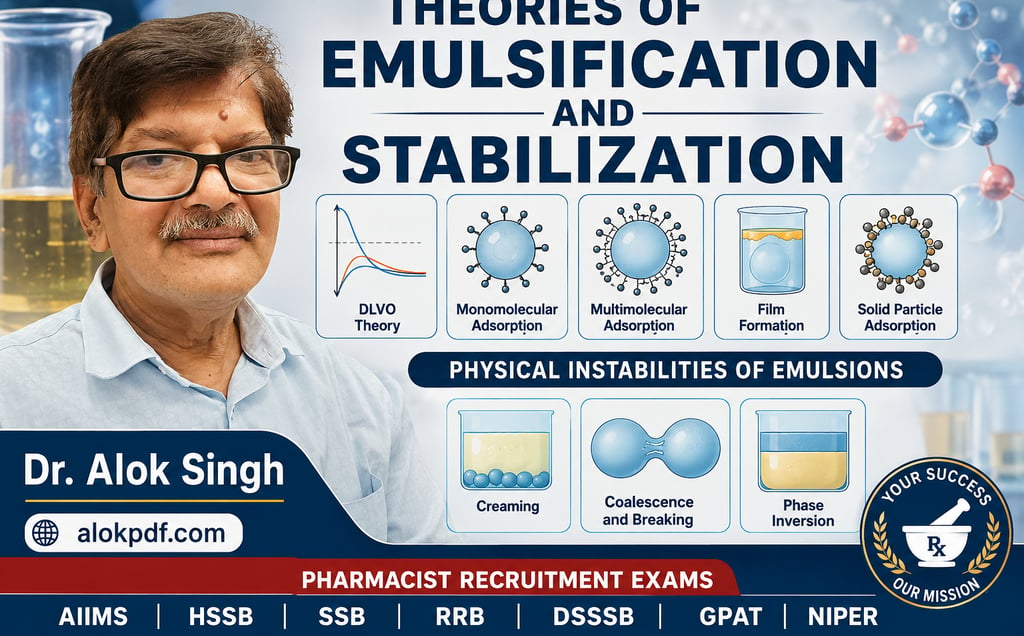
Theories of emulsification and stabilization (DLVO Theory, monomolecular adsorption, multimolecular adsorption, Film formation, and solid particle adsorption). Physical instabilities of emulsions (creaming, coalescence and breaking, and phase inversion).
Theories of Emulsification and Stabilization
Emulsions are thermodynamically unstable systems, so they require emulsifying agents to reduce interfacial tension and provide stability. Several theories explain how emulsifiers stabilize emulsions:
1. DLVO Theory
DLVO theory explains stability in terms of the balance between attractive (van der Waals) and repulsive (electrostatic) forces between dispersed droplets.
If repulsion dominates, = the Emulsion remains stable
If attraction dominates, = Droplets aggregate and destabilize
This theory is widely used to understand the stability of colloidal and emulsion systems in pharmaceutical systems.
2. Monomolecular Adsorption Theory
According to this theory, emulsifying agents (like surfactants) form a single molecular layer at the oil–water interface.
Hydrophilic head faces aqueous phase
Lipophilic tail faces oil phase
This monolayer reduces interfacial tension and prevents droplet coalescence.
3. Multimolecular Adsorption Theory
Here, emulsifiers (such as hydrophilic colloids like gelatin or acacia) form a multilayered film around dispersed droplets.
A thick adsorption layer increases steric stabilization
Prevents droplets from coming close enough to merge
4. Film Formation Theory
This theory suggests that emulsifying agents form a continuous, coherent film at the interface.
Film acts as a mechanical barrier
Prevents droplet fusion and coalescence
Can be rigid (solid-like) or flexible, depending on emulsifier type
5. Solid Particle Adsorption (Pickering Emulsions)
Finely divided solid particles (e.g., clays, silica) adsorb at the oil–water interface.
Particles form a rigid protective layer around droplets
Strongly prevent coalescence
Used in pharmaceutical and cosmetic formulations
Physical Instabilities of Emulsions
Emulsions undergo several physical changes during storage, which affect their quality and performance:
1. Creaming
Upward movement of dispersed droplets due to the density difference
Reversible on shaking
Does not involve a droplet size change
2. Coalescence
Fusion of droplets into larger droplets
Leads to permanent instability
Eventually causes phase separation
3. Breaking (Cracking)
Complete separation of oil and water phases
Irreversible process
Emulsion cannot be restored easily
4. Phase Inversion
Dispersed phase and continuous phase interchange
Example: oil-in-water (O/W) becomes water-in-oil (W/O)
Can be induced by a change in emulsifier concentration, temperature, or phase volume ratio
1. According to DLVO theory, stability of an emulsion is mainly due to:
A. Increase in viscosity
B. Balance between attractive and repulsive forces
C. Reduction in interfacial tension only
D. Sedimentation equilibrium
Answer: B Balance between attractive and repulsive forces
According to the DLVO Theory, the stability of an emulsion is mainly due to the balance between van der Waals attractive forces and electrostatic repulsive forces between dispersed droplets.
VTotal = VAttractive + VRepulsive
Explanation:
Attractive forces tend to bring droplets together, causing flocculation/coalescence.
Repulsive forces prevent droplets from coming close enough to aggregate.
A stable emulsion exists when repulsive forces are sufficiently high to overcome attractive forces.
Why are other options incorrect?
A. Increase in viscosity → Helps reduce creaming but is not the basis of DLVO theory.
C. Reduction in interfacial tension only → Important for emulsification, not the main DLVO stabilization mechanism.
D. Sedimentation equilibrium → Related to suspensions, not DLVO stabilization of emulsions.
2. In DLVO theory, the repulsive force between dispersed droplets arises mainly because of:
A. Van der Waals attraction
B. Brownian movement
C. Electrical double layer
D. Density difference
Answer: C
Correct Answer: C. Electrical double layer
According to the DLVO theory (Derjaguin–Landau–Verwey–Overbeek theory), the stability of emulsions and colloidal dispersions depends on the balance between:
Attractive Van der Waals forces
Repulsive electrostatic forces
The repulsive force arises mainly due to the formation of an electrical double layer around dispersed droplets or particles. When droplets acquire the same surface charge, they repel each other, preventing aggregation and coalescence.
This electrostatic repulsion increases the stability of the emulsion or colloidal system.
Why Other Options Are Incorrect
A. Van der Waals attraction.
Van der Waals forces are attractive forces, not repulsive.
They tend to pull droplets or particles together, promoting:
Flocculation
Aggregation
Coalescence
In DLVO theory, these forces oppose stability.
B. Brownian movement
Brownian movement refers to the random motion of particles due to collisions with solvent molecules.
It helps keep small particles suspended but does not create the repulsive force described in DLVO theory.
D. Density difference
Density differences affect:
Sedimentation
Creaming
as explained by Stokes’ law, but it is unrelated to electrostatic repulsion between droplets.
GPAT Tip
Remember this simple association:
DLVO theory = Attraction vs Repulsion
Repulsion = Electrical double layer
Attraction = Van der Waals forces
A stable dispersion exists when repulsive forces exceed attractive forces.
3. Which of the following attractive force is considered in the DLVO theory?
A. Osmotic pressure
B. Electrostatic force
C. Van der Waals force
D. Hydrogen bonding
Answer: C. Van der Waals force
According to the DLVO theory, the stability of colloidal dispersions and emulsions depends on the balance between:
Attractive Van der Waals forces
Repulsive electrostatic forces (electrical double layer)
The Van der Waals force is the primary attractive force considered in DLVO theory. These forces pull particles or droplets toward each other and may lead to:
Flocculation
Aggregation
Coalescence
if not opposed by sufficient electrostatic repulsion.
Why Other Options Are Incorrect
A. Osmotic pressure
Osmotic pressure is related to solvent movement across semipermeable membranes and is not one of the principal forces in DLVO theory.
B. Electrostatic force
Electrostatic force in DLVO theory is mainly repulsive, arising from the electrical double layer around particles.
The question asks specifically for the attractive force.
D. Hydrogen bonding
Hydrogen bonding may contribute to intermolecular interactions in some systems, but it is not the primary attractive force described in classical DLVO theory.
Exam Tip
Memorize the DLVO theory as
V = Van der Waals = Attraction
E = Electrical double layer = Repulsion
A colloidal system remains stable when:
Repulsive force > Attractive force
Frepulsive > Fattractive
4. Monomolecular adsorption theory of emulsification says that emulsifying agents:
A. Increase zeta potential only
B. Increase density of external phase
C. Form rigid films around globules
D. Reduce interfacial tension by forming a monolayer
Answer: D. Reduce interfacial tension by forming a monolayer
According to the Monomolecular Adsorption Theory, emulsifying agents orient themselves at the oil–water interface and form a single molecular layer (monolayer) around dispersed droplets.
This monolayer:
Reduces interfacial tension
Facilitates dispersion of one liquid into another
Helps stabilize the emulsion
Surface-active agents (surfactants) such as soaps and detergents commonly act by this mechanism.
Why Other Options Are Incorrect
A. Increase zeta potential only
Some emulsifying agents may increase zeta potential, producing electrostatic repulsion, but this is not the main basis of monomolecular adsorption theory.
The key concept is:
Adsorption at interface
Reduction of interfacial tension
B. Increase density of external phase
Density modification is unrelated to monomolecular adsorption theory.
Density differences mainly influence:
Creaming
Sedimentation
rather than emulsification mechanism.
C. Form rigid films around globules
Formation of a rigid or multimolecular film is explained by:
Multimolecular adsorption theory
Film formation theory
using hydrophilic colloids such as acacia or gelatin.
Monomolecular theory specifically involves a single molecular layer, not a rigid thick film.
Exam Tip
Quick comparison of emulsification theories:
Theory Main Mechanism
Monomolecular adsorption Monolayer formation & reduced interfacial tension
Multimolecular adsorption Thick flexible film around droplets
Solid particle adsorption Solid particles form a protective barrier
DLVO theory Balance of attractive & repulsive forces
Important keyword:
“Surfactant = Monolayer = Reduced interfacial tension."
γo/w↓
5. Which agent acts by monomolecular adsorption?
A. Bentonite
B. Gelatin
C. Acacia
D. Tweens
Answer: D. Tweens
Tween agents are surface-active agents (surfactants) that stabilize emulsions by the monomolecular adsorption theory.
They adsorb at the oil–water interface to form a monolayer. Thereby, reducing interfacial tension promotes emulsion stability.
Examples are:
Tween 20
Tween 80
These are commonly used nonionic emulsifying agents in pharmaceutical emulsions.
Why Other Options Are Incorrect
A. Bentonite
Bentonite acts mainly by the solid particle adsorption theory.
Fine solid particles accumulate at the interface and form a protective mechanical barrier around droplets.
B. Gelatin
Gelatin is a hydrophilic colloid that stabilizes emulsions by forming a multimolecular film around droplets.
It does not act by monomolecular adsorption.
C. Acacia
Acacia also acts mainly by multimolecular adsorption (film formation).
It forms a strong, flexible protective film around dispersed globules.
EXAM Tip
Remember this shortcut:
Emulsifying Agent Main Theory
Tweens / Spans Monomolecular adsorption
Acacia / Gelatin Multimolecular film
Bentonite / Veegum Solid particle adsorption
Memory trick:
“Surfactants form single layers.”
6. Multimolecular adsorption theory states the formation of:
A. Monolayer film
B. Electrical double layer only
C. Multilayer hydrophobic coating
D. Hydrated lyophilic film around droplets
Answer: D. Hydrated lyophilic film around droplets
According to the Multimolecular Adsorption Theory, hydrophilic colloids (lyophilic colloids) such as:
Acacia
Gelatin
Tragacanth
form a thick hydrated multimolecular film around dispersed droplets.
This film:
Prevents coalescence
Provides mechanical stability
Enhances emulsion stability
The protective layer is lyophilic and hydrated, which is the key feature of this theory.
Why Other Options Are Incorrect
A. Monolayer film
A monolayer film is characteristic of the Monomolecular Adsorption Theory, mainly produced by surfactants such as:
Tween
Spans
B. Electrical double layer only
Electrical double layer formation is related to DLVO theory and electrostatic stabilization, not multimolecular adsorption theory.
C. Multilayer hydrophobic coating
The film formed is actually hydrophilic (lyophilic) and hydrated, not hydrophobic.
This hydrated character helps stabilize the emulsion.
Exam Tip
Memory Tip:
Theory Main Feature
Monomolecular adsorption Single molecular layer
Multimolecular adsorption Thick hydrated lyophilic film
Solid particle adsorption Solid particle barrier
DLVO theory Electrostatic repulsion vs Van der Waals attraction
Memory trick:
“Hydrophilic colloids form hydrated films.”
7. Which emulsifying agent stabilizes an emulsion by multimolecular adsorption?
A. Span 80
B. Acacia
C. Sodium lauryl sulfate
D. Magnesium hydroxide
Answer: B. Acacia
Acacia stabilizes emulsions by the Multimolecular Adsorption Theory.
Acacia is a hydrophilic colloid that forms a:
Thick
Hydrated
Multimolecular protective film
around dispersed droplets, preventing coalescence and improving emulsion stability.
Why Other Options Are Incorrect
A. Span 80
Span 80 is a surface-active agent (surfactant).
It acts mainly by:
Monomolecular adsorption
Reduction of interfacial tension
not by multimolecular film formation.
C. Sodium lauryl sulfate
Sodium lauryl sulfate is also a surfactant acting by
Monomolecular adsorption theory
It forms a monolayer at the interface.
D. Magnesium hydroxide
Magnesium hydroxide is not a typical multimolecular film-forming emulsifying agent.
Finely divided solids may sometimes stabilize emulsions by solid particle adsorption, but magnesium hydroxide is not the standard answer here.
Exam Tip
Remember these classic associations:
Agent Type Example Theory
Surfactants: Tween, Span, SLS Monomolecular adsorption
Hydrophilic colloids: Acacia, Gelatin Multimolecular adsorption
Finely divided solids: Bentonite, Veegum Solid particle adsorption
Memory Trick:
“Acacia forms a hydrated protective film.”
8. Name the film formed in the multimolecular adsorption theory
A. Crystalline
B. Electrically neutral
C. Hydrated and flexible
D. Weak and non-hydrated
Answer: C. Hydrated and flexible
In the Multimolecular Adsorption Theory, hydrophilic colloids such as
Acacia
Gelatin
form a hydrated, flexible, multimolecular film around dispersed droplets.
This film:
Protects droplets from coalescence
Provides mechanical stability
Enhances emulsion stability
The hydrated nature of the film is very important because it improves compatibility with the continuous aqueous phase.
Why Other Options Are Incorrect
A. Crystalline
The protective film is colloidal and hydrated, not crystalline.
Crystalline structures are not involved in this emulsification mechanism.
B. Electrically neutral
The theory mainly emphasizes the formation of a hydrated protective film, not electrical neutrality.
Electrostatic effects are more closely associated with DLVO theory.
D. Weak and non-hydrated
The film is actually
Strong enough to prevent coalescence
Hydrated
Flexible
Non-hydrated films would not provide effective stabilization.
Exam Tip
Key phrase to memorize:
“Hydrophilic colloids form hydrated flexible films.”
Remember association:
Theory Film Type
Monomolecular adsorption Thin monolayer
Multimolecular adsorption Hydrated flexible film
Solid particle adsorption Rigid particulate barrier
9. Finely divided solids have the property to stabilize emulsions by:
A. Causing coalescence
B. Increasing density
C. Reducing viscosity
D. Forming a mechanical barrier at the interface
Answer: D
Correct Answer: D. Forming a mechanical barrier at the interface
Finely divided solids stabilize emulsions according to the Solid Particle Adsorption Theory.
Examples include:
Bentonite
Magnesium hydroxide
Veegum
These finely divided particles adsorb at the oil–water interface and form a rigid mechanical barrier around droplets. This barrier prevents:
Coalescence
Aggregation of droplets
thereby increasing emulsion stability.
Why Other Options Are Incorrect
A. Causing coalescence
Coalescence means fusion of droplets, which leads to emulsion breakdown.
Emulsifying agents work to prevent coalescence, not promote it.
B. Increasing density
Density changes may influence creaming or sedimentation but are not the primary stabilization mechanism of finely divided solids.
C. Reducing viscosity
In many cases, stabilizers actually increase viscosity to improve stability.
The key mechanism here is interfacial barrier formation, not viscosity reduction.
Exam Tip
Remember emulsification theories:
Theory Mechanism Common Agents
Monomolecular adsorption Monolayer formation Tween, Span
Multimolecular adsorption Hydrated flexible film Acacia, Gelatin
Solid particle adsorption Mechanical barrier Bentonite, Veegum
Memory trick:
“Fine solids form a rigid shield around droplets.”
10. Which one acts as a solid particle emulsifying agent?
A. Ethanol
B. Tween 80
C. Bentonite
D. Propylene glycol
Answer: C. Bentonite
Bentonite acts as a solid particle emulsifying agent.
According to the Solid Particle Adsorption Theory, finely divided solid particles adsorb at the oil–water interface and form a protective mechanical barrier around droplets, preventing coalescence and improving emulsion stability.
Bentonite is a classic example used in pharmaceutical emulsions.
Why Other Options Are Incorrect
A. Ethanol
Ethanol is mainly used as:
Solvent
Co-solvent
Preservative aid
It is not a solid particle emulsifying agent.
B. Tween 80
Tween 80 is a surfactant that acts by:
Monomolecular adsorption
Reduction of interfacial tension
not by solid particle adsorption.
D. Propylene glycol
Propylene glycol is commonly used as:
Solvent
Humectant
Co-solvent
It does not stabilize emulsions via solid particle adsorption.
Exam Tip
Classification:
Emulsifying Agent Type of Stabilization
Tween / Span Monomolecular adsorption
Acacia / Gelatin Multimolecular adsorption
Bentonite / Veegum Solid particle adsorption
Memory trick:
“Bentonite builds a solid protective wall.”
11. Which one stabilizes Pickering emulsions?
A. Alcohols
B. Hydrophilic colloids
C. Synthetic surfactants
D. Finely divided solid particles
Answer: D. Finely divided solid particles
Pickering emulsions are emulsions stabilized by finely divided solid particles adsorbed at the oil–water interface.
Examples of such stabilizing agents include:
Bentonite
Veegum
Magnesium hydroxide
Silica particles
These particles form a rigid mechanical barrier around droplets and prevent coalescence.
Why Other Options Are Incorrect
A. Alcohols
Alcohols mainly act as:
Solvents
Co-solvents
Preservatives (some cases)
They do not stabilize Pickering emulsions.
B. Hydrophilic colloids
Hydrophilic colloids such as:
Acacia
Gelatin
stabilize emulsions by multimolecular adsorption, not Pickering stabilization.
C. Synthetic surfactants
Synthetic surfactants like:
Tween 80
Sodium lauryl sulfate
act mainly by monomolecular adsorption and reduction of interfacial tension.
Exam Tip
Important association:
Emulsion Type Stabilizing Agent
Pickering emulsion Finely divided solid particles
Conventional surfactant emulsion Surface-active agents
Memory trick:
“Pickering emulsions pick solid particles for stability.”
12. In the film emulsification theory, emulsifying agents act on:
A. On Electrical barrier only
B. On sediment droplets
C. On micelles in continuous phase only
D. On a coherent interfacial film around droplets
Answer: D
Correct Answer: D. On a coherent interfacial film around droplets
According to the Film Emulsification Theory, emulsifying agents form a coherent, continuous interfacial film around dispersed droplets.
This protective film:
Surrounds the droplets
Prevents coalescence
Improves emulsion stability
The film acts as a mechanical barrier between dispersed globules.
Common film-forming emulsifying agents include:
Acacia
Gelatin
Why Other Options Are Incorrect
A. On electrical barrier only ❌
Electrical barriers are mainly related to:
Electrical double layer
Zeta potential
DLVO theory
Film theory specifically emphasizes formation of an interfacial film.
B. On sediment droplets ❌
Sedimentation is related to suspensions and density differences, not the primary mechanism of emulsification film theory.
C. On micelles in continuous phase only ❌
Micelles may form in surfactant systems above critical micelle concentration, but film emulsification theory focuses on the interfacial film surrounding droplets, not only micelles in bulk phase.
Exam Tip
Remember the major emulsification theories:
Theory Main Stabilizing Mechanism
Monomolecular adsorption Monolayer at interface
Multimolecular adsorption Hydrated flexible film
Film theory Coherent interfacial film
Solid particle adsorption Mechanical particulate barrier
Memory trick:
“Film theory = protective coat around droplets.”
13. Which one is NOT an emulsion stabilization mechanism?
A. Electrostatic repulsion
B. Formation of interfacial film
C. Reduction of interfacial tension
D. Increase in gravitational force
Answer: D. Increase in gravitational force
An increase in gravitational force does not stabilize an emulsion. Instead, it promotes instability phenomena such as:
Creaming
Sedimentation
Phase separation
A greater gravitational effect increases the tendency of droplets to separate based on density differences.
Why Other Options Are Correct Stabilization Mechanisms
A. Electrostatic repulsion
Electrostatic repulsion arises from the electrical double layer around droplets.
It prevents droplets from coming together and is explained by DLVO theory.
B. Formation of interfacial film
Emulsifying agents such as
Acacia
Gelatin
form a protective interfacial film around droplets, preventing coalescence.
C. Reduction of interfacial tension
Surfactants such as:
Tween 80
Sodium lauryl sulfate
reduce interfacial tension and facilitate stable emulsion formation.
γo/w↓
Exam Tip
Stable emulsions are favored by:
Low interfacial tension
Protective interfacial films
Electrostatic repulsion
Increased viscosity
Instability increases with:
Gravity effects
Coalescence
Creaming
Flocculation
Memory trick:
“Gravity separates; emulsifiers stabilize.”
14. Creaming in emulsions is
A. Globules fusion
B. Permanent phase separation
C. Chemical degradation of emulsifier
D. Reversible separation of dispersed phase
Answer: D
Correct Answer: D. Reversible separation of dispersed phase
Creaming is the reversible separation of the dispersed phase in an emulsion due to density differences between the two phases.
In creaming:
Droplets concentrate either at the top or bottom
The droplets do not fuse together
Shaking can usually redistribute the droplets uniformly
Thus, creaming does not destroy the emulsion permanently.
Why Other Options Are Incorrect
A. Globules fusion
Fusion of globules is called coalescence, not creaming.
Coalescence leads to larger droplets and eventual emulsion breakdown.
B. Permanent phase separation
Permanent phase separation is known as:
Cracking
Breaking
This is irreversible, unlike creaming.
C. Chemical degradation of emulsifier
Chemical degradation may destabilize emulsions but is not the definition of creaming.
Creaming is mainly a physical instability caused by density differences.
Exam Tip
Important distinction:
Phenomenon Reversible or Irreversible
Creaming Reversible
Flocculation Reversible
Coalescence Irreversible
Cracking/Breaking Irreversible
Memory trick:
“Creaming can be corrected by shaking.”
15. The reason for creaming in an emulsion is
A. Oil oxidation
B. Emulsifier Hydrolysis
C. Increase in zeta potential
D. Difference in density between phases
Answer: D. Difference in density between phases
Creaming occurs because of the difference in density between the dispersed phase and the continuous phase of an emulsion.
If oil droplets are lighter than the aqueous phase, they rise upward (upward creaming).
If dispersed particles are heavier, they settle downward (sedimentation).
Creaming is explained by Stokes’ law.
v=2r²(d₁−d₂)g/9η
From the equation:
Greater density difference (d1 - d2) = faster creaming
Larger droplet size = faster creaming
Higher viscosity = slower creaming
Why Other Options Are Incorrect
A. Oil oxidation
Oil oxidation causes
Rancidity
Off-odor
Chemical degradation
but it is not the primary cause of creaming.
B. Emulsifier hydrolysis
Hydrolysis of emulsifiers may destabilize emulsions chemically, but creaming mainly results from density differences and gravitational separation.
C. Increase in zeta potential
Higher zeta potential generally improves emulsion stability by increasing electrostatic repulsion between droplets.
It helps prevent aggregation rather than causing creaming.
GPAT Tip
Important point:
Creaming is reversible
Coalescence/cracking is irreversible
Ways to reduce creaming:
Reduce droplet size
Increase viscosity
Minimize density difference
Memory trick:
“Density difference drives creaming.”
16. In Stokes’ law, the creaming rate is directly proportional to:
A. Medium Viscosity
B. Temperature
C. Radius of globules squared
D. Density of dispersed phase only
Answer: C. Radius of globules squared
According to Stokes’ law, the creaming or sedimentation rate of dispersed globules is
From the equation: v ∝ r²
Thus, the creaming rate is directly proportional to the square of the globule radius.
Larger droplets cream much faster than smaller droplets do.
Why Other Options Are Incorrect
A. Medium viscosity
The creaming rate is inversely proportional to viscosity.
Higher viscosity slows down globule movement and reduces creaming.
B. Temperature
Temperature is not directly included in the classical Stokes’ law equation, though it may indirectly affect viscosity.
D. Density of dispersed phase only
The law depends on the difference in density between dispersed and continuous phases, not the dispersed phase density alone.
GPAT Tip
To reduce creaming:
Reduce globule size
Increase viscosity
Minimize density difference
Memory trick:
“Big droplets cream faster.”
Very high-yield Stokes’ law point: Creaming rate ∝ r²
17. The creaming rate decreases if:
A. Particle size increases
B. Temperature increases
C. Density difference increases
D. Viscosity of external phase increases
Answer: D. Viscosity of the external phase increases
According to Stokes’ law:
v=2r²(d₁−d₂)g/9η
where:
(v) = creaming rate
(r) = radius of globules
(d1 - d2) = density difference
η (eta) = viscosity of external phase
The equation shows that the creaming rate is inversely proportional to viscosity.
Therefore:
Higher viscosity = slower droplet movement
Lower viscosity = faster creaming
Hence, increasing the viscosity of the external phase decreases creaming.
Why Other Options Are Incorrect
A. Particle size increases The creaming rate is directly proportional to the square of the
particle radius.
Larger particles cream faster, not slower.
B. Temperature increases
An increase in temperature generally lowers viscosity, which may actually increase the creaming rate.
C. Density difference increases
A greater density difference between phases increases gravitational separation and therefore increases the creaming rate.
GPAT Tip
Ways to minimize creaming:
Decrease globule size
Increase viscosity
Reduce density difference
Common viscosity enhancers:
Acacia
Tragacanth
Methylcellulose
Memory trick:
“Thicker medium = slower creaming.”
18. The equation associated with the creaming of emulsions is:
A. Arrhenius equation
B. Stokes’ law
C. Henderson equation
D. Noyes–Whitney equation
Answer: B. Stokes’ law
The phenomenon of creaming in emulsions is explained by Stokes’ law. It describes the settling or rising velocity of dispersed particles/globules under gravity.
This equation shows that cream increases with
Larger globule size
Greater density difference
and decreases with:
Higher viscosity
Why Other Options Are Incorrect
A. Arrhenius equation
The Arrhenius equation relates:
Temperature
Rate constant of chemical reactions
It is not related to creaming of emulsions.
C. Henderson equation
The Henderson–Hasselbalch equation is used for:
Buffer calculations
pH determination
not emulsion stability.
D. Noyes–Whitney equation
The Noyes-Whitney equation describes
Drug dissolution rate
not creaming behavior.
Exam Tip
Very important association:
Equation Application
Stokes’ law Creaming / sedimentation
Arrhenius equation Reaction kinetics
Henderson–Hasselbalch Buffer pH
Noyes–Whitney Dissolution rate
Memory trick:
“Stokes controls settling and creaming.”
19. Coalescence means
A. Reduction in droplet size
B. Sedimentation of particles
C. Reversible aggregation of droplets
D. Fusion of droplets to form larger droplets
Answer: D. Fusion of droplets to form larger droplets
Coalescence is the process in which small dispersed droplets merge or fuse together to form larger droplets.
This occurs when the protective interfacial film around droplets breaks down, leading to emulsion instability.
Coalescence may eventually result in:
Cracking
Breaking of emulsion
Permanent phase separation
Why Other Options Are Incorrect
A. Reduction in droplet size
Coalescence causes an increase in droplet size, not a reduction.
B. Sedimentation of particles
Sedimentation refers to the settling of heavier particles under gravity, mainly seen in suspensions.
It is different from droplet fusion in emulsions.
C. Reversible aggregation of droplets
Reversible aggregation without fusion is called flocculation.
In flocculation:
Droplets cluster together
Individual droplet identity remains intact
In coalescence, droplets permanently fuse.
GPAT Tip
Important distinction:
Phenomenon Nature
Flocculation Reversible Aggregation
Coalescence Fusion of Droplets
Creaming Reversible Phase Concentration
Cracking Complete Irreversible Separation
Memory trick:
“Coalescence = Combine into larger droplets.”
20. Cracking (breaking) of emulsion means
A. Increase in viscosity
B. Temporary creaming
C. Reversible separation
D. Irreversible phase separation
Answer: D. Irreversible phase separation
Cracking or breaking of an emulsion refers to the irreversible separation of the emulsion into two distinct phases.
In cracked emulsions:
The dispersed droplets coalesce completely
The original emulsion cannot be restored by simple shaking
The emulsifying film is permanently destroyed
This represents complete emulsion failure.
Why Other Options Are Incorrect
A. Increase in viscosity
An increase in viscosity generally improves emulsion stability and reduces creaming.
It is not the definition of cracking.
B. Temporary creaming
Creaming is a reversible instability where droplets concentrate at the top or bottom but remain separate.
Shaking can usually redisperse the emulsion.
C. Reversible separation
Cracking is irreversible, not reversible.
Reversible separation is characteristic of creaming or flocculation.
21. Which instability precedes the emulsion's cracking?
A. Creaming
B. Flocculation
C. Coalescence
D. Ostwald ripening
Answer: C. Coalescence
Cracking (breaking) of an emulsion is usually preceded by coalescence.
In coalescence:
The protective film around droplets breaks down
Small droplets fuse to form larger droplets
Continuous fusion ultimately causes complete phase separation (cracking)
Thus, coalescence is a major step leading to irreversible emulsion breakdown.
Why Other Options Are Incorrect
A. Creaming
Creaming is only a reversible concentration of droplets due to density differences.
Although prolonged creaming may increase the chance of coalescence, creaming itself does not directly mean cracking.
B. Flocculation
Flocculation is a reversible aggregation where droplets remain distinct.
No fusion occurs in flocculation.
D. Ostwald ripening
Ostwald ripening involves the growth of larger droplets at the expense of smaller ones due to solubility differences.
It may destabilize emulsions over time, but it is not the classic immediate precursor to cracking.
GPAT Tip
The sequence of emulsion instability is often remembered as
Creaming = Coalescence = Cracking
Instability Key Feature
Creaming Droplets concentrate
Flocculation Loose aggregation
Coalescence Droplet fusion
Cracking Permanent separation
Memory trick:
“Fusion of droplets finally breaks the emulsion.”
22. Phase inversion means:
A. Hydrolysis of emulsifier
B. Creaming of dispersed phase
C. Change from o/w to w/o or vice versa
D. Conversion of emulsion into suspension
Answer: C. Change from o/w to w/o or vice versa
Phase inversion is the process in which an emulsion changes from:
Oil-in-water (o/w) to water-in-oil (w/o)
or
Water-in-oil (w/o) to oil-in-water (o/w)
This occurs when the dispersed phase and continuous phase interchange.
Common causes include:
Change in phase volume ratio
Addition of electrolytes
Temperature change
Change in emulsifying agent
Why Other Options Are Incorrect
A. Hydrolysis of emulsifier
Hydrolysis may degrade the emulsifier and destabilize the emulsion, but it does not define phase inversion.
B. Creaming of dispersed phase
Creaming is only an upward or downward movement of droplets due to density differences.
It does not involve an interchange of internal and external phases.
D. Conversion of emulsion into suspension
An emulsion contains liquid droplets dispersed in another liquid, whereas a suspension contains solid particles dispersed in a liquid.
Phase inversion does not convert an emulsion into a suspension.
GPAT Tip 🎯
Remember:
Emulsion Type Dispersed Phase Continuous Phase
o/w Oil Water
w/o Water Oil
Phase inversion = exchange of phases
Memory trick:
“Internal phase becomes external.”
23. Which one induces phase inversion?
A. Addition of preservatives
B. Low temperature only
C. Reduction in globule size only
D. Excessive internal phase volume
Answer: D. Excessive internal phase volume
Phase inversion occurs when an emulsion changes from
Oil-in-water (o/w) to water-in-oil (w/o)
or vice versa.
One of the most common causes is an excessive volume of the internal (dispersed) phase. When the dispersed phase becomes too concentrated. The existing continuous phase can no longer accommodate it. This causes the phases to interchange.
Why Other Options Are Incorrect
A. Addition of preservatives
Preservatives are added to prevent microbial growth. Generally, they do not cause phase inversion.
B. Low temperature only
Temperature changes can influence some emulsions. Especially those containing nonionic surfactants. But “low temperature only” is not a standard that causes phase inversion.
C. Reduction in globule size only
Smaller globule size usually improves emulsion stability by reducing creaming and coalescence.
It does not directly cause inversion.
Exam Tip
Important causes of phase inversion:
Cause Effect
Excess internal phase volume Phase interchange
Temperature change Inversion in nonionic emulsions
Electrolytes Alter emulsifier behavior
Memory trick:
“Too much dispersed phase flips the emulsion.”
24. An electrolyte destabilizes the stable emulsion by:
A. Increase in viscosity
B. Increase in hydration
C. Reduce interfacial tension
D. Compress the electrical double layer
Answer: D. Compress the electrical double layer
Electrolytes destabilize emulsions by compressing the electrical double layer around dispersed droplets.
DLVO theory states that stable emulsions are maintained by electrostatic repulsion between similarly charged droplets. When electrolytes are added:
The repulsive force decreases
Zeta potential decreases
Counterions neutralize surface charges
The electrical double layer becomes compressed
As a result, droplets come closer together, leading to:
Flocculation
Coalescence
Cracking
Why Other Options Are Incorrect
A. Increase in viscosity
Increasing viscosity generally improves emulsion stability by reducing droplet movement and creaming.
B. Increase in hydration
Hydration of protective colloids usually stabilizes emulsions rather than destabilizing them.
C. Reduce interfacial tension
Reduction in interfacial tension usually favors emulsion formation and stability.
Electrolytes mainly destabilize by affecting electrostatic repulsion.
Exam Tip
Important association:
Factor Effect on Emulsion
High zeta potential Stable emulsion
Electrolyte addition Double-layer compression
Reduced repulsion Flocculation/coalescence
Memory trick:
“Electrolytes shrink the electrical shield.”
Electrolyte=↓Zeta Potential=↓Repulsion
25. The energy barrier that prevents coalescence in DLVO theory is due to:
A. Osmotic pressure
B. Gravitational force
C. Brownian motion
D. Electrostatic repulsion
Answer: D
Correct Answer: D. Electrostatic repulsion
According to DLVO theory, the energy barrier preventing droplets or particles from coming together is produced by electrostatic repulsion arising from the electrical double layer surrounding the dispersed droplets.
When two similarly charged droplets approach each other:
Their electrical double layers repel
An energy barrier is created
Coalescence is prevented
If this repulsive barrier becomes weak, droplets can aggregate and fuse.
Why Other Options Are Incorrect
A. Osmotic pressure
Osmotic pressure is related to solvent movement across semipermeable membranes and is not the primary stabilizing energy barrier in DLVO theory.
B. Gravitational force
Gravity contributes to:
Creaming
Sedimentation
but not to the energy barrier preventing coalescence.
C. Brownian motion
Brownian motion causes the random movement of particles but does not create the electrostatic energy barrier responsible for colloidal stability.
GPAT Tip
DLVO theory balances two major forces:
Force Nature
Van der Waals force Attractive
Electrostatic repulsion Repulsive
Stable emulsion condition:
Frepulsive > Fattractive
Memory trick:
“Electrical repulsion builds the protective energy wall.”
26. Which of the following forms a w/o emulsion?
A. Acacia
B. Tween 80
C. Span 80
D. Sodium lauryl sulfate
Answer: C. Span 80
Span 80 is a lipophilic (oil-soluble) surfactant with a low HLB value, so it preferentially forms water-in-oil (w/o) emulsions.
Low HLB emulsifiers favor
Oil as the continuous phase
Water as the dispersed phase
Why Other Options Are Incorrect
A. Acacia
Acacia is a hydrophilic colloid that generally forms oil-in-water (o/w) emulsions.
B. Tween 80
Tween 80 has a high HLB value and is hydrophilic, so it forms o/w emulsions.
D. Sodium lauryl sulfate
Sodium lauryl sulfate is a hydrophilic surfactant and also favors o/w emulsions.
Exam Tip
Important HLB rule:
HLB Value Type of Emulsion Favored
Low HLB (3–6) w/o emulsion
High HLB (8–18) o/w emulsion
Examples:
Emulsifier Emulsion Type
Span 80 w/o
Tween 80 o/w
Memory trick:
“Span stays in oil.”
27. Hydrophilic colloids stabilize emulsions by:
A. Producing sedimentation
B. Increasing interfacial tension
C. Decreasing viscosity drastically
D. Forming hydrated multimolecular films
Answer: D. Forming hydrated multimolecular films
Hydrophilic colloids stabilize emulsions by forming hydrated multimolecular protective films around dispersed droplets.
Examples:
Acacia
Gelatin
Tragacanth
These agents act according to the multimolecular adsorption theory.
The hydrated film:
Prevents coalescence
Enhances emulsion stability
Increases viscosity moderately
Provides mechanical stability
Why Other Options Are Incorrect
A. Producing sedimentation
Sedimentation is an instability phenomenon and is not a stabilization mechanism for emulsions.
B. Increasing interfacial tension
Stable emulsions require a reduction of interfacial tension, not increase.
C. Decreasing viscosity drastically
Hydrophilic colloids usually increase viscosity, which helps reduce creaming and improve stability.
Exam Tip
Remember:
Emulsifying Agent Type Mechanism
Surfactants Monomolecular film
Hydrophilic colloids Hydrated multimolecular film
Finely divided solids Mechanical barrier
Memory trick:
“Hydrophilic colloids hold water and form protective hydrated films.”
28. Which one is reversible after shaking?
A. Creaming
B. Cracking
C. Coalescence
D. Phase inversion
Answer: A. Creaming
Creaming is a reversible instability of emulsions. The dispersed droplets concentrate at the top due to density differences.
The droplets do not fuse. The original emulsion can be restored by simple shaking.
Why Other Options Are Incorrect
B. Cracking
Cracking (breaking) is an irreversible separation of phases.
Once cracking occurs, shaking cannot restore the emulsion.
C. Coalescence
Coalescence involves the fusion of droplets into larger droplets.
This process is generally irreversible and may lead to cracking.
D. Phase inversion
Phase inversion involves the conversion of
o/w → w/o
orw/o → o/w
It is not corrected simply by shaking.
29. A pharmaceutical emulsion with irreversible separation into two layers is due to:
A. Creaming
B. Breaking
C. Flocculation
D. Ostwald ripening
Answer: B. Breaking
Breaking (cracking) of an emulsion is the irreversible separation of the emulsion into two distinct layers.
In this condition:
Droplets coalesce completely
The emulsifying film is destroyed
Simple shaking cannot restore the emulsion
Thus, the emulsion becomes permanently unstable.
Why Other Options Are Incorrect
A. Creaming
Creaming is a reversible concentration of dispersed droplets due to density differences.
The emulsion can be restored by shaking.
C. Flocculation
Flocculation is the reversible aggregation of droplets without fusion.
Individual droplets remain separate.
D. Ostwald ripening
Ostwald ripening is the growth of larger droplets at the expense of smaller droplets due to differences in solubility.
It contributes to instability gradually but does not directly define irreversible two-layer separation.
30. Which one is best to prevent coalescence?
A. Increase in globule interaction
B. Increase in density difference
C. Reducing viscosity to a minimum
D. Formation of strong interfacial film
Answer: D. Formation of strong interfacial film
Coalescence occurs when dispersed droplets fuse together to form larger droplets.
A strong interfacial film around droplets prevents direct contact and fusion, thereby preventing coalescence.
Such films are formed by emulsifying agents like
Acacia
Gelatin
These agents stabilize emulsions by forming protective hydrated films around droplets.
Why Other Options Are Incorrect
A. Increase in globule interaction
Greater interaction between droplets increases the chance of collision and fusion. It promotes coalescence rather than preventing it.
B. Increase in density difference
Higher density difference increases:
Creaming
Sedimentation
which may indirectly increase instability.
C. Reducing viscosity to a minimum
Lower viscosity allows droplets to move more freely. It increases collisions and promotes coalescence.
Higher viscosity generally improves stability.
Exam Tip
Factors preventing coalescence:
Strong interfacial film
High zeta potential
Adequate viscosity
Small droplet size
Memory trick:
“Strong film stops droplet fusion.”
31. Under which condition does an emulsion become unstable in DLVO theory?
A. Very high viscosity
B. Density difference becomes zero
C. Attractive forces exceed repulsive forces
D. Repulsive forces exceed attractive forces
Answer: C. Attractive forces exceed repulsive forces
According to DLVO theory, the stability of emulsions and colloidal dispersions depends on the balance between:
Attractive Van der Waals forces
Repulsive electrostatic forces (electrical double layer)
An emulsion becomes unstable when the attractive forces become stronger than the repulsive forces. In that situation:
Droplets come closer together
Flocculation and coalescence occur
Cracking may eventually result
Fattractive > Frepulsive
Why Other Options Are Incorrect
A. Very high viscosity
High viscosity usually improves emulsion stability by slowing droplet movement and reducing collisions.
B. Density difference becomes zero
A lower density difference actually reduces creaming and generally favors stability.
D. Repulsive forces exceed attractive forces
This condition represents a stable emulsion. This is due to droplets repelling each other and resisting aggregation.
Frepulsive > Fattractive
Exam Tip
DLVO theory summary:
Force Effect
Van der Waals attraction Destabilization
Electrostatic repulsion Stabilization
Memory trick:
“Attraction dominates → instability begins.”
32. A decreased zeta potential of emulsion droplets:
A. Promote coalescence
B. Convert o/w to w/o emulsion
C. Prevent creaming completely
D. Increase electrostatic repulsion
Answer: A. Promote coalescence
Zeta potential represents the magnitude of electrical charge around emulsion droplets.
When zeta potential decreases:
Electrostatic repulsion between droplets decreases
Droplets can approach each other more easily
Flocculation and coalescence become more likely
Thus, a decreased zeta potential promotes emulsion instability.
↓Zeta Potential = ↓Repulsion = ↑Coalescence
Why Other Options Are Incorrect
B. Convert o/w to w/o emulsion
Conversion between o/w and w/o emulsions is called phase inversion. This depends mainly on:
Phase volume ratio
Emulsifier type
Temperature
not directly on the zeta potential.
C. Prevent creaming completely
Zeta potential mainly affects droplet interaction and aggregation, not density-driven creaming.
Creaming depends on:
Density difference
Droplet size
Viscosity
D. Increase electrostatic repulsion
A decrease in zeta potential actually reduces electrostatic repulsion.
Higher zeta potential gives greater stability.
Exam Tip
Important concept:
Zeta Potential Emulsion Stability
High Stable
Low Coalescence likely
Memory trick:
“Low zeta = weak electrical shield.”
33. Which one for Pickering emulsions is CORRECT?
A. Interfacial tension becomes zero
B. Stability depends only on viscosity
C. Stabilization occurs by surfactant micelles
D. Solid particles adsorb irreversibly at the interface.
Answer: D. Solid particles adsorb irreversibly at the interface
Pickering emulsion property: stabilization occurs because finely divided solid particles adsorb strongly and almost irreversibly at the oil–water interface.
Examples of finely divided solid particles:
Bentonite
Silica
Veegum
These particles form a rigid mechanical barrier around droplets. This prevents coalescence and improves emulsion stability.
Why Other Options Are Incorrect
A. Interfacial tension becomes zero
Interfacial tension may decrease, but it does not become zero in Pickering emulsions.
Complete elimination of interfacial tension is unrealistic.
B. Stability depends only on viscosity
Viscosity contributes to stability, but Pickering emulsions are mainly stabilized by the adsorbed solid particle layer at the interface.
C. Stabilization occurs by surfactant micelles
Pickering emulsions are stabilized by solid particles, not by surfactant micelles.
Micellar stabilization is associated with surfactant systems.
Exam Tip
Key feature of Pickering emulsions:
Stabilizer Mechanism
Solid particles Mechanical interfacial barrier
Memory trick:
“Pickering emulsions pick particles, not surfactants.”
34. The phase inversion temperature method is related to:
A. Ionic surfactants
B. Nonionic surfactants
C. Solid particle emulsifiers
D. Hydrophilic colloids only
Answer: B
Correct Answer: B. Nonionic surfactants
The Phase Inversion Temperature (PIT) method is mainly associated with nonionic surfactants such as:
Tween 80
Nonionic surfactants contain polyoxyethylene chains whose hydrophilic character changes with temperature.
At the PIT:
Hydrophilic and lipophilic properties become balanced
The emulsion may invert from:
o/w → w/o
orw/o → o/w
This principle is widely used in emulsion formulation.
Why Other Options Are Incorrect
A. Ionic surfactants ❌
Ionic surfactants are less affected by temperature changes in terms of hydrophilic-lipophilic balance.
PIT is mainly characteristic of nonionic surfactants.
C. Solid particle emulsifiers ❌
Solid particle emulsifiers stabilize Pickering emulsions and are not related to PIT behavior.
D. Hydrophilic colloids only ❌
Hydrophilic colloids such as:
Acacia
Gelatin
stabilize emulsions by film formation, not by PIT mechanism.
Exam Tip 🎯
Important association:
Method Related Emulsifier
PIT method Nonionic surfactants
Pickering stabilization Solid particles
Multimolecular film theory Hydrophilic colloids
Memory trick:
“Temperature-sensitive emulsions use nonionic surfactants.”
35. An emulsion has a droplet radius that is doubled. The creaming rate will become ______ according to Stokes’ law.
A. Half
B. Four times
C. Eight times
D. Two times
Answer: B. Four times
According to Stokes’ law:
The creaming rate (v) is directly proportional to the square of the droplet radius: v ∝ r².
If the droplet radius is doubled: (2r)² = 4r²
Therefore, the creaming rate becomes four times greater.
Why Other Options Are Incorrect
A. Half
Doubling the radius increases the creaming rate rather than decreasing it.
C. Eight times
The relationship is with the square of the radius, not the cube.
D. Two times
Creaming rate does not increase linearly with radius; it increases with (r^2).
GPAT Tip 🎯
Very high-yield concept:
Small reduction in droplet size greatly improves emulsion stability.
Memory trick:
“Double radius = fourfold creaming.”
36. If the viscosity of the continuous phase is increased from 1 poise to 2 poise, the the creaming rate will
A. Become half
B. Double
C. Remain unchanged
D. Become four times
Answer: A. Become half
According to Stokes’ law:
The creaming rate (v) is inversely proportional to the viscosity of the continuous phase.
If viscosity increases from v ∝ 1/η,
then v→1/2
So, the creaming rate becomes half.
Why Other Options Are Incorrect
B. Double
Increasing viscosity slows droplet movement rather than increasing creaming.
C. Remain unchanged
Viscosity directly affects the creaming rate according to Stokes’ law.
D. Become four times
There is no square relationship with viscosity.
The inverse proportionality is linear.
Memory trick:
“Thicker medium slows creaming.”
37. Which condition causes phase inversion from o/w to w/o emulsion?
A. Reducing globule size
B. Decrease in temperature only
C. Increase in oil phase volume excessively
D. Increase in the water phase beyond the critical volume
Answer: C. Increase in oil-phase volume excessively
An oil-in-water (o/w) emulsion can undergo phase inversion to a water-in-oil (w/o) emulsion if the oil phase volume becomes excessively high.
When the internal (dispersed) oil phase exceeds the critical limit, the system can no longer maintain oil droplets dispersed in water. This result:
Oil becomes the continuous phase
Water becomes the dispersed phase
Leading to inversion from o/w → w/o.
Why Other Options Are Incorrect
A. Reducing globule size
Reducing droplet size generally improves emulsion stability and does not directly cause inversion.
B. Decrease in temperature only
Temperature can influence inversion in some nonionic surfactant systems, but “decrease in temperature only” is not the general direct cause here.
D. Increase in the water phase beyond the critical volume
Increasing water phase excessively would favor formation of an o/w emulsion, not conversion to w/o.
Exam Tip
Important rule:
Excess Internal Phase Result
Excess oil phase o/w → w/o
Excess water phase w/o → o/w
Memory trick:
“Whichever phase dominates may become continuous.”
38. Which one best differentiates coalescence from flocculation?
A. Coalescence is reversible
B. Flocculation always leads to cracking
C. Flocculation involves the fusion of droplets
D. Coalescence causes an increase in droplet size permanently
Answer: D
Correct Answer: D. Coalescence causes an increase in droplet size permanently
The key difference between coalescence and flocculation is that:
In coalescence, droplets fuse together permanently to form larger droplets.
In flocculation, droplets aggregate loosely but retain their individual identity.
Thus, coalescence results in a permanent increase in droplet size.
Why Other Options Are Incorrect
A. Coalescence is reversible ❌
Coalescence is generally irreversible because droplets permanently fuse.
B. Flocculation always leads to cracking ❌
Flocculation is usually reversible and does not necessarily lead to cracking.
C. Flocculation involves the fusion of droplets ❌
Fusion of droplets occurs in coalescence, not flocculation.
In flocculation, droplets remain separate within aggregates.
Exam Tip 🎯
Important comparison:
Feature Flocculation Coalescence
Droplet identity retained Yes No
Fusion occurs No Yes
Reversible Usually yes Usually no
Droplet size permanently increases No Yes
Memory trick:
“Flocs stick; coalesced droplets combine.”
39. A stable emulsion should ideally possess:
A. Weak interfacial film
B. High interfacial tension
C. Large density difference
D. Small uniform globule size
Answer: D. Small uniform globule size
A stable emulsion should ideally have small and uniformly sized globules because
Smaller droplets cream more slowly
Uniform size reduces instability
Smaller globules reduce chances of coalescence
According to Stokes’ law, the creaming rate is proportional to the square of the globule radius.
Thus, reducing droplet size greatly improves emulsion stability.
Why Other Options Are Incorrect
A. Weak interfacial film
A stable emulsion requires a strong protective interfacial film to prevent coalescence.
B. High interfacial tension
High interfacial tension opposes emulsion formation and promotes instability.
Stable emulsions require low interfacial tension.
C. Large density difference
A greater density difference increases creaming and phase separation.
A lower density difference favors stability.
Exam Tip
Characteristics of stable emulsions:
Small uniform droplets
Strong interfacial film
High zeta potential
Low interfacial tension
Adequate viscosity
Memory trick:
“Small uniform globules give stable emulsions.”
40. Which parameter is critical for long-term emulsion stability?
A. Odor of oil phase
B. Color of emulsion
C. Electrokinetic potential
D. Density of container
Answer: C. Electrokinetic potential
The electrokinetic potential (zeta potential) is highly important for long-term emulsion stability.
A high zeta potential produces strong electrostatic repulsion between droplets. This prevents:
Flocculation
Coalescence
Cracking
Thus, emulsions with sufficiently high zeta potential are generally more stable.
↑Zeta Potential→↑Stability
Why Other Options Are Incorrect
A. Odor of oil phase
Odor may indicate oxidation or degradation but is not a direct stability parameter.
B. Color of emulsion
Color has little relation to the electrostatic or physical stability of emulsions.
D. Density of container
Container density does not determine emulsion stability.
The important factor is the density difference between emulsion phases, not the container.
Exam Tip
Important stability factors:
Factor Effect
High zeta potential Better stability
Strong interfacial film Prevents coalescence
High viscosity Reduces creaming
Small droplet size Improves stability
Memory trick:
“High zeta = strong droplet repulsion.”
Dr. Alok Singh https://www.alokpdf.com/about-me