
Emulsion Stability MCQs for GPAT NIPER Pharmacist Exam
Practice and download the PDF "Emulsion Stability MCQs for GPAT NIPER Pharmacist Exam" on cracking, creaming, phase inversion, and methods to overcome instability.
Dr. Alok Bains
5/3/202610 min read
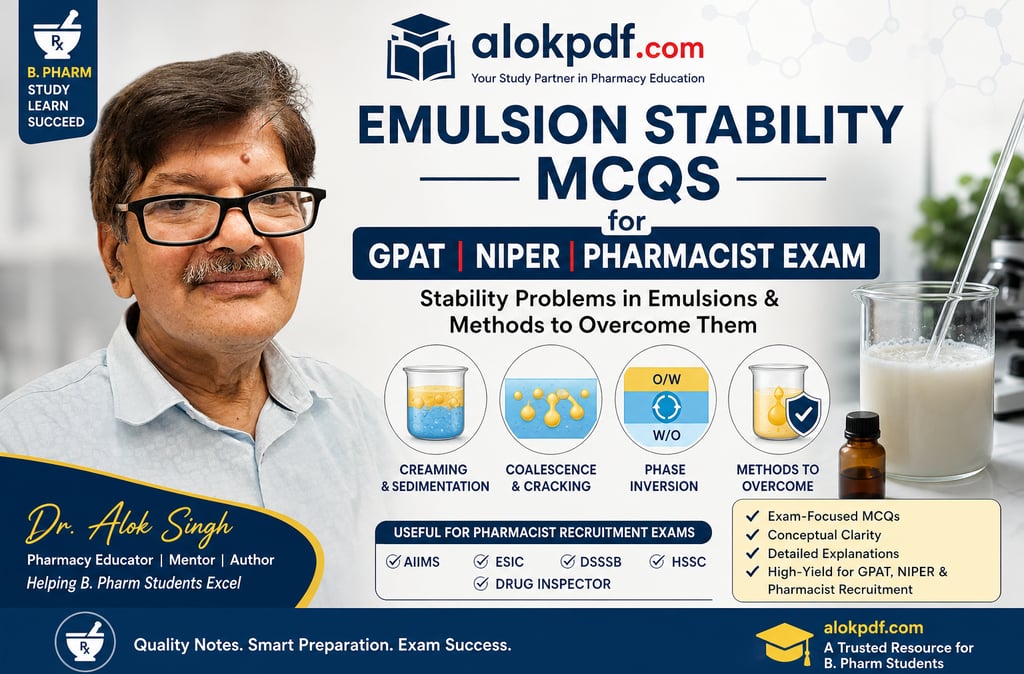
Emulsions: Stability Problems in Emulsions & Methods to Overcome Them.
1. Creaming in an emulsion is:
A. Irreversible separation of phases
B. Fusion of dispersed globules
C. Upward or downward movement of droplets due to density difference
D. Chemical degradation of emulsifier
Answer: C.
Explanation: C. Upward or downward movement of droplets due to density difference: This precisely describes creaming. It’s reversible if the emulsion is shaken, because the phases haven’t actually separated permanently.
A. Irreversible separation of phases → That’s breaking or cracking of an emulsion, not creaming.
B. Fusion of dispersed globules → That’s coalescence, where droplets merge into larger ones.
D. Chemical degradation of emulsifier → That’s a chemical instability, not physical creaming
2. Which one of the following instabilities is IRREVERSIBLE?
A. Creaming
B. Sedimentation
C. Flocculation
D. Cracking
Answer: D. Cracking
Explanation:
Cracking (or breaking) is the complete and permanent separation of the dispersed and continuous phases in an emulsion. Once this happens, the emulsion cannot be restored by simple shaking or mixing. It is irreversible.
Why the Others Are Wrong
Creaming → Droplets move up or down due to density differences. It’s reversible by shaking.
Sedimentation → Similar to creaming, but droplets settle downward. Also reversible.
Flocculation → Droplets cluster together but don’t fuse. Reversible with agitation.
3. Stokes’ law states that the creaming rate is directly proportional to
A. Concentration of emulsifier
B. Density of continuous phase
C. Square of droplet radius
D. Viscosity of medium
Answer: C.
Explanation:
Why C is Correct
Stokes’ law describes the velocity of a particle (or droplet) moving through a fluid under gravity.
The equation is:
v=2r2(ρd−ρc)g9η
Where:
v = creaming/sedimentation velocity
r = droplet radius
ρd−ρc = density difference between dispersed and continuous phase
g = gravitational acceleration
η = viscosity of continuous phase
Notice that the velocity is directly proportional to the square of the droplet radius. Larger droplets cream faster.
Why the Other Options Are Wrong
A. Viscosity of medium → Creaming rate is inversely proportional to viscosity. Higher viscosity slows creaming.
B. Density of continuous phase → It’s the difference in densities that matters, not the continuous phase alone.
D. Concentration of emulsifier → Emulsifier concentration affects droplet size and stability, but it’s not part of Stokes’ law directly.
Quick memory trick: “Big drops rise fast” → Larger droplet radius (r2) = faster creaming.
4. Which one is MOST effective to reduce creaming?
A. Increasing globule size
B. Removing emulsifying agent
C. Increasing viscosity of the continuous phase
D. Decreasing viscosity of the external phase
Answer: C.
Explanation: Why C is Correct
According to Stokes’ law, creaming velocity is inversely proportional to the viscosity of the continuous phase:
v=2r2(ρd−ρc)g9η
Increasing viscosity (η) slows down droplet movement, thereby reducing creaming.
This is why emulsions often use viscosity enhancers (like gums or polymers) to stabilize them.
Why the Other Options Are Wrong
A. Increasing globule size → Larger droplets cream faster (since velocity ∝ r2).
B. Removing emulsifying agent → Makes the emulsion unstable, leading to coalescence and cracking.
D. Decreasing viscosity of the external phase → Speeds up creaming, the opposite of what we want.
Quick memory trick: “Thick fluids hold drops still.” So, higher viscosity = less creaming.
5. Flocculation differs from coalescence because flocculation is
A. Droplets aggregate without fusion
B. Interfacial film is destroyed
C. Droplets fuse permanently
D. Phase inversion occurs
Answer: A.
Explanation: Why A is Correct
Flocculation: Droplets come together loosely, forming clusters, but their individual boundaries remain intact. No fusion occurs.
Coalescence: Droplets merge into larger ones, destroying the interfacial film between them. This is irreversible.
Why the Other Options Are Wrong
B. Interfacial film is destroyed → That’s coalescence, not flocculation.
C. Droplets fuse permanently → Again, coalescence.
D. Phase inversion occurs → That’s when the dispersed and continuous phases swap roles (e.g., O/W → W/O), unrelated to flocculation.
Easy memory trick: “Floccs = Flocks” → droplets flock together but don’t fuse.
6. Which instability directly causes the breaking of an emulsion?
A. Creaming
B. Coalescence
C. Sedimentation
D. Ostwald ripening only
Answer: B. Coalescence
Explanation: Why B is Correct
Breaking (or cracking) of an emulsion occurs when droplets fuse (coalesce), destroying the protective interfacial film.
Once coalescence progresses extensively, the dispersed phase separates, leading to irreversible breaking.
Why the Other Options Are Wrong
A. Creaming → Only upward/downward movement of droplets due to density differences. Reversible, not breaking.
C. Sedimentation → Downward settling of droplets. Also reversible.
D. Ostwald ripening only → This is the growth of larger droplets at the expense of smaller ones due to solubility differences. It can contribute to instability, but does not directly cause breaking by itself.
7. Which one about coalescence is CORRECT?
A. Coalescence is reversible by shaking
B. Coalescence decreases globule size
C. Coalescence is prevented by a strong interfacial film
D. Coalescence occurs without rupture of the interfacial film
Answer: C.
Explanation: Why C is Correct
Coalescence is the merging of droplets into larger ones, which destroys the interfacial film between them.
A strong, stable interfacial film (formed by emulsifiers or stabilizers) prevents droplets from fusing, thereby preventing coalescence.
Why the Other Options Are Wrong
A. Reversible by shaking → Coalescence is irreversible. Once droplets fuse, they cannot be separated by simple agitation.
B. Decreases globule size → It actually increases globule size, since droplets merge into bigger ones.
D. Occurs without rupture of the interfacial film → Coalescence requires rupture of the film; otherwise, droplets remain separate.
Quick Insight
Flocculation → Droplets cluster but don’t fuse (film intact).
Coalescence → Droplets fuse, film ruptured, irreversible.
Breaking/Cracking → End-stage separation caused by extensive coalescence.
Easy memory trick: “Film strong = no fusion.”
8. Ostwald ripening occurs primarily because:
A. Increase in emulsifier concentration
B. Water evaporates from the emulsion
C. Rapid sedimentation of Large droplets
D. Higher solubility of Small droplets than large droplets
Answer: D.
Explanation: Ostwald ripening occurs because smaller droplets in an emulsion have a higher solubility compared to larger droplets due to their greater surface curvature (the Gibbs–Thomson effect). As a result, molecules diffuse from the smaller droplets into the continuous phase and redeposit onto larger droplets. Over time, this leads to the growth of large droplets at the expense of small ones, destabilizing the emulsion.
9. Which one is a precursor to coalescence?
A. Cracking
B. Phase inversion
C. Flocculation
D. Creaming
Answer: C.
Explanation: Flocculation is the process in which droplets in an emulsion aggregate loosely due to attractive forces. They still retain their individual boundaries. The proximity of droplets increases the breakdown of liquid films. This leads to coalescence (fusion of droplets into larger ones).
Creaming is just the upward movement of droplets due to density differences.
Cracking refers to complete phase separation.
Phase inversion is when the dispersed and continuous phases swap roles.
So, flocculation acts as the precursor to coalescence because it brings droplets together, setting the stage for them to merge.
The sequence of emulsion instability processes (from creaming → flocculation → coalescence → breaking) in a simple flow chart?
10. Phase inversion in emulsions is:
A. Decrease in volume of internal phase
B. Excessive volume of dispersed
C. Temperature Reduction
D. viscosity Reduction
Answer: B.
Explanation: An increase in internal phase above the critical limit (~74%) causes inversion.
11. Phase inversion is prevented by :
A. Increase in globule size
B. Use of improper HLB emulsifier
C. Maintenance of appropriate phase-volume ratio
D. Reduction in emulsifier concentration
Answer: C.
Explanation: Phase inversion happens when the dispersed phase and continuous phase change their roles (e.g., oil-in-water turning into water-in-oil). To prevent this, the emulsion must maintain a proper phase‑volume ratio so that the continuous phase remains dominant and stable.
Increase in globule size → promotes instability, not prevention.
Improper HLB emulsifier → actually causes inversion or breaking.
Reduction in emulsifier concentration → reduces stability.
Thus, keeping the right phase‑volume ratio is the key to preventing phase inversion.
An oil-in-water (O/W) emulsion stabilized with sodium soap changes into a water-in-oil (W/O) emulsion after adding calcium chloride. This change occurs due to:
A. Creaming B. Cracking C. Phase inversion D. Ostwald ripening
The correct answer is C. Phase inversion, because calcium ions replace sodium ions in the soap, altering its emulsifying properties and flipping the emulsion type.
13. Which one LEAST affects the stability of the emulsion?
A. Container color
B. Viscosity
C. Droplet size
D. Density difference
Answer: D.
Explanation: Stability is affected by droplet size, viscosity, emulsifier, and density difference.
14. At what critical internal phase volume does emulsion instability begin to increase?
A. 20%
B. 54%
C. 74%
D. 92%
Answer: C. 74%
Explanation: Emulsion systems become unstable when the internal phase volume exceeds about 74%. It is due to the fact that at this point, the dispersed droplets are so tightly packed that they deform, coalesce, and destabilize the emulsion. This threshold is often referred to as the "critical packing volume.
15. Which one can reduce coalescence MOST effectively?
A. Increase in temperature
B. Increasing viscosity of the external phase
C. Decrease in interfacial film strength
D. Removal of protective colloid
Answer: B.
Explanation: why:
Increase in temperature (A): Usually promotes coalescence by lowering viscosity and weakening stabilizing films.
Increasing viscosity of the external phase (B): Slows down droplet movement, reducing collisions and coalescence.
Decrease in interfacial film strength (C): Makes droplets more prone to merging, so it increases coalescence.
Removal of protective colloid (D): Removes stabilizing agents, again increasing coalescence.
So, thickening the external phase is the most effective way to suppress droplet coalescence.
16. Assertion (A): Creaming is reversible.
Reason (R): Interfacial film remains intact surrounding droplets
A. Both A and R are true, but R is not the correct explanation
B. Both A and R are true, and R is the correct explanation
C. A is false, R is true
D. A is true, R is false
Answer: B.
Explanation: Here’s the reasoning:
Assertion (A): Creaming is reversible → True. Creaming is the upward movement of dispersed droplets due to density differences. Since the droplets remain intact, gentle shaking or mixing can redistribute them.
Reason (R): Interfacial film remains intact surrounding droplets → True. The protective film around droplets prevents them from merging, so the emulsion can be restored.
And importantly, R directly explains A: the intact interfacial film is the reason creaming can be reversed.
17. Which one is characterized by the destruction of the interfacial film?
A. Sedimentation
B. Creaming
C. Coalescence
D. Flocculation
Answer: C. Coalescence
Explanation: The breakdown:
Sedimentation (A): Droplets settle due to gravity, but the interfacial film remains intact.
Creaming (B): Droplets rise due to density differences, again without film destruction.
Coalescence (C): This is when droplets merge because the interfacial film is destroyed, leading to larger droplets and eventual phase separation.
Flocculation (D): Droplets cluster together but still retain their individual films, so they don’t merge.
So, coalescence is the instability mechanism directly characterized by the destruction of the interfacial film.
18. Which one is MOST suitable to minimize Ostwald ripening?
A. A highly soluble dispersed phase
B. The solubility increase of the internal phase
C. Oils with very low aqueous solubility
D. Reduction in emulsifier concentration
Answer: C.
Explanation: why:
A. Highly soluble dispersed phase → This promotes Ostwald ripening, since smaller droplets dissolve and redeposit onto larger ones.
B. Solubility increase of the internal phase → Again, this accelerates ripening, not minimizes it.
C. Oils with very low aqueous solubility → Correct. Using oils that barely dissolve in water reduces the driving force for molecular diffusion, thereby minimizing Ostwald ripening.
D. Reduction in emulsifier concentration → This weakens droplet stabilization and can worsen instability.
So, the key strategy is to choose oils with low solubility in the continuous phase, which slows down the molecular transfer that causes Ostwald ripening.
19. Which statement correctly describes emulsion stability?
A. Emulsions are thermodynamically stable systems
B. Emulsions are thermodynamically unstable but kinetically stable
C. Emulsions are chemically stable permanently
D. Emulsion stability is independent of emulsifier concentration
Answer: B.
Explanation:
A. Thermodynamically stable systems → False. Emulsions are not naturally stable; they tend to separate over time.
B. Thermodynamically unstable but kinetically stable → True. Emulsions require energy to form, and they are not stable in the long term. Stabilizers (like emulsifiers) can slow down separation, giving them kinetic stability.
C. Chemically stable permanently → False. Chemical reactions (like oxidation of oils) can occur, so they’re not permanently stable.
D. Stability independent of emulsifier concentration → False. Emulsifier concentration directly affects droplet stabilization and overall emulsion stability.
So, the defining feature is that emulsions are unstable in principle (thermodynamics), but can be maintained for practical use through kinetic stabilization.
20. A pharmacist notices the formation of larger globules after prolonged storage. What is the MOST probable cause?
A. Flocculation only
B. Coalescence
C. Sedimentation only
D. Increase in viscosity
Answer: B.
Explanation:
Flocculation only (A): Droplets cluster together but remain individually intact; they don’t merge into larger globules.
Coalescence (B): Droplets actually fuse because the interfacial film is destroyed, leading to the formation of larger globules — exactly what the pharmacist observed.
Sedimentation only (C): Droplets settle due to gravity but don’t grow in size.
Viscosity increase (D): This slows droplet movement but doesn’t directly cause larger globules.
So, the enlargement of globules after storage is most characteristic of coalescence.
21. Which additive is most commonly used to enhance emulsion stability by increasing viscosity?
A. Acacia
B. Sodium chloride
C. Methanol
D. Calcium chloride
Answer: A.
Explanation: Acacia (A): A natural gum that acts as a protective colloid and increases the viscosity of the external phase, thereby improving emulsion stability.
Sodium chloride (B): An electrolyte that can actually destabilize emulsions by affecting the electrical double layer.
Methanol (C): A solvent, not used for stabilizing emulsions.
Calcium chloride (D): Another electrolyte that tends to destabilize emulsions rather than stabilize them.
22. In pharmaceutical emulsions, why is creaming considered undesirable?
A. It indicates microbial contamination
B. It causes drastic changes in pH
C. It increases the probability of coalescence
D. It leads to immediate cracking
Answer: C.
Explanation:
A. Indicates microbial contamination → Incorrect. Creaming is a physical instability, not related to microbial growth.
B. Causes drastic changes in pH → Incorrect. Creaming does not alter chemical properties like pH.
C. Increases the probability of coalescence → Correct. Creaming concentrates droplets at the top, bringing them closer together and increasing the chance they merge.
D. Leads to immediate cracking → Incorrect. Cracking is an irreversible separation, but creaming alone does not directly cause it.
So, creaming is undesirable mainly because it raises the risk of coalescence, which can eventually lead to permanent instability.
23. Which type of emulsion instability is primarily associated with Brownian motion and attractive forces?
A. Flocculation
B. Cracking
C. Hydrolysis
D. Oxidation
Answer: A. Flocculation
Explanation:
Flocculation (A): Caused by Brownian motion and attractive forces between droplets. Droplets cluster together but remain individually intact, forming loose aggregates.
Cracking (B): Irreversible separation of phases, usually due to the complete breakdown of the emulsion.
Hydrolysis (C): A chemical instability, not related to droplet motion.
Oxidation (D): Another chemical instability, involving degradation of oils.
So, the instability linked specifically to Brownian motion and attractive forces is flocculation.
23. A formulation scientist aims for maximum emulsion stability. Which globule size distribution is preferred?
A. Highly polydisperse system
B. Broader size distribution
C. Smaller and uniform droplets
D. Larger droplets
Answer: C.
Explanation:
Large droplets only → Larger droplets are less stable because they rise or settle faster and are more prone to coalescence.
Broad size distribution → A wide range of droplet sizes increases instability, as smaller droplets dissolve into larger ones (Ostwald ripening).
Small and uniform droplets → Correct. Uniformly small droplets reduce gravitational separation and minimize coalescence, giving maximum kinetic stability.
Highly polydisperse system → Polydispersity promotes instability due to uneven droplet behavior.
So, for maximum emulsion stability, a small and uniform droplet size distribution is preferred.
25. 24. Which combination is CORRECT regarding emulsion instability?
A. Creaming — Irreversible
B. Cracking — Reversible
C. Flocculation — Droplets fuse
D. Coalescence — Globules merge
A. A only
B. B only
C. C only
D. D only
Answer: D.
Explanation:
Explanation:
A. Creaming — Irreversible → Incorrect. Creaming is reversible by shaking; it’s not permanent.
B. Cracking — Reversible → Incorrect. Cracking is the irreversible separation of phases.
C. Flocculation — Droplets fuse → Incorrect. In flocculation, droplets cluster but do not fuse; they remain intact.
D. Coalescence — Globules merge → Correct. Coalescence occurs when droplets lose their protective film and merge into larger globules.
So, the only correct combination is Coalescence — Globules merge.
Dr Alok Singh