Enzymes and Vitamins MCQs for GPAT and Pharmacist Exams
Practice coenzymes, enzyme kinetics, inhibitors, minerals, digestion, and absorption Enzymes and Vitamins MCQs for GPAT and Pharmacist exams NIPER, AIIMS Pharmacist, Railway Pharmacist, SSC, ESIC, and State Pharmacist exams, with detailed explanations and quick revision notes.
Dr. Alok Singh
7/10/202610 min read
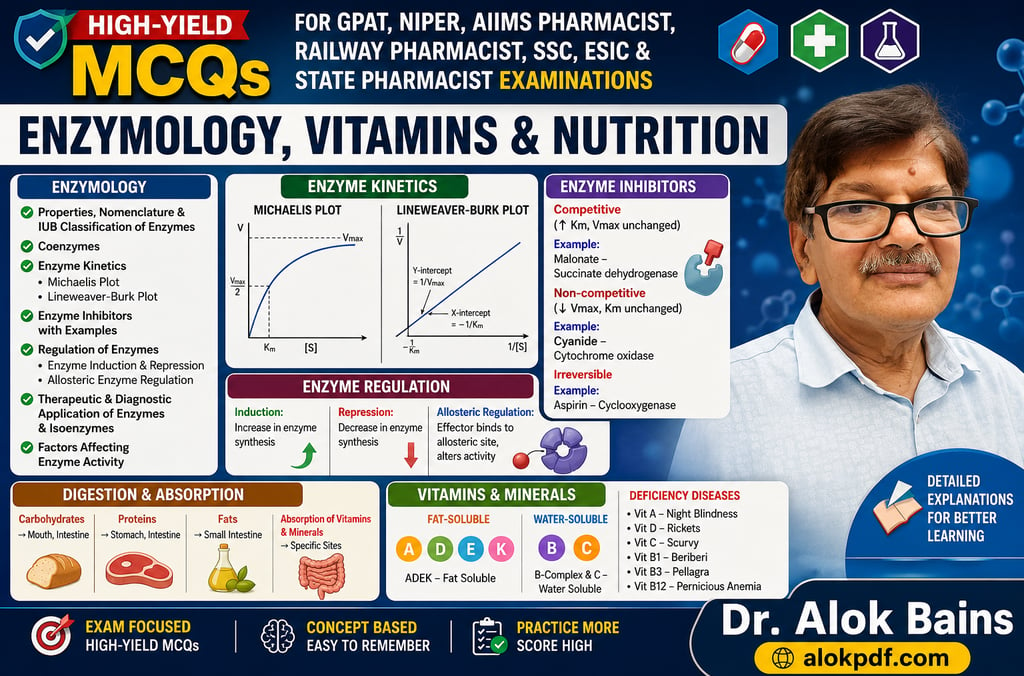
MCQs on Enzymes, Vitamins, Minerals and Nutrition with Explanations. GPAT, NIPER, AIIMS Pharmacist, Railway Pharmacist, SSC, ESIC, and State Pharmacist examinations
Quick Revision Notes: Enzymes, Vitamins, Minerals, and Nutrition
1. Enzymes: Definition and Properties
Enzymes are biological catalysts that increase the rate of biochemical reactions without being consumed.
Most enzymes are proteins, except a few RNA molecules called ribozymes.
Enzymes are highly specific for their substrates and reactions.
They work under mild physiological conditions of temperature and pH.
Enzymes lower the activation energy of a reaction.
Most enzymes are named by adding the suffix "-ase" to the substrate or reaction type (e.g., urease, lactase, oxidase).
Remember:
Enzymes are FAST because they are:
F – Functional catalysts
A – Act in small amounts
S – Specific in action
T – Temperature and pH sensitive
2. Cofactors, Coenzymes and Prosthetic Groups
Many enzymes require non-protein components for activity.
Cofactor
A non-protein substance required for enzyme activity.
Coenzyme
Organic cofactors loosely attached to enzymes.
Examples:
NAD⁺ → Vitamin B3 (Niacin)
FAD → Vitamin B2 (Riboflavin)
Coenzyme A → Vitamin B5 (Pantothenic acid)
Pyridoxal phosphate (PLP) → Vitamin B6
Prosthetic Group
A cofactor tightly bound to an enzyme.
Important Formula
Apoenzyme + Cofactor = Holoenzyme
3. IUB Classification of Enzymes
The International Union of Biochemistry classifies enzymes into six major classes.
Class Function Example
Oxidoreductases Oxidation-reduction reactions Dehydrogenase
Transferases Transfer of groups Hexokinase
Hydrolases Hydrolysis reactions Lipase
Lyases Addition or removal of groups without hydrolysis Decarboxylase
Isomerases Rearrangement reactions Racemase
Ligases Joining molecules using ATP DNA ligase
4. Enzyme Kinetics
Michaelis Constant (Km)
Km is the substrate concentration at which the reaction velocity becomes half of Vmax.
Interpretation of Km
Low Km → High affinity
High Km → Low affinity
Vmax
Maximum velocity is achieved when all enzyme active sites are saturated with substrate.
Important Rule:
Km and affinity are inversely related.
5. Michaelis-Menten Plot
Graph between substrate concentration (S) and reaction velocity (V).
Produces a hyperbolic curve.
Shows that enzyme activity increases with substrate concentration until saturation occurs.
6. Lineweaver-Burk Plot
Also called the double reciprocal plot.
Graph between 1/V and 1/[S].
Produces a straight line.
Important Points:
X-intercept = −1/Km
Y-intercept = 1/Vmax
Remember:
X gives Km and Y gives Vmax.
7. Enzyme Inhibitors
Competitive Inhibition
The inhibitor competes with the substrate for the active site.
Km increases.
Vmax remains unchanged.
Examples:
Malonate → Succinate dehydrogenase
Methotrexate → Dihydrofolate reductase
Sulfonamides → PABA pathway
Non-competitive Inhibition
The inhibitor binds away from the active site.
Vmax decreases.
Km remains unchanged.
Examples:
Cyanide
Heavy metals
Irreversible Inhibition
The enzyme is permanently inactivated.
Examples:
Aspirin → Cyclooxygenase
Organophosphates → Acetylcholinesterase
Memory Trick:
Competitive changes Km; non-competitive changes Vmax.
8. Regulation of Enzymes
Enzyme Induction
Increase in enzyme synthesis due to substrate or drug exposure.
Example: Phenobarbital induces liver microsomal enzymes.
Enzyme Repression
Decrease in enzyme synthesis due to end-product accumulation.
Allosteric Regulation
Regulatory molecules bind to a site other than the active site.
Characteristics:
Multiple subunits
Sigmoidal kinetics
Feedback regulation
9. Therapeutic Uses of Enzymes
Enzyme Clinical Use
Streptokinase Dissolves blood clots
Urokinase Thrombolytic therapy
Asparaginase Acute lymphoblastic leukemia
Hyaluronidase Improves spread of injected drugs
DNase Cystic fibrosis
Remember:
"SK saves clot, ASP treats ALL."
10. Diagnostic Uses of Enzymes and Isoenzymes
Enzyme Clinical Importance
Amylase Pancreatitis
Lipase Pancreatitis
ALT (SGPT) Liver disease
AST (SGOT) Liver and heart disease
ALP Bone and liver disorders
CK-MB Myocardial infarction
Important Isoenzymes
CK-MB → Heart
CK-MM → Skeletal muscle
CK-BB → Brain
LDH1 → Heart
11. Factors Affecting Enzyme Activity
Temperature
pH
Substrate concentration
Enzyme concentration
Presence of inhibitors
Presence of activators and cofactors
Optimum Conditions
Temperature: 37°C
Pepsin pH: 1.5–2
Trypsin pH: 8
Digestion and Absorption of Nutrients
12. Carbohydrate Digestion
Site Enzyme
Mouth Salivary amylase
Small intestine Pancreatic amylase
Intestinal brush border Maltase, Lactase, Sucrase
Final products absorbed:
Glucose
Fructose
Galactose
Remember:
Carbohydrate digestion starts in the mouth and ends in the intestine.
13. Protein Digestion
Site Enzyme
Stomach Pepsin
Pancreas Trypsin, Chymotrypsin
Intestin Peptidases
Final products absorbed:
Amino acids
Small peptides
14. Fat Digestion
Bile salts emulsify fats.
Pancreatic lipase breaks triglycerides into fatty acids and monoglycerides.
Absorption occurs mainly in the small intestine.
Remember:
Bile emulsifies; lipase digests.
15. Absorption of Minerals
Mineral Site of Absorption
Iron Duodenum
Calcium Duodenum and jejunum
Vitamin B12 Ileum
Vitamin D enhances calcium absorption.
Vitamins and Deficiency Diseases
Fat-Soluble Vitamins
Vitamin Function Deficiency
A Vision Night blindness
D Calcium absorption Rickets, Osteomalacia
E Antioxidant Hemolytic anemia
K Blood clotting Bleeding tendency
Memory Trick:
"ADEK stay with FAT."
Water-Soluble Vitamins
Vitamin Major Function Deficiency Disease
B1 (Thiamine) Carbohydrate metabolism Beriberi
B2 (Riboflavin) Oxidation reactions Cheilosis
B3 (Niacin) NAD and NADP synthesis Pellagra
B6 (Pyridoxine) Amino acid metabolism Neuropathy
B9 (Folic acid) DNA synthesis Megaloblastic anemia
B12 (Cobalamin) RBC maturation Pernicious anemia
Vitamin C Collagen synthesis Scurvy
Easy Mnemonic for Pellagra:
The 3 Ds of Pellagra
Dermatitis
Diarrhea
Dementia
16. High-Yield One-Liners for Exams
Low Km means high substrate affinity.
Competitive inhibitors increase Km.
Non-competitive inhibitors decrease Vmax.
CK-MB is a marker of myocardial infarction.
ALT is more specific for liver injury than AST.
Vitamin D increases calcium absorption.
Intrinsic factor is required for Vitamin B12 absorption.
Iron absorption occurs mainly in the duodenum.
Bile salts emulsify fats but do not digest them.
Enzymes lower activation energy but do not alter equilibrium.
Final Memory Formula
"Low Km = Loves substrate More."
"Competitive changes Km; Non-competitive changes Vmax."
"ADEK with Fat, B and C with Water."
Enzymes and Coenzymes
1. Which of the following enzymes does not require a cofactor for activity?
A. Carbonic anhydrase
B. Catalase
C. Pepsin
D. Hexokinase
Answer: C
Explanation: Pepsin is a simple protein enzyme and does not require a cofactor.
2. The term "holoenzyme" refers to:
A. Protein portion only
B. Cofactor only
C. Active enzyme with cofactor attached
D. Inactive enzyme precursor
Answer: C
Explanation: Holoenzyme = Apoenzyme + Cofactor.
3. Which vitamin acts as a coenzyme in transamination reactions?
A. Vitamin B1
B. Vitamin B6
C. Vitamin B2
D. Vitamin B12
Answer: B
Explanation: Pyridoxal phosphate (PLP), derived from vitamin B6, is essential for transamination.
4. Biotin functions primarily in:
A. Oxidation reactions
B. Carboxylation reactions
C. Hydrolysis reactions
D. Deamination reactions
Answer: B
Explanation: Biotin serves as a coenzyme for carboxylase enzymes.
5. Which coenzyme participates in one-carbon transfer reactions?
A. Coenzyme A
B. Tetrahydrofolate
C. NADP+
D. FAD
Answer: B
Explanation: Tetrahydrofolate derived from folic acid transfers one-carbon units.
IUB Classification
6. Dehydrogenases belong to which enzyme class?
A. Hydrolases
B. Transferases
C. Oxidoreductases
D. Isomerases
Answer: C
Explanation: Dehydrogenases catalyze oxidation-reduction reactions.
7. Phosphatases belong to:
A. Hydrolases
B. Ligases
C. Lyases
D. Isomerases
Answer: A
Explanation: Phosphatases remove phosphate groups by hydrolysis.
8. Decarboxylases are classified as:
A. Transferases
B. Lyases
C. Ligases
D. Hydrolases
Answer: B
Explanation: Lyases remove groups without hydrolysis or oxidation.
9. Racemases belong to which enzyme class?
A. Isomerases
B. Hydrolases
C. Oxidoreductases
D. Ligases
Answer: A
Explanation: Racemases catalyze conversion between optical isomers.
10. DNA ligase belongs to:
A. Hydrolases
B. Ligases
C. Lyases
D. Transferases
Answer: B
Explanation: DNA ligase joins DNA strands using ATP energy.
Enzyme Kinetics
11. At substrate concentrations much higher than Km, enzyme velocity approaches:
A. Zero
B. Km
C. Vmax
D. Half Vmax
Answer: C
Explanation: At saturation, all enzyme active sites are occupied.
12. Km is an indicator of:
A. Enzyme concentration
B. Catalytic activity
C. Enzyme-substrate affinity
D. pH optimum
Answer: C
Explanation: Lower Km indicates higher substrate affinity.
13. Which plot converts a hyperbolic curve into a straight line?
A. Michaelis plot
B. Arrhenius plot
C. Lineweaver-Burk plot
D. Dixon plot
Answer: C
Explanation: The double reciprocal plot gives a straight line.
14. In competitive inhibition, Vmax is:
A. Increased
B. Decreased
C. Unchanged
D. Zero
Answer: C
Explanation: Increasing substrate concentration can overcome competitive inhibition.
15. In noncompetitive inhibition, Km remains
A. Increased
B. Decreased
C. Unchanged
D. Infinite
Answer: C
Explanation: Noncompetitive inhibitors reduce Vmax without changing substrate affinity.
Enzyme Inhibition
16. Methotrexate inhibits:
A. Dihydrofolate reductase
B. Cyclooxygenase
C. Carbonic anhydrase
D. Xanthine oxidase
Answer: A
Explanation: Methotrexate is a competitive inhibitor of dihydrofolate reductase.
17. Allopurinol inhibits:
A. Lactate dehydrogenase
B. Xanthine oxidase
C. Lipase
D. Pepsin
Answer: B
Explanation: Used in gout treatment by reducing uric acid formation.
18. Penicillin inhibits bacterial
A. DNA synthesis
B. Protein synthesis
C. Cell wall synthesis enzymes
D. RNA synthesis
Answer: C
Explanation: Penicillin inhibits the transpeptidase involved in peptidoglycan synthesis.
19. Organophosphates inhibit:
A. Acetylcholinesterase
B. Monoamine oxidase
C. Catalase
D. Carbonic anhydrase
Answer: A
Explanation: This causes accumulation of acetylcholine.
20. Cyanide inhibits:
A. Cytochrome oxidase
B. Hexokinase
C. Pepsin
D. Trypsin
Answer: A
Explanation: Cyanide blocks cellular respiration.
Regulation of Enzymes
21. Lactose induces the synthesis of β-galactosidase in bacteria. This is an example of:
A. Repression
B. Feedback inhibition
C. Enzyme induction
D. Competitive inhibition
Answer: C
Explanation: The presence of a substrate stimulates enzyme synthesis.
22. Cholesterol inhibits HMG-CoA reductase synthesis by:
A. Induction
B. Repression
C. Activation
D. Covalent modification
Answer: B
Explanation: The end product suppresses enzyme formation.
23. Allosteric enzymes possess
A. One active site only
B. Regulatory binding sites
C. No active site
D. Covalently attached cofactors only
Answer: B
Explanation: Regulatory molecules bind to allosteric sites.
24. The first committed enzyme in a metabolic pathway is usually:
A. Structural enzyme
B. Allosteric enzyme
C. Digestive enzyme
D. Lysosomal enzyme
Answer: B
Explanation: It commonly regulates pathway activity.
25. Feedback inhibition is generally a form of:
A. Positive regulation
B. Negative regulation
C. Enzyme induction
D. Covalent activation
Answer: B
Explanation: End products reduce pathway activity.
Therapeutic and Diagnostic Enzymes
26. Urokinase is used clinically as:
A. Antibiotic
B. Antihypertensive
C. Thrombolytic agent
D. Antacid
Answer: C
Explanation: It dissolves blood clots.
27. Hyaluronidase is used to:
A. Dissolve kidney stones
B. Increase tissue permeability
C. Reduce blood glucose
D. Treat anemia
Answer: B
Explanation: It promotes spread of injected drugs.
28. DNase is therapeutically useful in:
A. Asthma
B. Cystic fibrosis
C. Hypertension
D. Diabetes
Answer: B
Explanation: It reduces sputum viscosity.
29. Elevated alkaline phosphatase suggests disease of:
A. Bone or liver
B. Kidney only
C. Lung only
D. Thyroid only
Answer: A
Explanation: ALP rises in bone disorders and cholestasis.
30. Increased serum ALT mainly indicates damage to:
A. Heart
B. Brain
C. Liver
D. Bone
Answer: C
Explanation: ALT is a sensitive marker of liver injury.
Isoenzymes
31. LDH1 is abundant in:
A. Liver
B. Skeletal muscle
C. Heart muscle
D. Bone
Answer: C
Explanation: LDH1 rises in myocardial infarction.
32. CK-MM is predominantly found in:
A. Brain
B. Skeletal muscle
C. Liver
D. Pancreas
Answer: B
Explanation: CK-MM is the major skeletal muscle isoenzyme.
33. CK-BB is primarily present in:
A. Brain
B. Liver
C. Kidney
D. Bone
Answer: A
Explanation: CK-BB predominates in nervous tissue.
34. Which enzyme was historically used for diagnosis of myocardial infarction?
A. ALP
B. CK-MB
C. Lipase
D. Acid phosphatase
Answer: B
Explanation: CK-MB rises within hours after cardiac injury.
Factors Affecting Enzyme Activity
35. Increasing enzyme concentration generally causes
A. Decrease in reaction velocity
B. Increase in reaction velocity
C. No effect
D. Enzyme denaturation
Answer: B
Explanation: More active sites are available.
36. Heavy metals inhibit enzymes by interacting with:
A. Amino groups
B. Sulfhydryl groups
C. Carboxyl groups
D. Phosphate groups
Answer: B
Explanation: Mercury and lead commonly bind sulfhydryl groups.
37. Extreme pH affects enzymes mainly by causing
A. Polymerization
B. Denaturation
C. Phosphorylation
D. Reduction
Answer: B
Explanation: Changes in ionization alter enzyme structure.
Digestion and Absorption
38. Salivary amylase digests:
A. Protein
B. Fat
C. Starch
D. Cellulose
Answer: C
Explanation: It converts starch into maltose and dextrins.
39. Trypsin is secreted by the pancreas as
A. Active trypsin
B. Pepsinogen
C. Trypsinogen
D. Chymotrypsin
Answer: C
Explanation: It is activated in the intestine by enterokinase.
40. Bile salts aid digestion by:
A. Hydrolyzing proteins
B. Emulsifying fats
C. Activating pepsin
D. Absorbing glucose
Answer: B
Explanation: Emulsification increases surface area for lipase action.
41. Most nutrient absorption occurs in the:
A. Stomach
B. Jejunum
C. Colon
D. Rectum
Answer: B
Explanation: The jejunum is the major absorptive site.
Vitamins and Minerals
42. Vitamin K is required for synthesis of
A. Hemoglobin
B. Clotting factors
C. Insulin
D. Thyroxine
Answer: B
Explanation: Vitamin K is essential for prothrombin synthesis.
43. Riboflavin deficiency causes:
A. Pellagra
B. Cheilosis
C. Scurvy
D. Beriberi
Answer: B
Explanation: Angular stomatitis and cheilosis are typical findings.
44. Vitamin E deficiency primarily causes:
A. Bleeding tendency
B. Hemolytic anemia
C. Night blindness
D. Rickets
Answer: B
Explanation: Vitamin E protects cell membranes from oxidation.
45. Deficiency of iodine results in:
A. Scurvy
B. Goiter
C. Beriberi
D. Pellagra
Answer: B
Explanation: Iodine is required for thyroid hormone synthesis.
46. Zinc deficiency commonly causes:
A. Delayed wound healing
B. Polycythemia
C. Hyperthyroidism
D. Hypercalcemia
Answer: A
Explanation: Zinc is important for tissue repair and immunity.
47. Copper deficiency may lead to:
A. Anemia
B. Hyperglycemia
C. Hyperlipidemia
D. Hypertension
Answer: A
Explanation: Copper is involved in iron metabolism.
48. Selenium acts mainly as a component of:
A. DNA polymerase
B. Glutathione peroxidase
C. Hexokinase
D. Pepsin
Answer: B
Explanation: Selenium contributes to antioxidant defense.
49. Magnesium acts as a cofactor for:
A. Very few enzymes
B. Hundreds of enzymes
C. Only digestive enzymes
D. Only liver enzymes
Answer: B
Explanation: Magnesium participates in numerous ATP-dependent reactions.
50. Intrinsic factor is essential for the absorption of:
A. Vitamin A
B. Vitamin D
C. Vitamin B12
D. Vitamin C
Answer: C
Explanation: Lack of intrinsic factor causes pernicious anemia.
Dr. Alok Singh
Basic Qustions (MCQs)
Enzymes: Properties, Nomenclature, and IUB Classification. .
1. Enzymes are chemically classified as:
A. Lipids
B. Carbohydrates
C. Proteins
D. Nucleic acids
Answer: C
2. The International Union of Biochemistry (IUB) classifies enzymes into how many major classes?
A. 4
B. 5
C. 6
D. 8
Answer: C
3. Oxidoreductases catalyze:
A. Hydrolysis reactions
B. Oxidation-reduction reactions
C. Transfer of functional groups
D. Isomerization reactions
Answer: B
4. Which enzyme class transfers functional groups from one molecule to another?
A. Ligases
B. Transferases
C. Lyases
D. Hydrolases
Answer: B
5. Hexokinase belongs to which IUB class?
A. Oxidoreductase
B. Transferase
C. Hydrolase
D. Lyase
Answer: B
6. Which enzyme class catalyzes bond formation coupled with ATP hydrolysis?
A. Isomerases
B. Hydrolases
C. Ligases
D. Lyases
Answer: C
7. The non-protein component tightly bound to an enzyme is called:
A. Apoenzyme
B. Prosthetic group
C. Substrate
D. Zymogen
Answer: B
8. The protein portion of a conjugated enzyme is called:
A. Coenzyme
B. Holoenzyme
C. Apoenzyme
D. Prosthetic group
Answer: C
9. Apoenzyme plus cofactor together constitute:
A. Zymogen
B. Holoenzyme
C. Isoenzyme
D. Metalloenzyme
Answer: B
10. NAD⁺ functions as a:
A. Substrate
B. Coenzyme
C. Inhibitor
D. Isoenzyme
Answer: B
Coenzymes
11. NAD⁺ is derived from which vitamin?
A. Vitamin B1
B. Vitamin B2
C. Vitamin B3
D. Vitamin B6
Answer: C
12. FAD is derived from:
A. Riboflavin
B. Pyridoxine
C. Biotin
D. Folic acid
Answer: A
13. Coenzyme A contains which vitamin?
A. Pantothenic acid
B. Riboflavin
C. Thiamine
D. Biotin
Answer: A
14. Pyridoxal phosphate is the active coenzyme form of:
A. Vitamin B1
B. Vitamin B2
C. Vitamin B6
D. Vitamin B12
Answer: C
Enzyme Kinetics
15. The Michaelis constant (Km) is defined as substrate concentration at which:
A. Enzyme activity stops
B. Velocity is maximum
C. Velocity is half of Vmax
D. Substrate is completely utilized
Answer: C
16. A low Km value indicates:
A. Low enzyme affinity for substrate
B. High enzyme affinity for substrate
C. Competitive inhibition
D. Enzyme denaturation
Answer: B
17. The Michaelis-Menten plot is a graph between:
A. 1/V and 1/[S]
B. Velocity and substrate concentration
C. Velocity and enzyme concentration
D. pH and velocity
Answer: B
18. The Lineweaver-Burk plot is also known as:
A. Double reciprocal plot
B. Saturation plot
C. Sigmoid plot
D. Arrhenius plot
Answer: A
19. In the Lineweaver-Burk plot, the X-intercept represents:
A. Vmax
B. 1/Vmax
C. -1/Km
D. Km
Answer: C
20. In the Lineweaver-Burk plot, the Y-intercept is equal to:
A. Km
B. Vmax
C. 1/Vmax
D. -1/Km
Answer: C
Enzyme Inhibition
21. Competitive inhibitors increase:
A. Vmax
B. Km
C. Both Km and Vmax
D. Neither Km nor Vmax
Answer: B
22. Which of the following is a competitive inhibitor of succinate dehydrogenase?
A. Malonate
B. Cyanide
C. Fluoride
D. Penicillin
Answer: A
23. Noncompetitive inhibitors generally:
A. Increase Vmax
B. Decrease Vmax
C. Increase Km only
D. Increase both Km and Vmax
Answer: B
24. Sulfonamides act as competitive inhibitors of:
A. PABA metabolism
B. DNA synthesis
C. Protein synthesis
D. Glycolysis
Answer: A
25. Aspirin irreversibly inhibits:
A. Cyclooxygenase
B. Hexokinase
C. Lactate dehydrogenase
D. Catalase
Answer: A
Regulation of Enzymes
26. Increased synthesis of enzyme molecules in response to substrate availability is called:
A. Repression
B. Induction
C. Inhibition
D. Activation
Answer: B
27. Reduction in enzyme synthesis due to end-product accumulation is called:
A. Enzyme induction
B. Enzyme activation
C. Enzyme repression
D. Feedback stimulation
Answer: C
28. Allosteric enzymes typically show which type of kinetic curve?
A. Linear
B. Hyperbolic
C. Sigmoidal
D. Exponential
Answer: C
29. The end product of a metabolic pathway inhibiting an early enzyme in the pathway is called:
A. Feed-forward activation
B. Feedback inhibition
C. Competitive activation
D. Enzyme induction
Answer: B
Therapeutic and Diagnostic Applications
30. Streptokinase is therapeutically used for:
A. Hypertension
B. Thrombolysis
C. Diabetes mellitus
D. Hyperlipidemia
Answer: B
31. Asparaginase is used in the treatment of:
A. Leukemia
B. Tuberculosis
C. Malaria
D. Asthma
Answer: A
32. Elevated serum amylase is commonly associated with:
A. Hepatitis
B. Pancreatitis
C. Myocardial infarction
D. Anemia
Answer: B
33. Which isoenzyme is most specific for myocardial infarction?
A. LDH1
B. LDH5
C. CK-MM
D. ALP
Answer: A
34. Creatine kinase-MB (CK-MB) is mainly associated with:
A. Liver disease
B. Skeletal muscle disease
C. Cardiac muscle injury
D. Kidney disease
Answer: C
Factors Affecting Enzyme Activity
35. The optimum temperature for most human enzymes is:
A. 25°C
B. 30°C
C. 37°C
D. 45°C
Answer: C
36. Enzyme denaturation commonly occurs at:
A. Very low temperatures
B. High temperatures
C. Neutral pH only
D. Low substrate concentration
Answer: B
37. Pepsin exhibits maximum activity at pH:
A. 1.5–2.0
B. 4–5
C. 7
D. 8–9
Answer: A
38. Trypsin functions optimally at pH:
A. 2
B. 4
C. 7.8–8.5
D. 11
Answer: C
Digestion and Absorption
39. Carbohydrate digestion begins in the:
A. Stomach
B. Mouth
C. Duodenum
D. Ileum
Answer: B
40. The principal enzyme responsible for protein digestion in the stomach is:
A. Trypsin
B. Pepsin
C. Lipase
D. Maltase
Answer: B
41. Fat digestion mainly occurs in the:
A. Stomach
B. Colon
C. Small intestine
D. Mouth
Answer: C
42. Vitamin B12 is absorbed in the:
A. Duodenum
B. Jejunum
C. Ileum
D. Colon
Answer: C
43. Iron is primarily absorbed from the:
A. Stomach
B. Duodenum
C. Ileum
D. Colon
Answer: B
44. Calcium absorption is enhanced by:
A. Vitamin A
B. Vitamin D
C. Vitamin K
D. Vitamin E
Answer: B
Vitamins and Associated Diseases
45. Deficiency of vitamin C causes:
A. Rickets
B. Pellagra
C. Scurvy
D. Beriberi
Answer: C
46. Deficiency of thiamine causes:
A. Beriberi
B. Rickets
C. Scurvy
D. Osteomalacia
Answer: A
47. Pellagra is caused by deficiency of:
A. Niacin
B. Riboflavin
C. Pyridoxine
D. Biotin
Answer: A
48. Night blindness results from deficiency of:
A. Vitamin D
B. Vitamin A
C. Vitamin E
D. Vitamin K
Answer: B
49. Deficiency of vitamin D in children causes:
A. Scurvy
B. Osteoporosis
C. Rickets
D. Beriberi
Answer: C
50. Megaloblastic anemia is commonly associated with a deficiency of:
A. Vitamin A
B. Vitamin C
C. Folic acid and Vitamin B12
D. Vitamin K
Answer: C