Gastrointestinal Diseases MCQs
Practice Gastrointestinal Diseases MCQs inflammatory bowel disease, peptic ulcer, jaundice, hepatitis, typhoid, and fatty liver disease with answers for GPAT, NIPER, AIIMS Pharmacist, SSC, ESIC, Railway Pharmacist, and State Pharmacist exams.
Dr. Alok Singh
7/4/20268 min read
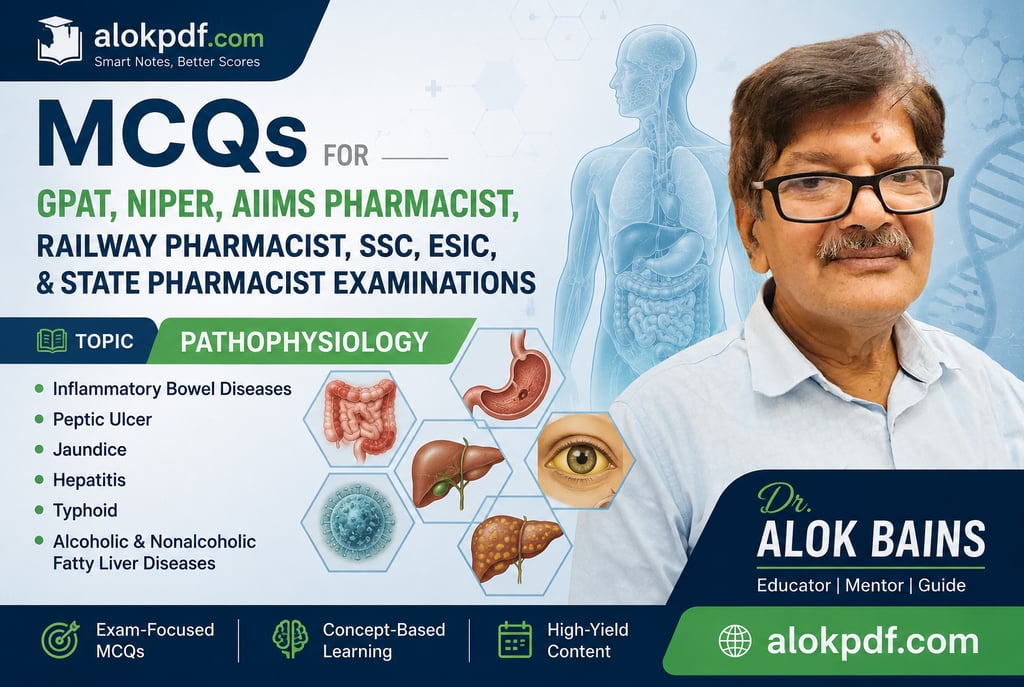
MCQs on Pathophysiology of Gastrointestinal Diseases, with Revision Notes (One-Liners)
(GPAT, NIPER, AIIMS Pharmacist, Railway Pharmacist, SSC, ESIC & State Pharmacist Exams)
1. Inflammatory Bowel Disease (IBD)
Easy-to-Remember Notes
IBD is a chronic immune-mediated inflammatory disease of the intestine.
The two major types are Crohn's disease and Ulcerative colitis (UC).
Crohn's disease: Can affect mouth to anus.
Ulcerative colitis: Limited to the colon and rectum.
Crohn's disease has skip lesions.
Ulcerative colitis has continuous lesions.
Crohn's disease causes transmural inflammation.
UC involves only the mucosa and submucosa.
Fistulas and strictures are common in Crohn's disease.
Toxic megacolon is a life-threatening complication of ulcerative colitis.
TNF-α is the major inflammatory cytokine in Crohn's disease.
Crohn's disease is mainly Th1/Th17 mediated.
UC is relatively Th2-mediated.
Long-standing ulcerative colitis increases the risk of colorectal carcinoma.
Anti-TNF drugs include Infliximab and Adalimumab.
Memory Trick
Crohn = "Cracks through the wall."
Transmural
Fistula
Skip lesions
UC = "Uniform Colon."
Continuous lesions
Colon only
Cancer risk
2. Peptic Ulcer Disease
Peptic ulcer develops due to an imbalance between aggressive and protective factors.
The two major causes are H. pylori infection and NSAIDs.
H. pylori produces urease, which converts urea into ammonia.
Ammonia neutralizes gastric acid around the bacterium.
NSAIDs inhibit COX, decreasing prostaglandin synthesis.
Prostaglandins increase mucus, bicarbonate secretion, and mucosal blood flow.
Histamine stimulates acid secretion through H₂ receptors.
Gastrin stimulates acid secretion from parietal cells.
Parietal cells secrete HCl and intrinsic factor.
Chief cells secrete pepsinogen.
Zollinger–Ellison syndrome is caused by a gastrinoma.
Duodenal ulcers are usually associated with increased acid secretion.
Gastric ulcers often result from reduced mucosal protection.
Memory Trick
"No PG → No Protection."
Jaundice
Jaundice is a yellow discoloration due to bilirubin >2–3 mg/dL.
Bilirubin is formed from hemoglobin breakdown.
Unconjugated bilirubin is water-insoluble.
Conjugated bilirubin is water-soluble.
Bilirubin is conjugated by UDP-glucuronyl transferase.
Hemolytic jaundice causes increased unconjugated bilirubin.
Obstructive jaundice causes increased conjugated bilirubin.
Obstructive jaundice produces dark urine.
Obstructive jaundice produces pale (clay-colored) stools.
Neonatal jaundice results from immature UDP-glucuronyl transferase.
Bilirubin reaches the intestine and is converted into urobilinogen.
Stercobilin gives stool its brown color.
Memory Trick
Unconjugated = Insoluble
Conjugated = Can be excreted
4. Hepatitis
Hepatitis is inflammation of the liver.
Hepatocyte injury is mainly immune-mediated, especially in HBV.
ALT is more liver-specific than AST.
Acute viral hepatitis markedly increases ALT.
HCV has the highest risk of chronic infection.
HAV and HEV usually do not become chronic.
HBV and HCV can cause cirrhosis.
Ballooning degeneration indicates hepatocyte injury.
Councilman bodies are apoptotic hepatocytes.
Chronic hepatitis may progress to fibrosis and cirrhosis.
Memory Trick
HCV = Chronic Virus
HAV = Acute Virus
5. Typhoid Fever
Caused by Salmonella Typhi.
Transmission is by the feco-oral route.
The organism enters through contaminated food and water.
Salmonella survives inside macrophages.
It spreads through the bloodstream causing bacteremia.
Peyer's patches in the terminal ileum are primarily affected.
Necrosis of Peyer's patches causes intestinal perforation.
Typhoid ulcers are longitudinal.
Relative bradycardia (Faget sign) is a classical clinical finding.
Chronic carriers harbor bacteria in the gallbladder.
Memory Trick
Typhi → Travels in macrophages
6. Alcoholic Fatty Liver Disease (AFLD)
Alcohol is metabolized by alcohol dehydrogenase.
Ethanol metabolism increases NADH.
Excess NADH promotes triglyceride synthesis.
Fat accumulates inside hepatocytes.
Fatty liver is the earliest reversible stage.
Continued alcohol intake causes alcoholic hepatitis.
Mallory-Denk bodies are characteristic.
AST is usually higher than ALT.
The typical AST:ALT ratio is about 2:1.
Chronic alcoholism eventually leads to cirrhosis.
7. Non-Alcoholic Fatty Liver Disease (NAFLD)
NAFLD occurs without significant alcohol intake.
It is the hepatic manifestation of metabolic syndrome.
Obesity is the strongest risk factor.
Insulin resistance is the major pathogenic mechanism.
Free fatty acids accumulate inside hepatocytes.
Oxidative stress causes inflammation.
NASH (Non-Alcoholic Steatohepatitis) is the progressive form.
NASH can progress to fibrosis, cirrhosis, and hepatocellular carcinoma.
Weight reduction improves NAFLD.
Diabetes mellitus significantly increases disease progression.
Memory Trick
NAFLD = "Metabolic Syndrome in the Liver."
Comparison Table
Feature. Crohn's Disease, Ulcerative Colitis
Site Mouth to anus Colon Only
Lesions Skip Continuous
Inflammation Transmural Mucosal
Fistula Common Rare
Cancer risk Moderate High
Jaundice Bilirubin Urine Stool
Hemolytic Unconjugated↑ Normal Dark
Hepatocellular Mixed Dark Normal/Pale
Obstructive Conjugated↑ Dark Pale
Alcoholic Liver Disease NAFLD
Alcohol intake present No alcohol
AST > ALT (≈2:1) ALT often ≥ AST
Mallory bodies Usually absent
NADH excess Insulin resistance
Q1. Which cytokine plays the most important role in the pathogenesis of Crohn's disease?
A. IL-4
B. IL-5
C. TNF-α
D. IL-10
Answer: C. TNF-α
Explanation: TNF-α is the major pro-inflammatory cytokine responsible for chronic intestinal inflammation in Crohn's disease. Anti-TNF drugs (Infliximab and Adalimumab) are highly effective.
Q2. Which feature differentiates Crohn's disease from ulcerative colitis?
A. Continuous lesions
B. Rectal involvement
C. Transmural inflammation
D. Limited to mucosa
Answer: C. Transmural inflammation
Explanation: Crohn's disease affects all layers of the bowel wall (transmural), whereas ulcerative colitis primarily involves the mucosa and submucosa.
Q3. "Skip lesions" are characteristic of
A. Ulcerative colitis
B. Crohn's disease
C. Peptic ulcer
D. Diverticulitis
Answer: B. Crohn's disease
Explanation: Crohn's disease shows discontinuous inflamed segments separated by normal bowel.
Q4. Which complication is more common in Crohn's disease?
A. Toxic megacolon
B. Intestinal fistula
C. Rectal bleeding
D. Pseudopolyps
Answer: B. Intestinal fistula
Explanation: Transmural inflammation causes fistulas, strictures, and abscesses.
Q5. Ulcerative colitis increases the risk of
A. Gastric carcinoma
B. Colon carcinoma
C. Pancreatic carcinoma
D. Liver carcinoma
Answer: B. Colon carcinoma
Explanation: Long-standing ulcerative colitis significantly increases colorectal cancer risk.
Q6. Which immune response predominates in Crohn's disease?
A. Th2 response
B. Th1-mediated response
C. IgE-mediated response
D. Complement activation
Answer: B. Th1-mediated response
Explanation: Crohn's disease is mainly Th1/Th17 mediated, whereas ulcerative colitis has a Th2-like response.
Peptic Ulcer Disease
Q7. The most common cause of duodenal ulcer is
A. Alcohol
B. H. pylori infection
C. Viral infection
D. Candida infection
Answer: B. H. pylori infection
Explanation: Approximately 90–95% of duodenal ulcers are associated with Helicobacter pylori infection.
Q8. NSAIDs produce peptic ulcers mainly by
A. Increasing gastrin secretion
B. Increasing acid secretion
C. Inhibiting prostaglandin synthesis
D. Stimulating mucus production
Answer: C. Inhibiting prostaglandin synthesis
Explanation: NSAIDs inhibit COX enzymes, decreasing protective prostaglandins, mucus, bicarbonate secretion, and mucosal blood flow.
Q9. Which factor directly damages gastric mucosal cells?
A. Bicarbonate
B. Mucus
C. Hydrogen ions
D. Prostaglandins
Answer: C. Hydrogen ions
Explanation: Excess H⁺ ions diffuse into damaged mucosa, causing cellular injury.
Q10. Zollinger-Ellison syndrome causes peptic ulcers due to
A. Increased prostaglandins
B. Gastrinoma
C. Viral gastritis
D. Autoimmune gastritis
Answer: B. Gastrinoma
Explanation: Gastrin-secreting tumors produce excessive acid, leading to refractory ulcers.
Q11. Which organism survives gastric acid by producing urease?
A. Salmonella
B. Helicobacter pylori
C. E. coli
D. Clostridium difficile
Answer: B. Helicobacter pylori
Explanation: Urease converts urea into ammonia, neutralizing gastric acid.
Q12. Which is NOT a protective factor against peptic ulcers?
A. Mucus
B. Bicarbonate
C. Prostaglandins
D. Histamine
Answer: D. Histamine
Explanation: Histamine stimulates acid secretion through H₂ receptors.
Jaundice
Q13. Hemolytic jaundice is associated with increased
A. Conjugated bilirubin
B. Unconjugated bilirubin
C. Albumin
D. Urobilinogen absence
Answer: B. Unconjugated bilirubin
Explanation: Excess RBC destruction overwhelms hepatic conjugation capacity.
Q14. Obstructive jaundice produces
A. Dark urine
B. Increased fecal stercobilin
C. Pale stools
D. Increased unconjugated bilirubin only
Answer: C. Pale stools
Explanation: No bile reaches the intestine, so stercobilin is absent.
Q15. Which bilirubin is water-soluble?
A. Unconjugated bilirubin
B. Albumin-bound bilirubin
C. Conjugated bilirubin
D. Free bilirubin
Answer: C. Conjugated bilirubin
Explanation: Conjugation with glucuronic acid makes bilirubin water soluble.
Q16. Neonatal physiological jaundice occurs mainly due to
A. Increased conjugation
B. Increased UDP-glucuronyl transferase activity
C. Immature glucuronyl transferase
D. Bile duct obstruction
Answer: C. Immature glucuronyl transferase
Explanation: Neonates have reduced bilirubin conjugation.
Q17. Which enzyme conjugates bilirubin?
A. ALT
B. AST
C. UDP-glucuronyl transferase
D. ALP
Answer: C. UDP-glucuronyl transferase
Explanation: This enzyme converts unconjugated bilirubin into conjugated bilirubin.
Q18. Hepatitis B virus primarily damages hepatocytes through
A. Direct viral cytotoxicity
B. Immune-mediated cytotoxicity
C. Endotoxin release
D. Complement deficiency
Answer: B. Immune-mediated cytotoxicity
Explanation: Cytotoxic T cells destroy infected hepatocytes.
Q19. Which hepatitis virus has the highest risk of chronic infection?
A. HAV
B. HEV
C. HCV
D. HDV
Answer: C. HCV
Explanation: Approximately 70–85% of HCV infections become chronic.
Q20. Ballooning degeneration is characteristic of
A. Viral hepatitis
B. Gallstones
C. Appendicitis
D. Gastritis
Answer: A. Viral hepatitis
Explanation: Ballooning degeneration reflects hepatocyte injury.
Q21. Which liver enzyme is most elevated in acute viral hepatitis?
A. ALP
B. ALT
C. GGT
D. LDH
Answer: B. ALT
Explanation: ALT is more liver-specific than AST.
Q22. Councilman bodies represent
A. Fat accumulation
B. Apoptotic hepatocytes
C. Fibrosis
D. Calcification
Answer: B. Apoptotic hepatocytes
Explanation: Acidophilic (Councilman) bodies are apoptotic liver cells.
Q23. Typhoid fever is caused by
A. Salmonella Typhi
B. Shigella dysenteriae
C. Vibrio cholerae
D. E. coli
Answer: A. Salmonella Typhi
Explanation: Salmonella Typhi invades intestinal mucosa and reticuloendothelial tissues.
Q24. Typhoid ulcers are commonly located in
A. Stomach
B. Duodenum
C. Ileum
D. Colon
Answer: C. Ileum
Explanation: Peyer's patches of the terminal ileum are primarily affected.
Q25. Which immune cells primarily harbor Salmonella Typhi?
A. Neutrophils
B. Macrophages
C. Eosinophils
D. Platelets
Answer: B. Macrophages
Explanation: Salmonella survives and multiplies inside macrophages.
Q26. Intestinal perforation in typhoid occurs due to necrosis of
A. Brunner's glands
B. Peyer's patches
C. Gastric glands
D. Paneth cells
Answer: B. Peyer's patches
Explanation: Necrosis leads to intestinal perforation and hemorrhage.
Q27. Which phase of typhoid shows bacteremia?
A. Only intestinal phase
B. Early systemic phase
C. Recovery phase
D. Carrier phase
Answer: B. Early systemic phase
Explanation: Salmonella spreads through blood during the first week.
Alcoholic Fatty Liver Disease (AFLD)
Q28. Alcohol metabolism increases hepatic
A. NAD⁺
B. NADH
C. ATP consumption
D. Glycogen synthesis
Answer: B. NADH
Explanation: Excess NADH promotes triglyceride synthesis and fatty liver.
Q29. The first reversible stage of alcoholic liver disease is
A. Cirrhosis
B. Fatty liver
C. Hepatocellular carcinoma
D. Portal hypertension
Answer: B. Fatty liver
Explanation: Hepatic steatosis is reversible after alcohol cessation.
Q30. Which enzyme is characteristically higher in alcoholic hepatitis?
A. ALT > AST
B. AST > ALT
C. ALP > AST
D. GGT < ALT
Answer: B. AST > ALT
Explanation: AST is typically about twice the ALT level (AST:ALT ≈ 2:1) in alcoholic liver disease.
Q31. Mallory-Denk bodies are composed mainly of
A. DNA fragments
B. Keratin intermediate filaments
C. Glycogen
D. Lipoproteins
Answer: B. Keratin intermediate filaments
Explanation: Mallory bodies are eosinophilic cytoplasmic inclusions in damaged hepatocytes.
Q32. The strongest risk factor for NAFLD is
A. Smoking
B. Obesity and insulin resistance
C. Vitamin C deficiency
D. Hyperthyroidism
Answer: B. Obesity and insulin resistance
Explanation: Insulin resistance promotes increased hepatic fat accumulation.
Q33. Which condition represents the progressive form of NAFLD?
A. Fatty liver
B. NASH
C. Hepatic cyst
D. Liver abscess
Answer: B. NASH
Explanation: Nonalcoholic steatohepatitis (NASH) includes steatosis, inflammation, and hepatocyte injury, which may progress to fibrosis and cirrhosis.
Q34. Which mechanism contributes most to NAFLD?
A. Autoimmunity
B. Increased free fatty acid influx to the liver
C. Viral infection
D. Iron deficiency
Answer: B. Increased free fatty acid influx to the liver
Explanation: Excess adipose lipolysis and insulin resistance increase free fatty acid delivery to hepatocytes.
Q35. Which statement is TRUE regarding NAFLD?
A. It occurs only in alcoholics.
B. It is strongly associated with metabolic syndrome.
C. It is caused by hepatitis B virus.
D. It never progresses to cirrhosis.
Answer: B. It is strongly associated with metabolic syndrome.
Explanation: NAFLD is considered the hepatic manifestation of metabolic syndrome and may progress to cirrhosis and hepatocellular carcinoma.
Q36. Which pair is correctly matched?
A. Crohn's disease: Continuous lesions
B. Ulcerative colitis: Transmural inflammation
C. Crohn's disease: Fistula formation
D. Ulcerative colitis: Skip lesions
Answer: C. Crohn's disease: Fistula formation
Explanation: Transmural inflammation in Crohn's disease predisposes to fistulas.
Q37. Dark urine with pale stools is most suggestive of
A. Hemolytic jaundice
B. Hepatocellular jaundice
C. Obstructive jaundice
D. Neonatal jaundice
Answer: C. Obstructive jaundice
Explanation: Conjugated bilirubin is excreted in urine, while the absence of bile pigments in the intestine results in pale stools.
Q38. Which disease is primarily associated with a Th1-mediated immune response?
A. Ulcerative colitis
B. Crohn's disease
C. Peptic ulcer
D. Typhoid
Answer: B. Crohn's disease
Explanation: Crohn's disease is driven predominantly by Th1/Th17 immune responses.
Q39. Which pathological feature is common to both alcoholic hepatitis and NASH?
A. Caseating granulomas
B. Hepatic steatosis with inflammation
C. Peyer's patch necrosis
D. Increased unconjugated bilirubin
Answer: B. Hepatic steatosis with inflammation
Explanation: Both conditions feature fat accumulation and inflammatory injury; however, alcohol is absent in NASH.
Q40. A patient has recurrent peptic ulcers despite proton pump inhibitor therapy and markedly elevated serum gastrin levels. The most likely diagnosis is
A. H. pylori infection
B. NSAID-induced ulcer
C. Zollinger-Ellison syndrome
D. Stress ulcer
Answer: C. Zollinger-Ellison syndrome
Explanation: Gastrin-secreting tumors (gastrinomas) cause excessive gastric acid secretion, leading to multiple, recurrent, and treatment-resistant peptic ulcers. This is a classic high-yield GPAT and NIPER concept.
Rapid Revision One-Liners (Frequently asked)
Crohn's disease shows skip lesions and transmural inflammation.
Ulcerative colitis is confined to the colon and rectum.
TNF-α is the key cytokine in Crohn's disease.
H. pylori produces urease to survive in the stomach.
NSAIDs cause ulcers by inhibiting prostaglandin synthesis.
Parietal cells secrete hydrochloric acid and intrinsic factor.
Conjugated bilirubin is water-soluble; unconjugated bilirubin is water-insoluble.
Neonatal jaundice results from immature UDP-glucuronyl transferase.
ALT is more liver-specific than AST.
HCV has the highest risk of chronic hepatitis.
Councilman bodies are apoptotic hepatocytes.
Salmonella Typhi survives within macrophages.
Typhoid ulcers occur in Peyer's patches of the terminal ileum.
Alcohol metabolism increases the hepatic NADH: NAD⁺ ratio.
Fatty liver is the earliest reversible stage of alcoholic liver disease.
Mallory-Denk bodies are characteristic of alcoholic hepatitis.
An AST: ALT ratio of about 2:1 suggests alcoholic liver disease.
Insulin resistance is the central mechanism in NAFLD.
NASH is the inflammatory, progressive form of NAFLD.
Long-standing ulcerative colitis increases the risk of colorectal carcinoma.
Dr. Alok Singh