General Metabolism of Amino Acids Notes
Master the general metabolism of amino acids with concise notes, urea cycle, transamination, deamination, and GPAT-style MCQs for pharmacy exams.
Dr. Alok Singh
7/21/20267 min read
General Metabolism of Amino Acids – MCQs for GPAT, NIPER, AIIMS Pharmacist, Railway Pharmacist, SSC, ESIC & State Pharmacist Exams
What is amino acid metabolism?
Amino acids are the building blocks of proteins. When proteins are broken down, amino acids are either:
Used to synthesize new proteins and other nitrogen-containing compounds, or
Catabolised (broken down) to produce energy.
Amino acid metabolism involves two important parts:
Removal of the amino (–NH₂) group (nitrogen metabolism)
Utilization of the carbon skeleton (energy metabolism)
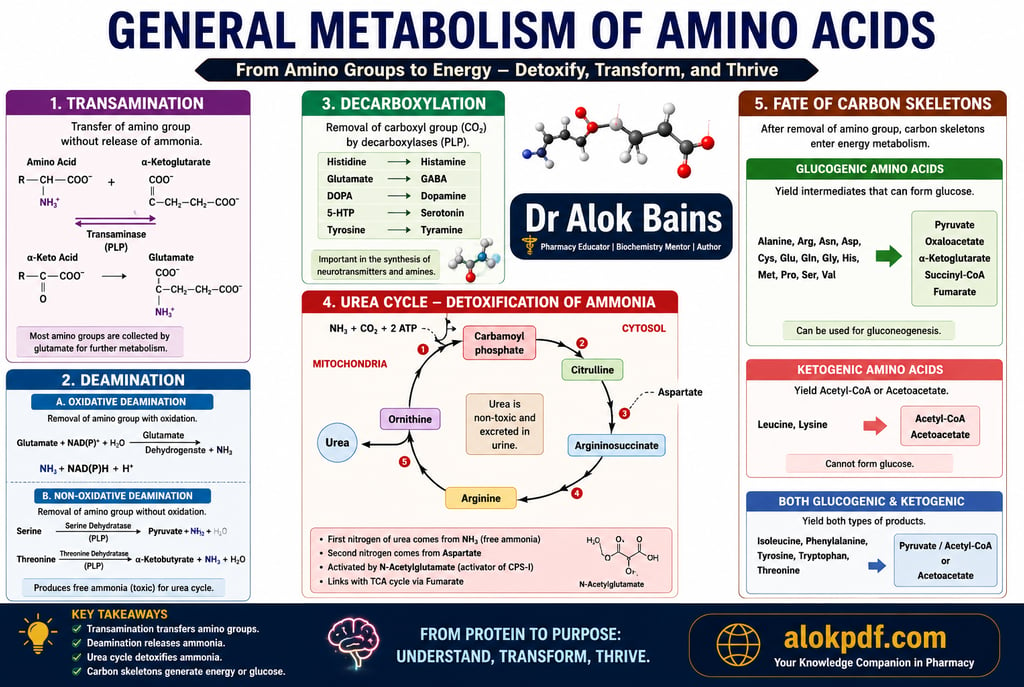
1. Transamination
Definition
Transamination is the transfer of an amino group (–NH₂) from one amino acid to an α-keto acid without releasing free ammonia.
General Reaction
Amino Acid + α-Ketoglutarate ⇌ α-Keto Acid + Glutamate
Enzymes
Aminotransferases (Transaminases)
Alanine aminotransferase (ALT/SGPT)
Aspartate aminotransferase (AST/SGOT)
Coenzyme
Pyridoxal phosphate (PLP)
Active form of Vitamin B₆
Importance
First step in amino acid breakdown.
Collects amino groups into glutamate.
Helps synthesize non-essential amino acids.
Does not release free ammonia.
Important Points for MCQs
✔ Requires Vitamin B₆ (PLP).
✔ α-Ketoglutarate is the major amino-group acceptor.
✔ Produces glutamate.
✔ Reversible reaction.
✔ Lysine and threonine generally do not undergo transamination.
2. Deamination
Deamination removes the amino group from amino acids, producing free ammonia (NH₃).
There are two major types.
A. Oxidative Deamination
Removal of an amino group with simultaneous oxidation, producing free ammonia.
Major Enzyme
Glutamate dehydrogenase (GDH)
Reaction
Glutamate → α-Ketoglutarate + NH₃
Cofactors
NAD⁺ or NADP⁺
Site
Liver mitochondria
Importance
Produces free ammonia for the urea cycle.
Regenerates α-ketoglutarate.
B. Non-Oxidative Deamination
Removal of an amino group without oxidation.
Examples
Serine → Pyruvate + NH₃
Threonine → α-Ketobutyrate + NH₃
Enzyme
Serine dehydratase
Threonine dehydratase
Difference Between Oxidative and Non-Oxidative Deamination
Feature Oxidative Deamination Non-Oxidative Deamination
Oxidation involved Yes No
Main enzyme Glutamate dehydrogenase Dehydratases
Cofactor NAD⁺/NADP⁺ Usually PLP
Main substrate Glutamate Serine, Threonine
Ammonia released Yes Yes
MCQ Tip
Transamination transfers NH₂.
Deamination removes NH₂.
3. Decarboxylation
Removal of the carboxyl group (CO₂) from an amino acid.
Enzyme
Amino acid decarboxylases
Coenzyme
Vitamin B₆ (PLP)
Importance
Produces many biologically active amines.
Examples
Amino Acid Product
Histidine Histamine
Glutamate GABA
DOPA Dopamine
5-Hydroxytryptophan Serotonin
Tyrosine Tyramine
Significance
Produces neurotransmitters.
Produces hormones.
Important in nervous system function.
MCQ Tip
Histidine → Histamine
Glutamate → GABA
These are commonly asked.
4. Urea Cycle (Nitrogen Disposal)
The urea cycle converts toxic ammonia into urea, which is safely excreted by the kidneys.
Site
Liver
Partly mitochondrial
Partly cytosolic
Why is it necessary?
Ammonia is highly toxic, especially to the brain.
The body converts ammonia into urea, which is
Non-toxic
Water-soluble
Easily excreted in urine
Steps of Urea Cycle (Easy Trick)
Step 1
Ammonia + CO₂
↓
Carbamoyl phosphate
Enzyme: Carbamoyl phosphate synthetase-I (CPS-I)
Activator: N-Acetylglutamate
Step 2
Carbamoyl phosphate + Ornithine
↓
Citrulline
Step 3
Citrulline + Aspartate
↓
Argininosuccinate
Step 4
Argininosuccinate
↓
Arginine + Fumarate
Step 5
Arginine
↓
Urea + Ornithine
Important Facts
Occurs only in the liver.
First, nitrogen comes from ammonia.
Second nitrogen comes from aspartate.
Fumarate links the urea cycle with the TCA cycle.
Urea is excreted through the kidneys.
MCQ points
Rate-limiting enzyme = CPS-I
Activator = N-Acetylglutamate
Hyperammonaemia occurs if the urea cycle is defective.
5. Fate of Carbon Skeletons
After removal of the amino group, the remaining carbon skeleton enters energy metabolism.
It may form:
Pyruvate
Acetyl-CoA
Acetoacetate
Oxaloacetate
α-Ketoglutarate
Succinyl-CoA
Fumarate
Glucogenic Amino Acids
These produce intermediates that can form glucose through gluconeogenesis.
Examples
Alanine
Glycine
Serine
Valine
Methionine
Histidine
Aspartate
End Products
Pyruvate
Oxaloacetate
Succinyl-CoA
Fumarate
α-Ketoglutarate
Ketogenic Amino Acids
These produce:
Acetyl-CoA
Acetoacetate
They cannot produce glucose.
Exclusively Ketogenic
Leucine
Lysine
Mnemonic
LL = Leucine & Lysine = Lipid Lovers
Both Glucogenic and Ketogenic
Isoleucine
Phenylalanine
Tyrosine
Tryptophan
Threonine
High-Yield Exam Facts
Vitamin B₆ is required for transamination and decarboxylation.
Glutamate is the central amino acid in nitrogen metabolism.
ALT and AST are markers of liver injury.
Glutamine transports ammonia safely in blood.
Alanine transports nitrogen from muscle to liver (Glucose–Alanine Cycle).
Only Leucine and Lysine are purely ketogenic.
Most amino acids are glucogenic.
Urea is synthesized only in the liver.
Hyperammonemia causes neurological symptoms.
Memory Tricks
Transamination
Transfer NH₂
(No free ammonia)
Deamination
Delete NH₂
(Free ammonia produced)
Decarboxylation
CO₂ removed
(Biogenic amines formed)
Urea Cycle
Ammonia → Urea → Urine
Ketogenic Amino Acids
LL = Leucine & Lysine
Quick Revision Table
Process Main Enzyme Product Key Point
Transamination ALT, AST Glutamate No free NH₃
Oxidative deamination Glutamate dehydrogenase NH₃ Uses NAD⁺/NADP⁺
Non-oxidative deamination Dehydratases NH₃ No oxidation
Decarboxylation Decarboxylase Biogenic amines PLP dependent
Urea cycle CPS-I Urea Liver only
Practice MCQs
1. Which coenzyme is required for both transamination and decarboxylation reactions?
A. FAD
B. NAD⁺
C. Pyridoxal phosphate (PLP)
D. Biotin
Answer: C. Pyridoxal phosphate (PLP)
2. The principal amino-group collector during amino acid metabolism is:
A. Pyruvate
B. Glutamate
C. Oxaloacetate
D. Citrate
Answer: B. Glutamate
3. Which amino acids are exclusively ketogenic?
A. Valine and Methionine
B. Leucine and Lysine
C. Phenylalanine and Tyrosine
D. Alanine and Glycine
Answer: B. Leucine and Lysine
4. Which enzyme catalyzes oxidative deamination?
A. ALT
B. AST
C. Glutamate dehydrogenase
D. Arginase
Answer: C. Glutamate dehydrogenase
5. The rate-limiting enzyme of the urea cycle is:
A. Arginase
B. Ornithine transcarbamylase
C. Carbamoyl phosphate synthetase-I
D. Argininosuccinate lyase
Answer: C. Carbamoyl phosphate synthetase-I
6. Histidine undergoes decarboxylation to form:
A. GABA
B. Histamine
C. Dopamine
D. Serotonin
Answer: B. Histamine
7. Which statement is correct?
A. Transamination releases free ammonia.
B. Oxidative deamination requires glutamate dehydrogenase.
C. Urea is synthesized in skeletal muscle.
D. Leucine is glucogenic.
Answer: B. Oxidative deamination requires glutamate dehydrogenase.
Exam Tip
For competitive pharmacy examinations, remember the sequence:
Transamination → Deamination → Urea Cycle → Carbon Skeleton Utilisation.
MCQs
1. Which enzyme requires pyridoxal phosphate (PLP) as a coenzyme and transfers an amino group without releasing free ammonia?
A. Glutamate dehydrogenase
B. Alanine aminotransferase (ALT)
C. Carbamoyl phosphate synthetase I
D. Arginase
Answer: B. Alanine aminotransferase (ALT)
Explanation:
ALT catalyses transamination, transferring an amino group from alanine to α-ketoglutarate, producing pyruvate and glutamate. PLP (vitamin B6) is the essential coenzyme. Glutamate dehydrogenase performs oxidative deamination, CPS-I catalyses the first step of the urea cycle, and arginase hydrolyses arginine to urea.
2. During amino acid catabolism, most amino groups are first transferred to:
A. Oxaloacetate
B. Pyruvate
C. α-Ketoglutarate
D. Succinyl-CoA
Answer: C. α-Ketoglutarate
Explanation:
Most transaminases transfer amino groups to α-ketoglutarate, forming glutamate, which acts as the major collector of amino groups before ammonia is released through oxidative deamination.
3. Which statement best explains the physiological importance of transamination?
A. It directly produces urea.
B. It converts amino acids into fatty acids.
C. It funnels amino groups to glutamate before ammonia release.
D. It produces ATP directly.
Answer: C. It funnels amino groups to glutamate before ammonia release.
Explanation:
Transamination safely transfers amino groups to glutamate, preventing accumulation of toxic free ammonia. Urea is formed later through the urea cycle.
4. Glutamate dehydrogenase catalyses:
A. Decarboxylation of glutamate
B. Oxidative deamination of glutamate
C. Transamination of glutamate
D. Amidation of glutamate
Answer: B. Oxidative deamination of glutamate
Explanation:
Glutamate dehydrogenase removes the amino group from glutamate as free ammonia using NAD⁺ or NADP⁺, producing α-ketoglutarate.
5. Which amino acid cannot undergo transamination?
A. Alanine
B. Aspartate
C. Lysine
D. Glutamate
Answer: C. Lysine
Explanation:
Lysine (along with threonine) generally does not undergo transamination because unstable cyclic intermediates would be formed.
6. Which vitamin deficiency most severely impairs transamination reactions?
A. Vitamin B₁
B. Vitamin B₂
C. Vitamin B₆
D. Vitamin B₁₂
Answer: C. Vitamin B₆
Explanation:
PLP, the active form of vitamin B₆, is the coenzyme required by all aminotransferases.
7. The major source of free ammonia entering the urea cycle is:
A. Alanine aminotransferase
B. Glutamate dehydrogenase
C. Arginase
D. Aspartate aminotransferase
Answer: B. Glutamate dehydrogenase
Explanation:
Oxidative deamination of glutamate by glutamate dehydrogenase releases free ammonia, which enters the urea cycle.
8. Which enzyme catalyses the first committed step of the urea cycle?
A. Carbamoyl phosphate synthetase I
B. Carbamoyl phosphate synthetase II
C. Ornithine transcarbamylase
D. Argininosuccinate synthetase
Answer: A. Carbamoyl phosphate synthetase I
Explanation:
CPS-I is located in mitochondria and uses free ammonia to synthesise carbamoyl phosphate.
9. Carbamoyl phosphate synthetase I is activated by:
A. ATP
B. Citrulline
C. N-Acetylglutamate
D. Arginine
Answer: C. N-Acetylglutamate
Explanation:
N-Acetylglutamate is the obligatory allosteric activator of CPS-I.
10. Which amino acid directly donates the second nitrogen atom of urea?
A. Glutamine
B. Glutamate
C. Aspartate
D. Alanine
Answer: C. Aspartate
Explanation:
One nitrogen of urea comes from free ammonia, while the second originates from aspartate.
11. Ornithine participates in the urea cycle by:
A. Being converted to glutamate
B. Acting as a catalytic carrier of carbamoyl groups
C. Donating ammonia directly
D. Producing ATP
Answer: B. Acting as a catalytic carrier of carbamoyl groups
Explanation:
Ornithine combines with carbamoyl phosphate to form citrulline and is regenerated at the end of the cycle.
12. Which step of the urea cycle occurs in the cytosol?
A. Formation of carbamoyl phosphate
B. Formation of citrulline
C. Formation of argininosuccinate
D. Activation of CPS-I
Answer: C. Formation of argininosuccinate
Explanation:
Only the first two reactions occur in mitochondria; the remaining reactions occur in the cytosol.
13. The immediate product formed after ornithine combines with carbamoyl phosphate is:
A. Arginine
B. Citrulline
C. Argininosuccinate
D. Fumarate
Answer: B. Citrulline
Explanation:
Ornithine transcarbamylase catalyzes the formation of citrulline.
14. Which intermediate links the urea cycle with the TCA cycle?
A. Citrulline
B. Fumarate
C. Ornithine
D. Carbamoyl phosphate
Answer: B. Fumarate
Explanation:
Fumarate enters the TCA cycle, forming the aspartate-argininosuccinate shunt.
15. Hyperammonemia primarily affects the brain because:
A. Ammonia inhibits glycolysis.
B. Excess glutamine causes osmotic swelling of astrocytes.
C. It blocks fatty acid oxidation.
D. It inhibits glycogen synthesis.
Answer: B. Excess glutamine causes osmotic swelling of astrocytes.
Explanation:
Ammonia is detoxified to glutamine in astrocytes. Excess glutamine causes cerebral edema and neurological dysfunction.
16. Which amino acid is exclusively ketogenic?
A. Phenylalanine
B. Tyrosine
C. Leucine
D. Isoleucine
Answer: C. Leucine
Explanation:
Only leucine and lysine are exclusively ketogenic.
17. Which amino acid is both glucogenic and ketogenic?
A. Lysine
B. Leucine
C. Isoleucine
D. Alanine
Answer: C. Isoleucine
Explanation:
Isoleucine yields acetyl-CoA (ketogenic) and succinyl-CoA (glucogenic).
18. Which amino acid is exclusively glucogenic?
A. Valine
B. Leucine
C. Lysine
D. Acetyl-CoA
Answer: A. Valine
Explanation:
Valine forms succinyl-CoA and contributes to gluconeogenesis.
19. The carbon skeleton of alanine is converted into:
A. Oxaloacetate
B. Pyruvate
C. Acetyl-CoA
D. Fumarate
Answer: B. Pyruvate
Explanation:
ALT converts alanine into pyruvate through transamination.
20. Which amino acid directly forms oxaloacetate?
A. Aspartate
B. Leucine
C. Lysine
D. Histidine
Answer: A. Aspartate
Explanation:
Aspartate is transaminated to oxaloacetate.
21. Which enzyme catalyzes non-oxidative deamination?
A. Glutamate dehydrogenase
B. Serine dehydratase
C. ALT
D. AST
Answer: B. Serine dehydratase
Explanation:
Serine dehydratase removes ammonia without oxidation, producing pyruvate.
22. Decarboxylation of histidine produces:
A. Histamine
B. Dopamine
C. GABA
D. Serotonin
Answer: A. Histamine
Explanation:
Histidine decarboxylase forms histamine, an important inflammatory mediator.
23. Which neurotransmitter is formed by decarboxylation of glutamate?
A. Dopamine
B. Serotonin
C. GABA
D. Histamine
Answer: C. GABA
Explanation:
Glutamate decarboxylase converts glutamate to γ-aminobutyric acid (GABA).
24. Which amino acid is the major transporter of ammonia from peripheral tissues to the liver?
A. Glycine
B. Glutamine
C. Serine
D. Methionine
Answer: B. Glutamine
Explanation:
Glutamine safely transports ammonia through the bloodstream.
25. During prolonged fasting, skeletal muscle transports amino nitrogen mainly as:
A. Glycine
B. Arginine
C. Alanine
D. Histidine
Answer: C. Alanine
Explanation:
The glucose-alanine cycle transports nitrogen to the liver while providing pyruvate for gluconeogenesis.
26. Which reaction directly generates free ammonia in kidney tissue to help maintain acid-base balance?
A. ALT reaction
B. Glutaminase reaction
C. AST reaction
D. Hexokinase reaction
Answer: B. Glutaminase reaction
Explanation:
Renal glutaminase liberates ammonia, which buffers urinary H⁺ ions as NH₄⁺.
27. The urea cycle primarily functions in:
A. Kidney cortex
B. Liver hepatocytes
C. Skeletal muscle
D. Brain
Answer: B. Liver hepatocytes
Explanation:
The liver is the principal site of urea synthesis.
28. Which pair of amino acids is exclusively ketogenic?
A. Leucine and Lysine
B. Valine and Leucine
C. Isoleucine and Lysine
D. Phenylalanine and Tyrosine
Answer: A. Leucine and Lysine
Explanation:
Only leucine and lysine produce ketone body precursors exclusively.
29. A deficiency of ornithine transcarbamylase would most likely result in:
A. Hypoglycemia without hyperammonemia
B. Hyperammonemia due to impaired urea synthesis
C. Increased ketone body formation only
D. Increased glycogen storage
Answer: B. Hyperammonemia due to impaired urea synthesis
Explanation:
OTC deficiency blocks the urea cycle, causing ammonia accumulation.
30. Which statement regarding amino acid metabolism is correct?
A. All amino acids are glucogenic.
B. All amino acids undergo transamination.
C. Glutamate occupies a central role in nitrogen metabolism.
D. Urea is synthesised mainly in skeletal muscle.
Answer: C. Glutamate occupies a central role in nitrogen metabolism.
Explanation:
Glutamate acts as the principal amino-group collector through transamination and releases ammonia via oxidative deamination. Not all amino acids are glucogenic; lysine and threonine do not normally undergo transamination, and urea is synthesised in the liver.
Dr. Alok Singh