GI Tract MCQs for GPAT
Practice high-yield GI tract MCQs for GPAT, NIPER, AIIMS Pharmacist, Railway Pharmacist, SSC, ESIC, and State Pharmacist exams. Solve conceptual questions on stomach acid secretion, pepsin, liver, pancreas, salivary glands, digestion, absorption, intestinal anatomy
Dr. Alok Singh
7/3/20266 min read
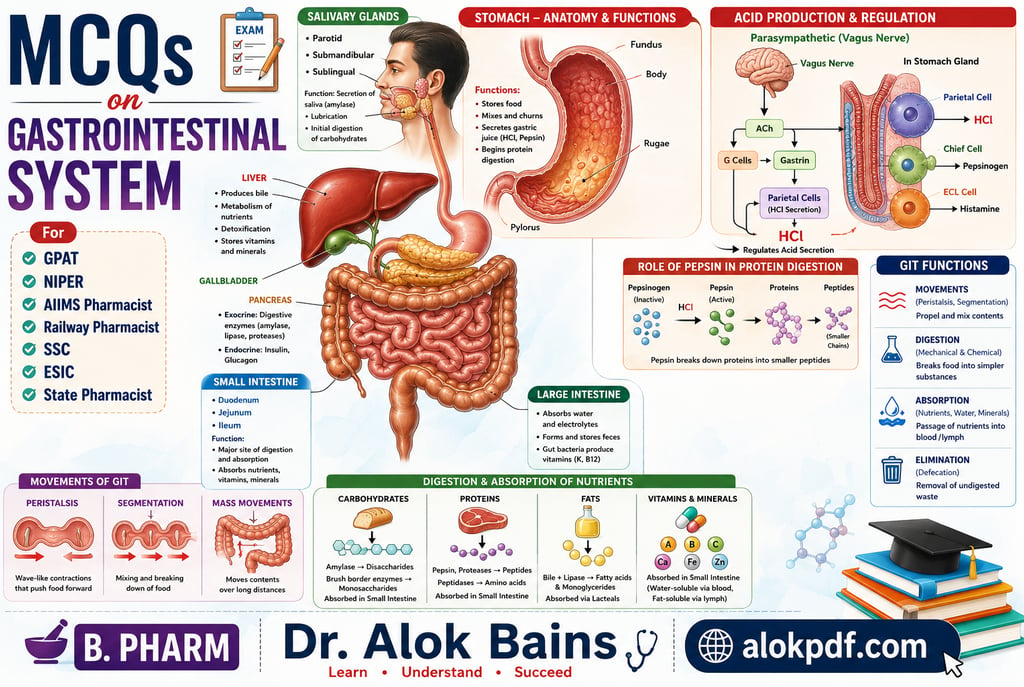
MCQs on Anatomy and Physiology of the Gastrointestinal Tract. Suitable for GPAT, NIPER, AIIMS Pharmacist, Railway Pharmacist, SSC, ESIC & State Pharmacist Examinations
Quick Revision Notes: Gastrointestinal Tract (GIT)
1. Stomach
The stomach is a muscular, J-shaped organ located in the upper left abdomen.
It stores food, mixes it with gastric juice, and begins protein digestion.
Major parts: Cardia, Fundus, Body, and Pylorus.
Gastric glands contain different types of secretory cells.
Cell Functions
Cell Secretion Function
Parietal cells HCl, Intrinsic factor Acid secretion, Vitamin B12 absorption
Chief cells Pepsinogen Protein digestion
G cells Gastrin Stimulates acid secretion
D cells Somatostatin Inhibits acid secretion
Mucous cells Mucus + HCO₃⁻ Protect gastric mucosa
Exam Tip: Parietal = HCl + Intrinsic Factor; Chief = Pepsinogen.
2. Hydrochloric Acid (HCl) Secretion
Functions
Activates pepsinogen into pepsin.
Denatures proteins.
Kills ingested microorganisms.
Facilitates iron absorption.
Regulation
Three major stimulators:
Acetylcholine (Vagus nerve): M3 receptor
Gastrin: G cells
Histamine: H₂ receptor
Major inhibitor:
Somatostatin
Mnemonic: A-G-H stimulates acid
A = Acetylcholine
G = Gastrin
H = Histamine
3. Pepsin
Secreted as inactive pepsinogen by chief cells.
Activated by hydrochloric acid.
Digests proteins into smaller peptides.
Functions best at pH 1.5–2.5.
Exam Tip: Pepsin is the only major proteolytic enzyme active in the stomach.
4. Small Intestine
Longest part of the digestive tract (about 6 m).
Divided into:
Duodenum
Jejunum
Ileum
Functions
Digestion of carbohydrates, proteins, and fats.
Absorption of nutrients.
Absorption of vitamins and minerals.
Important Absorption Sites
Duodenum: Iron, Calcium
Jejunum: Most nutrients
Terminal Ileum: Vitamin B12 and bile salts
Exam Tip: Maximum absorption occurs in the jejunum.
5. Large Intestine
Parts:
Cecum
Colon
Rectum
Anal canal
Functions
Absorbs water and electrolytes.
Forms and stores feces.
Produces Vitamin K and some B vitamins through intestinal bacteria.
Exam Tip: The large intestine absorbs water, not nutrients.
6. Salivary Glands
Three pairs:
Parotid
Submandibular
Sublingual
Functions
Lubricates food.
Begins carbohydrate digestion.
Facilitates swallowing.
Protects the oral cavity.
Salivary Enzymes
Salivary amylase → Starch digestion
Lingual lipase → Fat digestion (minor)
Exam Tip: The submandibular gland produces the majority of resting saliva.
7. Pancreas
The pancreas has both exocrine and endocrine functions.
Exocrine Secretions
Trypsinogen
Chymotrypsinogen
Pancreatic amylase
Pancreatic lipase
Bicarbonate
Functions
Digests proteins, carbohydrates, and fats.
Neutralizes acidic chyme entering the duodenum.
Hormonal Regulation
Secretin: Increases bicarbonate secretion.
CCK: Increases enzyme secretion and gallbladder contraction.
Exam Tip: Secretin = Bicarbonate; CCK = Enzymes + Gallbladder contraction.
8. Liver
The largest gland in the human body.
Major Functions
Produces bile.
Metabolizes carbohydrates, fats, and proteins.
Stores glycogen, iron, and vitamins.
Detoxifies drugs and toxins.
Synthesizes plasma proteins.
Produces clotting factors.
Bile Functions
Emulsifies fats.
Helps absorption of fat-soluble vitamins (A, D, E, K).
Exam Tip: The liver produces bile; the gallbladder stores and concentrates it.
9. Gallbladder
Functions
Stores bile.
Concentrates bile.
Releases bile after fatty meals.
Hormone
CCK causes gallbladder contraction.
10. Gastrointestinal Movements
Peristalsis
Wave-like contraction.
Propels food forward.
Segmentation
Mixing movement.
Enhances digestion and absorption.
Mass Movement
Powerful colonic contraction.
Moves feces toward the rectum.
Exam Tip: Peristalsis = Propulsion; Segmentation = Mixing.
11. Digestion of Carbohydrates
Site Enzyme
Mouth Salivary amylase
Small intestine Pancreatic amylase
Brush border Maltase, Lactase, Sucrase
Final products:
Glucose
Fructose
Galactose
12. Digestion of Proteins
Site Enzyme
Stomach: Pepsin
Small intestine: Trypsin, Chymotrypsin, Carboxypeptidase
Final products:
Amino acids
Small peptides
13. Digestion of Fats
Steps:
Emulsification by bile salts.
Digestion by pancreatic lipase.
Formation of micelles.
Absorption.
Formation of chylomicrons.
Transport through lacteals.
Exam Tip: Bile salts digest nothing—they only emulsify fats.
14. Absorption of Nutrients
Carbohydrates
Absorbed mainly as monosaccharides.
Glucose and galactose use SGLT1.
Fructose uses GLUT5.
Proteins
Absorbed as amino acids and small peptides.
Fats
Absorbed as fatty acids and monoglycerides.
Transported as chylomicrons through lymphatics.
15. Enteric Nervous System
Two major plexuses:
Myenteric (Auerbach's) Plexus
Controls gastrointestinal motility.
Submucosal (Meissner's) Plexus
Controls secretion and local blood flow.
Exam Tip: Auerbach = Motility; Meissner = Secretion.
One-Liners for Competitive Exams
Largest digestive gland: Liver
Largest salivary gland: Parotid
Most saliva: Submandibular gland
Longest part of GIT: Small intestine
Maximum nutrient absorption: Jejunum
Iron absorption: Duodenum
Vitamin B12 absorption: Terminal ileum
Water absorption: Large intestine
Acid-secreting cells: Parietal cells
Pepsinogen-secreting cells: Chief cells
Intrinsic factor: Parietal cells
H₂ receptors: Histamine-mediated acid secretion
M3 receptors: Vagal stimulation of acid secretion
CCK: Gallbladder contraction and pancreatic enzyme secretion
Secretin: Pancreatic bicarbonate secretion
Pepsin: Protein digestion
Pancreatic lipase: Fat digestion
Lacteals: Fat absorption
Peristalsis: Propulsion
Segmentation: Mixing
Auerbach's plexus: Motility
Meissner's plexus: Secretion
Kupffer cells: Liver macrophages
1. Hydrochloric acid in the stomach is secreted by:
A. Chief cells
B. Goblet cells
C. Parietal cells
D. Enteroendocrine cells
Answer: C
Explanation: Parietal (oxyntic) cells secrete HCl and intrinsic factor.
2. Which enzyme initiates protein digestion in the stomach?
A. Trypsin
B. Pepsin
C. Chymotrypsin
D. Carboxypeptidase
Answer: B
Explanation: Pepsin is secreted as pepsinogen by chief cells and activated by HCl.
3. Pepsinogen is converted into pepsin primarily by:
A. Trypsin
B. HCl
C. Bile salts
D. Enterokinase
Answer: B
4. Which receptor mediates vagal stimulation of gastric acid secretion?
A. α1 receptor
B. β2 receptor
C. M3 muscarinic receptor
D. D2 receptor
Answer: C
5. Which hormone directly stimulates parietal cells?
A. Secretin
B. Gastrin
C. CCK
D. GIP
Answer: B
6. Which substance inhibits gastric acid secretion?
A. Histamine
B. Gastrin
C. Somatostatin
D. Acetylcholine
Answer: C
7. Histamine stimulates acid secretion through:
A. H1 receptors
B. H2 receptors
C. H3 receptors
D. H4 receptors
Answer: B
8. Which gastric cell secretes intrinsic factor?
A. Chief cell
B. Mucous cell
C. Parietal cell
D. G cell
Answer: C
9. Vitamin B12 absorption mainly occurs in the:
A. Duodenum
B. Jejunum
C. Ileum
D. Colon
Answer: C
10. The longest part of the alimentary canal is:
A. Esophagus
B. Stomach
C. Small intestine
D. Large intestine
Answer: C
11. Which part of the small intestine receives bile and pancreatic juice?
A. Jejunum
B. Ileum
C. Duodenum
D. Cecum
Answer: C
12. The major site of nutrient absorption is:
A. Stomach
B. Duodenum
C. Jejunum
D. Colon
Answer: C
13. Peyer's patches are abundant in:
A. Duodenum
B. Jejunum
C. Ileum
D. Colon
Answer: C
14. Which intestinal structure greatly increases absorptive surface area?
A. Rugae
B. Gastric pits
C. Villi and microvilli
D. Haustra
Answer: C
15. Iron is mainly absorbed from the:
A. Ileum
B. Colon
C. Duodenum
D. Rectum
Answer: C
16. Calcium absorption primarily occurs in:
A. Colon
B. Ileum
C. Duodenum
D. Rectum
Answer: C
17. Bile salts are reabsorbed mainly from:
A. Duodenum
B. Jejunum
C. Terminal ileum
D. Cecum
Answer: C
18. Which vitamin requires intrinsic factor for absorption?
A. Vitamin A
B. Vitamin D
C. Vitamin B12
D. Vitamin C
Answer: C
19. The primary function of bile salts is:
A. Digest proteins
B. Digest carbohydrates
C. Emulsify fats
D. Digest DNA
Answer: C
20. The largest digestive gland is the:
A. Pancreas
B. Liver
C. Salivary gland
D. Gallbladder
Answer: B
21. Which liver cells perform phagocytosis?
A. Hepatocytes
B. Kupffer cells
C. Stellate cells
D. Cholangiocytes
Answer: B
22. Bile is stored and concentrated in the:
A. Liver
B. Pancreas
C. Gallbladder
D. Duodenum
Answer: C
23. Which pancreatic cells secrete digestive enzymes?
A. Alpha cells
B. Beta cells
C. Acinar cells
D. Delta cells
Answer: C
24. Bicarbonate-rich pancreatic secretion is produced by:
A. Acinar cells
B. Islets
C. Duct cells
D. Alpha cells
Answer: C
25. Secretin primarily stimulates:
A. Gastrin secretion
B. Acid secretion
C. Pancreatic bicarbonate secretion
D. Pepsin secretion
Answer: C
26. Cholecystokinin (CCK) primarily stimulates:
A. Gastric acid secretion
B. Gallbladder contraction
C. Colon motility
D. Saliva secretion
Answer: B
27. Which salivary gland contributes about 70% of resting saliva?
A. Parotid
B. Sublingual
C. Submandibular
D. Buccal
Answer: C
28. The largest salivary gland is:
A. Sublingual
B. Buccal
C. Submandibular
D. Parotid
Answer: D
29. Salivary amylase begins digestion of:
A. Protein
B. Fat
C. Starch
D. Cellulose
Answer: C
30. Lingual lipase mainly digests:
A. Proteins
B. Fats
C. Carbohydrates
D. Vitamins
Answer: B
31. The enteric nervous system consists of:
A. Sympathetic chain only
B. Myenteric and submucosal plexuses
C. Cranial nerves only
D. Spinal nerves only
Answer: B
32. Which plexus regulates GI motility?
A. Meissner's plexus
B. Auerbach's plexus
C. Cardiac plexus
D. Pulmonary plexus
Answer: B
33. Meissner's plexus primarily controls:
A. Skeletal muscle
B. GI secretion
C. Respiration
D. Vision
Answer: B
34. Segmentation movements primarily function to:
A. Propel food rapidly
B. Mix intestinal contents
C. Cause vomiting
D. Produce bile
Answer: B
35. Peristalsis mainly serves to:
A. Digest fat
B. Propel food forward
C. Produce enzymes
D. Neutralize acid
Answer: B
36. Which phase of gastric secretion is mediated predominantly by the vagus nerve?
A. Intestinal phase
B. Gastric phase
C. Cephalic phase
D. Colonic phase
Answer: C
37. Gastric emptying is slowed by:
A. Gastrin
B. Parasympathetic stimulation
C. Fat in the duodenum
D. Hunger
Answer: C
38. The brush-border enzyme that activates trypsinogen is:
A. Pepsin
B. Enteropeptidase
C. Amylase
D. Lipase
Answer: B
39. Trypsin activates:
A. Pepsinogen only
B. Other pancreatic proteases
C. Salivary amylase
D. HCl
Answer: B
40. Pancreatic lipase requires which substance for optimal activity?
A. Gastrin
B. Pepsin
C. Bile salts
D. Histamine
Answer: C
41. Most carbohydrate digestion is completed in the:
A. Mouth
B. Stomach
C. Small intestine
D. Colon
Answer: C
42. Glucose absorption occurs mainly by:
A. Passive diffusion
B. Na+-glucose cotransporter (SGLT1)
C. Endocytosis
D. Osmosis
Answer: B
43. Fructose is absorbed mainly through:
A. GLUT5
B. SGLT1
C. GLUT2 only
D. Na+/K+ ATPase
Answer: A
44. Amino acids are absorbed mainly by:
A. Passive diffusion only
B. Active transport
C. Pinocytosis only
D. Simple osmosis
Answer: B
45. Most lipid absorption occurs in the form of:
A. Free triglycerides
B. Chylomicrons
C. HDL
D. LDL
Answer: B
46. Chylomicrons enter the circulation through:
A. Portal vein
B. Lacteals
C. Hepatic vein
D. Renal vein
Answer: B
47. Which part of the GIT absorbs most water?
A. Stomach
B. Small intestine
C. Rectum
D. Esophagus
Answer: B
48. The principal function of the large intestine is:
A. Protein digestion
B. Water and electrolyte absorption
C. Fat digestion
D. Pepsin secretion
Answer: B
49. Vitamin K is synthesized by:
A. Liver
B. Gastric glands
C. Intestinal bacteria
D. Pancreas
Answer: C
50. Which combination correctly matches the digestive organ and its secretion?
A. Chief cell – HCl
B. Parietal cell – Pepsinogen
C. Acinar cell – Digestive enzymes
D. Goblet cell – Bile
Answer: C
Revision Points (One-Liners)
Parietal cells: HCl + Intrinsic factor
Chief cells: Pepsinogen
G cells: Gastrin
ECL cells: Histamine
D cells: Somatostatin
Vagus nerve (M3): ↑ Gastric acid secretion
H2 receptor: Histamine-mediated acid secretion
Duodenum: Iron and calcium absorption
Jejunum: Maximum nutrient absorption
Terminal ileum: Vitamin B12 and bile salt absorption
Large intestine: Water and electrolyte absorption
Liver: Largest gland
Pancreatic acinar cells: Digestive enzymes
Pancreatic duct cells: Bicarbonate
Secretin: Bicarbonate secretion
CCK: Gallbladder contraction and pancreatic enzyme secretion
Salivary amylase: Starch digestion
Pepsin: Protein digestion
Trypsin: Activates other pancreatic proteases
Segmentation: Mixing
Peristalsis: Propulsion
Auerbach's plexus: Motility
Meissner's plexus: Secretion
Lacteals: Fat absorption
Portal vein: Carbohydrates and amino acids to the liver
Kupffer cells: Liver macrophages
Dr. Alok Singh