GPAT Cell Biology MCQs
Master GPAT Cell Biology MCQs covering membrane transport, cell division, cell junctions, and intracellular signaling pathways. Includes exam-oriented questions for B.Pharm, GPAT, NIPER, AIIMS Pharmacist, Railway Pharmacist, SSC, ESIC, and State Pharmacist exams.
Dr. Alok Singh
6/14/20264 min read
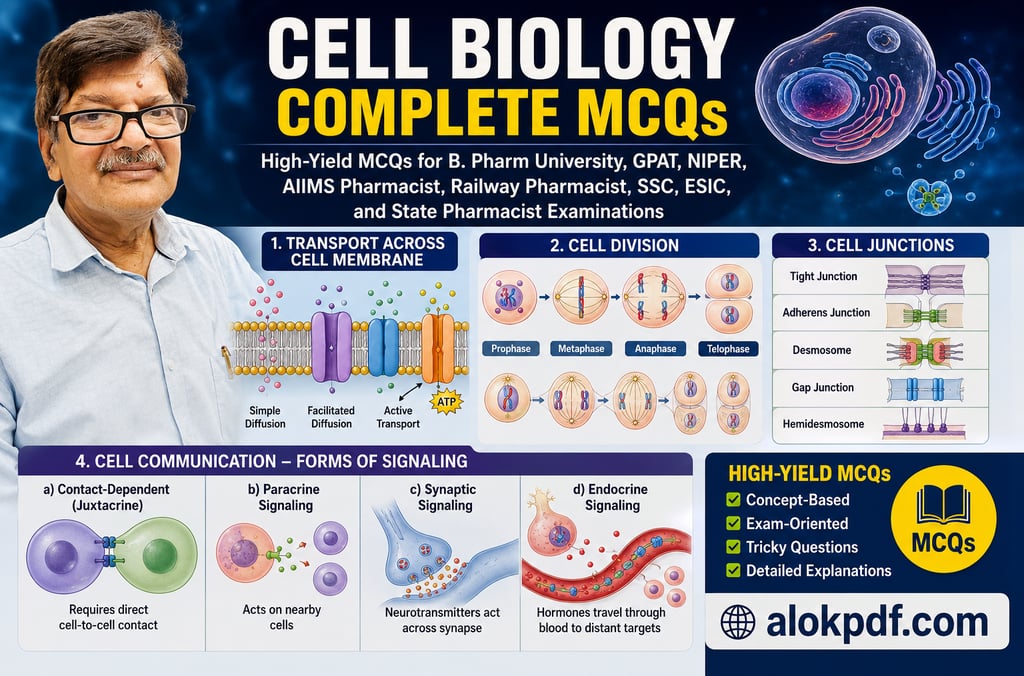
MCQs Transport Across Cell Membrane, Cell Division, Cell Junctions & Cell Communication
(B.Pharm University, GPAT, NIPER, AIIMS Pharmacist, Railway Pharmacist, SSC, ESIC & State Pharmacist Exams)
1. Which transport mechanism requires a carrier protein but does NOT directly utilize ATP?
A. Primary active transport
B. Secondary active transport
C. Facilitated diffusion
D. Endocytosis
Answer: C. Facilitated diffusion
Explanation: Facilitated diffusion uses carrier proteins, but movement occurs down the concentration gradient without ATP expenditure.
2. The Na⁺/K⁺-ATPase pump transports:
A. 2 Na⁺ out and 3 K⁺ in
B. 3 Na⁺ out and 2 K⁺ in
C. 3 Na⁺ in and 2 K⁺ out
D. Equal numbers of Na⁺ and K⁺
Answer: B. 3 Na⁺ out and 2 K⁺ in
Explanation: This electrogenic pump maintains the resting membrane potential.
3. Which of the following is an example of secondary active transport?
A. Na⁺/K⁺ pump
B. GLUT4 transporter
C. Na⁺-glucose cotransporter
D. Aquaporin
Answer: C. Na⁺-glucose cotransporter
Explanation: It utilizes the sodium gradient established by the Na⁺/K⁺ pump.
4. Water movement across a semipermeable membrane due to osmotic pressure is called:
A. Filtration
B. Diffusion
C. Osmosis
D. Pinocytosis
Answer: C. Osmosis
5. Which process is MOST likely to exhibit saturation kinetics?
A. Simple diffusion
B. Osmosis
C. Facilitated diffusion
D. Filtration
Answer: C. Facilitated diffusion
Explanation: Carrier proteins become saturated at high substrate concentrations.
6. Receptor-mediated endocytosis involves:
A. Nonspecific uptake of extracellular fluid
B. Uptake through ligand-receptor interaction
C. Exocytosis of proteins
D. Passive membrane transport
Answer: B. Uptake through ligand-receptor interaction
7. Which membrane transport process can move substances against their concentration gradient?
A. Simple diffusion
B. Facilitated diffusion
C. Active transport
D. Osmosis
Answer: C. Active transport
8. The movement of water through aquaporins is best described as:
A. Primary active transport
B. Secondary active transport
C. Facilitated diffusion
D. Pinocytosis
Answer: C. Facilitated diffusion
9. A red blood cell placed in a hypotonic solution will:
A. Shrink
B. Remain unchanged
C. Swell and may burst
D. Lose water
Answer: C. Swell and may burst
10. Which cellular process is responsible for the uptake of large solid particles?
A. Pinocytosis
B. Phagocytosis
C. Exocytosis
D. Diffusion
Answer: B. Phagocytosis
11. DNA replication occurs during which phase of the cell cycle?
A. G1 phase
B. S phase
C. G2 phase
D. M phase
Answer: B. S phase
12. During mitosis, chromosomes align at the equatorial plate in:
A. Prophase
B. Metaphase
C. Anaphase
D. Telophase
Answer: B. Metaphase
13. Separation of sister chromatids occurs during:
A. Prophase
B. Metaphase
C. Anaphase
D. Telophase
Answer: C. Anaphase
14. Crossing over occurs during:
A. Mitotic prophase
B. Meiotic prophase I
C. Metaphase II
D. Anaphase II
Answer: B. Meiotic prophase I
15. Which meiotic stage is characterized by the pairing of homologous chromosomes?
A. Leptotene
B. Zygotene
C. Diplotene
D. Diakinesis
Answer: B. Zygotene
16. The chromosome number is reduced by half during:
A. Mitosis
B. Meiosis I
C. Meiosis II
D. Cytokinesis
Answer: B. Meiosis I
17. The spindle fibers are primarily composed of:
A. Actin filaments
B. Intermediate filaments
C. Microtubules
D. Collagen fibers
Answer: C. Microtubules
18. Which phase immediately follows DNA synthesis?
A. G1
B. G2
C. Mitosis
D. Cytokinesis
Answer: B. G2
19. A human somatic cell after mitosis produces:
A. Four haploid cells
B. Two diploid cells
C. Four diploid cells
D. Two haploid cells
Answer: B. Two diploid cells
20. Which checkpoint ensures DNA replication is complete before mitosis begins?
A. G1 checkpoint
B. G2 checkpoint
C. Metaphase checkpoint
D. Cytokinesis checkpoint
Answer: B. G2 checkpoint
21. Tight junctions primarily function to:
A. Provide mechanical strength
B. Prevent paracellular diffusion
C. Facilitate cell communication
D. Anchor cells to the basement membrane
Answer: B. Prevent paracellular diffusion
22. Gap junctions allow direct passage of:
A. Proteins only
B. DNA fragments
C. Ions and small molecules
D. Lipids only
Answer: C. Ions and small molecules
23. Desmosomes are particularly abundant in:
A. Cardiac muscle and epidermis
B. Neurons
C. Liver cells only
D. Red blood cells
Answer: A. Cardiac muscle and epidermis
24. Hemidesmosomes attach epithelial cells to:
A. Adjacent epithelial cells
B. Gap junctions
C. Basement membrane
D. Cytoplasm
Answer: C. Basement membrane
25. Which junction is MOST important for synchronized contraction of cardiac muscle?
A. Tight junction
B. Desmosome
C. Gap junction
D. Hemidesmosome
Answer: C. Gap junction
26. Contact-dependent signaling requires:
A. Hormone secretion into the blood
B. Direct cell-to-cell contact
C. Neurotransmitter release
D. Diffusion through extracellular fluid
Answer: B. Direct cell-to-cell contact
27. Which signaling type acts on neighboring cells without entering systemic circulation?
A. Endocrine
B. Synaptic
C. Paracrine
D. Intracrine
Answer: C. Paracrine
28. Nitric oxide signaling is a classic example of:
A. Endocrine signaling
B. Paracrine signaling
C. Synaptic signaling
D. Contact-dependent signaling
Answer: B. Paracrine signaling
29. Neurotransmitters released into the synaptic cleft mediate:
A. Endocrine signaling
B. Paracrine signaling
C. Synaptic signaling
D. Contact signaling
Answer: C. Synaptic signaling
30. Which signaling mechanism typically produces the fastest cellular response?
A. Endocrine
B. Paracrine
C. Synaptic
D. Contact-dependent
Answer: C. Synaptic
31. Insulin acts primarily through:
A. Contact-dependent signaling
B. Synaptic signaling
C. Endocrine signaling
D. Paracrine signaling
Answer: C. Endocrine signaling
32. Which statement regarding endocrine signaling is CORRECT?
A. Signals act only on adjacent cells.
B. Hormones travel through the blood to distant targets.
C. Requires direct membrane contact.
D. Occurs only in neurons.
Answer: B. Hormones travel through blood to distant targets.
33. A signaling molecule affecting the same cell that secreted it is called:
A. Endocrine signaling
B. Synaptic signaling
C. Autocrine signaling
D. Contact-dependent signaling
Answer: C. Autocrine signaling
34. Which of the following is NOT a form of intercellular communication?
A. Contact-dependent
B. Paracrine
C. Endocrine
D. Glycolysis
Answer: D. Glycolysis
35. The major advantage of synaptic signaling over endocrine signaling is:
A. Greater diffusion distance
B. Faster and highly specific communication
C. Longer duration of action
D. Requirement of blood transport
Answer: B. Faster and highly specific communication
36. Ouabain inhibits Na⁺/K⁺-ATPase. Its immediate effect is:
A. Increased K⁺ uptake
B. Increased Na⁺ extrusion
C. Accumulation of intracellular Na⁺
D. Enhanced glucose transport
Answer: C. Accumulation of intracellular Na⁺
37. Which cell junction primarily contributes to the blood-brain barrier?
A. Gap junction
B. Tight junction
C. Desmosome
D. Hemidesmosome
Answer: B. Tight junction
38. During meiosis, genetic diversity mainly results from:
A. Cytokinesis
B. DNA repair
C. Crossing over and independent assortment
D. Chromosome condensation
Answer: C. Crossing over and independent assortment
39. Which transport process is BOTH carrier-mediated and energy-independent?
A. Primary active transport
B. Secondary active transport
C. Facilitated diffusion
D. Endocytosis
Answer: C. Facilitated diffusion
40. A hormone released into the blood and acting on a distant organ is an example of:
A. Synaptic signaling
B. Endocrine signaling
C. Paracrine signaling
D. Juxtacrine signaling
Answer: B. Endocrine signaling
Exam Trap Points
Simple diffusion: No carrier, no saturation.
Facilitated diffusion: Carrier-mediated, saturable, no ATP.
Primary active transport: Direct ATP use.
Secondary active transport: Uses ion gradient energy.
Crossing over: Prophase I (Pachytene).
Chromosome number reduced → Meiosis I
Tight junction: Barrier function.
Gap junction: Cell communication.
Desmosome: Mechanical strength.
Hemidesmosome: Cell-basement membrane attachment.
Paracrine: Nearby cells.
Synaptic: Neuron to target cell.
Endocrine: Hormones via blood.
Contact-dependent (juxtacrine): Direct membrane contact.
Dr Alok Singh