
GPAT MCQs on Skeletal Muscle and Muscle Contraction
Practice GPAT and pharmacist recruitment exam GPAT MCQs on Skeletal Muscle and Muscle Contraction, skeletal muscle physiology, neuromuscular junction, joints, rheumatoid arthritis, osteoporosis, and gout.
Dr. Alok Singh
6/20/20265 min read
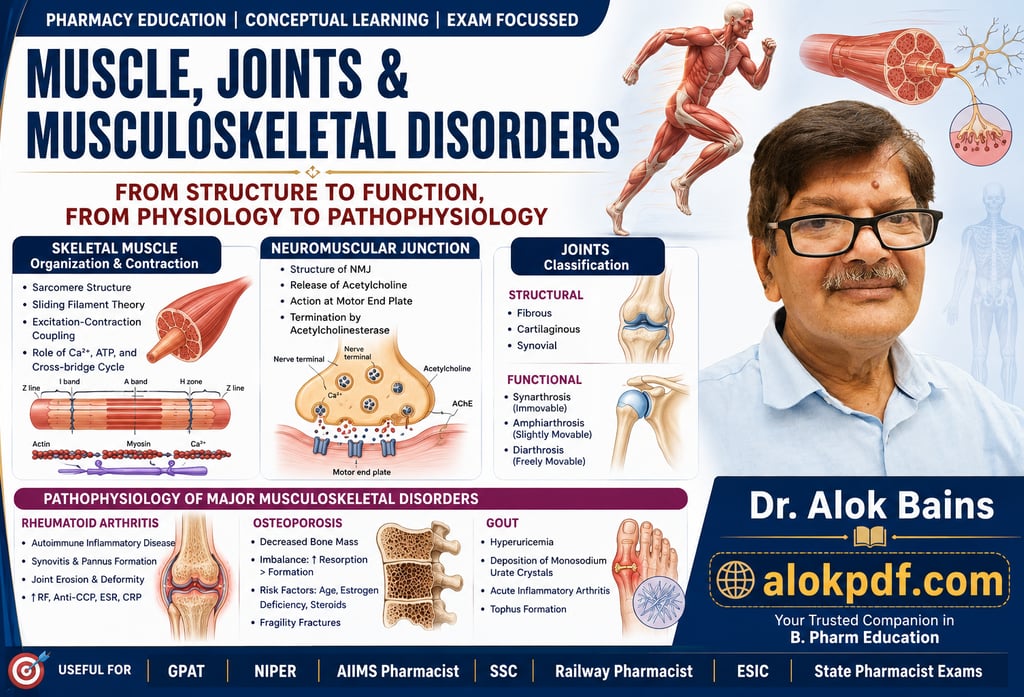
MCQs on Skeletal Muscle, Muscle Contraction, Neuromuscular Junction, Joints, Rheumatoid Arthritis, Osteoporosis, and Gout
1. The functional contractile unit of skeletal muscle is:
A. Myofibril
B. Sarcolemma
C. Sarcomere
D. Fascicle
Answer: C. Sarcomere
2. Which band remains unchanged in length during skeletal muscle contraction?
A. A band
B. I band
C. H zone
D. Z line
Answer: A. A band
Explanation: The length of thick filaments does not change during contraction.
3. The protein responsible for binding calcium during muscle contraction is
A. Tropomyosin
B. Troponin C
C. Troponin I
D. Myosin
Answer: B. Troponin C
4. Which structure anchors thin filaments in a sarcomere?
A. M line
B. H zone
C. Z line
D. A band
Answer: C. Z line
5. During maximal contraction of skeletal muscle, which structure may disappear?
A. A band
B. Z line
C. H zone
D. Sarcolemma
Answer: C. H zone
6. ATP is directly required for:
A. Exposure of active sites on actin
B. Calcium release from SR only
C. Detachment of myosin head from actin
D. Troponin activation
Answer: C. Detachment of myosin head from actin
7. In rigor mortis, muscles become stiff because:
A. Excess ATP is present
B. Calcium is absent
C. Myosin cannot detach from actin due to ATP depletion
D. Actin is destroyed
Answer: C. Myosin cannot detach from actin due to ATP depletion
8. The immediate source of calcium for skeletal muscle contraction is:
A. Extracellular fluid
B. T-tubules
C. Sarcoplasmic reticulum
D. Mitochondria
Answer: C. Sarcoplasmic reticulum
9. Which protein has ATPase activity in skeletal muscle?
A. Actin
B. Troponin
C. Tropomyosin
D. Myosin head
Answer: D. Myosin head
10. The triad of skeletal muscle consists of
A. One T-tubule and two terminal cisternae
B. Two T-tubules and one terminal cisterna
C. Three T-tubules
D. Sarcolemma and SR
Answer: A. One T-tubule and two terminal cisternae
11. The sequence of events during contraction is correctly represented as:
A. ATP hydrolysis - Ca²⁺ release - Cross-bridge formation
B. Ca²⁺ release - Troponin activation - Cross-bridge formation
C. Cross-bridge formation - Ca²⁺ release - ATP hydrolysis
D. Troponin activation - Ca²⁺ release - Cross-bridge formation
Answer: B. Ca²⁺ release - Troponin activation - Cross-bridge formation
12. The I band contains:
A. Thick filaments only
B. Thin filaments only
C. Thick and thin filaments
D. No filaments
Answer: B. Thin filaments only
13. The neurotransmitter released at the neuromuscular junction is:
A. Dopamine
B. Acetylcholine
C. GABA
D. Norepinephrine
Answer: B. Acetylcholine
14. Acetylcholine acts on which receptor at the motor end plate?
A. Muscarinic M2 receptor
B. Nicotinic Nm receptor
C. Nicotinic Nn receptor
D. β2 receptor
Answer: B. Nicotinic Nm receptor
15. The enzyme responsible for rapid degradation of acetylcholine in the synaptic cleft is:
A. Monoamine oxidase
B. Catechol-O-methyltransferase
C. Acetylcholinesterase
D. Choline acetyltransferase
Answer: C. Acetylcholinesterase
16. Which ion triggers exocytosis of acetylcholine from the presynaptic terminal?
A. Sodium
B. Potassium
C. Calcium
D. Chloride
Answer: C. Calcium
17. Myasthenia gravis primarily affects:
A. Presynaptic calcium channels
B. Acetylcholine synthesis
C. Postsynaptic nicotinic receptors
D. Acetylcholinesterase activity
Answer: C. Postsynaptic nicotinic receptors
18. Botulinum toxin causes paralysis by:
A. Blocking nicotinic receptors
B. Inhibiting acetylcholine release
C. Increasing acetylcholine degradation
D. Blocking calcium uptake into SR
Answer: B. Inhibiting acetylcholine release
19. Lambert-Eaton syndrome is characterized by antibodies against:
A. Nicotinic receptors
B. Acetylcholinesterase
C. Voltage-gated calcium channels
D. Sodium channels
Answer: C. Voltage-gated calcium channels
20. Fibrous joints are joined by:
A. Cartilage
B. Synovial fluid
C. Fibrous connective tissue
D. Ligaments only
Answer: C. Fibrous connective tissue
21. An example of a primary cartilaginous joint is
A. Intervertebral disc
B. Pubic symphysis
C. Epiphyseal plate
D. Knee joint
Answer: C. Epiphyseal plate
22. The knee joint is classified as a
A. Fibrous joint
B. Cartilaginous joint
C. Synovial joint
D. Syndesmosis
Answer: C. Synovial joint
23. Functionally, synarthrosis refers to
A. Freely movable joint
B. Slightly movable joint
C. Immovable joint
D. Saddle joint
Answer: C. Immovable joint
24. Which joint permits movement in a single plane?
A. Ball-and-socket joint
B. Hinge joint
C. Saddle joint
D. Condyloid joint
Answer: B. Hinge joint
25. The shoulder joint is an example of
A. Pivot joint
B. Saddle joint
C. Ball-and-socket joint
D. Plane joint
Answer: C. Ball-and-socket joint
26. The atlantoaxial joint is a
A. Pivot joint
B. Hinge joint
C. Condyloid joint
D. Saddle joint
Answer: A. Pivot joint
27. Rheumatoid arthritis is primarily a
A. Degenerative disease
B. Autoimmune inflammatory disease
C. Metabolic disease
D. Infectious disease
Answer: B. Autoimmune inflammatory disease
28. The characteristic pathological lesion of rheumatoid arthritis is:
A. Tophus
B. Osteophyte
C. Pannus
D. Bouchard node
Answer: C. Pannus
29. Which joint involvement is most characteristic of rheumatoid arthritis?
A. Distal interphalangeal joints
B. First metatarsophalangeal joint only
C. Symmetrical involvement of small joints
D. Vertebral joints only
Answer: C. Symmetrical involvement of small joints
30. Rheumatoid factor is most commonly
A. IgG against IgM
B. IgM against Fc portion of IgG
C. IgA against IgG
D. IgE against collagen
Answer: B. IgM against Fc portion of IgG
31. The most specific laboratory marker for rheumatoid arthritis is
A. ESR
B. CRP
C. Anti-CCP antibody
D. Rheumatoid factor
Answer: C. Anti-CCP antibody
32. Osteoporosis is characterized by:
A. Defective mineralization of bone
B. Increased bone mass
C. Reduced bone mass with normal mineralization
D. Excess cartilage formation
Answer: C. Reduced bone mass with normal mineralization
33. The gold standard diagnostic investigation for osteoporosis is:
A. X-ray
B. MRI
C. DEXA scan
D. CT scan
Answer: C. DEXA scan
34. A T-score of −2.5 or below indicates:
A. Normal bone density
B. Osteopenia
C. Osteoporosis
D. Osteoarthritis
Answer: C. Osteoporosis
35. Postmenopausal osteoporosis is primarily related to deficiency of
A. Growth hormone
B. Estrogen
C. Testosterone
D. Cortisol
Answer: B. Estrogen
36. Which cell is mainly responsible for bone resorption?
A. Osteoblast
B. Osteocyte
C. Osteoclast
D. Chondrocyte
Answer: C. Osteoclast
Gout
37. Gout is caused by deposition of
A. Calcium phosphate crystals
B. Calcium oxalate crystals
C. Monosodium urate crystals
D. Cholesterol crystals
Answer: C. Monosodium urate crystals
38. The most common site of the first acute gout attack is:
A. Hip joint
B. Knee joint
C. First metatarsophalangeal joint
D. Shoulder joint
Answer: C. First metatarsophalangeal joint
39. Hyperuricemia results from increased levels of:
A. Urea
B. Uric acid
C. Creatinine
D. Bilirubin
Answer: B. Uric acid
40. Needle-shaped, negatively birefringent crystals are seen in
A. Rheumatoid arthritis
B. Osteoarthritis
C. Gout
D. Septic arthritis
Answer: C. Gout
41. Which enzyme is inhibited by allopurinol?
A. Cyclooxygenase
B. Lipoxygenase
C. Xanthine oxidase
D. Carbonic anhydrase
Answer: C. Xanthine oxidase
42. Tophi are
A. Cartilaginous nodules
B. Osteophytes
C. Deposits of monosodium urate crystals in tissues
D. Fibrous tumors
Answer: C. Deposits of monosodium urate crystals in tissues
43. Assertion (A): During muscle contraction, the length of actin and myosin filaments remains constant.
Reason (R): Muscle contraction occurs due to sliding of filaments past each other.
A. Both A and R are true, and R explains A
B. Both A and R are true, but R does not explain A
C. A is true, R is false
D. A is false, R is true
Answer: A
44. Assertion (A): Osteoporosis predisposes to fractures.
Reason (R): Bone mineralization is defective in osteoporosis.
A. Both true and R explains A
B. Both true but R does not explain A
C. A true, R false
D. A false, R true
Answer: C
Explanation: Mineralization is normal in osteoporosis; bone mass is reduced.
45. Assertion (A): Myasthenia gravis causes muscle weakness.
Reason (R): Autoantibodies destroy nicotinic acetylcholine receptors at the NMJ.
A. Both A and R are true, and R explains A
B. Both true but R does not explain A
C. A true, R false
D. A false, R true
Answer: A
Memory-Based One-Liners
46. The protein masking myosin-binding sites on actin is
A. Troponin
B. Tropomyosin
C. Titin
D. Nebulin
Answer: B. Tropomyosin
47. Freely movable joints are termed
A. Synarthrosis
B. Amphiarthrosis
C. Diarthrosis
D. Syndesmosis
Answer: C. Diarthrosis
48. Most abundant purine end product in humans
A. Urea
B. Uric acid
C. Creatinine
D. Ammonia
Answer: B. Uric acid
49. The hallmark cytokine involved in rheumatoid arthritis is
A. IL-4
B. TNF-α
C. Erythropoietin
D. Gastrin
Answer: B. TNF-α
50. The power stroke during muscle contraction is produced by
A. ATP binding to myosin
B. Release of ADP and Pi from myosin head
C. Calcium binding to actin
D. Sodium influx into muscle
Answer: B. Release of ADP and Pi from myosin head
Dr. Alok Singh