GPAT nervous system MCQs
Practice GPAT nervous system MCQs covering neurons, CNS, brain, and reflexes with detailed answers, ideal for NIPER, B.Pharm, AIIMS Pharmacist, Railway Pharmacist, SSC, ESIC, and State Pharmacist exam preparation.
Dr. Alok Singh
6/30/20266 min read
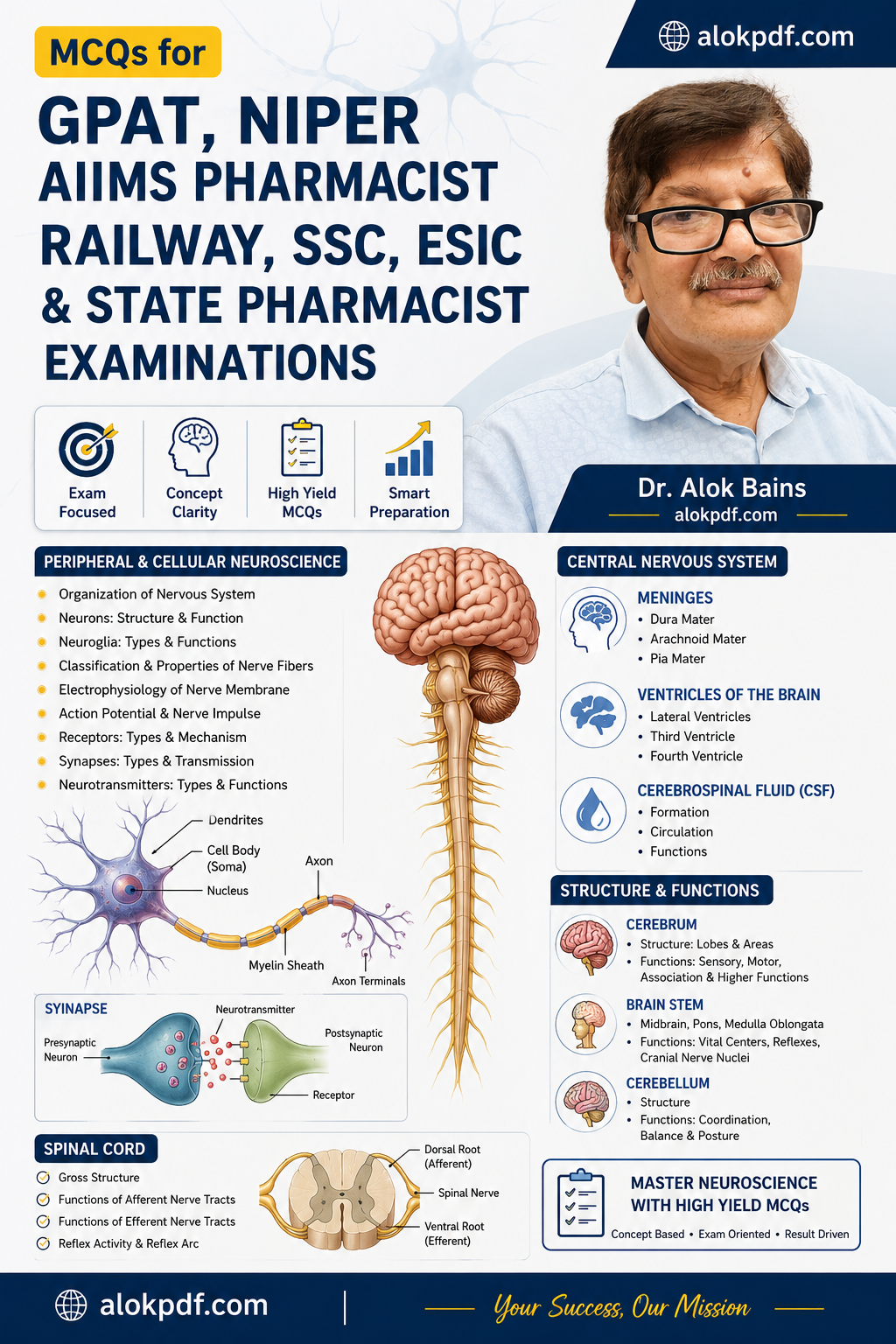
MCQs for GPAT, NIPER, and AIIMS/SSC/ESIC pharmacist exams. Topics: CNS, Spinal cord, Reflex action
Which neuroglial cell forms the blood-brain barrier and is most numerous in the CNS? A) Microglia B) Astrocytes C) Oligodendrocytes D) Ependymal cells
Answer: B: Astrocytes form the BBB via their end-feet on capillaries and are the most abundant glial cells.
Myelination in the peripheral nervous system is carried out by: A) Oligodendrocytes B) Schwann cells C) Astrocytes D) Satellite cells
Answer: B: One Schwann cell myelinates only one axon segment (internode), unlike oligodendrocytes, which myelinate multiple CNS axons.
The "macrophages of the CNS" are: A) Astrocytes B) Microglia C) Schwann cells D) Ependymal cells Answer: B: Microglia are mesodermal in origin (unlike other glia, which are neuroectodermal) and perform immune surveillance.
A bipolar neuron is characteristically found in: A) Anterior horn of spinal cord B) Retina C) Cerebral cortex D) Dorsal root ganglion
Answer: B: Bipolar neurons (one axon, one dendrite) are typical of the retina, olfactory epithelium, and cochlear/vestibular ganglia.
Which nerve fiber type has the fastest conduction velocity? A) C fibres B) A-delta fibres C) A-alpha fibres D) B fibres
Answer: C. Alpha fibers are large-diameter, heavily myelinated (proprioception, motor); conduction velocity is directly proportional to fiber diameter and myelination.
Pain of "fast, sharp, pricking" type is carried by: A) A-alpha, B) A-delta, C) C fibres, D) A-beta
Answer: B. A-delta fibers (thinly myelinated) carry fast/sharp pain; C fibers (unmyelinated) carry slow, dull, burning pain.
According to the Erlanger-Gasser classification, the fiber type with the smallest diameter and slowest conduction is A) A B) B C) C D) None; all are equal
Answer: C. C fibers are unmyelinated, have the smallest diameter, have the slowest conduction (~0.5–2 m/s), carrying pain, temperature, and postganglionic autonomic impulses.
Which of the following best explains why myelinated fibers conduct impulses faster than unmyelinated fibers of similar diameter? A) Higher resting membrane potential B) Saltatory conduction at nodes of Ranvier C) Increased number of mitochondria D) Greater neurotransmitter release
Answer: B. Myelin insulates the axon; depolarization "jumps" from node to node (saltatory conduction), drastically increasing speed.
The resting membrane potential of a typical neuron is approximately A) -30 mV, B) -70 mV, C) +40 mV, or D) 0 mV.
Answer: B — Maintained mainly by K+ leak channels and the Na+/K+-ATPase pump (3 Na+ out: 2 K+ in).
During the depolarization phase of an action potential, which ion channel opens first? A) Voltage-gated K+ B) Voltage-gated Na⁺ C) Ca²⁺ channels D) Cl⁻ channels
Answer: B. Rapid Na+ influx through voltage-gated Na+ channels causes the rising phase; delayed K+ channel opening causes repolarization.
The absolute refractory period corresponds to the time when: A) Na⁺ channels are in the open/inactivated state and cannot reopen; B) K⁺ channels are closed; C) The membrane is hyperpolarized; D) Resting potential is restored
Answer: A. During the absolute refractory period, Na⁺ channels are inactivated (not just closed), making a second action potential impossible regardless of stimulus strength.
Which statement about action potentials is TRUE? A) They are graded responses. B) They follow the "all-or-none" law. C) Their amplitude varies with stimulus strength. D) They can sum.
Answer: B — Action potentials are all-or-none; once the threshold is reached, the AP fires at full amplitude regardless of further stimulus increase (unlike graded potentials).
The afterhyperpolarization phase of the action potential is due to: A) Continued Na⁺ influx B) Delayed closure of voltage-gated K+ channels C) Ca²⁺ efflux D) Cl⁻ influx.
Answer: B — K+ channels remain open slightly longer than needed to reach resting potential, causing transient hyperpolarization.
Which of the following is an example of an inhibitory postsynaptic potential (IPSP) mechanism? A) Opening of Na+ channels B) Opening of Cl⁻ or K⁺ channels C) Closing of K+ channels D) Opening of Ca²⁺ channels at presynaptic terminal Answer: B — IPSPs hyperpolarize the membrane via Cl⁻ influx (e.g., GABA-A) or K⁺ efflux (e.g., GABA-B), moving the membrane away from threshold.
Release of neurotransmitter from presynaptic vesicles is triggered by influx of A) Na+ B) K+ C) Ca²⁺ D) Cl⁻ Answer: C — Depolarization of the presynaptic terminal opens voltage-gated Ca²⁺ channels; Ca²⁺ influx triggers vesicle fusion (via SNARE proteins) and exocytosis.
Which neurotransmitter is primarily associated with the neuromuscular junction (skeletal muscle)? A) Norepinephrine B) Acetylcholine C) GABA D) Dopamine
Answer: B. ACh acts on nicotinic receptors (N-M subtype) at the motor end plate, causing depolarization (EPP) and muscle contraction.
The major inhibitory neurotransmitter in the brain is _____, while in the spinal cord it is _____. A) GABA; Glycine B) Glutamate; Glycine C) GABA and Glutamate D) Dopamine; Serotonin
Answer: A. GABA predominates in cortical/brain inhibition (GABA-A and GABA-B receptors); glycine is the major inhibitory transmitter in the spinal cord (e.g., Renshaw cell inhibition).
Temporal summation at a synapse refers to A) summing EPSPs from multiple presynaptic neurons simultaneously. B) Successive firing of the same presynaptic neuron in rapid succession leading to summed EPSPs C) Summation of action potentials within a single axon D) Decrease in synaptic strength over time Answer: B. Temporal summation = repeated stimuli from one terminal close in time; spatial summation = multiple terminals firing simultaneously.
Down-regulation of receptors typically occurs due to: A) Decreased agonist exposure; B) Chronic/prolonged agonist exposure; C) Receptor antagonism only; D) Genetic mutation.
Answer: B. Chronic agonist exposure leads to receptor internalization/down-regulation (desensitization), a key concept in tolerance.
Ionotropic receptors differ from G-protein-coupled (metabotropic) receptors in that they: A) Act through second messengers; B) Directly form an ion channel and produce fast responses; C) Always cause inhibition; D) Have a longer latency of action
Answer: B. Ionotropic receptors (e.g., nicotinic ACh, GABA-A, glutamate NMDA/AMPA) are ligand-gated ion channels giving millisecond-fast responses; GPCRs act via second messengers with slower, longer-lasting effects.
The innermost meningeal layer that closely adheres to the brain surface, following its gyri and sulci, is A) Dura mater B) Arachnoid mater C) Pia mater D) Periosteum
Answer: C. Pia mater is a delicate, vascular membrane intimately adherent to the brain/spinal cord surface.
CSF is primarily produced by: A) Arachnoid villi B) Choroid plexus C) Pia mater D) Subarachnoid space Answer: B. The choroid plexus (in the lateral, third, and fourth ventricles) secretes CSF; arachnoid villi are sites of CSF reabsorption into venous sinuses.
The total volume of CSF in an adult is approximately: A) 50 mL B) 150 mL C) 500 mL D) 1000 mL
Answer: B. Approx. 125-150 mL, with about 500 mL produced and reabsorbed daily (turnover ~3-4 times/day).
CSF passes from the third ventricle to the fourth ventricle via: A) Foramen of Monro; B) Aqueduct of Sylvius (cerebral aqueduct); C) Foramen of Magendie; D) Foramen of Luschka
Answer: B—The foramen of Monro connects the lateral ventricle to the third ventricle; the cerebral aqueduct (Sylvius) connects the third to the fourth ventricle; Magendie/Luschka foramina drain the fourth ventricle into the subarachnoid space.
Which condition results from obstruction of CSF flow leading to its accumulation in the ventricles? A) Meningitis B) Hydrocephalus C) Encephalitis D) Hydrocele
Answer: B. Hydrocephalus results from impaired CSF circulation/absorption, causing ventricular dilation and raised intracranial pressure.
Broca's area, responsible for motor speech production, is located in the A) Temporal lobe B) Parietal lobe C) Frontal lobe D) Occipital lobe
Answer: C — Broca's area lies in the inferior frontal gyrus (frontal lobe); Wernicke's area (speech comprehension) is in the temporal lobe.
The primary visual cortex is located in the A) Frontal lobe, B) Parietal lobe, C) Occipital lobe, D) Temporal lobe
Answer: C. The occipital lobe houses the primary visual cortex (around the calcarine sulcus).
Which part of the brainstem contains vital centers for respiration and cardiovascular regulation? A) Midbrain B) Pons C) Medulla oblongata D) Thalamus.
Answer: C. The medulla oblongata contains the respiratory, vasomotor, and cardiac centers; it is also the site of decussation of pyramidal tracts.
Damage to the cerebellum characteristically produces A) Spastic paralysis; B) Ataxia and loss of coordination, with no loss of muscle power; C) Sensory loss; D) Memory loss
Answer: B. Cerebellar lesions cause ataxia, dysmetria, intention tremor, and impaired coordination, but muscle strength/sensation remain intact (the cerebellum coordinates, doesn't initiate movement).
The thalamus functions primarily as A) A relay and integrating center for sensory information to the cortex, B) The primary motor output center, C) The site of CSF production, D) The respiratory control center
Answer: A — All sensory pathways (except olfaction) relay through the thalamus before reaching the cerebral cortex.
The corticospinal tract is an example of a/an _____ pathway, carrying _____ information. A) Afferent; sensory B) Efferent; motor C) Afferent; motor D) Efferent; sensory
Answer: B. The corticospinal (pyramidal) tract is a descending efferent motor pathway from the cortex to spinal motor neurons.
The dorsal column-medial lemniscus pathway carries: A) Pain and temperature; B) Fine touch, vibration, and proprioception; C) Motor commands; D) Crude touch only
Answer: B — This pathway carries fine touch, vibration, and conscious proprioception; pain/temperature travel via the spinothalamic tract.
In a monosynaptic reflex (e.g., knee-jerk/patellar reflex), the pathway involves A) Sensory neuron to interneuron to motor neuron; B) Sensory neuron directly synapsing on motor neuron; C) Multiple interneurons in series. D) Only motor neuron activation, no sensory input.
Answer: B — The stretch reflex (deep tendon reflex) is the classic monosynaptic reflex—a single synapse between the Ia sensory afferent and the alpha motor neuron.
The withdrawal reflex (e.g., pulling one's hand away from a hot object) is an example of a A) Monosynaptic reflex B) Polysynaptic reflex involving reciprocal innervation C) Autonomic reflex only D) Cranial nerve reflex
Answer: B — Withdrawal reflexes are polysynaptic, involving interneurons that mediate flexor withdrawal on the stimulated side and an extensor (crossed-extensor) response on the opposite side.
Which spinal cord segment is the lowest level associated with the bulbocavernosus reflex (relevant in spinal shock assessment)? A) L1-L2 B) S2-S4 C) T10-T12 D) C5-C6
Answer: B — The bulbocavernosus reflex is mediated by sacral segments S2-S4; its return signals the end of spinal shock.
Dr. Alok Simgh