GPAT NIPER exams Pharmacist AIIMS, ESIC, Railway HSSC MCQ Emulsion
Explore GPAT NIPER exams and pharmacist recruitment AIIMS, ESIC, Railway & HSSC jobs plus exam MCQs on emulsions classification, preparation, and identification.”
Dr. Alok Bains
5/1/20267 min read
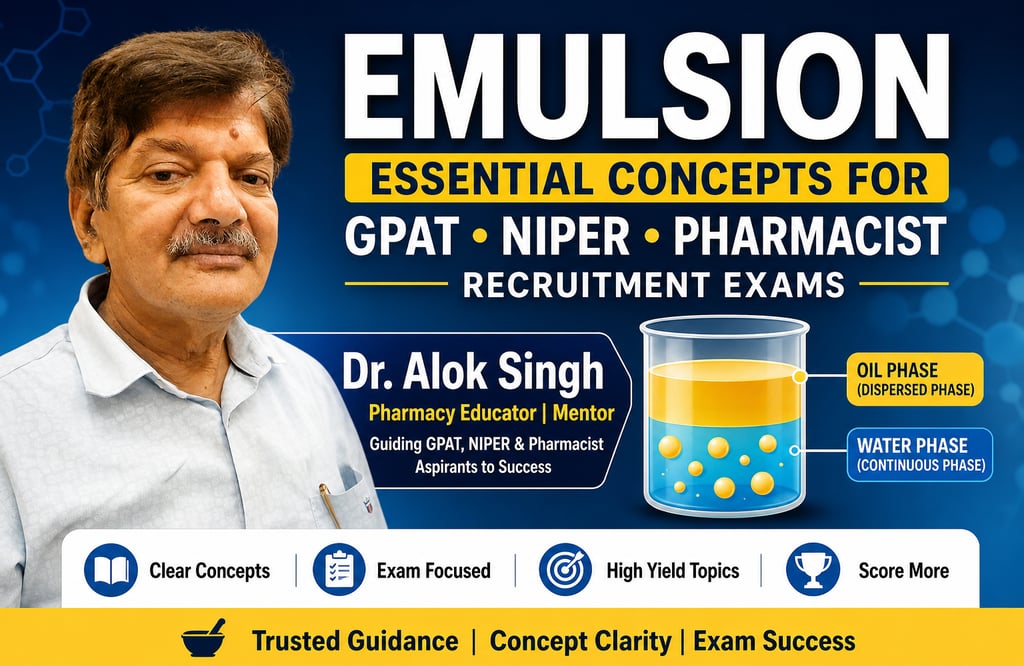

Emulsions Definition, Classification & Emulsifying Agents Identification Tests of Emulsion, Type & Methods of Preparation.
1. An emulsion is best defined as
A. Solid in a liquid dispersion
B. Biphasic system consists of two immiscible liquids, one dispersed into the other
C. Alcohol and water homogeneous mixture
D. Gas in a liquid colloidal dispersion
Answer: B
Explanation: An emulsion is a biphasic system with two immiscible liquids; one liquid is dispersed as globules (dispersed phase or internal phase) into another (external phase or continuous phase).
2. In an O/W emulsion, the dispersed phase is:
A. Water
B. Oil
C. Air
D. Surfactant
Answer: B
Conceptual Trap: Many students confuse the continuous phase with the dispersed phase.
3. Which of the following is an example of a W/O emulsion?
A. Milk
B. Vanishing cream
C. Cold cream
D. Oral fish liver oil emulsion
Answer: C
Explanation: Cold cream is a water-in-oil (W/O) emulsion; vanishing cream is oil-in-water (O/W).
4. The external phase of an emulsion determines its:
A. Color
B. Viscosity
C. Type of emulsion
D. Globule size
Answer: C
5. Which statement is TRUE regarding O/W emulsions?
A. They are greasy and not washable with water
B. Water is the dispersed phase
C. They conduct electricity better than W/O emulsions
D. They require low HLB surfactants
Answer: C
Conceptual Trap: Water is the continuous phase, so O/W emulsions conduct electricity.
6. Multiple emulsions are commonly represented as:
A. O/O
B. W/W
C. O/W/O or W/O/W
D. S/O
Answer: C
7. Which emulsifying agent forms a monomolecular film?
A. Acacia
B. Gelatin
C. Sodium lauryl sulfate
D. Bentonite
Answer: C
Explanation: Surfactants such as sodium lauryl sulfate (SLS) tend to form monomolecular films at the interface.
8. Bentonite acts as an emulsifying agent by:
A. Lowering interfacial tension only
B. Increasing density of oil phase
C. Forming particulate interfacial film
D. Forming multimolecular film
Answer: C
9. Which of the following is a natural emulsifying agent?
A. Tween 80
B. Span 20
C. Acacia
D. Sodium lauryl sulfate
Answer: C
10. Hydrophilic colloids stabilize emulsions mainly
A. Form multimolecular films
B. Produce electrostatic repulsion only
C. Increase volatility
D. Reduce density difference
Answer: A
11. Which emulsifying agent is most suitable for preparing an O/W emulsion?
A. Span 80
B. Cholesterol
C. Tween 80
D. Calcium oleate
Answer: C
Conceptual Trap: High HLB surfactants favor O/W emulsions.
12. Which of the following possesses the highest hydrophilic character?
A. Span series
B. Tweens
C. Fatty alcohols
D. Cholesterol
Answer: B
13. The main function of an emulsifying agent is to:
A. Increase globule size
B. Increase phase separation
C. Reduce interfacial tension between immiscible liquids
D. Produce sedimentation
Answer: C
14. Lecithin is classified as a:
A. Synthetic anionic emulsifier
B. Natural emulsifying agent
C. Finely divided solid emulsifier
D. Semisynthetic emulsifier
Answer: B
15. Which one of the following is NOT a mechanism of emulsifying agents?
A. Increase in coalescence
B. Rigid interfacial film Formation
C. Interfacial tension Reduction
D. Electrical repulsion between the dispersed phase droplets
Answer: A
16. According to Bancroft’s rule:
A. The phase in which the emulsifier is more soluble becomes the external phase
B. Oil always forms the external phase
C. Water always forms the dispersed phase
D. Emulsions are thermodynamically stable
Answer: A
17. Which pair is correctly matched?
Emulsifier Type
A. Acacia, Finely divided solid
B. Bentonite, Hydrophilic colloid
C. Tween 80, Nonionic surfactant
D. Anionic Surfactant
Answer: C
18. Which instability of emulsion involves irreversible separation of phases?
A. Creaming
B. Flocculation
C. Cracking
D. Sedimentation
Answer: C
Conceptual Trap: Creaming is reversible; cracking is irreversible.
19. Magnesium hydroxide acts as an emulsifying agent as
A. Nonionic surfactant
B. Finely divided solid
C. Hydrophilic colloid
D. Cationic surfactant
Answer: B
20. A surfactant with a low HLB value generally produces:
A. O/W emulsions
B. Multiple emulsions
C. W/O emulsions
D. Microemulsions only
Answer: C
GPAT/NIPER Revision Points
Oil-in-water (O/W) emulsions are washable, non-greasy, high-HLB emulsifiers
Water-in-oil (W/O) emulsions are greasy, occlusive, and low-HLB emulsifiers
Acacia/Gelatin forms a multimolecular film
Bentonite/Veegum forms a particulate film
SLS/Tweens/Spans form a monomolecular film
Cracking tends to irreversible instability
Creaming tends to have reversible instability
Dr Alok Singh
21. Electricity readily conducts through emulsion is:
A. Water-in-oil emulsion
B. Multiple emulsion
C. Oil-in-water emulsion
D. Microemulsion
Answer: C.
Explanation: Oil-in-water emulsion (O/W) conduct electricity due to its water as continuous phase.
22. In the dye solubility test, uniform distribution of methylene blue indicates:
A. W/O emulsion
B. O/W emulsion
C. Multiple emulsion
D. Phase inversion
Answer: B.
Explanation: Methylene blue is a water-soluble dye; thus, it uniformly distributes in water. It indicates O/W emulsions. Here water is continuous phase.
23. Coose CORRECT statement related to the cobalt chloride test
A. Blue color indicates O/W emulsion
B. Pink color indicates O/W emulsion
C. Pink color indicates W/O emulsion
D. Test is based on fluorescence
Answer: B.
Explanation: Cobalt chloride paper is pink in colour. It changes from blue to pink in the presence of water. This indicates an O/W type.
24. An emulsion remains stable only when diluted with (Dilution test)
A. Dispersed phase
B. Internal phase
C. External phase
D. Emulsifying agent
Answer: C. External phase
Explanation: Emulsions can only be diluted with their continuous/external phase.
25. Which of the following pairs is correctly matched?
Test Observation
A. Cobalt chloride test: Water in Oil emulsion (W/O) turns pink
B. Dye test: Sudan III identifies Oil in Water emulsion (O/W)
C. Dilution test: O/W dilutes with water
D. Conductivity test: Water in Oil Emulsion (W/O) conducts electricity
A. A only
B. B only
C. C only
D. D only
Answer: C.
Explanation: Oil in Water emulsion (O/W) is diluted with water. Sudan III is oil-soluble. Thus, it identifies Water in Oil Emulsion (W/O).
26. Choose the MOST suitable method to prepare emulsions containing volatile oils?
A. Bottle method
B. Dry gum method
C. Wet gum method
D. Nascent soap method
Answer: A. Bottle method
Explanation: The bottle method (also known as the Forbes Method) is the preferred technique for preparing emulsions that contain volatile and low-viscosity oils.”
27. In the continental method (also called the dry gum method), the primary emulsion is formed by triturating the oil with gum, followed by the gradual addition of water.
A. Triturating oil and gum before adding water
B. Adding oil slowly into the mucilage
C. Mixing gum with water first
D. Heating oil and water separately
Answer: A.
Explanation: The gum is first triturated with oil in a dry mortar in the dry gum method, and then the required amount of water is added all at once to form the primary emulsion
28. In primary emulsion preparation, the standard oil:water: gum ratio using acacia is:
A. 2: 4: 1
B. 2: 2: 1
C. 1: 2: 4
D. 4 : 2: 1
Answer: B. 4: 2: 1
Explanation: The standard primary emulsion ratio for fixed oils with acacia is 4 parts oil, 2 parts water, and 1 part gum.
29. What is the first step in the wet gum method?
A. Heat the oil phase
B. Triturate oil with gum
C. Add all oil at once
D. Mix gum with water to form mucilage
Answer: D.
Explanation: The wet gum method (also known as the English method begins with the preparation of the mucilage.
30. The “cracking or clicking sound” heard during emulsion preparation indicates:
A. Coalescence
B. Creaming
C. Formation of primary emulsion
D. Phase inversion
Answer: C.
Explanation: In the dry gum method, a characteristic cracking or clicking sound indicates the successful formation of the primary emulsion.
31. Which test may fail in nonionic O/W emulsions?
A. Dilution test
B. Fluorescence test
C. Dye test
D. Conductivity test
Answer: D.
Explanation: Nonionic emulsions may exhibit low electrical conductivity even when they are of the oil‑in‑water (O/W) type.
32. Oil-soluble dyes frequently employed to identify water-in-oil (W/O) emulsions include…:
A. Sudan III and scarlet red
B. Congo red and eosin
C. Amaranth and methylene blue
D. Crystal violet and methylene blue
Answer: A.
Explanation: Oil-soluble dyes such as Sudan III and scarlet red are commonly used to identify water-in-oil (W/O) emulsions.
33. Which method is also known as the English method?
A. Dry gum method
B. Wet gum method
C. Bottle method
D. Nascent soap method
Answer: B.
34. In the conductivity test, the glowing of the bulb indicates:
A. Water in Oil (W/O) emulsion
B. Oil in Water (O/W) emulsion
C. Micro emulsion
D. Stable emulsion
Answer: B.
Explanation: In oil-in-water (O/W) emulsions, the continuous aqueous phase conducts electricity, allowing current to pass through.
35.
Assertion (A): In the dry gum method, all water is added at once.
Reason (R): Rapid addition of water helps in the immediate formation of the primary emulsion.
Options:
A. A is true, R is false
B A is false, R is true
B. Both A and R are true, but R is not the correct explanation
D, Both A and R are true, and R is the correct explanation
Answer: D.
Explanation: Sudden addition of water followed by rapid trituration promotes quick emulsification and ensures immediate formation of the primary emulsion.
36. Which method of emulsion preparation is least suitable for highly viscous oils?
A. Bottle method
B. Dry gum method
C. Wet gum method
D. Mechanical homogenization
Answer: B. Dry gum method (Continental method)
Explanation: Because this technique requires vigorous trituration and rapid dispersion of oil with gum before adding water, it becomes difficult to achieve proper emulsification when the oil is highly viscous. In such cases, the wet gum (English) method or other modified approaches are preferred.
Dry gum method → Difficult with viscous oils (because rapid trituration and sudden water addition don’t disperse thick oils effectively).
Wet gum method → Works well with viscous oils (since gum is hydrated first, making dispersion smoother).
Bottle method → Best for volatile oils or light oils (simple shaking).
Mechanical homogenization → Suitable for all types, especially viscous oils (powerful mixing overcomes thickness).
So whenever you see highly viscous oils, remember: Skip Dry gum, go for Wet gum or mechanical homogenization.
37. Which test is based on the property of oil fluorescence?
A. Conductivity test
B. Fluorescence test
C. Dye solubility test
D. Dilution test
Answer: B.
Explanation: This test is based on the natural fluorescence exhibited by oils when exposed to ultraviolet light. In emulsions, only the oil phase fluoresces, so observing this property helps distinguish between oil-in-water (O/W) and water-in-oil (W/O) emulsions.
38. A pharmacist adds water slowly to an emulsion, and phase separation occurs. The emulsion is likely:
A. Oil in water (O/W emulsion)
B. Water in Oil (W/O emulsion)
C. Multiple emulsion
D. Microemulsion
Answer: B. W/O emulsion
Explanation: W/O emulsions cannot be diluted with water because water is the internal phase. Emulsion can only be diluted by using a continuous phase (external phase)
39. Which method forms soap “in situ” during emulsion preparation?
A. Bottle method
B. Wet gum method
C. Nascent soap method
D. Dry gum method
Answer: C.
40. Which of the following is TRUE regarding dry gum and wet gum methods?
A. Both use different oil:water:gum ratios
B. Wet gum method forms mucilage first
C. The dry gum method is called the English method
D. The bottle method is identical to the wet gum method
Answer: B.
Dr Alok Singh