Semisolid Dosage Forms MCQs for GPAT & Pharmacist Exams
Explore comprehensive MCQs on semisolid dosage forms focusing on mechanisms and factors influencing dermal penetration of drugs. Ideal for GPAT, NIPER, and pharmacist recruitment exam preparation with detailed answers.
Dr. Alok Bains
5/7/202611 min read
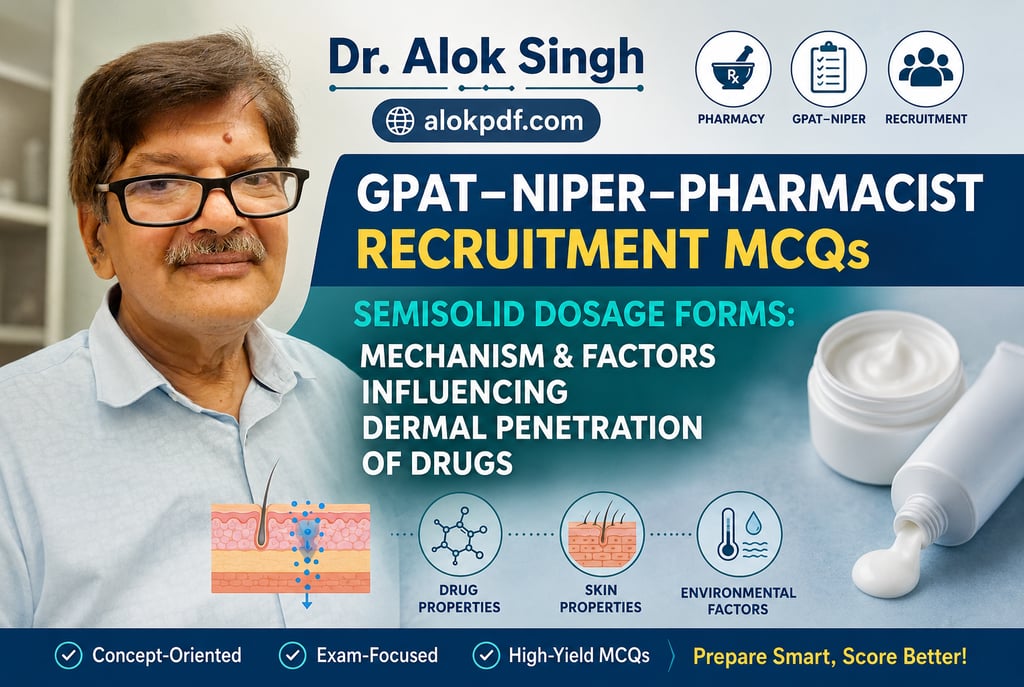
GPAT–NIPER–Pharmacist Recruitment MCQs: Semisolid Dosage Forms: Mechanism & Factors Influencing Dermal Penetration of Drugs
1. Identify the principal barrier to percutaneous drug absorption through the skin.
A. Dermis
B. Epidermis
C. Stratum corneum
D. Sebaceous gland
Answer: C.
Explanation:
The stratum corneum is the outermost layer of the skin. It consists of dead, keratinized cells embedded in lipid material. It is the major rate-limiting barrier for transdermal and topical drug absorption.
Trap:
Epidermis contains the stratum corneum, but the specific barrier layer is the stratum corneum itself.
Dermis is highly vascular and aids absorption after the drug crosses the barrier.
Sebaceous glands contribute little to overall percutaneous absorption.
GPAT/NIPER Tip:
Most lipid-soluble drugs penetrate mainly through the intercellular lipid pathway of the stratum corneum. Generally, students mark the dermis due to its vascularity.
2. By which primary mechanism does drug penetration through the skin occur?
A. Active transport
B. Passive diffusion
C. Endocytosis
D. Facilitated diffusion
Answer: B.
Explanation
Drug penetration through the skin primarily occurs by passive diffusion. Here, drug molecules move from a higher concentration to a lower concentration across the skin barrier.
Key Points:
No energy is required.
Most drugs penetrate through the intercellular lipid matrix of the Stratum corneum.
Lipophilic and low-molecular-weight drugs diffuse more easily.
Traps:
Active transport: Rare in skin absorption because the stratum corneum lacks transport systems.
Facilitated diffusion: Requires carrier proteins. It is not the main route in skin.
Endocytosis: Negligible role in percutaneous absorption.
GPAT/NIPER tips:
Percutaneous absorption generally follows Fick's Law of Diffusion:
J = {D K A Delta C}/{h}
where:
(J) = rate of diffusion
(D) = diffusion coefficient
(K) = partition coefficient
(A) = surface area
(\Delta C) = concentration gradient
(h) = membrane thickness
3. Which pathway plays the MINIMAL role in dermal drug absorption under normal physiological conditions?
A. Gastrointestinal
B. Intercellular
C. Transcellular
D. Follicular
Answer: A.
Explanation:
The gastrointestinal (GIT) absorption pathway has essentially no role in dermal/percutaneous drug absorption under normal physiological conditions.
Skin Penetration Pathways:
Intercellular pathway: Major route through the lipid matrix of the Stratum corneum
Transcellular pathway: Through corneocytes and lipids
Follicular pathway: Via hair follicles and sweat glands; minor but important for some formulations
Trap:
Many students mark Follicular as a minor route, but it still contributes to dermal absorption.
The gastrointestinal route is unrelated to skin penetration unless the drug is accidentally ingested.
GPAT/NIPER Tip:
Under normal conditions, the intercellular lipid pathway is considered the dominant route for most topical and transdermal drugs.
4. The transport of drugs via hair follicles and sebaceous glands is termed which pathway?
A. Transfollicular absorption
B. Intercellular absorption
C. Transcellular absorption
D. Intradermal diffusion
Answer: A.
Explanation:
Transport of drugs through hair follicles and sebaceous glands occurs via the transfollicular absorption pathway. It is also called the appendageal pathway.
Involves penetration through:
Hair follicles
Sebaceous glands
Sweat glands
Represents a relatively small surface area of the skin but can be important for:
Ions
Large polar molecules
Targeted follicular therapy
Traps:
Intercellular absorption: Between corneocytes through lipid matrix
Transcellular absorption: Through corneocytes directly
Intradermal diffusion: Not the standard term for follicular penetration
GPAT/NIPER tip:
The follicular route contributes less under normal conditions. It is significant in nanoparticle delivery and pilosebaceous-targeting therapies.
5. Which route represents the predominant pathway for absorption of most topically applied drugs?
A. Lymphatic
B. Transfollicular
C. Sweat duct
D. Transepidermal
Answer: D.
Explanation:
The predominant pathway for absorption of most topically applied drugs is the transepidermal route.
This route mainly occurs through:
Intercellular pathway (major)
Transcellular pathway
Both across the stratum corneum.
Why Other Options Are Incorrect:
Transfollicular route: Minor pathway through hair follicles
Sweat duct route: Minimal contribution due to small surface area
Lymphatic route: Not a primary route for topical skin absorption
GPAT/NIPER Tip:
For most lipophilic drugs, intercellular diffusion within the transepidermal pathway is the dominant mechanism of skin permeation.
6. Percutaneous absorption of a drug is generally enhanced by which factors?
A. High molecular weight
B. Low lipid solubility
C. More skin hydration
D. Thick stratum corneum
Answer: C.
Explanation:
Hydration of the Stratum corneum increases its permeability by swelling and loosening the tightly packed keratinized cells, thereby enhancing percutaneous drug absorption.
Why Other Options Are Incorrect:
High molecular weight → Large molecules penetrate poorly through skin
Low lipid solubility → Drugs need sufficient lipophilicity to partition into stratum corneum lipids
Thick stratum corneum → Acts as a stronger diffusion barrier and decreases absorption
GPAT/NIPER Tip:
Drugs showing optimal skin permeation usually have:
Low molecular weight (< 500 Da)
Moderate lipid solubility
Good potency at low dose
According to Fick's Law of Diffusion:
J = {D K A Delta C}/{h}
An increase in hydration effectively increases the diffusion coefficient (D) and permeability of the skin.
Trap:
Hydrated stratum corneum is softer and prone to permeation.
7. What is the optimal molecular weight generally considered for efficient transdermal drug penetration?
A. >900 Da
B. >860 Da
C. <400 Da
D. <1000 Da
Answer: C. <400 Da
Explanation:
For efficient transdermal penetration, drugs generally should have a molecular weight below about 400–500 Da. Molecules larger than this penetrate poorly through the Stratum corneum.
GPAT/NIPER Tips:
Ideal properties of a transdermal drug:
Molecular weight < 500 Da (preferably < 400 Da)
Moderate lipid solubility
Potent at low dose
Adequate skin permeability
Why Other Options Are Incorrect:
>900 Da → Too large for effective passive diffusion
>860 Da → Poor skin permeation
<1000 Da → Too broad and not considered optimal
Remember:
Skin permeability decreases sharply as the drug molecular size increases. Reason: Diffusion through the stratum corneum becomes difficult.
8. Which physicochemical property of a drug most strongly facilitates its penetration through the skin?
A. Increase in molecular size
B. Balanced lipid & aqueous solubility
C. Water insolubility
D. Stronger ionic character
Answer: B.
Explanation:
Efficient skin penetration requires a drug to have a partition coefficient balanced with lipophilic and hydrophilic properties.
The drug must be sufficiently lipophilic to partition into the lipid-rich Stratum corneum.
It must also possess some aqueous solubility to move through the viable epidermis and dermis.
Why Other Options Are Incorrect:
Increase in molecular size: Reduces diffusion through skin
Water insolubility: Excessive lipophilicity may trap drug in stratum corneum
Stronger ionic character: Ionized drugs penetrate poorly because skin favors unionized molecules
GPAT/NIPER Tip:
Drugs with moderate partition coefficient (log P usually around 1–3) show optimal transdermal permeation.
9. The partition coefficient of a drug primarily determines which aspect of its dermal absorption?
A. Drug molecules color
B. Drug molecules stability
C. Speed of drug transport across skin
D. Preservation efficacy
Answer: C.
Explanation:
The Partition coefficient determines how well a drug partitions between the lipid-rich Stratum corneum and the aqueous layers beneath it.
A suitable partition coefficient enhances:
Drug penetration into the stratum corneum
Diffusion across the skin
Overall rate/speed of percutaneous absorption
Conceptual Understanding:
Too lipophilic → Drug remains trapped in stratum corneum
Too hydrophilic → Drug cannot effectively enter the skin barrier
Balanced partitioning → Optimal skin transport
Why Other Options Are Incorrect:
Drug color → Unrelated to absorption
Drug stability → Depends on chemical properties, not partition coefficient alone
Preservation efficacy → Related to antimicrobial preservatives, not skin permeation
GPAT/NIPER tips:
In Fick's Law of Diffusion, the partition coefficient (K) directly influences permeation rate:
J = {D K A Delta C}/{h}
10. By what primary mechanism do occlusive ointment bases improve dermal drug penetration?
A. Decreasing in skin hydration
B. Evaporation
C. Increase in stratum corneum hydration
D. Decrease in contact time
Answer: C.
Explanation:
Occlusive ointment bases form a protective film over the skin that prevents water loss, thereby increasing hydration of the Stratum corneum.
Hydration causes:
Swelling of keratinized cells
Loosening of the compact structure
Increased permeability of the skin
This enhances dermal drug penetration.
Why Other Options Are Incorrect:
Decreasing hydration of skin → Would reduce permeability
Increasing evaporation → Occlusive bases actually reduce evaporation
Decreasing contact time → Ointments usually increase contact time with skin
GPAT/NIPER Tip:
Highly occlusive bases such as hydrocarbons (e.g., petrolatum) are excellent emollients because they reduce transepidermal water loss and improve drug absorption.
11. At which anatomical site is percutaneous absorption typically greatest?
A. Scalp
B. Sole
C. Palm
D. Skin with thick keratin
Answer: A.
Explanation:
Percutaneous absorption is greatest through areas where the Stratum corneum is relatively thin and blood supply is rich. The scalp has:
Thin skin
Numerous hair follicles
Good vascularization
These factors enhance drug penetration.
Why Other Options Are Incorrect:
Sole → Very thick stratum corneum; poor absorption
Palm → Thick keratinized layer reduces penetration
Skin with thick keratin → Acts as a stronger barrier to diffusion
GPAT/NIPER Tip:
General order of skin permeability:
Scalp > Face > Trunk > Forearm > Palm/Sole
Thicker keratinized regions show much lower percutaneous absorption.
Thin, highly vascular regions of the skin allow drugs to penetrate more efficiently. The stratum corneum barrier is reduced, and blood flow quickly carries the absorbed substance away, maintaining a strong concentration gradient.
Which anatomical site demonstrates the highest percutaneous absorption due to its thinness and rich vascular supply?
A. Forearm
B. Palm
C. Scalp
D. Scrotum
The scrotal skin is classically cited as showing maximum absorption because it is both thin and highly vascular.
12. Which skin part has generally LOWER Percutaneous absorption:
A. Damaged skin
B. Inflamed skin
C. Hydrated skin
D. Thick keratinized skin
Answer: D.
Explanation:
Thick keratinized skin has lower percutaneous absorption because the thickened Stratum corneum creates a stronger diffusion barrier for drugs.
Why Other Options Increase Absorption:
Damaged skin → Barrier disrupted, absorption increases
Inflamed skin → Increased blood flow and permeability enhance absorption
Hydrated skin → Swelling of stratum corneum increases permeability
GPAT/NIPER Tip:
Palms and soles exhibit poor drug penetration because of their highly keratinized, thick stratum corneum.
13. Which factor most significantly enhances dermal drug penetration?
A. Decrease in temperature
B. Reduction in blood flow
C. Increase in skin hydration
D. High molecular size
Answer: C.
Explanation:
Increased hydration of the Stratum corneum is one of the most important factors enhancing dermal drug penetration.
Hydration:
Swells keratinized cells
Loosens the compact lipid structure
Increases skin permeability
Facilitates passive diffusion of drugs
Why Other Options Are Incorrect:
Decrease in temperature → Reduces diffusion and blood circulation
Reduction in blood flow → Lowers systemic uptake after penetration
Large molecular size → Large molecules diffuse poorly through skin
GPAT/NIPER Tip:
Occlusive ointments enhance absorption mainly by increasing hydration and reducing transepidermal water loss.
14. What factor drives passive diffusion across the skin?
A. Electrical potential
B. Hydrostatic pressure
C. Osmotic pressure
D. Concentration gradient
Answer: D.
Explanation:
Passive diffusion across the skin is primarily driven by the Concentration gradient, where drug molecules move from an area of higher concentration to lower concentration.
This process follows Fick's Law of Diffusion:
J = {D K A Delta C}/{h}
where:
( Delta C ) = concentration gradient driving diffusion
(J) = diffusion rate
Why Other Options Are Incorrect:
Electrical potential → Important mainly in iontophoresis
Hydrostatic pressure → Not the main driving force in skin diffusion
Osmotic pressure → More relevant in membrane water movement
GPAT/NIPER Tip:
A higher concentration gradient generally increases the rate of percutaneous absorption until equilibrium.
15. Which one about dermal penetration is an accurate statement?
A. Hydrophilic drugs are easy to penetrate intact skin
B. Large molecules have more penetration power than small molecules
C. Lipophilic drugs diffuse through stratum corneum
D. Skin appendages are the majority of absorption area
Answer: C.
Explanation:
The Stratum corneum is rich in lipids, so lipophilic drugs diffuse more readily through it by passive diffusion.
Why Other Options Are Incorrect:
Hydrophilic drugs easily penetrate intact skin: Intact skin strongly resists hydrophilic substances
Large molecules penetrate faster than small molecules: Smaller molecules penetrate more efficiently
Skin appendages are the majority of absorption area: Hair follicles and sweat glands contribute only a small fraction of total absorption area
GPAT/NIPER Tip:
Drugs with:
Low molecular weight
Moderate lipophilicity
Non-ionized form
generally show the best percutaneous absorption.
16. Which of the following represents a biological factor that influences dermal penetration?
A. Diffusion coefficient
B. Molecular size
C. Partition coefficient
D. Skin age
Answer: D.
Explanation:
Skin aging is a biological factor influencing dermal penetration because the structure and function of the skin change with age.
Examples:
Infant skin: More permeable
Elderly skin: Altered barrier properties and hydration
Why Other Options Are Incorrect:
Diffusion coefficient: Physicochemical property related to drug movement
Molecular size: Physicochemical property of the drug
Partition coefficient: Determines drug lipid/water balance
GPAT/NIPER Tips:
Biological factors affecting percutaneous absorption include:
Age
Skin condition
Hydration
Blood flow
Thickness of stratum corneum
While molecular size and partition coefficient are drug-related physicochemical factors.
17. Which physicochemical property shows an inverse relationship with the extent of skin penetration?
A. Solubility in Lipid
B. Concentration of Drug
C. Molecular weight
D. Hydration in Skin
Answer: C.
Explanation:
Molecular weight shows an inverse relationship with skin penetration.
As molecular weight increases:
Diffusion through the Stratum corneum decreases
Percutaneous absorption becomes poorer
Why Other Options Increase Penetration:
Lipid solubility → Enhances partitioning into stratum corneum
Drug concentration → Increases concentration gradient and diffusion rate
Skin hydration → Increases permeability of stratum corneum
GPAT/NIPER Tip:
Most efficiently absorbed transdermal drugs generally have a molecular weight below 500 Da.
18. How does drug absorption typically change when the skin is damaged or inflamed?
A. Increases
B. Decreases
C.Remains unchanged
D. Stops completely
Answer: A.
Explanation:
When the skin is damaged or inflamed, the integrity of the Stratum corneum is disrupted. This leads to increased permeability and enhanced drug absorption.
Inflammation may also:
Increase blood flow
Increase skin hydration
Reduce barrier resistance
All of which enhance percutaneous absorption.
Why Other Options Are Incorrect:
Decreases → Usually, the opposite occurs due to barrier disruption
Remains unchanged → Skin condition significantly affects absorption
Stops completely → Absorption generally increases rather than stopping
GPAT/NIPER tip:
Topical corticosteroids and other potent drugs may produce greater systemic absorption when applied to damaged, inflamed, or abraded skin.
19. What role does the sweat duct pathway play in the process of dermal drug absorption?
A. Major route of drug absorption
B. Negligible absorption when compared with transepidermal route
C. Only for systemic absorption
D. Drugs absorbed only by Active transport mechanism
Answer: B.
Explanation:
The Sweat duct pathway contributes very little to overall dermal drug absorption because sweat ducts occupy only a very small fraction of the total skin surface area.
The predominant route is the Transepidermal absorption pathway.
Why Other Options Are Incorrect:
Major route of drug absorption → Incorrect; appendageal pathways are minor
Only for systemic absorption → Not limited to systemic delivery
Drugs absorbed only by active transport mechanism → Skin absorption mainly occurs by passive diffusion
GPAT/NIPER Tip:
Skin appendages (hair follicles and sweat glands) may become important for ions, polar drugs, and nanoparticle delivery, but they normally contribute minimally to total absorption.
20. Which type of dosage form is most effective in promoting skin hydration and thereby enhancing drug penetration?
A. Paste
B. Oleaginous ointment
C. Dusting powder
D. Aerosol spray
Answer: B.
Explanation:
An oleaginous ointment base is highly occlusive and prevents transepidermal water loss. This increases hydration of the Stratum corneum.
Increased hydration:
Softens keratin
Swells the stratum corneum
Enhances drug penetration
Why Other Options Are Incorrect:
Paste: Less occlusive due to high powder content
Dusting powder: Absorbs moisture and decreases hydration
Aerosol spray: Usually non-occlusive and evaporative
GPAT/NIPER Tip:
Hydrocarbon bases like petrolatum are excellent emollients. They are commonly used when prolonged skin contact and enhanced penetration are desired.
21. Assertion (A): Hydration of the stratum corneum enhances percutaneous absorption.
Reason (R): Increased hydration makes the skin more permeable to drug diffusion.
A. Both A and R are true, and R is the correct explanation of A
B. Both A and R are true, but R is not the correct explanation
C. A is true, but R is false
D. A is false, but R is true
Answer: A
Explanation:
The Stratum corneum becomes more permeable when hydrated.
Assertion (A) is true because hydration enhances percutaneous absorption.
Reason (R) is also true because increased hydration swells and loosens the keratinized structure of the stratum corneum, facilitating drug diffusion.
Thus, the reason correctly explains the assertion.
GPAT/NIPER Tip:
Occlusive ointment bases enhance drug absorption mainly by increasing hydration and reducing transepidermal water loss.
22. Assertion (A): Drugs with high molecular weight penetrate the skin easily.
Reason (R): Skin permeability increases in direct proportion to molecular size
A. Both true
B. Both false
C. A true, R false
D. A false, R false
Answer: D
Explanation:
Assertion (A) is false
Drugs with high Molecular weight do not penetrate the skin easily. Larger molecules diffuse poorly through the Stratum corneum.
Reason (R) is false
Skin permeability does not increase directly with molecular size. In fact, permeability generally decreases as molecular size increases.
GPAT/NIPER Tip:
Efficient transdermal drugs usually have:
Molecular weight below 500 Da
Moderate lipophilicity
Good potency at low dose.
23. Match the following routes of drug absorption:
List I List II
A. Through hair follicles 1. Transepidermal
B. Between corneocytes 2. Transfollicular
C. Across cells 3. Intercellular
A. A-2, B-3, C-1
B. A-2, B-2, C-1
C. A-3, B-2, C-1
D. A-2, B-3, C-1
The correct matching is:
A. Through hair follicles → 2. Transfollicular
B. Between corneocytes → 3. Intercellular
C. Across cells → 1. Transepidermal
Answer: A
A–2, B–3, C–1
Explanation:
Transfollicular absorption occurs through hair follicles.
Intercellular absorption occurs between corneocytes.
Transepidermal absorption includes transport across skin cells.
24. Which combination of factors most strongly promotes transdermal drug absorption?
A. Hydrophilic drug and High molecular weight
B. Low molecular weight with moderate lipophilicity
C. Dry skin and Polar drug
D. Thick skin and Ionized drug
Answer: B.
Explanation:
Efficient transdermal absorption occurs when a drug has:
Low molecular weight → easier diffusion through the skin barrier
Lipophilicity in a moderate range → allows partitioning into the lipid-rich Stratum corneum while still maintaining some aqueous solubility
Why Other Options Are Incorrect:
Hydrophilic drug and high molecular weight: Poor skin permeation
Dry skin and polar drug: Both reduce penetration
Thick skin and ionized drug: Thick keratinized skin and ionization hinder absorption
GPAT/NIPER Tip:
Ideal transdermal drugs are usually:
< 500 Da
Moderately lipophilic
Potent at low doses
Mostly unionized at skin pH.
25. Which of the following statements about dermal penetration is incorrect?
A. The stratum corneum is a primary barrier
B. Passive diffusion is the main mechanism of drug absorption through skin
C. Hydration decreases drug permeability
D. Molecular size affects the rate of absorption
Answer: C
Explanation:
This statement is incorrect because hydration of the Stratum corneum actually increases skin permeability and enhances dermal drug penetration.
Hydration:
Swells keratinized cells
Loosens the compact structure
Facilitates passive diffusion of drugs
Why Other Statements Are Correct:
A. The stratum corneum is the primary barrier to percutaneous absorption
B. Passive diffusion is the major mechanism of skin absorption
D. Molecular size significantly affects absorption rate; smaller molecules penetrate better
GPAT/NIPER Tip:
Occlusive ointment bases enhance drug absorption mainly by increasing hydration of the stratum corneum.
Dr. Alok Singh