Heart Anatomy MCQs for GPAT
Boost your exam preparation with **Heart Anatomy MCQs for GPAT**. Practice high-yield questions on cardiac anatomy, blood circulation, ECG, cardiac cycle, blood pressure, and cardiac output for GPAT, NIPER, AIIMS Pharmacist, Railway Pharmacist, SSC, ESIC, and State Pharmacist exams.
Dr. Alok Singh
6/28/20264 min read
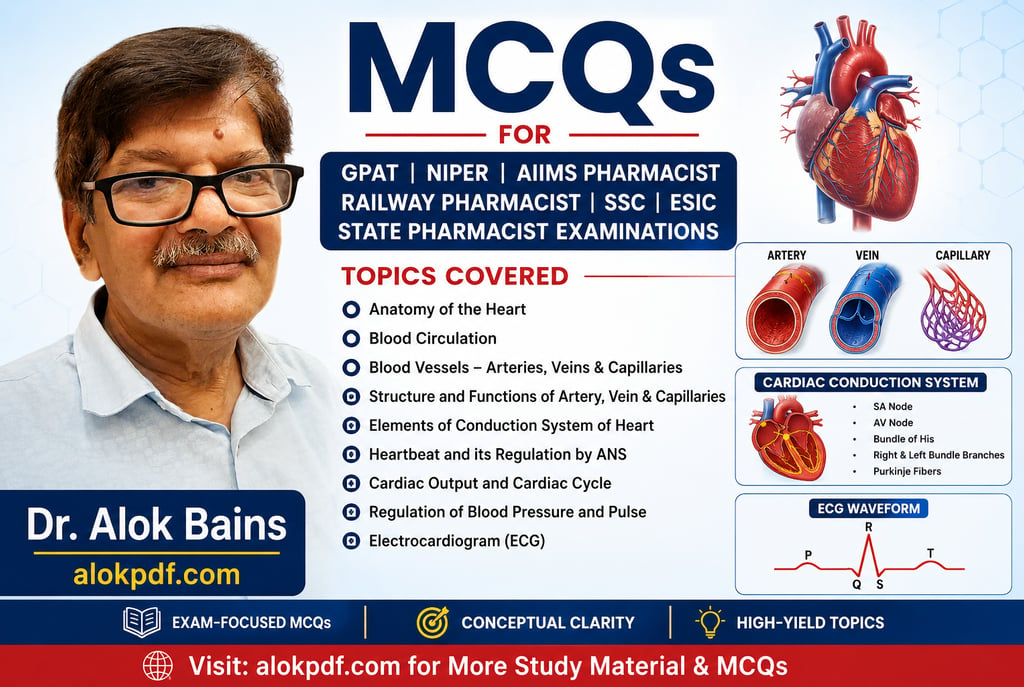
MCQs, Topic: Heart, Blood Circulation, Blood Vessels, Cardiac Cycle, Cardiac Output, Blood Pressure, Pulse & ECG
1 Which layer of the heart wall is primarily responsible for pumping blood?
A. Epicardium
B. Myocardium
C. Endocardium
D. Pericardium
Answer: B
Explanation: The myocardium is composed of cardiac muscle fibers responsible for contraction. The left ventricular myocardium is the thickest because it pumps blood into systemic circulation.
2. The fibrous skeleton of the heart mainly serves to:
A. Generate cardiac impulses
B. Prevent overfilling of ventricles
C. Electrically insulate atria from ventricles
D. Store calcium ions
Answer: C
Explanation: The fibrous skeleton prevents direct electrical conduction from atria to ventricles. Electrical impulses pass only through the AV node and bundle of His.
The coronary arteries fill predominantly during:
A. Ventricular systole
B. Atrial systole
C. Ventricular diastole
D. Isovolumetric contraction
Answer: C
Explanation: During systole, myocardial contraction compresses the coronary vessels. Most coronary perfusion occurs during ventricular relaxation (diastole).
4. Which chamber possesses the thickest myocardium?
A. Right atrium
B. Left atrium
C. Right ventricle
D. Left ventricle
Answer: D
Explanation: The left ventricle pumps blood against systemic vascular resistance and therefore has the thickest muscular wall.
5. The only artery carrying deoxygenated blood in adults is:
A. Aorta
B. Coronary artery
C. Pulmonary artery
D. Renal artery
Answer: C
6. The only vein carrying oxygenated blood in adults is:
A. Coronary sinus
B. Superior vena cava
C. Pulmonary vein
D. Inferior vena cava
Answer: C
7. The normal pacemaker of the heart is
A. AV node
B. Bundle of His
C. Purkinje fibers
D. Sinoatrial node
Answer: D
Explanation: The SA node has the highest intrinsic firing rate (60–100 impulses/min).
8. Delay in impulse transmission between atria and ventricles mainly occurs at:
A. SA node
B. AV node
C. Bundle branches
D. Purkinje fibers
Answer: B
Explanation: The AV node delays conduction by approximately 0.1 second, allowing ventricular filling.
9. Which component conducts impulses most rapidly?
A. SA node
B. AV node
C. Purkinje fibers
D. Atrial muscle
Answer: C
10. Bundle of His is located between
A. SA node and atria
B. AV node and bundle branches
C. Bundle branches and Purkinje fibers
D. Purkinje fibers and ventricular muscle
Answer: B
11. Stroke volume equals:
A. End systolic volume − End diastolic volume
B. Heart rate × Cardiac output
C. End diastolic volume − End systolic volume
D. Cardiac output ÷ Heart rate²
Answer: C
12. Cardiac output is calculated as:
A. Stroke volume × Heart rate
B. Blood pressure × Heart rate
C. Pulse pressure × Stroke volume
D. End diastolic volume × Heart rate
Answer: A
13. A healthy adult has:
Heart rate = 75/min
Stroke volume = 70 mL
The cardiac output is:
A. 3.5 L/min
B. 4.2 L/min
C. 5.25 L/min
D. 6.5 L/min
Answer: C
14. The first heart sound (S1) is produced by closure of
A. Semilunar valves
B. Mitral and tricuspid valves
C. Aortic valve only
D. Pulmonary valve only
Answer: B
15. The second heart sound (S2) corresponds to the closure of
A. AV valves
B. Mitral valve
C. Aortic and pulmonary valves
D. Tricuspid valve
Answer: C
16. During isovolumetric contraction:
A. AV valves are open
B. Semilunar valves are open
C. All valves are closed
D. Blood enters the ventricles.
Answer: C
17. The ejection phase begins when:
A. AV valves open
B. Semilunar valves open
C. SA node fires
D. Atria relax
Answer: B
18. The largest decrease in ventricular volume occurs during:
A. Ventricular filling
B. Atrial systole
C. Ventricular ejection
D. Isovolumetric relaxation
Answer: C
19. Which blood vessel has the thickest tunica media?
A. Vein
B. Artery
C. Venule
D. Capillary
Answer: B
20. Exchange of gases primarily occurs in:
A. Arteries
B. Veins
C. Capillaries
D. Arterioles
Answer: C
21. Continuous capillaries are characteristically found in:
A. Liver
B. Kidney glomerulus
C. Brain
D. Bone marrow
Answer: C
22. Fenestrated capillaries are commonly found in:
A. Brain
B. Skeletal muscle
C. Endocrine glands
D. Tendons
Answer: C
23. Sinusoidal capillaries are present in:
A. Brain
B. Liver
C. Skin
D. Lungs
Answer: B
24. Which vessel contributes most to peripheral resistance?
A. Capillary
B. Vein
C. Arteriole
D. Venule
Answer: C
25. The major determinant of venous return is:
A. Valve closure
B. Skeletal muscle pump
C. Cardiac output alone
D. Blood viscosity only
Answer: B
26. Stimulation of the vagus nerve causes:
A. Increased heart rate
B. Increased AV conduction
C. Bradycardia
D. Increased contractility
Answer: C
27. Sympathetic stimulation produces:
A. Bradycardia
B. Reduced cardiac output
C. Increased force of contraction
D. AV block
Answer: C
28. The neurotransmitter released by postganglionic sympathetic fibers to the heart is:
A. Acetylcholine
B. Dopamine
C. Norepinephrine
D. Serotonin
Answer: C
29. Parasympathetic stimulation mainly acts through
A. β1 receptors
B. α1 receptors
C. Muscarinic M2 receptors
D. Nicotinic receptors
Answer: C
30. The baroreceptors regulating blood pressure are located mainly in
A. Coronary sinus
B. Pulmonary artery
C. Carotid sinus and aortic arch
D. Renal artery
Answer: C
31. An increase in arterial blood pressure causes
A. Increased sympathetic discharge
B. Increased parasympathetic activity
C. Increased heart rate
D. Increased renin release
Answer: B
32. Pulse pressure is calculated as:
A. Systolic − Diastolic pressure
B. Diastolic − Systolic pressure
C. MAP − Diastolic pressure
D. Cardiac output × TPR
Answer: A
33. Mean arterial pressure depends mainly upon
A. Heart sounds
B. Cardiac output and total peripheral resistance
C. Pulse pressure only
D. Venous return only
Answer: B
34. Which ECG wave represents atrial depolarization?
A. QRS complex
B. P wave
C. T wave
D. U wave
Answer: B
35. Which ECG component represents ventricular depolarization?
A. P wave
B. T wave
C. QRS complex
D. PR interval
Answer: C
36. The T wave represents:
A. Atrial depolarization
B. Ventricular repolarization
C. Atrial repolarization
D. AV nodal conduction
Answer: B
37. The PR interval reflects conduction through:
A. Ventricles only
B. AV node
C. Purkinje fibers only
D. Ventricular muscle only
Answer: B
38. The QT interval corresponds approximately to:
A. Atrial systole
B. Ventricular systole
C. Ventricular filling only
D. Atrial diastole only
Answer: B
39. Which factor increases cardiac output in a healthy individual during exercise?
A. Decreased stroke volume
B. Increased vagal tone
C. Increased heart rate and stroke volume
D. Reduced venous return
Answer: C
40. Which of the following correctly matches the vessel with its primary function?
A. Artery – Exchange of nutrients
B. Capillary – Regulation of blood pressure
C. Vein – Blood reservoir
D. Venule – Major resistance vessel
Answer: C
SA node is the natural pacemaker.
The AV node provides the physiological delay.
Purkinje fibers have the fastest conduction velocity.
Coronary circulation occurs mainly during diastole.
S1: Closure of mitral and tricuspid valves.
S2: Closure of aortic and pulmonary valves.
Stroke Volume = EDV − ESV
Cardiac Output = Heart Rate × Stroke Volume
Arterioles are the principal resistance vessels.
Veins are capacitance (reservoir) vessels.
Capillaries are the primary exchange vessels.
Pulse Pressure = Systolic BP − Diastolic BP
Mean Arterial Pressure ≈ Diastolic BP + 1/3 Pulse Pressure
P wave: Atrial depolarization.
QRS complex: Ventricular depolarization.
T wave: Ventricular repolarization.
Sympathetic stimulation increases heart rate, conduction velocity, and contractility.
Parasympathetic (vagal) stimulation decreases heart rate and AV nodal conduction.
Baroreceptors in the carotid sinus and aortic arch mediate rapid blood pressure regulation.
Dr. Alok Singh