
Hormones and Endocrine Glands MCQs for GPAT and NIPER
Practice Hormones and Endocrine Glands MCQs for GPAT and NIPER, AIIMS Pharmacist, Railway, SSC, ESIC, and State Pharmacist examinations. Pharmacist MCQs on hormones, endocrine glands, and hormone action with answers.
Dr. Alok Singh
7/8/202610 min read
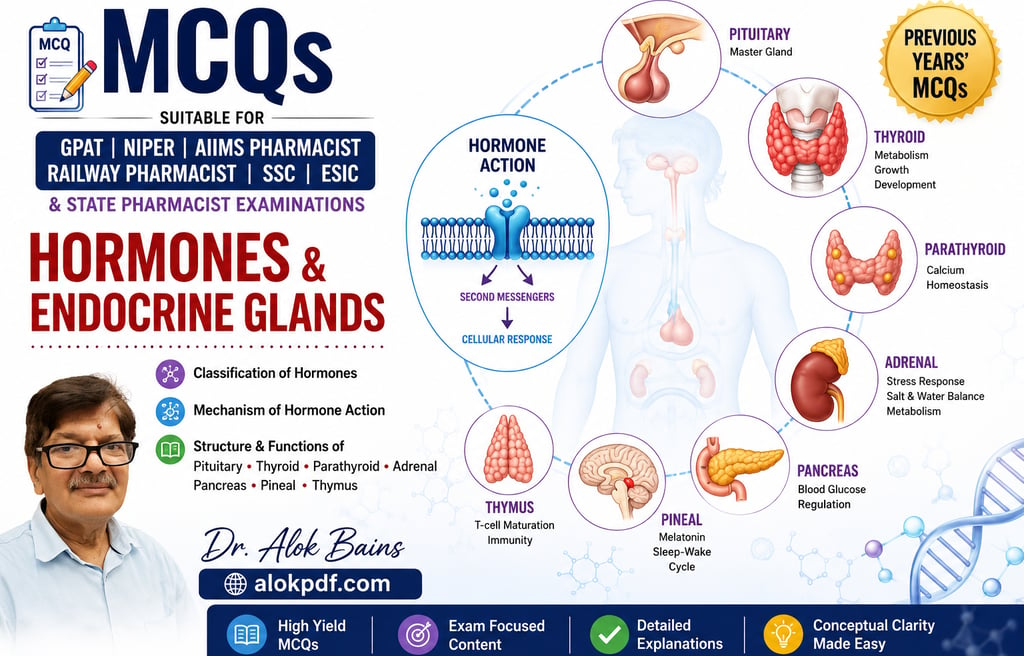
MCQs on Hormones and Endocrine Glands. Classification of hormones and mechanism of hormone action. Structure and functions of the pituitary gland, thyroid gland, parathyroid gland, adrenal gland, pancreas, pineal gland and thymus.
Quick Revision Notes:
1. Hormones:
Hormones are chemical messengers produced by endocrine glands and released directly into the bloodstream to regulate the functions of distant target organs.
Remember:
Hormone = Chemical Messenger + Blood Transport + Specific Target Organ
2. Classification of Hormones
A. Peptide and Protein Hormones
These hormones are made of amino acids and are water-soluble.
Examples:
Insulin
Glucagon
Growth hormone (GH)
Prolactin
ACTH
TSH
FSH
LH
Parathyroid hormone (PTH)
Important Features:
Stored in secretory granules.
Cannot cross the cell membrane.
Act through membrane receptors.
Usually use second messengers such as cAMP or IP3-DAG.
Memory Trick:
"Protein hormones stay Outside the cell."
B. Steroid Hormones
These hormones are synthesized from cholesterol and are lipid-soluble.
Examples:
Cortisol
Aldosterone
Testosterone
Estrogen
Progesterone
Important Features:
Not stored in large quantities.
Diffuse through cell membrane.
Bind intracellular or nuclear receptors.
Directly influence gene transcription.
Memory Trick:
"Steroids Slip through the membrane."
C. Amino Acid-Derived Hormones
These hormones are synthesized from amino acids, mainly tyrosine.
Examples:
Thyroxine (T4)
Triiodothyronine (T3)
Epinephrine
Norepinephrine
Dopamine
Melatonin
Memory Trick:
"Tyrosine gives rise to Thyroid hormones and Catecholamines."
3. Mechanism of Hormone Action
1. Membrane Receptor Mechanism
Used by water-soluble hormones.
Sequence:
Hormone → Receptor → Second Messenger → Cellular Response
Common Second Messengers:
cAMP
cGMP
IP3-DAG
Calcium ions
Examples:
Glucagon → cAMP
TSH → cAMP
Oxytocin → IP3-DAG
2. Intracellular Receptor Mechanism
Used by lipid-soluble hormones.
Sequence:
Hormone enters cell → Binds receptor → Alters gene transcription → Protein synthesis
Examples:
Cortisol
Aldosterone
Thyroid hormones
Memory Trick:
"Fat-soluble hormones go Inside the cell."
3. Receptor Tyrosine Kinase Mechanism
The most important example is insulin.
Sequence:
Insulin binds receptor → Tyrosine kinase activation → Cellular effects
Memory Trick:
"Insulin has its own kinase machine."
4. Pituitary Gland
The pituitary gland is known as the Master Gland because it controls several other endocrine glands.
Anterior Pituitary Hormones:
Growth Hormone (GH)
Prolactin (PRL)
Thyroid Stimulating Hormone (TSH)
Adrenocorticotropic Hormone (ACTH)
Follicle Stimulating Hormone (FSH)
Luteinizing Hormone (LH)
Mnemonic:
"FLAT PiG"
FSH
LH
ACTH
TSH
Prolactin
Growth Hormone
Posterior Pituitary Hormones:
Oxytocin
Antidiuretic Hormone (ADH)
Functions:
GH → Growth
TSH → Stimulates thyroid gland
ACTH → Stimulates adrenal cortex
FSH and LH → Reproductive functions
Prolactin → Milk production
ADH → Water conservation
Oxytocin → Uterine contraction and milk ejection
5. Thyroid Gland
The thyroid gland secretes:
Thyroxine (T4)
Triiodothyronine (T3)
Calcitonin
Functions:
Regulates basal metabolic rate.
Controls growth and development.
Increases oxygen consumption.
Calcitonin lowers blood calcium levels.
Remember:
T3 and T4 increase metabolism, Calcitonin decreases calcium.
6. Parathyroid Gland
The parathyroid gland secretes:
Parathyroid Hormone (PTH)
Functions:
Increases blood calcium concentration.
Stimulates bone resorption.
Increases calcium reabsorption in kidneys.
Activates vitamin D.
Memory Trick:
"PTH Pulls calcium into the blood."
7. Adrenal Gland
The adrenal gland consists of cortex and medulla.
Adrenal Cortex
Zona Glomerulosa
Produces:
Aldosterone
Function:
Sodium retention and potassium excretion.
Zona Fasciculata
Produces:
Cortisol
Function:
Stress response and glucose metabolism.
Zona Reticularis
Produces:
Androgens
Function:
Secondary sexual characteristics.
Glomerulosa → Salt (Aldosterone)
Fasciculata → Sugar (Cortisol)
Reticularis → Sex (Androgens)
Adrenal Medulla
Produces:
Epinephrine
Norepinephrine
Functions:
Increases heart rate.
Raises blood glucose.
Prepares the body for fight-or-flight response.
8. Pancreas
The endocrine pancreas contains Islets of Langerhans.
Cell Type Hormone
Alpha cells Glucagon
Beta cells Insulin
Delta cells Somatostatin
PP cells Pancreatic polypeptide
Alpha → Glucagon
Beta → Insulin
Delta → Somatostatin
PP → Pancreatic polypeptide
Functions:
Insulin lowers blood glucose.
Glucagon raises blood glucose.
Somatostatin inhibits several hormones.
9. Pineal Gland
The pineal gland secretes:
Melatonin
Functions:
Regulates sleep-wake cycle.
Controls circadian rhythm.
Memory Trick:
"Melatonin = Moon hormone."
10. Thymus Gland
The thymus gland secretes:
Thymosin
Functions:
Maturation of T-lymphocytes.
Development of immunity in childhood.
Important Fact:
The thymus is large in children and gradually shrinks after puberty.
Memory Trick:
"T for Thymus and T for T-cells."
One-Line Revision Table
Gland Major Hormone Main Function
Pituitary GH, TSH, ACTH Controls other glands
Thyroid T3, T4 Increases metabolism
Parathyroid PTH Raises blood calcium
Adrenal Cortex Cortisol, Aldosterone Stress and electrolyte balance
Adrenal Medulla Epinephrine Fight-or-flight response
Pancreas Insulin, Glucagon Blood glucose regulation
Pineal Melatonin Sleep regulation
Thymus Thymosin T-cell maturation
Master = Pituitary
Thyroid = Thyroid gland
Protects = Parathyroid gland
Against = Adrenal gland
Panicked = Pancreas
Midnight = Pineal gland
Threats = Thymus gland
1. Which of the following hormones acts through intracellular receptors?
A. Insulin
B. Glucagon
C. Thyroxine
D. Growth hormone
Answer: C. Thyroxine
Explanation: Thyroid hormones are lipid-soluble and diffuse through the cell membrane to bind intracellular nuclear receptors, thereby regulating gene transcription.
2. Which hormone acts through the cAMP second messenger system?
A. Insulin
B. Growth hormone
C. Glucagon
D. Cortisol
Answer: C. Glucagon
Explanation: Glucagon binds to G-protein coupled receptors and activates adenylate cyclase, increasing intracellular cAMP levels.
3. Steroid hormones are synthesized mainly from:
A. Amino acids
B. Cholesterol
C. Fatty acids
D. Glycogen
Answer: B. Cholesterol
Explanation: All steroid hormones, including cortisol, aldosterone, estrogen, progesterone, and testosterone, are derived from cholesterol.
4. Which hormone belongs to the peptide hormone class?
A. Cortisol
B. Aldosterone
C. Insulin
D. Thyroxine
Answer: C. Insulin
Explanation: Insulin is a peptide hormone composed of amino acids and acts via membrane receptors.
5. Catecholamines are synthesized from:
A. Tyrosine
B. Tryptophan
C. Cholesterol
D. Glycine
Answer: A. Tyrosine
Explanation: Epinephrine, norepinephrine, and dopamine are catecholamines derived from tyrosine.
6. Which pituitary hormone stimulates milk production?
A. Oxytocin
B. Prolactin
C. ACTH
D. FSH
Answer: B. Prolactin
Explanation: Prolactin secreted by the anterior pituitary stimulates milk synthesis in mammary glands.
7. Oxytocin is secreted from:
A. Anterior pituitary
B. Posterior pituitary
C. Adrenal cortex
D. Pineal gland
Answer: B. Posterior pituitary
Explanation: Oxytocin is synthesized in the hypothalamus and stored and released from the posterior pituitary.
8. Which hormone stimulates the adrenal cortex?
A. TSH
B. ACTH
C. FSH
D. LH
Answer: B. ACTH
Explanation: Adrenocorticotropic hormone stimulates secretion of glucocorticoids from the adrenal cortex.
9. The hormone responsible for linear growth in children is:
A. TSH
B. Prolactin
C. Growth hormone
D. ACTH
Answer: C. Growth hormone
Explanation: Growth hormone promotes bone and tissue growth primarily through insulin-like growth factor-1 (IGF-1).
10. Deficiency of growth hormone in childhood causes:
A. Acromegaly
B. Gigantism
C. Dwarfism
D. Cushing syndrome
Answer: C. Dwarfism
Explanation: Growth hormone deficiency during childhood leads to stunted growth and pituitary dwarfism.
11. Which cells of the thyroid gland secrete calcitonin?
A. Follicular cells
B. Parafollicular cells
C. Chief cells
D. Oxyphil cells
Answer: B. Parafollicular cells
Explanation: C-cells or parafollicular cells produce calcitonin, which lowers blood calcium levels.
12. The major hormone secreted by the thyroid gland is:
A. Calcitonin
B. Thyroxine
C. Parathormone
D. Aldosterone
Answer: B. Thyroxine
Explanation: Thyroxine (T4) is the principal hormone secreted by the thyroid gland and regulates metabolism.
13. Which hormone increases blood calcium concentration?
A. Calcitonin
B. Insulin
C. Parathyroid hormone
D. Melatonin
Answer: C. Parathyroid hormone
Explanation: Parathyroid hormone increases serum calcium by acting on bones, kidneys, and intestines.
14. The functional cells of the parathyroid gland are:
A. Follicular cells
B. Chief cells
C. Beta cells
D. Chromaffin cells
Answer: B. Chief cells
Explanation: Chief cells synthesize and secrete parathyroid hormone (PTH).
15. Which layer of the adrenal cortex secretes aldosterone?
A. Zona fasciculata
B. Zona reticularis
C. Zona glomerulosa
D. Adrenal medulla
Answer: C. Zona glomerulosa
Explanation: Zona glomerulosa is the outermost layer and secretes mineralocorticoids, mainly aldosterone.
16. Cortisol is secreted by:
A. Zona glomerulosa
B. Zona fasciculata
C. Zona reticularis
D. Adrenal medulla
Answer: B. Zona fasciculata
Explanation: Zona fasciculata secretes glucocorticoids, principally cortisol.
17. Which hormone is secreted by the adrenal medulla?
A. Cortisol
B. Aldosterone
C. Epinephrine
D. Testosterone
Answer: C. Epinephrine
Explanation: The adrenal medulla secretes catecholamines such as epinephrine and norepinephrine.
18. Which pancreatic cells produce insulin?
A. Alpha cells
B. Beta cells
C. Delta cells
D. PP cells
Answer: B. Beta cells
Explanation: Beta cells of the islets of Langerhans synthesize and secrete insulin.
19. Glucagon is secreted by:
A. Alpha cells
B. Beta cells
C. Delta cells
D. Acinar cells
Answer: A. Alpha cells
Explanation: Alpha cells secrete glucagon, which increases blood glucose levels.
20. Somatostatin is secreted by:
A. Alpha cells
B. Beta cells
C. Delta cells
D. PP cells
Answer: C. Delta cells
Explanation: Somatostatin inhibits secretion of insulin, glucagon, and growth hormone.
21. Melatonin is secreted by:
A. Thymus gland
B. Pineal gland
C. Pituitary gland
D. Thyroid gland
Answer: B. Pineal gland
Explanation: Melatonin regulates circadian rhythm and sleep-wake cycles.
22. The thymus gland plays a major role in:
A. Calcium metabolism
B. Glucose metabolism
C. T-lymphocyte maturation
D. Blood pressure regulation
Answer: C. T-lymphocyte maturation
Explanation: The thymus is essential for the development and maturation of T lymphocytes involved in immunity.
23. Which hormone acts via tyrosine kinase receptors?
A. Glucagon
B. ACTH
C. Insulin
D. TSH
Answer: C. Insulin
Explanation: Insulin receptors possess intrinsic tyrosine kinase activity, leading to phosphorylation cascades.
24. Which hormone uses the IP3-DAG second messenger pathway?
A. Parathyroid hormone
B. Growth hormone
C. Oxytocin
D. Glucagon
Answer: C. Oxytocin
Explanation: Oxytocin activates phospholipase C, generating IP3 and DAG as second messengers.
25. Which gland is known as the "master gland" of the body?
A. Thyroid gland
B. Pituitary gland
C. Pineal gland
D. Adrenal gland
Answer: B. Pituitary gland
Explanation: The pituitary gland controls several endocrine glands through trophic hormones such as TSH, ACTH, FSH, and LH.
26. Which hormone decreases blood glucose levels?
A. Glucagon
B. Cortisol
C. Epinephrine
D. Insulin
Answer: D. Insulin
Explanation: Insulin promotes glucose uptake by tissues and glycogen synthesis, reducing blood glucose concentration.
27. Which endocrine gland degenerates after puberty?
A. Thyroid gland
B. Adrenal gland
C. Thymus gland
D. Pineal gland
Answer: C. Thymus gland
Explanation: The thymus undergoes involution after puberty and is gradually replaced by adipose tissue.
28. Which hormone regulates basal metabolic rate?
A. Insulin
B. Thyroxine
C. Aldosterone
D. Melatonin
Answer: B. Thyroxine
Explanation: Thyroid hormones increase oxygen consumption and regulate basal metabolic rate.
29. Which hormone promotes sodium and water retention?
A. Cortisol
B. Aldosterone
C. Glucagon
D. Calcitonin
Answer: B. Aldosterone
Explanation: Aldosterone acts on renal tubules to increase sodium reabsorption and potassium excretion.
30. Which of the following is an amino acid-derived hormone?
A. Insulin
B. Cortisol
C. Thyroxine
D. Progesterone
Answer: C. Thyroxine
Explanation: Thyroxine is synthesized from tyrosine residues and iodine and is classified as an amino acid-derived hormone.
Advanced MCQs on Hormones and Endocrine Glands
Assertion–Reason Questions
1.
Assertion (A): Steroid hormones act mainly through intracellular receptors.
Reason (R): Steroid hormones are lipid soluble and can cross the plasma membrane.
A. Both A and R are true, and R is the correct explanation of A.
B. Both A and R are true, but R is not the correct explanation of A.
C. A is true, but R is false.
D. A is false, but R is true.
Answer: A
Explanation: Lipid-soluble steroid hormones diffuse through cell membranes and bind intracellular receptors to regulate gene transcription.
2.
Assertion (A): Insulin acts through a tyrosine kinase receptor.
Reason (R): Insulin increases intracellular cAMP concentration.
Answer: C
Explanation: Insulin acts through receptor tyrosine kinase but does not act through cAMP signaling.
3.
Assertion (A): The anterior pituitary is called the master gland.
Reason (R): It secretes tropic hormones that regulate other endocrine glands.
Answer: A
Explanation: Hormones such as TSH, ACTH, FSH, and LH regulate target endocrine organs.
4.
Assertion (A): Calcitonin lowers blood calcium concentration.
Reason (R): Calcitonin stimulates osteoclastic bone resorption.
Answer: C
Explanation: Calcitonin inhibits osteoclastic activity and promotes calcium deposition in bones.
5.
Assertion (A): Parathyroid hormone increases calcium reabsorption in kidneys.
Reason (R): PTH decreases vitamin D activation.
Answer: C
Explanation: PTH actually increases activation of vitamin D, enhancing intestinal calcium absorption.
6.
Assertion (A): The adrenal medulla is functionally similar to sympathetic ganglia.
Reason (R): Chromaffin cells are modified postganglionic sympathetic neurons.
Answer: A
Explanation: The adrenal medulla secretes catecholamines in response to sympathetic stimulation.
7.
Assertion (A): Growth hormone secretion increases during deep sleep.
Reason (R): Growth hormone release is stimulated by GHRH from the hypothalamus.
Answer: B
Explanation: Both statements are true, but GHRH release does not specifically explain nocturnal secretion.
8.
Assertion (A): Melatonin secretion is highest during daylight hours.
Reason (R): Light suppresses melatonin synthesis.
Answer: D
Explanation: Melatonin secretion peaks in the dark and decreases with light exposure.
9.
Assertion (A): Aldosterone secretion is regulated mainly by the renin-angiotensin system.
Reason (R): ACTH is the principal regulator of aldosterone release.
Answer: C
Explanation: Aldosterone secretion is primarily regulated by angiotensin II and plasma potassium levels.
10.
Assertion (A): Glucagon increases blood glucose concentration.
Reason (R): Glucagon stimulates glycogenolysis and gluconeogenesis.
Answer: A
Explanation: Both mechanisms contribute to increased plasma glucose.
Match the Following
11. Match the hormone with its receptor type.
List I List II
P. Insulin 1. Nuclear receptor
Q. Cortisol 2. GPCR
R. Glucagon 3. Receptor tyrosine kinase
S. Thyroxine 4. Intracellular receptor
A. P-3, Q-4, R-2, S-1
B. P-2, Q-4, R-3, S-1
C. P-3, Q-2, R-4, S-1
D. P-4, Q-3, R-2, S-1
Answer: A
12. Match the gland with the hormone.
List I List II
P. Pineal gland 1. Thymosin
Q. Thymus 2. Melatonin
R. Adrenal cortex 3. Cortisol
S. Parathyroid gland 4. PTH
A. P-2, Q-1, R-3, S-4
B. P-1, Q-2, R-4, S-3
C. P-3, Q-4, R-2, S-1
D. P-4, Q-3, R-1, S-2
Answer: A
13. Match adrenal cortex zones with hormones.
List I List II
P. Zona glomerulosa 1. Androgens
Q. Zona fasciculata 2. Cortisol
R. Zona reticularis 3. Aldosterone
A. P-3, Q-2, R-1
B. P-2, Q-1, R-3
C. P-1, Q-3, R-2
D. P-3, Q-1, R-2
Answer: A
14. Match pancreatic cells with secretions.
List I List II
P. Alpha cells 1. Somatostatin
Q. Beta cells 2. Pancreatic polypeptide
R. Delta cells 3. Glucagon
S. PP cells 4. Insulin
A. P-3, Q-4, R-1, S-2
B. P-4, Q-3, R-1, S-2
C. P-3, Q-1, R-4, S-2
D. P-2, Q-4, R-3, S-1
Answer: A
15. Match hormones with second messengers.
List I List II
P. TSH 1. Tyrosine kinase
Q. Oxytocin 2. cAMP
R. Insulin 3. IP3-DAG
A. P-2, Q-3, R-1
B. P-3, Q-2, R-1
C. P-1, Q-2, R-3
D. P-2, Q-1, R-3
Answer: A
Clinical Case-Based Questions
A child presents with short stature and delayed skeletal growth. Laboratory findings reveal low serum IGF-1 levels. Which hormone deficiency is most likely?
A. ACTH
B. Growth hormone
C. TSH
D. Prolactin
Answer: B
Explanation: Growth hormone stimulates IGF-1 production, which mediates bone growth.
17. A patient has a moon face, central obesity, and muscle wasting. Excess secretion of which hormone is likely?
A. Aldosterone
B. Cortisol
C. Thyroxine
D. Glucagon
Answer: B
Explanation: Hypercortisolism produces the classical features of Cushing syndrome.
A patient develops tetany after thyroid surgery. Which hormone is likely deficient?
A. Calcitonin
B. PTH
C. TSH
D. Thyroxine
Answer: B
Explanation: Accidental removal of parathyroid glands causes hypocalcemia and tetany.
A patient complains of heat intolerance, weight loss, and tachycardia. Which hormone is elevated?
A. Insulin
B. Thyroxine
C. Cortisol
D. Aldosterone
Answer: B
A patient with fasting blood glucose of 280 mg/dL has destruction of beta cells. Which hormone is deficient?
A. Glucagon
B. Somatostatin
C. Insulin
D. Cortisol
Answer: C
Hyperpigmentation & hypotension are suggestive of deficiency of
A. Cortisol
B. Melatonin
C. Insulin
D. Prolactin
Answer: A
Which endocrine gland is most active during childhood but undergoes involution after puberty?
A. Pineal gland
B. Thyroid gland
C. Thymus
D. Pituitary gland
Answer: C
A patient develops hypertension with hypokalemia due to excessive aldosterone secretion. Which adrenal zone is involved?
A. Zona fasciculata
B. Zona reticularis
C. Zona glomerulosa
D. Medulla
Answer: C
A tumor of chromaffin cells would increase secretion of:
A. Cortisol
B. Epinephrine
C. Aldosterone
D. Testosterone
Answer: B
Which hormone is responsible for milk ejection reflex?
A. Prolactin
B. Oxytocin
C. Estrogen
D. FSH
Answer: B
26. Which hormone has the shortest plasma half-life?
A. Cortisol
B. Thyroxine
C. Epinephrine
D. Aldosterone
Answer: C
27. Which hormone exhibits pulsatile secretion?
A. Growth hormone
B. Thyroxine
C. Cortisol
D. Aldosterone
Answer: A
28. Which hormone has both endocrine and paracrine functions?
A. Somatostatin
B. Thyroxine
C. ACTH
D. PTH
Answer: A
29. Which hormone is synthesized as preproinsulin?
A. Growth hormone
B. Insulin
C. Cortisol
D. Glucagon
Answer: B
30. Which hormone is iodine-containing?
A. Cortisol
B. Insulin
C. Thyroxine
D. Aldosterone
Answer: C
The principal regulator of calcium homeostasis is:
A. Melatonin
B. PTH
C. TSH
D. ACTH
Answer: B
The hypothalamic hormone inhibiting growth hormone release is
A. Somatostatin
B. Dopamine
C. TRH
D. CRH
Answer: A
Which hormone stimulates uterine contraction during labor?
A. Prolactin
B. Oxytocin
C. LH
D. ACTH
Answer: B
The endocrine pancreas constitutes approximately what percentage of pancreatic mass?
A. 1–2%
B. 10–15%
C. 25–30%
D. 40–50%
Answer: A
Which pituitary hormone stimulates cortisol secretion?
A. LH
B. FSH
C. ACTH
D. TSH
Answer: C
Which hormone follows circadian rhythm most prominently?
A. Cortisol
B. Insulin
C. PTH
D. Calcitonin
Answer: A
Which hormone decreases serum phosphate levels?
A. PTH
B. Calcitonin
C. Aldosterone
D. Cortisol
Answer: A
Which endocrine gland develops from neural crest cells?
A. Thyroid follicular cells
B. Adrenal medulla
C. Pituitary gland
D. Parathyroid gland
Answer: B
Which hormone promotes glycogen synthesis?
A. Glucagon
B. Cortisol
C. Insulin
D. Epinephrine
Answer: C
Which hormone acts through JAK-STAT signaling?
A. Growth hormone
B. Glucagon
C. ACTH
D. TSH
Answer: A
Which pituitary hormone is under tonic inhibition by dopamine?
A. ACTH
B. Growth hormone
C. Prolactin
D. TSH
Answer: C
Which endocrine gland stores hormones extracellularly?
A. Thyroid gland
B. Pituitary gland
C. Adrenal gland
D. Pancreas
Answer: A
Which hormone promotes potassium excretion by kidneys?
A. Insulin
B. Aldosterone
C. Cortisol
D. PTH
Answer: B
The immediate precursor of epinephrine is:
A. Tyrosine
B. Dopamine
C. Norepinephrine
D. DOPA
Answer: C
Which hormone increases intestinal calcium absorption indirectly?
A. Calcitonin
B. PTH
C. Insulin
D. Melatonin
Answer: B
46 Which gland secretes hormones involved in immune maturation?
A. Pineal gland
B. Thymus
C. Pituitary gland
D. Adrenal medulla
Answer: B
47 Which hormone exhibits negative feedback on hypothalamus and pituitary?
A. Cortisol
B. Insulin
C. Melatonin
D. Calcitonin
Answer: A
48 Which hormone is secreted in response to hyperglycemia?
A. Glucagon
B. Insulin
C. Cortisol
D. Growth hormone
Answer: B
49 Which endocrine gland originates from Rathke's pouch?
A. Posterior pituitary
B. Adrenal medulla
C. Anterior pituitary
D. Pineal gland
Answer: C
50 Which hormone increases basal metabolic rate most significantly?
A. Cortisol
B. Insulin
C. Thyroxine
D. PTH
Answer: C
Explanation: Thyroid hormones increase oxygen consumption and metabolic activity in most tissues, thereby increasing basal metabolic rate.
Dr Alok Singh.