
Human Reproductive System MCQs for GPAT
Master Human Reproductive System MCQs for GPAT, NIPER, AIIMS Pharmacist, Railway Pharmacist, ESIC, SSC, and State Pharmacist exams with conceptual questions and quick revision notes.
Dr. Alok Singh
7/11/20267 min read
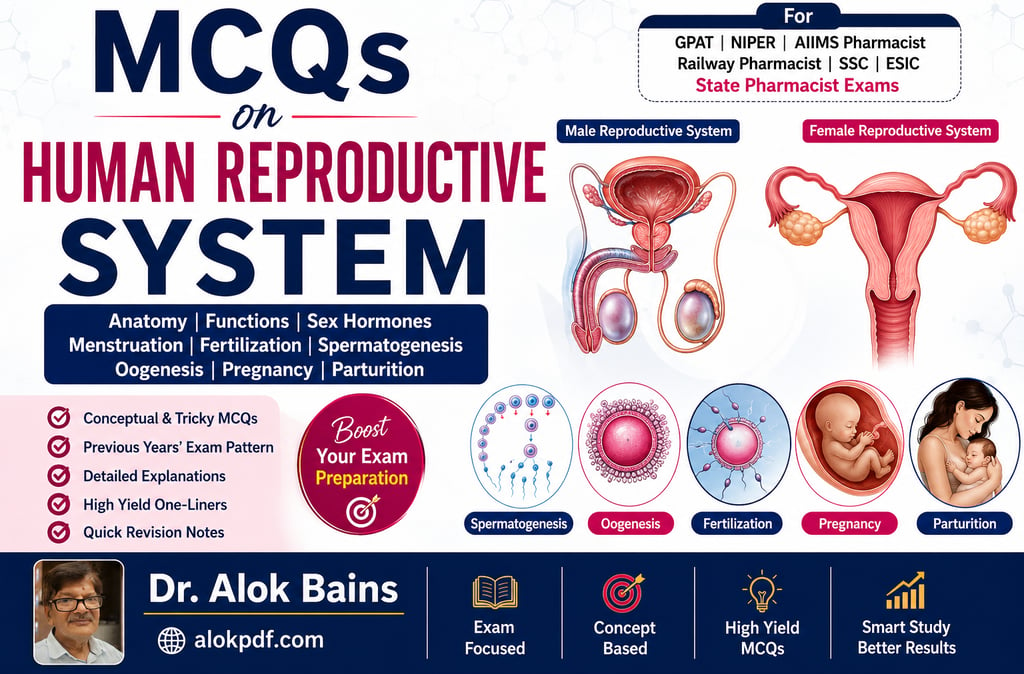
Quick Revision Notes & MCQs: Human Reproductive System for GPAT, NIPER, AIIMS Pharmacist, Railway Pharmacist, SSC, ESIC, and State Pharmacist Exams
1. Male Reproductive System
The male reproductive system consists of:
Primary sex organ: Testes
Accessory ducts: Rete testis, vasa efferentia, epididymis, vas deferens, ejaculatory duct, urethra
Accessory glands: Seminal vesicles, prostate gland, bulbourethral glands
External genitalia: Penis and scrotum
Functions
Production of sperm (spermatogenesis)
Secretion of testosterone
Transport and delivery of sperm during ejaculation
Important Facts
Seminal vesicles contribute about 60–70% of semen volume.
Prostate gland contributes about 20–30% of semen volume.
Bulbourethral glands secrete alkaline mucus for lubrication.
Epididymis is the site of sperm maturation and storage.
2. Female Reproductive System
The female reproductive system includes:
Ovaries
Fallopian tubes (oviducts)
Uterus
Cervix
Vagina
External genitalia (vulva)
Functions
Production of ova (oogenesis)
Secretion of female sex hormones
Fertilization, implantation, pregnancy and childbirth
Important Facts
The ampulla of the fallopian tube is the usual site of fertilization.
The endometrium is the inner lining of the uterus and undergoes cyclic changes.
The myometrium is the muscular layer responsible for uterine contractions during labor.
3. Male Sex Hormones
Testosterone
Produced by Leydig cells of the testes under the influence of LH.
Functions
Development of male reproductive organs
Development of secondary sexual characteristics
Maintenance of spermatogenesis
Increase in muscle and bone mass
Hormonal Control
Hypothalamus: GnRH
Anterior pituitary: LH and FSH
LH: Leydig cells: Testosterone
FSH: Sertoli cells Spermatogenesis
4. Female Sex Hormones
Estrogen
Produced mainly by developing ovarian follicles.
Functions
Development of female reproductive organs
Development of secondary sexual characteristics
Proliferation of endometrium
Progesterone
Produced mainly by the corpus luteum.
Functions
Preparation of uterus for implantation
Maintenance of pregnancy
Reduction of uterine contractions
5. Spermatogenesis
Spermatogenesis is the formation of sperm in the seminiferous tubules of testes.
Sequence
Spermatogonium (2n)
Primary spermatocyte (2n)
Secondary spermatocyte (n)
Spermatid (n)
Spermatozoa (n)
Important Facts
Begins at puberty.
One primary spermatocyte produces four spermatozoa.
Requires FSH and testosterone.
Sertoli cells nourish developing sperm.
Memory Tip
LH Loves Leydig cells
FSH supports Sertoli cells
6. Oogenesis
Oogenesis is the formation of ova in ovaries.
Sequence
Oogonium (2n)
Primary oocyte (2n)
Secondary oocyte (n)
Ovum (n)
Important Facts
Begins during fetal life.
Primary oocytes remain arrested in Prophase I until puberty.
Secondary oocyte remains arrested in Metaphase II until fertilization.
One primary oocyte produces only one functional ovum.
Memory Tip
Primary = Prophase I
Secondary = Second stop at Metaphase II
7. Menstrual Cycle
The average menstrual cycle lasts 28 days.
Menstrual Phase (Days 1–5)
Shedding of endometrium occurs.
Caused by fall in estrogen and progesterone.
Proliferative Phase (Days 6–14)
Endometrium regenerates.
Dominated by estrogen.
Ovulation (Day 14)
Triggered by the LH surge.
Secondary oocyte is released.
Secretory Phase (Days 15–28)
Dominated by progesterone.
Endometrium becomes thick and glandular.
Memory Tip
Estrogen Builds
Progesterone Protects
8. Fertilization
Fertilization is the fusion of sperm and ovum.
Site
Usually occurs in the ampulla of fallopian tube.
Important Events
Capacitation of sperm occurs in the female reproductive tract.
Acrosomal reaction allows penetration of zona pellucida.
Cortical reaction prevents polyspermy.
Important Fact
Implantation usually occurs 6–7 days after fertilization.
9. Pregnancy
Pregnancy begins after implantation of the blastocyst in the uterine wall.
Placental Hormones
Human chorionic gonadotropin (hCG)
Human placental lactogen (hPL)
Estrogen
Progesterone
Relaxin
Functions of Placenta
Exchange of oxygen and nutrients
Removal of waste products
Endocrine function
Important Fact
hCG maintains the corpus luteum during early pregnancy.
10. Parturition (Childbirth)
Parturition is the process of delivery of the baby.
Mechanism
Stretching of cervix stimulates oxytocin release.
Oxytocin increases uterine contractions.
Contractions further stimulate oxytocin secretion.
This is an example of positive feedback mechanism.
Important Hormones
Oxytocin: Uterine contractions and milk ejection
Prolactin: Milk production
Relaxin: Relaxation of pelvic ligaments and cervix
Facts for One-Minute Revision
Largest contribution to semen volume: Seminal vesicles
Testosterone secretion: Leydig cells
Blood-testis barrier: Sertoli cells
Sperm maturation: Epididymis
Fertilization site: Ampulla of the fallopian tube
Implantation: Day 6–7
Ovulation: LH surge
Primary oocyte arrest: Prophase I
Secondary oocyte arrest: Metaphase II
Corpus luteum maintenance: hCG
Milk production: Prolactin
Milk ejection: Oxytocin
Pregnancy-maintaining hormone: Progesterone
Hormone responsible for endometrial proliferation: Estrogen
50 One-Liner Previous-Year Style Facts: Human Reproductive System
The testes are located in the scrotum to maintain a temperature approximately 2–3°C below body temperature for spermatogenesis.
The functional unit of the testis is the seminiferous tubule.
Sertoli cells are called the "nurse cells" of the testes.
Leydig cells are also known as interstitial cells.
Testosterone is secreted by Leydig cells under the influence of LH.
FSH acts primarily on Sertoli cells to promote spermatogenesis.
The blood-testis barrier is formed by tight junctions between Sertoli cells.
The acrosome of sperm is derived from the Golgi apparatus.
The middle piece of sperm contains numerous mitochondria.
Mature sperm are stored mainly in the epididymis.
The epididymis is the principal site for sperm maturation.
The vas deferens transports sperm from the epididymis to the urethra.
The ejaculatory duct is formed by the union of the vas deferens and seminal vesicle duct.
The seminal vesicles contribute the largest volume of semen.
Fructose present in semen is secreted mainly by the seminal vesicles.
The secretion of the prostate gland is slightly alkaline.
The bulbourethral glands secrete mucus for lubrication and neutralization of acidity.
One primary spermatocyte produces four spermatozoa.
Spermatogenesis begins at puberty.
Human sperm remain viable in the female reproductive tract for approximately 48–72 hours.
The ovary is the primary female reproductive organ.
The ovary produces both ova and female sex hormones.
The normal ovary contains follicles in different stages of development.
The mature ovarian follicle is called the Graafian follicle.
The corpus luteum develops from the ruptured Graafian follicle.
Progesterone is mainly secreted by the corpus luteum.
The usual site of fertilization is the ampulla of the fallopian tube.
The finger-like projections of the oviduct are called fimbriae.
The endometrium is the inner lining of the uterus.
The functional layer of the endometrium is shed during menstruation.
The average menstrual cycle lasts 28 days.
Menstruation occurs due to a fall in estrogen and progesterone levels.
The proliferative phase is dominated by estrogen.
The secretory phase is dominated by progesterone.
Ovulation is triggered by the LH surge.
In a 28-day cycle, ovulation generally occurs on the 14th day.
The primary oocyte remains arrested in Prophase I until puberty.
The secondary oocyte remains arrested in Metaphase II until fertilization.
One primary oocyte produces only one functional ovum.
Capacitation of sperm occurs in the female reproductive tract.
The acrosomal reaction helps sperm penetrate the zona pellucida.
The cortical reaction prevents polyspermy.
Implantation usually occurs 6–7 days after fertilization.
The outer cell layer of the blastocyst forms the trophoblast.
Human chorionic gonadotropin (hCG) maintains the corpus luteum during early pregnancy.
The placenta acts as both an exchange organ and an endocrine organ.
The placenta secretes hCG, hPL, estrogen, progesterone, and relaxin.
Prolactin is responsible for milk production after childbirth.
Oxytocin is responsible for milk ejection and uterine contractions.
Parturition is an example of a positive feedback mechanism mediated by oxytocin.
MCQs on Human Reproductive System for GPAT, NIPER, AIIMS Pharmacist, Railway Pharmacist, SSC, ESIC & State Pharmacist Exams
1. Which structure contributes the maximum volume to human semen?
A. Seminiferous tubules
B. Prostate gland
C. Seminal vesicles
D. Bulbourethral glands
Answer: C. Seminal vesicles
Explanation: Seminal vesicles contribute approximately 60–70% of semen volume and provide fructose for sperm energy.
2. Sertoli cells are primarily responsible for:
A. Testosterone secretion
B. Sperm maturation and nourishment
C. Secretion of prostaglandins
D. Production of LH
Answer: B. Sperm maturation and nourishment
3. Leydig cells are stimulated by which hormone?
A. FSH
B. LH
C. Prolactin
D. Oxytocin
Answer: B. LH
4. Which statement regarding the blood-testis barrier is correct?
A. It is formed by Leydig cells.
B. It prevents autoimmune destruction of sperm cells.
C. It separates epididymis from seminiferous tubules.
D. It allows free movement of antibodies into seminiferous tubules.
Answer: B. It prevents autoimmune destruction of sperm cells.
5. The acrosome of sperm is derived from the:
A. Golgi apparatus
B. Endoplasmic reticulum
C. Mitochondria
D. Nucleus
Answer: A. Golgi apparatus
6. Which part of sperm contains mitochondria arranged spirally?
A. Head
B. Acrosome
C. Middle piece
D. Tail
Answer: C. Middle piece
7. Spermatogenesis begins under the influence of:
A. Progesterone
B. Testosterone alone
C. FSH and testosterone
D. Estrogen and FSH
Answer: C. FSH and testosterone
8. One primary spermatocyte ultimately produces:
A. 1 spermatozoon
B. 2 spermatozoa
C. 3 spermatozoa
D. 4 spermatozoa
Answer: D. 4 spermatozoa
9. Oogenesis differs from spermatogenesis because
A. Oogenesis begins at puberty.
B. Oogenesis produces equal-sized gametes.
C. Cytoplasmic division is unequal in oogenesis.
D. Meiosis is completed before birth.
Answer: C. Cytoplasmic division is unequal in oogenesis.
10. Primary oocytes remain arrested in which stage until puberty?
A. Metaphase I
B. Prophase I
C. Metaphase II
D. Anaphase II
Answer: B. Prophase I
11. Secondary oocyte is arrested in:
A. Prophase I
B. Metaphase I
C. Metaphase II
D. Telophase II
Answer: C. Metaphase II
12. Fertilization normally occurs in the:
A. Uterus
B. Cervix
C. Ampulla of fallopian tube
D. Infundibulum
Answer: C. Ampulla of fallopian tube
13. Capacitation of sperm occurs in the:
A. Testis
B. Epididymis
C. Vas deferens
D. Female reproductive tract
Answer: D. Female reproductive tract
14. The zona pellucida prevents:
A. Implantation
B. Fertilization
C. Polyspermy
D. Cleavage
Answer: C. Polyspermy
15. Implantation generally occurs on the:
A. 2nd day after fertilization
B. 4th day after fertilization
C. 6th–7th day after fertilization
D. 14th day after fertilization
Answer: C. 6th–7th day after fertilization
16. Which hormone is responsible for maintaining the corpus luteum during early pregnancy?
A. LH
B. FSH
C. hCG
D. Estrogen
Answer: C. hCG
17. If fertilization does not occur, degeneration of the corpus luteum causes a fall in:
A. FSH only
B. LH only
C. Estrogen and progesterone
D. Oxytocin and prolactin
Answer: C. Estrogen and progesterone
18. The proliferative phase of the menstrual cycle is mainly under the influence of:
A. Progesterone
B. Estrogen
C. Oxytocin
D. Relaxin
Answer: B. Estrogen
19. The secretory phase of the menstrual cycle is mainly under the influence of:
A. FSH
B. LH
C. Progesterone
D. Estrogen
Answer: C. Progesterone
20. Ovulation is triggered by a sudden surge of
A. FSH
B. LH
C. Progesterone
D. Prolactin
Answer: B. LH
21. In a normal 28-day menstrual cycle, ovulation usually occurs on:
A. Day 7
B. Day 10
C. Day 14
D. Day 21
Answer: C. Day 14
22. Which hormone causes development of secondary sexual characters in females?
A. Progesterone
B. Estrogen
C. FSH
D. hCG
Answer: B. Estrogen
23. Which hormone prepares the endometrium for implantation?
A. Estrogen
B. Progesterone
C. Oxytocin
D. Prolactin
✅ Answer: B. Progesterone
24. The placenta primarily acts as:
A. Digestive organ only
B. Respiratory organ only
C. Endocrine organ only
D. Exchange and endocrine organ
Answer: D. Exchange and endocrine organ
25. Which hormone is NOT secreted by the placenta?
A. hCG
B. hPL
C. Progesterone
D. FSH
Answer: D. FSH
26. Human chorionic gonadotropin is functionally similar to:
A. FSH
B. LH
C. Prolactin
D. Oxytocin
Answer: B. LH
27. Milk ejection reflex is mediated mainly by:
A. Prolactin
B. Oxytocin
C. Estrogen
D. Progesterone
Answer: B. Oxytocin
28. Which hormone is responsible for milk production after childbirth?
A. Oxytocin
B. Prolactin
C. Relaxin
D. hPL
Answer: B. Prolactin
29. During parturition, the positive feedback mechanism involves:
A. Estrogen and progesterone
B. FSH and LH
C. Oxytocin and uterine contractions
D. Prolactin and oxytocin
Answer: C. Oxytocin and uterine contractions
30. Relaxin secreted during pregnancy mainly causes
A. Milk secretion
B. Endometrial shedding
C. Relaxation of pelvic ligaments and cervix
D. Ovulation
Answer: C. Relaxation of pelvic ligaments and cervix
31. Which of the following structures is homologous to the penis in females?
A. Labia majora
B. Vagina
C. Clitoris
D. Cervix
Answer: C. Clitoris
32. The broad ligament is associated with the:
A. Testis
B. Ovary and uterus
C. Epididymis
D. Prostate gland
Answer: B. Ovary and uterus
33. Which structure stores sperm temporarily before ejaculation?
A. Seminiferous tubules
B. Rete testis
C. Epididymis
D. Prostate gland
Answer: C. Epididymis
34. Which layer of the uterus is shed during menstruation?
A. Myometrium
B. Perimetrium
C. Functional layer of endometrium
D. Basal layer of endometrium
Answer: C. Functional layer of endometrium
35. A woman with blockage of both fallopian tubes is most likely to have difficulty with:
A. Ovulation
B. Fertilization
C. Menstruation
D. Hormone secretion
Answer: B. Fertilization.
Dr. Alok Singh