
LFT RFT ELISA MCQs for GPAT PDF
Practice conceptual and previous-year-style LFT RFT ELISA MCQs for GPAT PDF . Liver Function Tests (LFT), Renal Function Tests (RFT), and ELISA for GPAT, NIPER, AIIMS Pharmacist, Railway Pharmacist, SSC, ESIC, and State Pharmacist examinations.
Dr. Alok Singh
7/12/20269 min read
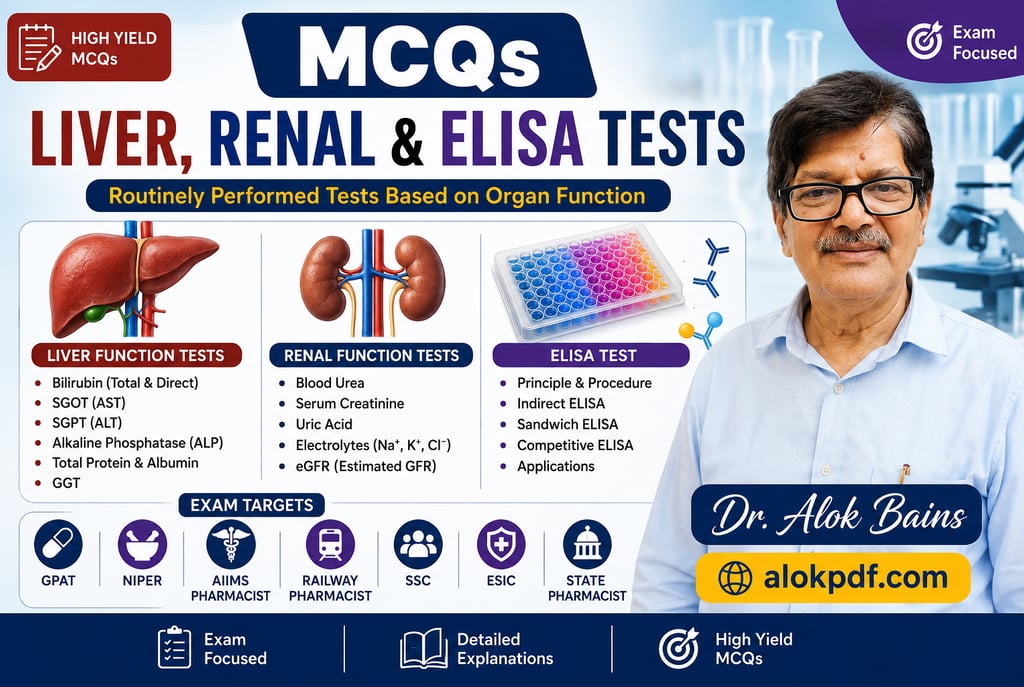
Quick Revision Notes: Liver Function Tests (LFTs), Renal Function Tests (RFTs), and ELISA. GPAT, NIPER, AIIMS Pharmacist, Railway Pharmacist, SSC, ESIC, and State Pharmacist examinations.
Liver Function Tests (LFTs)
Liver function tests are a group of laboratory investigations used to assess hepatocellular injury, cholestasis, and synthetic function of the liver. Despite the name, many LFTs actually measure liver damage rather than liver function.
Important Liver Markers
1. AST (SGOT) and ALT (SGPT)
These are transaminase enzymes released during liver cell injury.
ALT is more specific for liver damage because AST is also present in the heart, skeletal muscle, and RBCs.
ALT > AST → Viral hepatitis
AST/ALT > 2 → Alcoholic liver disease
2. Alkaline Phosphatase (ALP)
Marker of cholestasis and biliary obstruction.
Also elevated in bone diseases, pregnancy, and growing children.
Elevated ALP alone does not confirm liver disease.
3. Gamma-Glutamyl Transferase (GGT)
Helps determine whether raised ALP is of hepatic origin.
Elevated in alcoholic liver disease and after enzyme-inducing drugs such as phenytoin and phenobarbital.
4. Bilirubin
Unconjugated (Indirect) Bilirubin
Increased hemolytic jaundice.
Not excreted in urine.
Conjugated (Direct) Bilirubin
Increased obstructive jaundice and hepatocellular disease.
Water-soluble and appears in urine.
5. Albumin
Synthesized exclusively by the liver.
Indicates chronic liver synthetic function.
Decreases in chronic liver disease and cirrhosis.
6. Prothrombin Time (PT)
Reflects synthesis of clotting factors by the liver.
Best indicator of acute liver failure.
Prolonged PT indicates impaired liver synthetic function.
Quick Memory Aid
AST & ALT: Hepatocyte Attack
ALP & GGT: Bile duct Obstruction
Albumin & PT: Liver Production Function
Renal Function Tests (RFTs)
Renal function tests are used to assess the glomerular filtration, tubular function, and excretory capacity of the kidneys.
1. Blood Urea Nitrogen (BUN)
Urea is formed in the liver and excreted by the kidneys.
Influenced by diet, hydration, and gastrointestinal bleeding.
Less specific than serum creatinine for kidney function.
2. Serum Creatinine
Produced from muscle creatine metabolism.
A better routine indicator of kidney function than urea.
Increases when GFR decreases.
3. Creatinine Clearance
Used to estimate Glomerular Filtration Rate (GFR).
Slightly overestimates true GFR due to tubular secretion of creatinine.
4. Inulin Clearance
Gold standard for measuring GFR.
Inulin is:
Freely filtered
Not reabsorbed
Not secreted
Not metabolized
5. Microalbuminuria
Earliest marker of diabetic nephropathy.
Appears before serum creatinine rises.
6. Uric Acid
Elevated in gout and reduced renal excretion.
Often included in routine renal assessment.
Important Clinical Patterns
High BUN/Creatinine ratio: Dehydration or GI bleeding
Low BUN/Creatinine ratio: Liver disease
Massive proteinuria: Nephrotic syndrome
Hematuria: Nephritic syndrome
Quick Memory Aid
Creatinine = Routine kidney marker
Inulin = Ideal (gold standard) GFR marker
Microalbuminuria = Early diabetic nephropathy
Urea = Influenced by many factors
ELISA (Enzyme-Linked Immunosorbent Assay)
ELISA is an immunological test based on specific antigen-antibody interactions and is widely used for the diagnosis of infectious diseases, hormones, and tumor markers.
Principle
Antigen binds to antibody.
The enzyme-labelled reagent reacts with the substrate.
A color change is produced and measured spectrophotometrically.
Common Enzymes Used
Horseradish Peroxidase (HRP)
Alkaline Phosphatase (ALP)
Types of ELISA
1. Direct ELISA
Detects antigen directly.
Simple but less sensitive.
2. Indirect ELISA
Detects antibodies in patient serum.
Commonly used for HIV screening.
More sensitive due to signal amplification.
3. Sandwich ELISA
Detects antigens.
Suitable for proteins present in low concentrations.
4. Competitive ELISA
Labeled and unlabeled antigens compete for antibody binding.
Higher antigen concentration produces lower color intensity.
Direct = Detect Antigen Directly
Indirect = Identify Antibodies
Sandwich = Search for Antigen
Competitive = Color decreases as concentration increases
One-Minute Revision for Exams
Liver Function Tests
ALT: Liver-specific enzyme
AST/ALT > 2: Alcoholic liver disease
ALP + GGT ↑: Cholestasis
Albumin ↓: Chronic liver disease
PT ↑: Acute liver failure
Renal Function Tests
Creatinine → Best routine kidney marker
Inulin → Gold standard GFR marker
Microalbuminuria → Earliest diabetic nephropathy
High BUN/Creatinine ratio → Dehydration
ELISA
Indirect ELISA → Antibody detection
Sandwich ELISA → Antigen detection
Competitive ELISA → Inverse signal relationship
HRP → Most common enzyme
PYQ-Style One-Liner Conceptual Traps: Liver Function Tests, Renal Function Tests, and ELISA
Liver Function Tests (LFTs)
ALT is more liver-specific than AST, but AST rises earlier in alcoholic liver disease.
AST/ALT ratio > 2 strongly suggests alcoholic liver disease, whereas ALT > AST is typical of viral hepatitis.
ALP is not liver-specific; it is also elevated in bone disorders, pregnancy, and growing children.
GGT elevation with ALP elevation suggests hepatobiliary origin, whereas isolated ALP elevation suggests possible bone disease.
Albumin is a liver function marker, not a liver injury marker.
AST and ALT are tests of hepatocellular injury, not hepatic function.
Prothrombin time reflects hepatic synthetic capacity more rapidly than serum albumin.
Albumin decreases mainly in chronic liver disease, not early acute hepatitis.
Conjugated bilirubin is water soluble and appears in urine; unconjugated bilirubin does not.
Dark urine in jaundice indicates conjugated hyperbilirubinemia.
Hemolytic jaundice causes increased unconjugated bilirubin but usually no bilirubinuria.
Obstructive jaundice causes increased conjugated bilirubin and pale stools.
Urobilinogen is increased in hemolytic jaundice but decreased or absent in obstructive jaundice.
A normal bilirubin level does not exclude liver disease.
GGT is inducible by alcohol and anticonvulsants such as phenytoin and phenobarbital.
Serum ammonia is not a routine LFT but is useful in hepatic encephalopathy.
A patient with cirrhosis may have nearly normal AST and ALT values despite severe liver dysfunction.
The term "Liver Function Test" is misleading because many tests measure injury rather than function.
Renal Function Tests (RFTs)
Serum creatinine is a better marker of GFR than blood urea.
Creatinine does not rise until approximately 50% of renal function has already been lost.
A normal serum creatinine does not exclude early kidney disease.
Inulin clearance is the gold standard for GFR measurement but is rarely used clinically.
Creatinine clearance slightly overestimates true GFR due to tubular secretion of creatinine.
Urea is filtered and partially reabsorbed; creatinine is filtered with minimal reabsorption.
High protein diet and gastrointestinal bleeding can increase blood urea without renal disease.
Dehydration increases the BUN/creatinine ratio.
Intrinsic renal failure usually lowers the BUN/creatinine ratio compared with prerenal causes.
Microalbuminuria is the earliest laboratory evidence of diabetic nephropathy.
Dipstick protein testing may be negative despite microalbuminuria.
Nephrotic syndrome is characterized by massive proteinuria, hypoalbuminemia, and edema.
Hematuria is more typical of nephritic syndrome than nephrotic syndrome.
Serum uric acid reflects both production and renal excretion.
Hyperuricemia does not necessarily imply gout.
Estimated GFR decreases physiologically with aging.
A rise in serum creatinine from 0.8 to 1.6 mg/dL represents approximately a 50% reduction in GFR.
ELISA
ELISA is based on antigen-antibody interaction and enzyme-mediated signal generation.
Indirect ELISA primarily detects antibodies, whereas sandwich ELISA primarily detects antigens.
Competitive ELISA produces an inverse relationship between signal intensity and antigen concentration.
Higher color intensity in competitive ELISA means lower analyte concentration.
Indirect ELISA is generally more sensitive than direct ELISA because secondary antibodies amplify the signal.
Sandwich ELISA cannot be used effectively for very small molecules with a single epitope.
Horseradish peroxidase and alkaline phosphatase are the most commonly used ELISA enzymes.
ELISA is highly sensitive but is mainly a screening test in diseases such as HIV infection.
A positive HIV ELISA requires confirmatory testing before diagnosis is established.
ELISA uses enzymes, whereas radioimmunoassay uses radioactive isotopes.
Washing steps are critical in ELISA because inadequate washing causes false-positive results.
Blocking agents in ELISA reduce non-specific binding and background signal.
The substrate itself is colorless; the enzyme-substrate reaction generates the measurable color.
GPAT/NIPER Favourite Conceptual Traps
ALT and AST are transaminases, whereas ALP and GGT are cholestatic enzymes.
Serum albumin and prothrombin time assess liver synthesis; bilirubin assesses excretory function.
Creatinine clearance estimates GFR, whereas PAH clearance estimates renal plasma flow.
Inulin clearance equals GFR because filtration is the only process affecting inulin.
The earliest diabetic nephropathy marker is microalbuminuria, not elevated serum creatinine.
Conjugated bilirubin is direct bilirubin; unconjugated bilirubin is indirect bilirubin.
In obstructive jaundice, serum ALP may rise disproportionately higher than AST and ALT.
A patient can have severe liver failure with only mild enzyme elevation but cannot have severe synthetic failure with normal prothrombin time for long.
The best single routine test for chronic liver synthetic function is serum albumin, whereas for acute hepatic failure, it is prothrombin time.
Creatinine is produced from muscle creatine metabolism; therefore, muscle mass affects serum creatinine levels.
Low muscle mass can falsely reassure clinicians by producing a normal serum creatinine despite reduced GFR.
When a question asks for the 'best marker of GFR,' the answer is inulin; when it asks for the 'best routine marker,' the answer is serum creatinine or eGFR, depending on the options given.
MCQs on Liver Function Tests (LFTs), Renal Function Tests (RFTs), and ELISA
Liver Function Tests (LFTs)
1. Which liver function parameter is considered the most sensitive indicator of cholestasis?
A. ALT
B. AST
C. ALP
D. Serum albumin
Answer: C. ALP
2. A patient with obstructive jaundice is most likely to show:
A. Increased unconjugated bilirubin only
B. Increased conjugated bilirubin and ALP
C. Increased AST only
D. Decreased GGT
Answer: B. Increased conjugated bilirubin and ALP
3. The AST/ALT ratio greater than 2 is classically associated with:
A. Viral hepatitis
B. Alcoholic liver disease
C. Obstructive jaundice
D. Wilson's disease
Answer: B. Alcoholic liver disease
4. Which enzyme helps differentiate hepatic ALP elevation from bone ALP elevation?
A. LDH
B. CK-MB
C. GGT
D. Amylase
Answer: C. GGT
5. Prothrombin time is prolonged in liver disease primarily because the liver synthesizes:
A. Immunoglobulins
B. Vitamin D
C. Clotting factors
D. Hemoglobin
Answer: C. Clotting factors
6. Which of the following is a true liver function test rather than a liver injury marker?
A. ALT
B. AST
C. Albumin
D. GGT
Answer: C. Albumin
7. A patient has elevated AST and ALT with normal ALP and bilirubin. This pattern most likely indicates:
A. Hepatocellular injury
B. Cholestasis
C. Hemolytic anemia
D. Bone disease
Answer: A. Hepatocellular injury
8. Which bilirubin fraction increases predominantly in hemolytic jaundice?
A. Conjugated bilirubin
B. Direct bilirubin
C. Unconjugated bilirubin
D. Delta bilirubin
Answer: C. Unconjugated bilirubin
9. Which protein synthesized in the liver has the shortest half-life and is therefore an early marker of impaired hepatic synthetic function?
A. Albumin
B. Fibrinogen
C. Prealbumin
D. Ceruloplasmin
Answer: C. Prealbumin
10. In severe hepatocellular damage, serum ammonia levels increase because:
A. Increased protein synthesis occurs
B. Urea cycle function decreases
C. Renal clearance increases
D. Bilirubin synthesis increases
Answer: B. Urea cycle function decreases
Renal Function Tests (RFTs)
11. Serum creatinine is preferred over blood urea for assessing GFR because creatinine:
A. Is reabsorbed completely
B. Is unaffected by muscle mass
C. Is filtered with minimal tubular reabsorption
D. Is synthesized only in kidneys
Answer: C. Is filtered with minimal tubular reabsorption
12. Which parameter rises first in acute kidney injury?
A. Serum creatinine
B. Blood urea nitrogen
C. Serum sodium
D. Hemoglobin
Answer: B. Blood urea nitrogen
13. Creatinine clearance provides an estimate of:
A. Renal plasma flow
B. Effective renal blood flow
C. Glomerular filtration rate
D. Tubular secretion rate
Answer: C. Glomerular filtration rate
14. A decreased BUN/Creatinine ratio is commonly seen in:
A. Dehydration
B. Gastrointestinal bleeding
C. Liver disease
D. Heart failure
Answer: C. Liver disease
15. The normal BUN:Creatinine ratio is approximately:
A. 2:1
B. 5:1
C. 10–20:1
D. 30–40:1
Answer: C. 10–20:1
16. Microalbuminuria is an early marker of:
A. Acute glomerulonephritis
B. Diabetic nephropathy
C. Renal calculi
D. Nephrotic syndrome
Answer: B. Diabetic nephropathy
17. Which substance is considered the gold standard marker for measuring GFR experimentally?
A. Creatinine
B. Urea
C. Inulin
D. Uric acid
Answer: C. Inulin
18. Increased serum uric acid is commonly associated with:
A. Addison's disease
B. Gout
C. Hyperthyroidism
D. Hepatitis
Answer: B. Gout
19. Which finding is most suggestive of nephrotic syndrome?
A. Hematuria
B. Glycosuria
C. Massive proteinuria
D. Hyperkalemia
Answer: C. Massive proteinuria
20. Which of the following can falsely elevate serum creatinine without reducing GFR?
A. Reduced muscle mass
B. Increased meat intake
C. Pregnancy
D. Malnutrition
Answer: B. Increased meat intake
ELISA (Enzyme Linked Immunosorbent Assay)
21. ELISA is primarily based on:
A. Electrophoresis
B. Antigen-antibody interaction
C. Osmosis
D. Centrifugation
Answer: B. Antigen-antibody interaction
22. Which enzyme is most commonly used in ELISA?
A. Catalase
B. Hexokinase
C. Horseradish peroxidase
D. Pyruvate kinase
Answer: C. Horseradish peroxidase
23. In indirect ELISA, the enzyme is linked to:
A. Antigen
B. Primary antibody
C. Secondary antibody
D. Substrate
Answer: C. Secondary antibody
24. Sandwich ELISA is best suited for detection of:
A. Small drugs
B. Antibodies only
C. Antigens present in low concentration
D. Electrolytes
Answer: C. Antigens present in low concentration
25. Which type of ELISA is commonly used for HIV screening?
A. Competitive ELISA
B. Direct ELISA
C. Indirect ELISA
D. Sandwich ELISA
Answer: C. Indirect ELISA
26. In competitive ELISA:
A. Signal intensity is directly proportional to antigen concentration.
B. Signal intensity is inversely proportional to antigen concentration.
C. No enzyme is used.
D. Antibody is absent.
Answer: B. Signal intensity is inversely proportional to antigen concentration.
27. The substrate used with horseradish peroxidase in ELISA most commonly produces:
A. Fluorescence only
B. Color change
C. Precipitation only
D. Radioactivity
Answer: B. Color change
28. Which of the following diseases is routinely diagnosed using ELISA?
A. Tuberculosis only
B. HIV infection
C. Malaria only
D. Typhoid only
Answer: B. HIV infection
29. A major advantage of ELISA over radioimmunoassay is:
A. Lower sensitivity
B. Requirement of radioactive isotopes
C. Safer handling and disposal
D. Inability to automate
Answer: C. Safer handling and disposal
30. Which statement regarding ELISA is INCORRECT?
A. ELISA can detect antigen or antibody.
B. ELISA requires enzyme-labeled reagents.
C. ELISA always uses radioactive tracers.
D. ELISA is widely used in diagnostic laboratories.
Answer: C. ELISA always uses radioactive tracers.
Top 25 Previous-Year Concept Repeats: LFTs, RFTs, and ELISA
Liver Function Tests (LFTs)
AST/ALT ratio > 2 strongly suggests alcoholic liver disease.
ALT (SGPT) is more liver-specific than AST (SGOT).
ALP is the most important biochemical marker of cholestasis and obstructive jaundice.
GGT is used to confirm that elevated ALP is of hepatobiliary origin rather than bone origin.
Conjugated bilirubin is water-soluble and is excreted in urine.
Unconjugated bilirubin is albumin-bound and does not appear in urine.
Hemolytic jaundice causes predominantly unconjugated hyperbilirubinemia.
Obstructive jaundice causes conjugated hyperbilirubinemia with increased ALP and GGT.
Serum albumin is a marker of chronic liver synthetic function.
Prothrombin time is the best routine indicator of acute hepatic synthetic failure.
Renal Function Tests (RFTs)
Serum creatinine is a better routine indicator of GFR than blood urea.
Inulin clearance is the gold standard method for measuring GFR.
Creatinine clearance slightly overestimates GFR because creatinine undergoes tubular secretion.
PAH clearance is used for the estimation of renal plasma flow, not GFR.
Microalbuminuria is the earliest laboratory evidence of diabetic nephropathy.
A patient may lose approximately 50% of renal function before serum creatinine rises above normal.
A high BUN/creatinine ratio suggests prerenal azotemia, such as dehydration or GI bleeding.
Low BUN/Creatinine ratio is seen in liver disease and reduced urea synthesis.
Massive proteinuria (>3.5 g/day) is a hallmark of nephrotic syndrome.
Hematuria and RBC casts are characteristic features of nephritic syndrome.
ELISA
ELISA is based on a highly specific antigen-antibody interaction.
Indirect ELISA is commonly used for antibody detection, including HIV screening.
Sandwich ELISA is primarily used for antigen detection.
Competitive ELISA shows an inverse relationship between antigen concentration and color intensity.
Horseradish peroxidase (HRP) and alkaline phosphatase are the most commonly used enzymes in ELISA.
Dr. Alok Singh