Lipid Metabolism MCQs for GPAT NIPER AIIMS Pharmacist
Prepare with Lipid Metabolism MCQs for GPAT NIPER AIIMS Pharmacist lipid metabolism notes, β-oxidation, lipoproteins, fatty acid synthesis, and ketone bodies.
Dr. Alok Singh
7/18/20268 min read
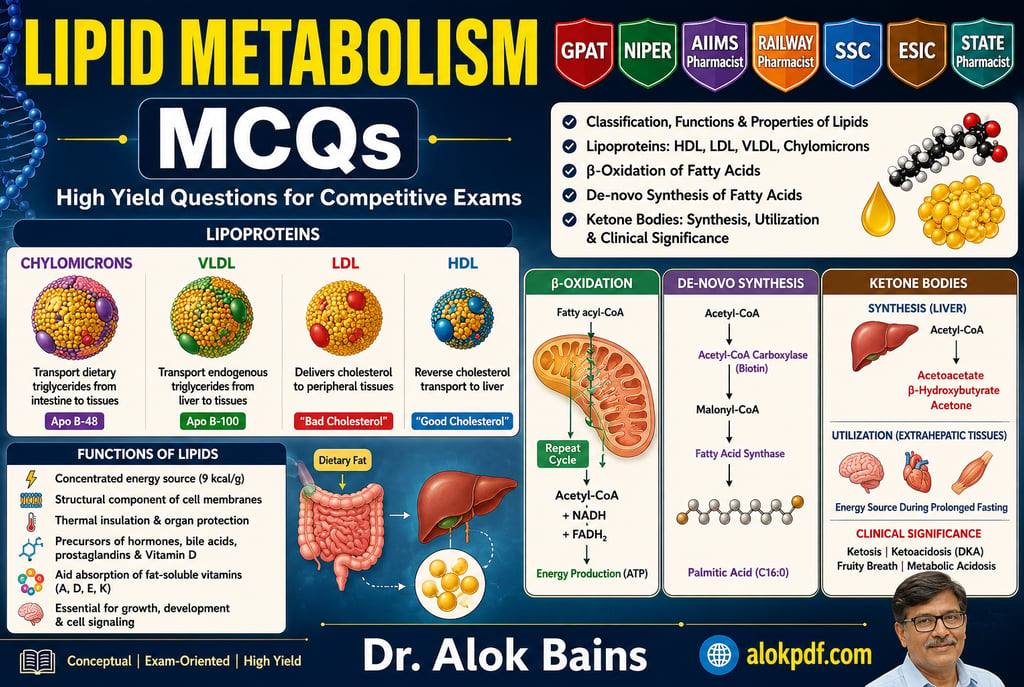
Lipid Metabolism: β-oxidation and de novo synthesis of fatty acids: Ketone bodies (GPAT, NIPER, AIIMS Pharmacist, Railway Pharmacist, SSC, ESIC & State Pharmacist Exams).
Lipid Metabolism
Lipids are a diverse group of hydrophobic biomolecules that play essential roles in energy storage, cell membrane structure, hormone synthesis, insulation, and cellular signaling. Lipid metabolism encompasses the digestion, absorption, transport, synthesis, degradation, and utilization of lipids to meet the body's energy and structural requirements. Since lipids are insoluble in water, they are transported in blood as lipoproteins. Understanding lipid metabolism is fundamental for competitive examinations because disorders such as hyperlipidemia, atherosclerosis, obesity, fatty liver disease, and diabetic ketoacidosis are closely associated with abnormalities in lipid metabolism.
A. Classification, Functions, and Properties of Lipids and Lipoproteins
Classification of Lipids
Lipids are broadly classified into three major categories:
1. Simple Lipids
These are esters of fatty acids with alcohols.
Fats and oils (Triglycerides)
Waxes
Examples: Butter, ghee, vegetable oils, beeswax
2. Compound (Complex) Lipids
These lipids contain additional groups besides fatty acids and alcohol.
Phospholipids
Glycolipids
Lipoproteins
Examples: Lecithin, cephalin, sphingomyelin
3. Derived Lipids
These are products formed by the hydrolysis of simple and complex lipids.
Fatty acids
Cholesterol
Steroid hormones
Fat-soluble vitamins (A, D, E, K)
Ketone bodies
Functions of Lipids
Lipids perform several important physiological functions:
Store energy (9 kcal/g), making them the body's most concentrated energy source.
Form structural components of cell membranes (phospholipids and cholesterol).
Provide thermal insulation and protect vital organs from mechanical injury.
Act as precursors for steroid hormones, bile acids, prostaglandins, and vitamin D.
Aid in the absorption and transport of fat-soluble vitamins (A, D, E, and K).
Supply essential fatty acids required for normal growth and cellular functions.
Serve as signaling molecules involved in inflammation, immunity, and cell communication.
Properties of Lipids
Insoluble in water but soluble in organic solvents such as ether, chloroform, and benzene.
Highly reduced molecules that yield large amounts of ATP upon oxidation.
Stored mainly as triglycerides in adipose tissue.
Undergo hydrolysis by lipase enzymes.
Susceptible to oxidation, leading to rancidity.
Lipoproteins
Since lipids are insoluble in plasma, they circulate as lipoproteins composed of lipids and apolipoproteins.
Types of Lipoproteins
1. Chylomicrons
Site of synthesis: Intestinal mucosal cells
Major lipid: Dietary (exogenous) triglycerides
Major function: Transport dietary triglycerides from the intestine to adipose tissue and muscles.
Characteristic feature: Largest lipoprotein with the lowest density.
2. Very Low-Density Lipoprotein (VLDL)
Site of synthesis: Liver
Major lipid: Endogenous triglycerides
Major function: Delivers triglycerides synthesized in the liver to peripheral tissues.
Clinical importance: Elevated VLDL is associated with hypertriglyceridemia.
3. Low-Density Lipoprotein (LDL)
Origin: Formed from VLDL after triglyceride removal.
Major lipid: Cholesterol
Major function: Delivers cholesterol to peripheral tissues.
Clinical importance: Known as "Bad Cholesterol" because elevated LDL promotes atherosclerosis and coronary artery disease.
4. High-Density Lipoprotein (HDL)
Site of synthesis: Liver and intestine
Major function: Removes excess cholesterol from peripheral tissues and transports it back to the liver (reverse cholesterol transport).
Clinical importance: Known as "Good Cholesterol" because it protects against cardiovascular disease.
Comparison of Lipoproteins
Lipoprotein Major Lipid Primary Function Clinical Significance
Chylomicron Dietary triglycerides Transport dietary fat Largest, lowest density
VLDL Endogenous triglycerides Transport liver triglycerides Hypertriglyceridemia
LDL Cholesterol Delivers cholesterol to tissues Atherosclerosis ("Bad cholesterol")
HDL Protein & cholesterol Reverse cholesterol transport Cardioprotective ("Good cholesterol")
B. β-Oxidation and De Novo Synthesis of Fatty Acids
β-Oxidation of Fatty Acids
β-Oxidation is the catabolic process in which fatty acids are broken down in the mitochondrial matrix to generate acetyl-CoA, NADH, and FADH₂, which subsequently produce ATP through the citric acid cycle and oxidative phosphorylation.
Steps of β-Oxidation
Activation of fatty acids to fatty acyl-CoA in the cytoplasm.
Transport of long-chain fatty acids into mitochondria through the carnitine shuttle (CPT-I and CPT-II).
Sequential β-oxidation cycles involving:
Oxidation
Hydration
Second oxidation
Thiolytic cleavage
Release of one acetyl-CoA in each cycle until complete degradation.
Key Features
Occurs in the mitochondrial matrix.
Produces large amounts of ATP.
One cycle yields:
One acetyl-CoA
One NADH
One FADH₂
Palmitic acid (16 carbons) produces 8 acetyl-CoA, 7 NADH, and 7 FADH₂, yielding approximately 106 ATP after complete oxidation.
Regulation of β-Oxidation
Stimulated during fasting, starvation, prolonged exercise, and diabetes mellitus.
Inhibited by malonyl-CoA, which blocks Carnitine Palmitoyl Transferase-I (CPT-I).
Glucagon and epinephrine stimulate fatty acid oxidation, whereas insulin inhibits lipolysis.
De Novo Fatty Acid Synthesis
Fatty acid synthesis is an anabolic pathway that converts excess carbohydrates into fatty acids for energy storage.
Site: Cytosol of liver, adipose tissue, and lactating mammary glands.
Rate-Limiting Enzyme
Acetyl-CoA Carboxylase (ACC)
Converts acetyl-CoA to malonyl-CoA.
Requires biotin (Vitamin B₇) as a coenzyme.
Reducing Power
NADPH, mainly generated by the pentose phosphate pathway, provides reducing equivalents for fatty acid synthesis.
End Product
Palmitic acid (16-carbon saturated fatty acid) is the principal product synthesized by the fatty acid synthase complex.
Regulation
Stimulated by insulin and citrate.
Inhibited by glucagon, epinephrine, palmitoyl-CoA, and AMP-activated protein kinase (AMPK).
Ketone Bodies
Ketone bodies are water-soluble compounds synthesized from acetyl-CoA in the liver during prolonged fasting, carbohydrate deprivation, and uncontrolled diabetes mellitus.
Types of Ketone Bodies
Acetoacetate
β-Hydroxybutyrate
Acetone
Synthesis (Ketogenesis)
Site: Mitochondria of liver cells
During prolonged fasting or insulin deficiency, β-oxidation increases, generating excess acetyl-CoA. When oxaloacetate is diverted toward gluconeogenesis, acetyl-CoA cannot efficiently enter the citric acid cycle and is instead converted into ketone bodies.
Utilization (Ketolysis)
Ketone bodies are transported through the bloodstream and utilized by:
Brain (during prolonged fasting)
Heart
Skeletal muscles
Kidney cortex
The liver cannot utilize ketone bodies because it lacks the enzyme succinyl-CoA:acetoacetate CoA transferase (thiophorase).
Clinical Significance
Ketosis
Occurs during:
Prolonged fasting
Starvation
Low-carbohydrate (ketogenic) diets
Prolonged exercise
Ketone bodies provide an alternative source of energy and help conserve glucose for tissues that depend on it.
Diabetic Ketoacidosis (DKA)
A life-threatening complication, especially of uncontrolled Type 1 Diabetes Mellitus, characterized by:
Excessive ketone body production
Hyperglycemia
Metabolic acidosis
Dehydration
Fruity (acetone) breath
Kussmaul respiration
Early diagnosis and prompt insulin therapy are essential to prevent severe complications.
Exam Pearls (Highly Important for Competitive Exams)
Lipids provide 9 kcal/g, the highest energy yield among nutrients.
Chylomicrons transport dietary triglycerides, whereas VLDL transports endogenous triglycerides.
LDL is known as bad cholesterol, while HDL is good cholesterol.
Apo C-II activates lipoprotein lipase; Apo B-100 binds LDL receptors.
β-Oxidation occurs in the mitochondrial matrix, whereas fatty acid synthesis occurs in the cytosol.
Carnitine is essential for mitochondrial transport of long-chain fatty acids.
Acetyl-CoA carboxylase is the rate-limiting enzyme of fatty acid synthesis and requires biotin.
Malonyl-CoA inhibits CPT-I, preventing simultaneous fatty acid synthesis and oxidation.
The liver synthesizes ketone bodies but cannot utilize them because it lacks thiophorase.
Diabetic ketoacidosis is a classic complication of Type 1 Diabetes Mellitus and is frequently tested in GPAT, NIPER, AIIMS, ESIC, SSC, and State Pharmacist examinations.
MCQs on Lipid Metabolism
(GPAT | NIPER | AIIMS Pharmacist | Railway Pharmacist | SSC | ESIC | State Pharmacist Exams)
1. Which lipoprotein is primarily responsible for transporting dietary triglycerides from the intestine to peripheral tissues?
A. LDL
B. HDL
C. Chylomicrons
D. VLDL
Answer: C. Chylomicrons
Explanation: Chylomicrons are synthesized in intestinal mucosal cells and transport exogenous (dietary) triglycerides to adipose tissue and muscles via lipoprotein lipase (LPL).
2. The apolipoprotein required for activation of lipoprotein lipase is
A. Apo A-I
B. Apo B-48
C. Apo C-II
D. Apo E
Answer: C. Apo C-II
Explanation: Apo C-II activates lipoprotein lipase, which hydrolyzes triglycerides present in chylomicrons and VLDL.
3. Which lipoprotein contains the highest percentage of protein?
A. Chylomicrons
B. VLDL
C. LDL
D. HDL
Answer: D. HDL
Explanation: HDL contains nearly 50% protein, making it the densest lipoprotein.
4. Which lipoprotein is richest in triglycerides under fasting conditions?
A. HDL
B. LDL
C. VLDL
D. Chylomicrons
Answer: C. VLDL
Explanation: VLDL transports endogenous triglycerides synthesized in the liver.
5. Which lipoprotein delivers cholesterol mainly to peripheral tissues?
A. HDL
B. LDL
C. Chylomicrons
D. VLDL
Answer: B. LDL
Explanation: LDL carries cholesterol from the liver to peripheral tissues and is therefore called "bad cholesterol."
6. HDL protects against atherosclerosis because it
A. Delivers cholesterol to tissues
B. Converts cholesterol into bile acids
C. Removes cholesterol from peripheral tissues
D. Synthesizes cholesterol
Answer: C. Removes cholesterol from peripheral tissues
Explanation: HDL performs reverse cholesterol transport, carrying excess cholesterol back to the liver.
7. Which apolipoprotein is recognized by LDL receptors?
A. Apo A-I
B. Apo B-100
C. Apo C-II
D. Apo B-48
Answer: B. Apo B-100
Explanation: Apo B-100 binds LDL receptors for receptor-mediated endocytosis.
8. Which lipoprotein is synthesized only in the intestine?
A. LDL
B. HDL
C. Chylomicrons
D. VLDL
Answer: C. Chylomicrons
Explanation: Chylomicrons are exclusively synthesized in intestinal epithelial cells.
9. Which of the following is NOT a function of lipids?
A. Energy storage
B. Thermal insulation
C. Genetic information storage
D. Cell membrane formation
Answer: C. Genetic information storage
Explanation: DNA and RNA store genetic information; lipids mainly provide energy and structural support.
10. Which fatty acid is considered essential in humans?
A. Palmitic acid
B. Oleic acid
C. Linoleic acid
D. Stearic acid
Answer: C. Linoleic acid
Explanation: Humans cannot synthesize linoleic acid because they lack Δ12 desaturase.
11. β-Oxidation of fatty acids occurs primarily in
A. Cytosol
B. Lysosomes
C. Mitochondrial matrix
D. Nucleus
Answer: C. Mitochondrial matrix
Explanation: β-Oxidation enzymes are located in the mitochondrial matrix.
12. Carnitine is required for
A. Cholesterol synthesis
B. Fatty acid synthesis
C. Transport of long-chain fatty acids into mitochondria
D. Ketone body synthesis
Answer: C. Transport of long-chain fatty acids into mitochondria
Explanation: Long-chain fatty acids require the carnitine shuttle to enter mitochondria.
13. Which enzyme is inhibited by malonyl-CoA?
A. Lipoprotein lipase
B. CPT-I
C. Hormone-sensitive lipase
D. Acetyl-CoA carboxylase
Answer: B. CPT-I
Explanation: Malonyl-CoA prevents simultaneous fatty acid synthesis and oxidation by inhibiting CPT-I.
14. Which vitamin is required as a coenzyme in fatty acid synthesis?
A. Vitamin B12
B. Biotin
C. Vitamin C
D. Niacin
Answer: B. Biotin
Explanation: Acetyl-CoA carboxylase requires biotin for carboxylation of acetyl-CoA.
15. The rate-limiting enzyme of fatty acid synthesis is
A. Fatty acid synthase
B. Acetyl-CoA carboxylase
C. Thiolase
D. Carnitine acyltransferase
Answer: B. Acetyl-CoA carboxylase
Explanation: Acetyl-CoA carboxylase converts acetyl-CoA into malonyl-CoA.
16. The major reducing equivalent used in fatty acid synthesis is
A. NADH
B. NADPH
C. FADH2
D. FMN
Answer: B. NADPH
Explanation: NADPH provides reducing power during de novo fatty acid synthesis.
17. During one cycle of β-oxidation, the products are
A. One acetyl-CoA, one NADH, one FADH2
B. One acetyl-CoA, one ATP
C. Two acetyl-CoA
D. One pyruvate
Answer: A. One acetyl-CoA, one NADH, one FADH2
Explanation: Each β-oxidation cycle shortens the fatty acid by two carbons.
18. Complete oxidation of palmitic acid (C16) produces
A. 4 acetyl-CoA
B. 6 acetyl-CoA
C. 8 acetyl-CoA
D. 10 acetyl-CoA
Answer: C. 8 acetyl-CoA
Explanation: A 16-carbon fatty acid yields eight acetyl-CoA molecules.
19. Fatty acid synthesis mainly occurs in
A. Mitochondria
B. Cytosol
C. Lysosomes
D. Golgi apparatus
Answer: B. Cytosol
Explanation: Fatty acid synthase is a cytosolic enzyme complex.
20. Which hormone stimulates hormone-sensitive lipase?
A. Insulin
B. Glucagon
C. Thyroxine
D. Growth hormone
Answer: B. Glucagon
Explanation: Glucagon and epinephrine activate hormone-sensitive lipase through cAMP.
21. Ketone bodies are synthesized mainly in the
A. Brain
B. Liver
C. Kidney
D. Heart
Answer: B. Liver
Explanation: Hepatic mitochondria synthesize ketone bodies during fasting.
22. Which is NOT a ketone body?
A. Acetoacetate
B. β-Hydroxybutyrate
C. Acetone
D. Acetyl-CoA
Answer: D. Acetyl-CoA
Explanation: Acetyl-CoA is the precursor, not a ketone body.
23. Which enzyme is absent in the liver, preventing ketone body utilization?
A. Thiolase
B. HMG-CoA synthase
C. Succinyl-CoA: acetoacetate CoA transferase (Thiophorase)
D. HMG-CoA lyase
Answer: C. Succinyl-CoA: acetoacetate CoA transferase
Explanation: The liver produces ketone bodies but cannot utilize them because thiophorase is absent.
24. Ketone bodies serve as an important fuel for
A. Red blood cells
B. Brain during prolonged fasting
C. Liver
D. Mature adipocytes
Answer: B. Brain during prolonged fasting
Explanation: During prolonged starvation, the brain adapts to use ketone bodies.
25. Excessive ketone body production leads to
A. Respiratory alkalosis
B. Metabolic alkalosis
C. Metabolic acidosis
D. Respiratory acidosis
Answer: C. Metabolic acidosis
Explanation: Accumulation of acidic ketone bodies causes ketoacidosis.
26. Which condition is most commonly associated with diabetic ketoacidosis?
A. Type 2 diabetes
B. Type 1 diabetes mellitus
C. Hyperthyroidism
D. Cushing syndrome
Answer: B. Type 1 diabetes mellitus
Explanation: Insulin deficiency increases lipolysis and ketogenesis.
27. During prolonged fasting, acetyl-CoA accumulates because oxaloacetate is diverted toward
A. Glycolysis
B. Glycogenesis
C. Gluconeogenesis
D. Pentose phosphate pathway
Answer: C. Gluconeogenesis
Explanation: Reduced oxaloacetate limits TCA cycle activity, favoring ketone body formation.
28. Which statement correctly differentiates fatty acid synthesis and β-oxidation?
A. Both occur in mitochondria.
B. Both use NADPH.
C. Fatty acid synthesis occurs in the cytosol, whereas β-oxidation occurs in mitochondria.
D. Both require carnitine.
Answer: C. Fatty acid synthesis occurs in the cytosol, whereas β-oxidation occurs in mitochondria.
Explanation: This compartmentalization prevents futile cycling.
29. Match the lipoproteins with their principal functions.
List I List II
P. HDL 1. Dietary triglyceride transport
Q. LDL 2. Reverse cholesterol transport
R. Chylomicron 3. Cholesterol delivery to tissues
S. VLDL 4. Endogenous triglyceride transport
Choose the correct answer.
A. P-2, Q-3, R-1, S-4
B. P-3, Q-2, R-4, S-1
C. P-4, Q-1, R-2, S-3
D. P-2, Q-4, R-3, S-1
Answer: A
Explanation: HDL removes cholesterol, LDL delivers cholesterol, chylomicrons carry dietary triglycerides, and VLDL transports endogenous triglycerides.
30. Assertion (A): Malonyl-CoA inhibits CPT-I.
Reason (R): This prevents newly synthesized fatty acids from undergoing immediate β-oxidation.
A. Both A and R are true, and R is the correct explanation.
B. Both A and R are true, but R is not the correct explanation.
C. A is true, but R is false.
D. A is false, but R is true.
Answer: A
Explanation: Malonyl-CoA coordinates fatty acid metabolism by preventing simultaneous synthesis and degradation.
Exam Booster (Facts)
HDL = Highest protein, highest density, reverse cholesterol transport.
LDL = Bad cholesterol (Apo B-100).
VLDL = Endogenous triglyceride transporter.
Chylomicrons = Dietary triglyceride transporter (Apo B-48).
Apo C-II activates lipoprotein lipase.
β-Oxidation occurs in the mitochondrial matrix; fatty acid synthesis occurs in the cytosol.
Carnitine is required for the transport of long-chain fatty acids into mitochondria.
Acetyl-CoA carboxylase is the rate-limiting enzyme of fatty acid synthesis and requires biotin.
The liver synthesizes ketone bodies but cannot utilize them because it lacks thiophorase.
Diabetic ketoacidosis is a classic complication of uncontrolled Type 1 diabetes mellitus.