
Neurology MCQs for GPAT
Practice Neurology MCQs for GPAT covering epilepsy, Parkinson's disease, stroke, migraine, depression, schizophrenia, Alzheimer's disease, and meningitis. Includes high-yield conceptual questions with answers and quick revision for GPAT, NIPER, AIIMS, Railway, SSC, ESIC, State Pharmacist examination
Dr. Alok Singh
7/2/20266 min read
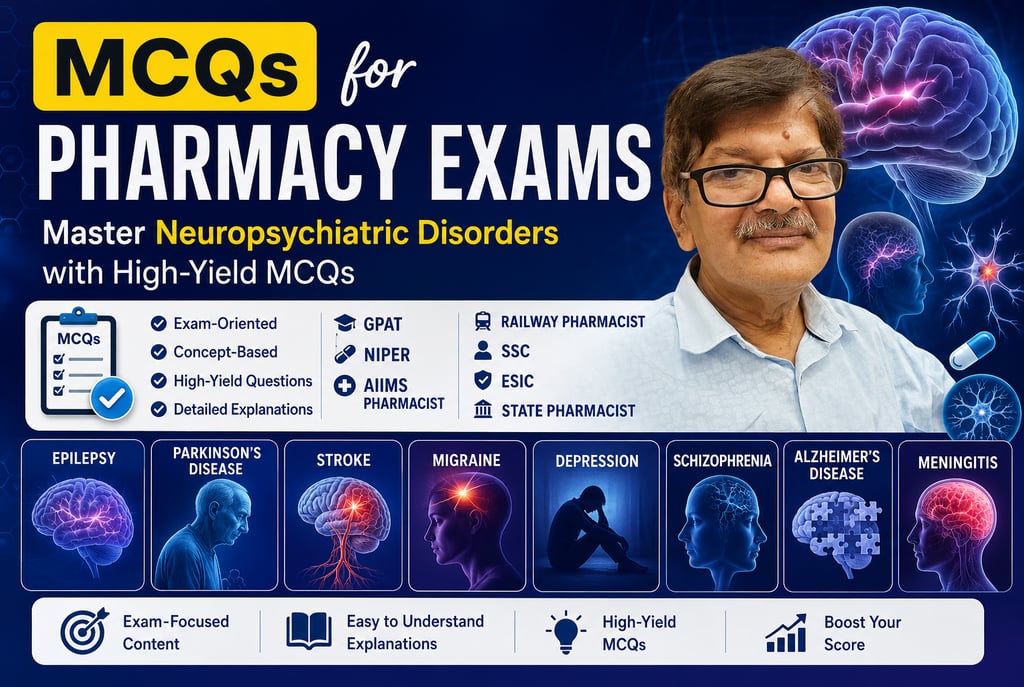
MCQs for GPAT, NIPER, AIIMS Pharmacist, Railway Pharmacist, SSC, ESIC & State Pharmacist examinations. Epilepsy, Parkinson's Disease, Stroke, Migraine, Depression, Schizophrenia, Alzheimer's & meningitis.
Epilepsy
Epilepsy is a chronic neurological disorder characterised by recurrent, unprovoked seizures.
Seizures result from abnormal, excessive electrical activity in the brain.
Generalised tonic-clonic seizure: Loss of consciousness with tonic and clonic muscle contractions.
Absence seizure: Brief loss of awareness; characteristic 3-Hz spike-and-wave EEG.
Status epilepticus: Continuous seizure lasting ≥5 minutes or recurrent seizures without regaining consciousness.
First-line emergency treatment: lorazepam or diazepam.
Drug of choice (DOC) for absence seizures: Ethosuximide.
Valproate: Broad-spectrum antiepileptic drug.
Carbamazepine and phenytoin may worsen absence seizures.
GABA is the major inhibitory neurotransmitter; glutamate is the major excitatory neurotransmitter.
Parkinson's Disease
Progressive neurodegenerative disorder caused by degeneration of dopaminergic neurones in the substantia nigra pars compacta.
Cardinal features (TRAP):
Tremor at rest
Rigidity
Akinesia/Bradykinesia
Postural instability
Resting tremor decreases during voluntary movement.
Gold standard therapy: Levodopa + Carbidopa.
Carbidopa inhibits peripheral dopa decarboxylase and does not cross the blood-brain barrier.
Dopamine agonists: Pramipexole, Ropinirole.
MAO-B inhibitors: Selegiline, Rasagiline.
COMT inhibitors: Entacapone, Tolcapone.
Stroke
Sudden loss of neurological function due to interruption of cerebral blood flow.
Ischaemic stroke: ~85% of all strokes.
Hemorrhagic stroke: ~15%.
Common symptoms:
Sudden facial drooping
Arm weakness
Speech difficulty
FAST: Face – Arm – Speech – Time.
A CT scan is performed before thrombolytic therapy to exclude haemorrhage.
The middle cerebral artery is the most commonly affected.
Early recognition and treatment improve outcomes.
Migraine
Recurrent unilateral, pulsating headache lasting 4–72 hours.
Associated with nausea, vomiting, photophobia, and phonophobia.
Migraine with aura is preceded by reversible neurological symptoms, commonly visual disturbances.
Pathophysiology involves activation of the trigeminovascular system and release of CGRP.
Acute treatment: Triptans and NSAIDs.
Prophylaxis: Propranolol, Topiramate, Valproate.
Depression
Characterised by persistent low mood and loss of interest (anhedonia).
Associated with deficiency of serotonin (5-HT), norepinephrine, and dopamine.
Common symptoms:
Depressed mood
Sleep disturbance
Fatigue
Poor concentration
Suicidal ideation
SSRIs are the preferred first-line antidepressants.
Common SSRIs: Fluoxetine, Sertraline, Escitalopram.
Therapeutic effect usually appears after 2–4 weeks.
Schizophrenia
Chronic psychiatric disorder with disturbances of thought, perception, emotion, and behavior.
Positive symptoms:
Hallucinations
Delusions
Disorganized speech
Negative symptoms:
Flat affect
Social withdrawal
Avolition
Alogia
Associated with increased dopaminergic activity in the mesolimbic pathway.
Typical antipsychotics mainly block D₂ receptors.
Clozapine is the drug of choice for treatment-resistant schizophrenia.
Clozapine may cause agranulocytosis; regular CBC monitoring is essential.
Alzheimer's Disease
Most common cause of dementia in the elderly.
Characterized by progressive memory loss and cognitive decline.
Pathological features:
β-Amyloid plaques
Neurofibrillary tangles (hyperphosphorylated tau protein)
Associated with deficiency of acetylcholine.
Donepezil, Rivastigmine, Galantamine: Acetylcholinesterase inhibitors.
Memantine: NMDA receptor antagonist used in moderate-to-severe disease.
Meningitis
Inflammation of the meninges caused by bacterial, viral, fungal, or other infections.
Classical triad:
Fever
Neck stiffness
Altered mental status
Other symptoms:
Severe headache
Photophobia
Vomiting
Positive Kernig's and Brudzinski's signs indicate meningeal irritation.
Lumbar puncture with CSF examination is the confirmatory investigation.
Bacterial meningitis CSF:
↑ Neutrophils
↑ Protein
↓ Glucose
Early antibiotic therapy significantly reduces mortality
1. Which neurotransmitter is primarily deficient in Parkinson's disease?
A. Acetylcholine
B. Dopamine
C. Serotonin
D. GABA
Answer: B
Explanation: Degeneration of dopaminergic neurones in the substantia nigra pars compacta causes dopamine deficiency.
2. Which feature differentiates Parkinson's disease from essential tremor?
A. Resting tremor
B. Intention tremor
C. Cerebellar ataxia
D. Hyperreflexia
Answer: A
3. A patient develops rigidity, resting tremor, and bradykinesia after prolonged antipsychotic therapy. The most likely mechanism is
A. Increased serotonin
B. Dopamine receptor blockade
C. GABA deficiency
D. Increased glutamate
Answer: B
4. Which drug is considered the gold standard for symptomatic treatment of Parkinson's disease?
A. Bromocriptine
B. Selegiline
C. Levodopa + Carbidopa
D. Amantadine
Answer: C
5. Carbidopa is administered with levodopa because it
A. Crosses the blood-brain barrier
B. Prevents central metabolism
C. Inhibits peripheral dopa decarboxylase
D. Stimulates dopamine receptors
Answer: C
6. Which of the following is NOT a cardinal feature of Parkinson's disease?
A. Bradykinesia
B. Resting tremor
C. Rigidity
D. Spasticity
Answer: D
7. Generalized tonic-clonic seizure is characterized by
A. Loss of consciousness with tonic and clonic phases
B. Blank staring only
C. Brief muscle jerks only
D. Continuous focal twitching
Answer: A
8. Absence seizures are characterized by
A. Aura before seizure
B. Brief loss of awareness without postictal confusion
C. Tongue biting
D. Urinary incontinence
Answer: B
9. Which EEG finding is classical for an absence seizure?
A. 3-Hz spike-and-wave pattern
B. Delta waves
C. Alpha rhythm
D. Beta rhythm
Answer: A
10. The drug of choice for absence seizures is
A. Phenytoin
B. Carbamazepine
C. Ethosuximide
D. Phenobarbital
Answer: C
11. Which antiepileptic drug may worsen absence seizures?
A. Ethosuximide
B. Valproate
C. Carbamazepine
D. Clonazepam
Answer: C
12. Status epilepticus is defined as:
A. Continuous seizure lasting ≥5 minutes or recurrent seizures without recovery
B. Two seizures in one year
C. One seizure with fever
D. Any focal seizure
Answer: A
13. The first-line emergency drug for status epilepticus is
A. Diazepam/Lorazepam
B. Phenytoin
C. Carbamazepine
D. Valproate
Answer: A
14. Which neurotransmitter is primarily inhibitory in the CNS?
A. Dopamine
B. Glutamate
C. GABA
D. Acetylcholine
Answer: C
15. Migraine pain is believed to involve activation of
A. Nigrostriatal pathway
B. Trigeminovascular system
C. Corticospinal tract
D. Spinothalamic tract
Answer: B
16. Which symptom commonly precedes migraine with aura?
A. Facial palsy
B. Visual disturbances
C. Loss of smell
D. Hearing loss
Answer: B
17. The drug of choice for an acute migraine attack is
A. Sumatriptan
B. Levodopa
C. Haloperidol
D. Donepezil
Answer: A
18. Which drug is commonly used for migraine prophylaxis?
A. Propranolol
B. Aspirin
C. Diazepam
D. Haloperidol
Answer: A
19. Which type of stroke accounts for nearly 85% of all strokes?
A. Hemorrhagic
B. Ischemic
C. Subarachnoid hemorrhage
D. Epidural hemorrhage
Answer: B
20. Sudden unilateral weakness and slurred speech are classical features of
A. Migraine
B. Stroke
C. Meningitis
D. Parkinson's disease
Answer: B
21. Before administering thrombolytic therapy in an acute stroke, the most important investigation is
A. MRI spine
B. Chest X-ray
C. CT scan of brain
D. ECG
Answer: C
22. Which artery is most commonly involved in ischaemic stroke?
A. Basilar artery
B. Middle cerebral artery
C. Vertebral artery
D. Anterior spinal artery
Answer: B
23. Which symptom is characteristic of bacterial meningitis?
A. Bradykinesia
B. Neck stiffness
C. Resting tremor
D. Masked facies
Answer: B
24. Kernig's and Brudzinski's signs indicate
A. Parkinsonism
B. Meningeal irritation
C. Stroke
D. Alzheimer's disease
Answer: B
25. The confirmatory investigation for meningitis is
A. EEG
B. Lumbar puncture with CSF examination
C. ECG
D. EMG
Answer: B
26. Which CSF finding is typical of bacterial meningitis?
A. High glucose
B. Low protein
C. Neutrophilic pleocytosis with low glucose
D. Normal CSF
Answer: C
27. Which neurotransmitter is primarily deficient in Alzheimer's disease?
A. Dopamine
B. Acetylcholine
C. GABA
D. Norepinephrine
Answer: B
28. The hallmark pathological feature of Alzheimer's disease includes
A. Lewy bodies
B. Neurofibrillary tangles and amyloid plaques
C. Demyelination
D. Astrocytosis only
Answer: B
29. Donepezil acts by
A. Blocking NMDA receptors
B. Inhibiting acetylcholinesterase
C. Blocking dopamine receptors
D. Stimulating GABA receptors
Answer: B
30. Memantine acts as a
A. GABA agonist
B. NMDA receptor antagonist
C. Dopamine agonist
D. Serotonin antagonist
Answer: B
31. Which neurotransmitter is most closely associated with depression?
A. Increased dopamine only
B. Deficiency of serotonin and norepinephrine
C. Increased acetylcholine
D. Increased glutamate only
Answer: B
32. Which antidepressants selectively inhibit serotonin reuptake?
A. SSRIs
B. MAO inhibitors
C. TCAs
D. Lithium
Answer: A
33. Which antidepressant has the least anticholinergic effects?
A. Amitriptyline
B. Imipramine
C. Fluoxetine
D. Clomipramine
Answer: C
34. Which symptom is NOT typical of major depression?
A. Anhedonia
B. Insomnia
C. Grandiosity
D. Hopelessness
Answer: C
35. Positive symptoms of schizophrenia include
A. Hallucinations and delusions
B. Social withdrawal
C. Flat affect
D. Avolition
Answer: A
36. Negative symptoms of schizophrenia include
A. Delusions
B. Hallucinations
C. Flat affect
D. Paranoia
Answer: C
37. Typical antipsychotic drugs mainly block
A. Dopamine D2 receptors
B. Serotonin receptors only
C. NMDA receptors
D. GABA receptors
Answer: A
38. Clozapine is preferred in:
A. Drug-resistant schizophrenia
B. Acute migraine
C. Parkinson's disease
D. Epilepsy
Answer: A
39. Clozapine therapy requires regular monitoring of
A. Liver enzymes
B. White blood cell count
C. Serum calcium
D. Blood glucose only
Answer: B
40. Which neurotransmitter is primarily excitatory in the CNS?
A. GABA
B. Glycine
C. Glutamate
D. Dopamine
Answer: C
Assertion–Reason Questions
41.
Assertion (A): Carbamazepine is not preferred for absence seizures.
Reason (R): Carbamazepine may aggravate generalised absence seizures.
A. Both A and R are true, and R is the correct explanation.
B. Both are true, but R is not the correct explanation.
C. A is true, but R is false.
D. A is false, but R is true.
Answer: A
42.
Assertion (A): Levodopa is combined with carbidopa.
Reason (R): Carbidopa inhibits the peripheral metabolism of levodopa.
Answer: A
43.
Assertion (A): A CT scan is performed before thrombolysis in acute stroke.
Reason (R): Hemorrhagic stroke must be excluded before thrombolytic therapy.
Answer: A
44.
Assertion (A): Donepezil improves cognition in Alzheimer's disease.
Reason (R): It inhibits acetylcholinesterase.
Answer: A
45.
Assertion (A): Clozapine is effective in treatment-resistant schizophrenia.
Reason (R): It has a unique receptor profile with a lower risk of extrapyramidal symptoms.
Answer: A
Previous-Year Pattern Concept-Based Questions
46. Which condition is most likely to present with resting tremor that disappears during voluntary movement?
A. Essential tremor
B. Parkinson's disease
C. Cerebellar lesion
D. Hyperthyroidism
Answer: B
47. A patient presents with fever, severe headache, neck rigidity, and photophobia. The most probable diagnosis is
A. Stroke
B. Migraine
C. Meningitis
D. Parkinsonism
Answer: C
48. Which disease is associated with progressive loss of recent memory before remote memory?
A. Schizophrenia
B. Alzheimer's disease
C. Migraine
D. Stroke
Answer: B
49. A patient suddenly develops aphasia and right-sided hemiplegia. The most likely vascular territory involved is
A. Middle cerebral artery
B. Posterior cerebral artery
C. Anterior spinal artery
D. Vertebral artery
Answer: A
50. Which of the following pairs is correctly matched?
A. Parkinson's disease — Dopamine deficiency
B. Alzheimer's disease — Acetylcholine deficiency
C. Depression — Serotonin deficiency
D. All of the above
Answer: D
High-Yield One-Liners
Dopamine ↓ → Parkinson's disease.
Acetylcholine ↓ → Alzheimer's disease.
Serotonin & norepinephrine ↓ → Depression.
Dopamine ↑ (mesolimbic pathway) → Schizophrenia.
GABA ↓ or glutamate ↑ → Seizures.
Ethosuximide → Drug of choice for absence seizures.
Levodopa + Carbidopa → Gold standard for Parkinson's disease.
Sumatriptan → Acute migraine.
Propranolol → Migraine prophylaxis.
Donepezil → Mild to moderate Alzheimer's disease.
Memantine → Moderate to severe Alzheimer's disease.
Clozapine → Treatment-resistant schizophrenia.
Lorazepam → First-line emergency drug for status epilepticus.
CT brain before thrombolysis in acute stroke.
Lumbar puncture confirms meningitis.
FAST helps identify stroke early.
Dr. Alok Singh