
Pharmaceutical Biotechnology MCQs
Practice challenging Pharmaceutical Biotechnology MCQs with answers and explanations covering protein therapeutics, monoclonal antibodies, protein characterization, enzyme immobilization, and cell culture for GPAT, NIPER, and pharmacist exams.
Dr. Alok Singh
7/25/202615 min read
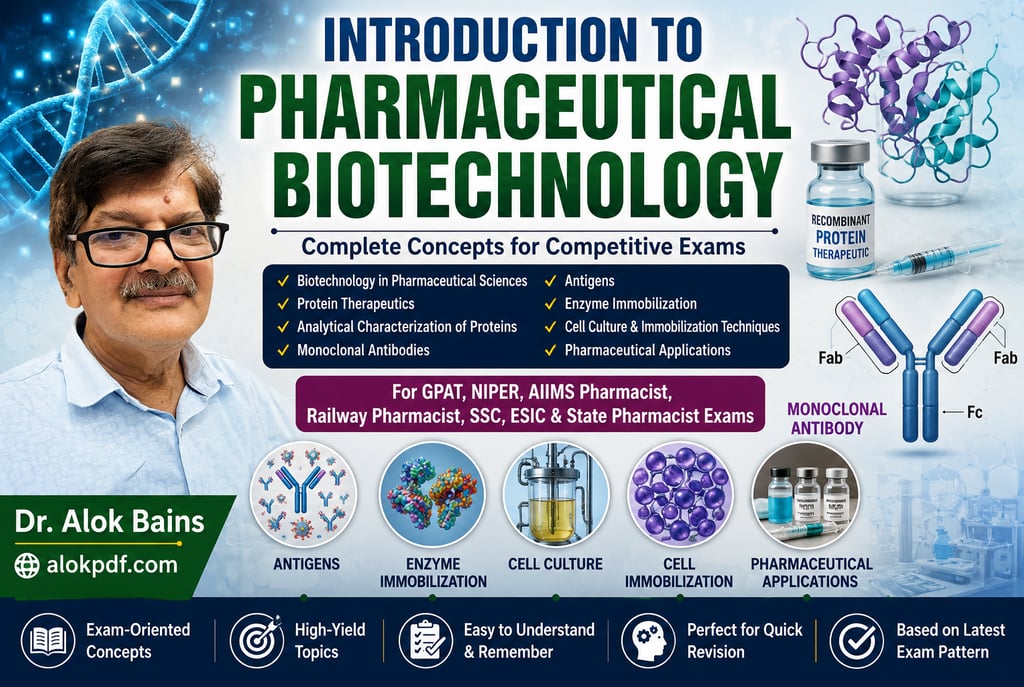
Pharmaceutical Biotechnology MCQs for GPAT, NIPER & Pharmacist Exams
Introduction to Pharmaceutical Biotechnology: Concise Notes for Competitive Exams
Introduction
Pharmaceutical biotechnology is the application of biotechnology to the discovery, development, production, and characterization of medicines. It uses living organisms, cells, enzymes, and biological processes to develop therapeutic and diagnostic products.
Unlike many conventional drugs produced by chemical synthesis, biotechnology allows the production of complex biological products such as recombinant proteins, monoclonal antibodies, vaccines, therapeutic enzymes, cell therapies, and gene therapies.
For competitive examinations such as GPAT, NIPER, AIIMS Pharmacist, Railway Pharmacist, SSC, ESIC, and State Pharmacist exams, it is important to understand both the basic concepts and the differences between closely related terms.
1. Biotechnology in Pharmaceutical Sciences
Biotechnology uses living systems or biological processes to develop useful products. Pharmaceutical biotechnology applies these principles to modern drug discovery, development, manufacturing, and diagnostics.
Major biotechnology-derived products
Recombinant proteins – insulin, growth hormone, erythropoietin, interferons
Monoclonal antibodies – targeted therapies
Vaccines – recombinant and subunit vaccines
Therapeutic enzymes – enzyme replacement therapies
Gene therapies
Cell-based therapies
Biosimilars – biological products highly similar to an approved reference product
Takeaway
Pharmaceutical Biotechnology = Biology + Technology → Modern Medicines
2. Protein Therapeutics
Protein therapeutics are medicines in which proteins or peptides produce the desired therapeutic effect.
Important examples
Protein Therapeutic Major Application
Insulin Diabetes mellitus
Erythropoietin (EPO) Anemia
Human growth hormone Growth hormone deficiency
Interferons Viral infections and certain cancers
Coagulation factors Hemophilia
Monoclonal antibodies Cancer and autoimmune diseases
Advantages
High specificity for biological targets
Can replace missing or defective proteins
Useful for treating complex diseases
Can selectively act on specific biological pathways
Limitations
Protein therapeutics are generally sensitive to:
Temperature
pH changes
Oxidation
Light
Agitation
Proteolytic degradation
They may undergo:
Denaturation – loss or alteration of normal protein structure
Aggregation – association of protein molecules
Degradation – chemical or enzymatic breakdown
Protein aggregation may reduce biological activity and can potentially increase immunogenicity.
Protein Structure: Quick Revision
Primary structure → Amino acid sequence
Secondary structure → α-helix and β-sheet
Tertiary structure → Three-dimensional structure of a single polypeptide
Quaternary structure → Association of multiple polypeptide chains
Takeaway
Protein therapeutics → Highly specific but structurally sensitive
3. Analytical Characterization of Proteins
Protein characterization is essential to establish the identity, purity, molecular size, structure, stability, and biological properties of therapeutic proteins.
Important analytical techniques
Technique Main Purpose
SDS-PAGE Separates proteins mainly according to molecular size under denaturing conditions
Size-Exclusion Chromatography (SEC) Separates proteins according to size; useful for detecting aggregates
Ion-Exchange Chromatography Separates proteins based on charge
Isoelectric Focusing (IEF) Separates proteins according to isoelectric point (pI)
Mass Spectrometry (MS) Determines molecular mass and helps characterize molecular modifications
ELISA Detects or measures specific proteins or antigens using antibodies
Western Blotting Detects a specific protein
Circular Dichroism (CD) Provides information about protein secondary structure
Memory Trick
SDS-PAGE → Size
SEC → Size + Aggregation
IEF → pI
MS → Molecular Mass
ELISA → Specific Detection
Takeaway
In exam questions, remember that SDS-PAGE and SEC both involve size, but SDS-PAGE is an electrophoretic method performed under denaturing conditions, whereas SEC separates molecules according to their size or hydrodynamic volume and is particularly useful for studying aggregation.
4. Monoclonal Antibodies (mAbs)
A monoclonal antibody (mAb) is an antibody produced by a single B-cell clone and is highly specific for a particular epitope.
Hybridoma Technology
The classical method of monoclonal antibody production involves the fusion of:
Antibody-producing B lymphocyte + Immortal myeloma cell → Hybridoma
The resulting hybridoma:
Produces a specific antibody
Can multiply continuously
Produces large quantities of identical antibodies
Important Antibody Regions
Fab Region
Mainly responsible for antigen binding
Contains the antigen-binding site
Determines antigen specificity
Fc Region
Responsible for important effector functions
Interacts with Fc receptors
Participates in immune mechanisms
Variable Region
Determines antigen-binding specificity
Contains the complementarity-determining regions (CDRs)
Constant Region
Determines the characteristic antibody class
Contributes to effector functions
Applications of Monoclonal Antibodies
Cancer treatment
Autoimmune diseases
Inflammatory disorders
Transplantation
Diagnostic testing
Targeted therapy
Takeaway
Fab = Finds and Binds antigen
Fc = Facilitates effector functions
Monoclonal = One clone → Highly uniform specificity
5. Antigens and Related Immunological Concepts
Antigen
An antigen is a substance that can be specifically recognized by components of the immune system, such as antibodies or immune receptors.
Important: An antigen is not necessarily capable of inducing an immune response.
Epitope
An epitope, also called an antigenic determinant, is the specific part of an antigen recognized by an antibody or immune receptor.
Immunogen
An immunogen is a substance capable of inducing an immune response.
Hapten
A hapten is a small molecule that can be recognized by the immune system but generally cannot induce an immune response by itself.
When attached to a suitable carrier protein, a hapten can become immunogenic.
Easy Memory Trick
Antigen → Recognized
Immunogen → Induces an immune response
Hapten → Needs a carrier to become immunogenic
Epitope → Specific part recognized
Takeaway
Antigen and immunogen are not always synonymous: an antigen can be recognized by the immune system, whereas an immunogen can induce an immune response.
6. Enzyme Immobilization
Enzyme immobilization is the process of fixing or confining an enzyme to a solid support or within a matrix while retaining its catalytic activity.
Major Methods
1. Adsorption
The enzyme is attached to the surface of a support through relatively weak forces.
Advantages:
Simple
Inexpensive
Limitation:
Enzyme may leak from the support
2. Covalent Binding
The enzyme is chemically attached to the support.
Advantages:
Strong attachment
Reduced enzyme leakage
Limitation:
Activity may decrease if important functional groups are affected
3. Entrapment
The enzyme is physically trapped within a gel or polymer matrix.
The enzyme is not necessarily chemically bound to the matrix.
4. Encapsulation
The enzyme is enclosed within a semipermeable membrane.
5. Cross-Linking
Enzyme molecules are chemically linked to one another using cross-linking agents.
Advantages of Immobilized Enzymes
Enzyme can be recovered and reused
Easier separation of enzyme from the product
Improved operational stability
Suitable for continuous processing
May reduce production costs
Limitations
Diffusion or mass-transfer problems
Possible reduction in enzyme activity
Higher initial immobilization cost
Takeaway
Immobilized enzyme = Reusable enzyme + Easy separation
Exam focus: Covalent attachment is strong and minimizes leakage, whereas adsorption is simpler but may allow enzyme desorption.
7. Cell Culture
Cell culture is the growth and maintenance of cells under controlled conditions outside the original organism.
Types of Cell Culture
Adherent Cells
Require attachment to a solid surface for growth.
Suspension Cells
Grow freely in liquid culture medium.
Suitable for large-scale production in bioreactors.
CHO Cells
Chinese Hamster Ovary (CHO) cells are widely used for the production of therapeutic proteins and monoclonal antibodies.
Why are CHO cells important?
CHO cells can perform many important mammalian post-translational modifications, including appropriate protein folding and glycosylation.
This makes them particularly useful for producing complex therapeutic proteins that require mammalian-like processing.
Applications of Cell Culture
Cell culture is used for producing:
Recombinant proteins
Monoclonal antibodies
Vaccines
Viral vectors
Cell-based therapies
Takeaway
CHO cells → Major mammalian production system for therapeutic proteins and monoclonal antibodies
8. Cell Immobilization
Cell immobilization is the process of restricting living cells within a defined region while allowing nutrients, substrates, oxygen, and products to move through the system.
Common Methods
Entrapment
Encapsulation
Adsorption
Covalent attachment
Advantages
Cells can be retained and reused
High cell concentration can be maintained
Easier separation of cells from products
Useful for continuous bioprocessing
Major Limitation
The most important limitation is often mass transfer limitation.
Poor diffusion of:
Oxygen
Nutrients
Substrates
and accumulation of:
Metabolic waste
may reduce cell growth and productivity.
Takeaway
Cell immobilization → Cells stay in place, while nutrients and products move
9. Pharmaceutical Applications of Biotechnology
Pharmaceutical biotechnology has applications throughout modern drug development.
1. Drug Discovery
Identification of biological targets
Recombinant DNA technology
Molecular biology techniques
2. Therapeutic Proteins
Examples include:
Insulin
Growth hormone
Erythropoietin
Interferons
Coagulation factors
3. Monoclonal Antibodies
Used in:
Cancer therapy
Autoimmune diseases
Inflammatory diseases
Targeted therapies
4. Vaccines
Biotechnology contributes to:
Recombinant vaccines
Subunit vaccines
Other modern vaccine platforms
5. Enzyme Technology
Applications include:
Therapeutic enzymes
Enzyme replacement therapy
Biocatalysis
Pharmaceutical processing
6. Cell Culture
Used for:
Recombinant protein production
Monoclonal antibody production
Vaccine production
Viral vector production
7. Cell and Gene Therapy
Applications include:
Treatment of inherited disorders
Cancer therapy
Regenerative medicine
8. Diagnostics
Biotechnology is used in:
ELISA
Monoclonal antibody-based diagnostic tests
Molecular diagnostic methods
Takeaway
Pharmaceutical biotechnology contributes to drug discovery, therapeutic production, vaccines, diagnostics, and advanced cell- and gene-based therapies.
Key Points for Competitive Examinations
Protein Therapeutics
Highly specific but sensitive to environmental conditions.
Aggregation may reduce potency and increase immunogenicity.
Correct higher-order structure is essential for biological activity.
Glycosylation can affect stability, pharmacokinetics, biological activity, and immunogenicity.
Protein Characterization
SDS-PAGE → Size under denaturing conditions
SEC → Size and aggregation
IEF → Isoelectric point (pI)
Ion-exchange chromatography → Charge
Mass spectrometry → Molecular mass and molecular characterization
ELISA → Specific detection or measurement
Western blotting → Detection of a specific protein
Monoclonal Antibodies
Monoclonal antibody → Derived from a single B-cell clone
Hybridoma → B lymphocyte + immortal myeloma cell
Fab → Antigen binding
Fc → Effector functions
Variable region → Antigen specificity
Monoclonal → Uniform specificity for a particular epitope
Polyclonal → Mixture of antibodies recognizing multiple epitopes
Immunology
Antigen → Specifically recognized
Immunogen → Induces immune response
Epitope → Specific antigenic determinant recognized
Hapten → Usually requires a carrier to become immunogenic
Immobilization
Adsorption → Simple but weaker attachment
Covalent binding → Strong attachment; possible activity loss
Entrapment → Physical confinement in a matrix
Encapsulation → Enclosed by a semipermeable membrane
Immobilized enzyme → Reusable and easier to separate
Immobilized cells → Retained in a defined region
Major limitation → Mass-transfer or diffusion problems
Cell Culture
Adherent cells → Require attachment
Suspension cells → Grow freely in liquid medium
CHO cells → Widely used for therapeutic protein and monoclonal antibody production
Mammalian cells are preferred when complex post-translational modifications are required.
Quick Revision: One-Minute Memory Map
PHARMACEUTICAL BIOTECHNOLOGY
↓
Protein Therapeutics → Insulin, EPO, Interferons
↓
Protein Characterization → SDS-PAGE, SEC, IEF, MS
↓
Monoclonal Antibodies → B Cell + Myeloma = Hybridoma
↓
Antigens → Antigen, Epitope, Immunogen, Hapten
↓
Enzyme Immobilization → Adsorption, Covalent, Entrapment, Encapsulation
↓
Cell Culture → CHO Cells → Recombinant Proteins & mAbs
↓
Cell Immobilization → Cells retained; mass transfer is critical
↓
Applications → Therapeutics + Vaccines + Diagnostics + Cell/Gene Therapy
Final Exam Focus
Before attempting the MCQs, make sure you can clearly distinguish:
Antigen vs. Immunogen
Antigen vs. Epitope
Fab vs. Fc region
Monoclonal vs. Polyclonal antibodies
SDS-PAGE vs. SEC
IEF vs. Ion-exchange chromatography
Adsorption vs. Covalent immobilization
Enzyme immobilization vs. Cell immobilization
Adherent vs. Suspension cell culture
Bacterial vs. Mammalian expression systems
Protein denaturation vs. Aggregation
Role of CHO cells in biopharmaceutical production
Final Takeaway
The central idea of pharmaceutical biotechnology is the use of biological systems to produce complex medicines and improve pharmaceutical processes. For competitive examinations, focus not only on definitions but also on why a particular technique, cell system, analytical method, or immobilization strategy is preferred in a given situation.
With these concepts clear, the following MCQs can be approached by applying the principles rather than relying only on memorization.
MCQ set designed for advanced pharmacy competitive examinations.
1. Pharmaceutical biotechnology is best distinguished from conventional pharmaceutical sciences by its primary use of:
A. Synthetic organic chemistry for drug discovery
B. Biological systems or organisms to develop therapeutic products
C. Physical methods for drug formulation
D. Inorganic compounds for therapeutic applications
Answer: B. Biological systems or organisms to develop therapeutic products
Explanation: Pharmaceutical biotechnology applies biotechnology principles to develop biopharmaceuticals, including recombinant proteins, monoclonal antibodies, vaccines, gene therapies, and cell-based products.
2. Which of the following is the most important reason that protein therapeutics are generally more difficult to develop and formulate than conventional small-molecule drugs?
A. Proteins have no defined molecular structure
B. Proteins are generally susceptible to structural changes and degradation
C. Proteins cannot interact with biological targets
D. Proteins are always orally bioavailable
Answer: B. Proteins are generally susceptible to structural changes and degradation
Explanation: Proteins are sensitive to temperature, pH, oxidation, aggregation, agitation, and proteolysis. Changes in higher-order structure can significantly affect biological activity and immunogenicity.
3. A therapeutic protein retains its amino acid sequence but loses its biological activity due to disruption of hydrogen bonds and disulfide interactions. Which structural level is primarily affected?
A. Primary structure only
B. Secondary structure only
C. Tertiary and/or quaternary structure
D. Genetic code
Answer: C. Tertiary and/or quaternary structure
Explanation: The primary structure is the amino acid sequence. Disruption of non-covalent interactions and disulfide bonds can alter the three-dimensional tertiary or quaternary structure, potentially resulting in loss of activity.
4. Which analytical technique is most directly useful for determining the molecular mass of a purified therapeutic protein?
A. Mass spectrometry
B. UV-visible spectroscopy alone
C. Thin-layer chromatography
D. Polarimetry
Answer: A. Mass spectrometry
Explanation: Mass spectrometry (MS) provides highly accurate molecular mass information and can also help identify post-translational modifications and sequence-related characteristics.
5. A monoclonal antibody is produced by a hybridoma formed through fusion of:
A. T lymphocyte and myeloma cell
B. B lymphocyte and myeloma cell
C. B lymphocyte and T lymphocyte
D. Stem cell and myeloma cell
Answer: B. B lymphocyte and myeloma cell
Explanation: Hybridoma technology involves fusion of an antibody-producing B lymphocyte with an immortal myeloma cell, producing a hybrid cell capable of continuous antibody production.
6. The major advantage of monoclonal antibodies over conventional polyclonal antibodies is their:
A. Ability to recognize multiple unrelated epitopes
B. Uniform specificity for a particular epitope
C. Complete absence of immunogenicity
D. Permanent stability under all storage conditions
Answer: B. Uniform specificity for a particular epitope
Explanation: Monoclonal antibodies are derived from a single B-cell clone and therefore recognize one specific epitope with high uniformity.
7. An antigen is best defined as a substance that:
A. Always produces an immune response
B. Can specifically interact with components of the immune system
C. Is always a protein
D. Can only activate T cells
Answer: B. Can specifically interact with components of the immune system
Explanation: An antigen is recognized specifically by antibodies, B-cell receptors, or T-cell receptors. Not every antigen is necessarily highly immunogenic; immunogenicity refers specifically to the ability to induce an immune response.
8. A small molecule becomes immunogenic only after covalent attachment to a larger carrier protein. The small molecule is called:
A. Adjuvant
B. Epitope
C. Hapten
D. Antibody
Answer: C. Hapten
Explanation: A hapten is a small molecule that can be recognized by the immune system but generally cannot induce an immune response independently. When linked to a carrier protein, it can become immunogenic.
9. Which analytical method is particularly useful for detecting protein aggregation based on differences in molecular size?
A. Size-exclusion chromatography
B. Ion-exchange chromatography
C. Affinity chromatography
D. Gas chromatography
Answer: A. Size-exclusion chromatography
Explanation: Size-exclusion chromatography (SEC) separates molecules according to their hydrodynamic size and is commonly used to detect protein monomers, dimers, and higher-order aggregates.
10. A therapeutic protein exhibits a slight change in its isoelectric point after manufacturing process modification. Which technique would be most appropriate for investigating this change?
A. Isoelectric focusing
B. Size-exclusion chromatography
C. SDS-PAGE only
D. Gas chromatography
Answer: A. Isoelectric focusing
Explanation: Isoelectric focusing (IEF) separates proteins according to their isoelectric point (pI) and is useful for detecting charge variants of therapeutic proteins.
11. Which technique is most appropriate for evaluating the purity and apparent molecular size of a protein under denaturing conditions?
A. SDS-PAGE
B. ELISA
C. Isoelectric focusing
D. UV spectroscopy
Answer: A. SDS-PAGE
Explanation: SDS-PAGE denatures proteins and separates them primarily according to molecular size. It is widely used to assess protein purity and detect degradation products.
12. A protein therapeutic contains an incorrect disulfide-bond arrangement but has the correct amino acid sequence. Which statement is most accurate?
A. Its primary structure is necessarily incorrect
B. Its higher-order structure may be altered
C. Its molecular weight must become zero
D. Its genetic code must have changed
Answer: B. Its higher-order structure may be altered
Explanation: Disulfide bonds contribute significantly to tertiary and quaternary protein structure. Incorrect disulfide pairing can cause misfolding and loss of biological activity.
13. Which of the following is a major concern associated with protein aggregation in pharmaceutical formulations?
A. Increased chemical purity
B. Potential increase in immunogenicity
C. Guaranteed increase in therapeutic efficacy
D. Elimination of all adverse effects
Answer: B. Potential increase in immunogenicity
Explanation: Protein aggregates can alter the immune response and may increase the risk of immunogenicity. Aggregation is therefore an important critical quality attribute of biopharmaceuticals.
14. The Fc region of an IgG monoclonal antibody is primarily responsible for:
A. Antigen-binding specificity
B. Effector functions and interaction with Fc receptors
C. Recognition of DNA sequences
D. Catalytic activity of the antibody
Answer: B. Effector functions and interaction with Fc receptors
Explanation: The Fab region primarily determines antigen-binding specificity, whereas the Fc region mediates effector functions such as interaction with Fc receptors and complement-related mechanisms.
15. Which part of an antibody directly determines its antigen-binding specificity?
A. Constant region
B. Fc region
C. Variable region
D. Hinge region only
Answer: C. Variable region
Explanation: The variable regions of the heavy and light chains, particularly their complementarity-determining regions (CDRs), form the antigen-binding site and determine specificity.
16. The principal advantage of immobilizing an enzyme in an industrial pharmaceutical process is:
A. Complete elimination of enzyme activity
B. Reuse of the enzyme and easier separation from the product
C. Conversion of the enzyme into a small molecule
D. Prevention of all enzyme denaturation
Answer: B. Reuse of the enzyme and easier separation from the product
Explanation: Immobilized enzymes can often be recovered and reused, facilitate continuous processing, and simplify product separation. Immobilization may also improve operational stability.
17. Which of the following is NOT a common method of enzyme immobilization?
A. Adsorption
B. Covalent binding
C. Entrapment
D. Complete hydrolysis of the enzyme
Answer: D. Complete hydrolysis of the enzyme
Explanation: Common immobilization approaches include adsorption, covalent attachment, cross-linking, entrapment, and encapsulation. Hydrolysis destroys the enzyme rather than immobilizing it.
18. An enzyme is trapped within the pores of a polymeric matrix but is not chemically bound to the matrix. This technique is called:
A. Covalent binding
B. Adsorption
C. Entrapment
D. Cross-linking
Answer: C. Entrapment
Explanation: In entrapment, enzyme molecules are physically confined within a matrix or gel. The enzyme is not necessarily chemically attached to the support.
19. Which immobilization method is most likely to minimize enzyme leakage from the support?
A. Simple adsorption
B. Covalent attachment
C. Passive diffusion
D. Dialysis
Answer: B. Covalent attachment
Explanation: Covalent immobilization forms strong chemical bonds between the enzyme and support, generally reducing enzyme leakage compared with simple adsorption.
20. A major disadvantage of covalent enzyme immobilization is:
A. Poor enzyme recovery
B. Possible loss of enzyme activity due to modification of critical functional groups
C. Inability to reuse the enzyme
D. Complete dissolution of the support
Answer: B. Possible loss of enzyme activity due to modification of critical functional groups
Explanation: Covalent attachment may alter the enzyme's conformation or block essential amino acid residues, potentially reducing catalytic activity.
21. Which of the following best describes the major advantage of immobilized enzymes over free enzymes in continuous pharmaceutical bioprocessing?
A. They are always more active than free enzymes
B. They can be retained within the reactor and reused
C. They cannot be affected by temperature
D. They eliminate the need for substrate
Answer: B. They can be retained within the reactor and reused
Explanation: Immobilized enzymes can remain in a bioreactor or column, allowing continuous operation and repeated use while the product is collected separately.
22. In mammalian cell culture, serum is traditionally added to the culture medium primarily because it provides:
A. Only glucose
B. Growth factors, hormones, proteins, and other nutrients
C. Only antibiotics
D. Only inorganic salts
Answer: B. Growth factors, hormones, proteins, and other nutrients
Explanation: Serum contains various growth-promoting and survival factors, hormones, attachment factors, proteins, lipids, and nutrients. However, chemically defined serum-free media are increasingly preferred for biopharmaceutical production.
23. Which cell culture system is generally most appropriate for large-scale production of recombinant monoclonal antibodies?
A. Mammalian cell culture
B. Red blood cells
C. Mature neurons
D. Platelets
Answer: A. Mammalian cell culture
Explanation: Mammalian cells, particularly Chinese hamster ovary (CHO) cells, are widely used for monoclonal antibody production because they can perform complex post-translational modifications, including appropriate glycosylation.
24. Why are CHO cells widely used for recombinant therapeutic protein production?
A. They cannot perform post-translational modifications
B. They are capable of producing complex mammalian proteins with relevant post-translational modifications
C. They produce only bacterial proteins
D. They are naturally immortal human cells
Answer: B. They are capable of producing complex mammalian proteins with relevant post-translational modifications
Explanation: CHO cells are a major expression system because they can produce complex proteins with mammalian-like folding and post-translational modifications, while also being adaptable to large-scale culture.
25. Which cell immobilization technique involves trapping viable cells within a gel matrix?
A. Entrapment
B. Lyophilization
C. Distillation
D. Dialysis
Answer: A. Entrapment
Explanation: In cell entrapment, living cells are physically confined within a porous matrix, such as alginate, while allowing nutrients and metabolites to diffuse through the matrix.
26. The major limitation of cell immobilization by entrapment is:
A. Complete inability of nutrients to enter the matrix
B. Diffusion limitations for nutrients, oxygen, and products
C. Inability to maintain viable cells
D. Immediate destruction of all cells
Answer: B. Diffusion limitations for nutrients, oxygen, and products
Explanation: Entrapped cells may experience mass-transfer limitations, especially in dense matrices, leading to reduced nutrient and oxygen availability and accumulation of metabolites.
27. A biotechnology-based manufacturing process produces a therapeutic protein that has the same amino acid sequence as the reference product but a different glycosylation pattern. The most appropriate conclusion is:
A. The products are necessarily identical in all respects
B. Glycosylation is irrelevant to therapeutic proteins
C. The difference may affect biological activity, pharmacokinetics, or immunogenicity
D. The amino acid sequence must automatically be different
Answer: C. The difference may affect biological activity, pharmacokinetics, or immunogenicity
Explanation: Post-translational modifications, especially glycosylation, can influence protein folding, stability, half-life, receptor interaction, biological activity, and immunogenicity.
28. Which combination correctly matches an analytical method with its primary application?
A. SEC — protein charge separation
B. IEF — separation based on isoelectric point
C. SDS-PAGE — separation based exclusively on pI
D. Mass spectrometry — only measurement of pH
Answer: B. IEF — separation based on isoelectric point
Explanation:
SEC: size-based separation
IEF: separation based on pI
SDS-PAGE: primarily size-based separation under denaturing conditions
MS: mass-to-charge analysis and molecular characterization
29. A therapeutic protein is exposed to elevated temperature and subsequently forms insoluble aggregates. This phenomenon is best classified as:
A. Protein denaturation and aggregation
B. DNA replication
C. Antigen presentation
D. Gene transcription
Answer: A. Protein denaturation and aggregation
Explanation: Elevated temperature can destabilize protein structure, causing unfolding or partial unfolding, followed by intermolecular association and aggregation.
30. Which statement best explains why pharmaceutical biotechnology is important for modern drug development?
A. It has completely replaced synthetic chemistry
B. It enables production of complex therapeutic molecules that are difficult or impossible to obtain by conventional synthesis
C. It is limited exclusively to antibiotics
D. It eliminates the need for quality control
Answer: B. It enables production of complex therapeutic molecules that are difficult or impossible to obtain by conventional synthesis
Explanation: Biotechnology enables the production of complex molecules such as recombinant proteins, monoclonal antibodies, vaccines, enzymes, cell therapies, and gene-based therapeutics.
31. Assertion–Reason Question
Assertion (A): Monoclonal antibodies produced by a single hybridoma clone are highly specific for a particular antigenic epitope.
Reason (R): A hybridoma originates from the fusion of one antibody-producing B cell with an immortal myeloma cell.
A. Both A and R are true, and R is the correct explanation of A
B. Both A and R are true, but R is not the correct explanation of A
C. A is true, but R is false
D. A is false, but R is true
Answer: A. Both A and R are true, and R is the correct explanation of A
Explanation: A single hybridoma clone originates from one B-cell clone, retaining its specific antibody-producing characteristics. The myeloma component provides continuous proliferation.
32. Assertion–Reason Question
Assertion (A): Immobilized enzymes are often preferred for industrial biocatalytic processes.
Reason (R): Immobilization can facilitate enzyme recovery and reuse.
A. Both A and R are true, and R is the correct explanation of A
B. Both A and R are true, but R is not the correct explanation of A
C. A is true, but R is false
D. Both A and R are false
Answer: A. Both A and R are true, and R is the correct explanation of A
Explanation: One of the key advantages of enzyme immobilization is the ability to separate the enzyme from the reaction mixture and reuse it, improving process economics.
33. Match the Following
Column I Column II
1. SDS-PAGE A. Separation based on pI
2. Size-exclusion chromatography B. Separation based on molecular size
3. Isoelectric focusing C. Denaturing electrophoretic separation
4. Mass spectrometry D. Molecular mass determination
A. 1-C, 2-B, 3-A, 4-D
B. 1-B, 2-C, 3-D, 4-A
C. 1-A, 2-D, 3-B, 4-C
D. 1-D, 2-A, 3-C, 4-B
Answer: A. 1-C, 2-B, 3-A, 4-D
Explanation: This is a high-yield analytical characterization association:
SDS-PAGE → denaturing electrophoresis; SEC → size; IEF → pI; MS → molecular mass.
34. A recombinant therapeutic protein shows a sudden decrease in potency after storage. Analytical studies show no change in amino acid sequence but reveal extensive aggregation. Which explanation is most appropriate?
A. The primary structure is responsible for the loss of potency
B. Aggregation may alter the protein's functional three-dimensional structure
C. Aggregation necessarily increases protein activity
D. Protein aggregation has no pharmaceutical significance
Answer: B. Aggregation may alter the protein's functional three-dimensional structure
Explanation: Biological activity depends strongly on the correct higher-order structure of a protein. Aggregation may reduce the concentration of active monomer and may also increase immunogenicity.
35. Which scenario most strongly favors the use of a mammalian expression system rather than a bacterial expression system?
A. Production of a simple non-glycosylated peptide
B. Production of a complex glycoprotein requiring mammalian-like post-translational modifications
C. Production of glucose
D. Production of sodium chloride
Answer: B. Production of a complex glycoprotein requiring mammalian-like post-translational modifications
Explanation: Mammalian expression systems are preferred for proteins requiring complex folding, glycosylation, disulfide bond formation, and other post-translational modifications that may not be accurately reproduced in bacterial systems.
Rapid Revision: Most Important Exam Traps
Antigen ≠ immunogen: An antigen can be recognized by the immune system; an immunogen can induce an immune response.
Hapten: Usually immunogenic only after attachment to a suitable carrier.
Fab region: Mainly responsible for antigen recognition and binding.
Fc region: Responsible for many antibody effector functions.
Monoclonal antibody: Derived from a single B-cell clone and recognizes a specific epitope.
Hybridoma: B lymphocyte + immortal myeloma cell.
SDS-PAGE: Primarily separates proteins by molecular size under denaturing conditions.
SEC: Separates proteins according to size/hydrodynamic volume.
IEF: Separates proteins according to isoelectric point.
Mass spectrometry: Important for molecular mass and detailed protein characterization.
Enzyme immobilization: Allows recovery and reuse; may improve operational stability.
Entrapment: Physical confinement of enzymes or cells within a matrix.
Covalent immobilization: Strong attachment but may reduce activity if critical residues are affected.
CHO cells: Widely used for production of recombinant therapeutic proteins and monoclonal antibodies.
Protein aggregation: Can reduce potency and increase immunogenicity.
Glycosylation: Can affect stability, pharmacokinetics, biological activity, and immunogenicity.
Protein therapeutics: Highly sensitive to temperature, pH, oxidation, agitation, proteolysis, and formulation conditions.
Dr Alok Singh