Rheology in Pharmacy
Learn Rheology in Pharmacy with easy notes and high-yield MCQs on Newtonian and non-Newtonian systems, thixotropy, viscoelasticity, viscometers, and pharmaceutical applications for GPAT and pharmacist exams.
Dr. Alok Singh
5/18/202621 min read


Rheological studies: Newtonian, non-Newtonian, Thixotropy & Viscoelasticity and their Applications.
Rheological Studies
Rheology deals with the flow and deformation of matter under the influence of applied force. It is used in pharmacy to study the flow behavior of liquids, semisolids, and suspensions. This affects manufacturing, stability, packaging, and patient acceptability. Rheological studies help to evaluate viscosity, pourability, spreadability, and syringeability of pharmaceutical preparations.
Newtonian Systems
Newtonian systems are fluids that obey Newton’s law of flow. In Newtonian systems, viscosity remains constant regardless of the rate of shear applied.
F=ηG
Where:
F = shearing stress
G = rate of shear
η = viscosity
Examples of Newtonian systems are water, alcohol, glycerin, and simple syrups. The rheogram of a Newtonian liquid is a straight line passing through the origin.
Characteristics
Constant viscosity
Direct proportionality between shear stress and shear rate
Easy to measure using capillary viscometers
Non-Newtonian Systems
Non-Newtonian systems do not obey Newton’s law of flow. In non-Newtonian systems, fluid viscosity changes with the rate of shear. Most pharmaceutical suspensions, emulsions, creams, and gels show non-Newtonian behavior.
Types of Non-Newtonian Flow
1. Plastic Flow
These systems require a minimum force before flow begins. This minimum force is called "yield value." Example: flocculated suspensions and toothpaste.
2. Pseudoplastic Flow
Viscosity decreases as shear rate increases. This is also called shear-thinning behavior. Examples are tragacanth mucilage and polymer solutions.
3. Dilatant Flow
Viscosity increases with increasing shear rate. It is also called shear-thickening behavior. Example: concentrated suspensions.
Thixotropy
Thixotropy is an isothermal and reversible gel-sol transformation. In thixotropy, a material becomes less viscous after shaking and regains viscosity upon standing.
It is commonly observed in suspensions, gels, and creams. Thixotropic systems improve pourability during shaking and provide stability during storage.
Measurement of Thixotropy
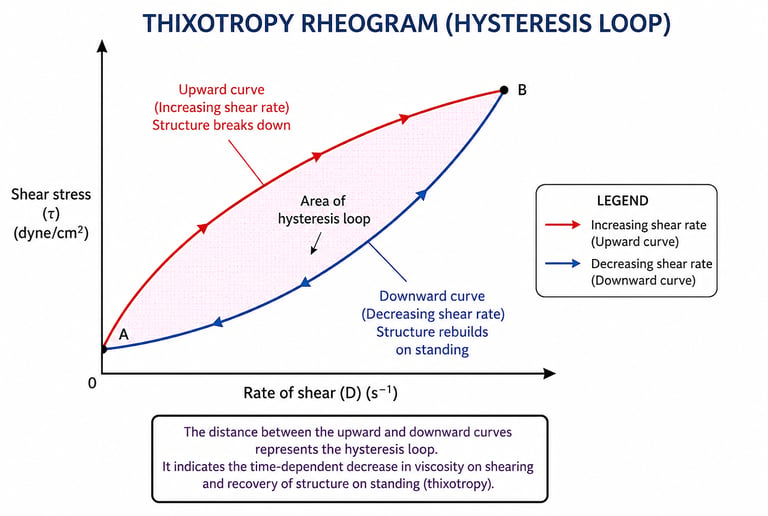
Thixotropy is measured by plotting a rheogram. The thixotropy rheogram is plotted by using increasing and decreasing shear rates. The downward curve does not coincide with the upward curve, forming a hysteresis loop.
Bulges and Spurs
Bulges are irregular deviations in the hysteresis loop. It is due to a structural breakdown during shear.
Spurs are sharp projections in the rheogram. It is due to sudden structural changes or air entrapment.
Negative Thixotropy
Negative thixotropy, also called rheopexy. Rheopexy is the phenomenon in which viscosity increases after shear is applied. Unlike thixotropy, the system becomes thicker after shaking.
Examples: certain lubricants and concentrated gypsum suspensions.
Determination of Rheological Properties
Rheological properties are determined using viscometers.
Single-Point Viscometers
These instruments measure viscosity at a single shear rate.
Examples
Ostwald viscometer
Brookfield viscometer (at fixed speed)
They are useful for Newtonian liquids.
Multi-Point Viscometers
These instruments measure viscosity at multiple shear rates and help in studying non-Newtonian behavior.
Examples
Cone and plate viscometer
Rotational viscometer
They are useful for constructing rheograms and studying thixotropy.
Viscoelasticity
Viscoelastic materials exhibit both viscous and elastic properties. When stress is applied, part of the energy is dissipated as flow and part is stored elastically.
Examples include gels, ointments, and biological fluids.
Importance
Determines spreadability of creams and ointments
Influences texture and consistency
Helps in formulation design
Psycho-rheology
Psycho-rheology is the study of the relationship between rheological properties and patient perception or psychological response.
It evaluates how consumers perceive texture, smoothness, thickness, and ease of application of pharmaceutical and cosmetic products.
Examples
Patient preference for smooth creams
Acceptability of cough syrups based on thickness
Consumer perception of shampoo consistency
Applications of Rheology in Pharmaceutical Preparations
Formulation of suspensions and emulsions by controlling sedimentation and creaming.
Improvement of the stability of semisolid preparations.
Optimization of mixing, filtration, and pumping during manufacturing.
Determination of pourability and spreadability of liquid and semisolid products.
Evaluation of syringeability of injectable preparations.
Enhancement of patient acceptability through suitable texture and consistency.
Quality control testing of pharmaceutical products.
Selection of suitable packaging containers for creams, gels, and lotions.
A liquid whose viscosity remains constant despite a change in the rate of shear is
A. Plastic fluid
B. Dilatant fluid
C. Newtonian fluid
D. Pseudoplastic fluid
Answer: C. Newtonian fluid
Explanation
A Newtonian fluid obeys Newton’s law of flow. Its viscosity remains constant regardless of the applied shear rate.
F=ηG
Where:
F = Shearing stress
η = Viscosity
G = Rate of shear
In Newtonian systems, viscosity (η) does not change even if the rate of shear increases or decreases.
Examples of Newtonian Fluids
Water
Alcohol
Glycerin
Simple syrups
Why Other Options Are Incorrect
A. Plastic fluid
Requires a yield value before flow starts.
Example: toothpaste and flocculated suspensions.
B. Dilatant fluid
Shows an increase in viscosity with an increase in shear rate.
Also called shear-thickening systems.
D. Pseudoplastic fluid
Shows decrease in viscosity with increase in shear rate.
Also called shear-thinning systems.
Pharmacist Exam Tips
High-Yield Concept
Flow Type Behavior
Newtonian Constant viscosity
Pseudoplastic Viscosity decreases on shaking
Dilatant Viscosity increases on shaking
Plastic Requires yield value
Memory Trick
“NEW-tonian = NEVER changes viscosity”
Newtonian fluids = viscosity remains constant
Frequently Asked Exam Pattern
Competitive exams often ask:
Identification of flow type from viscosity behavior
Examples of Newtonian vs non-Newtonian systems
Yield value associated with plastic flow
Difference between pseudoplastic and dilatant systems
Expected Follow-Up Question
Which of the following is a Newtonian liquid?
→ Water / Alcohol / Glycerin are common answers in GPAT and pharmacist recruitment exams.
Which of the following is an example of a Newtonian system?
A. Bentonite magma
B. Blood
C. Water
D. Toothpaste
Answer: C. Water
Explanation
A Newtonian system is a liquid that shows constant viscosity regardless of the applied shear rate.
Water is a classic example of a Newtonian fluid because its viscosity remains unchanged even when the force or shear rate changes.
Why Other Options Are Incorrect
A. Bentonite magma
Shows thixotropic and non-Newtonian behavior.
Viscosity changes with shear.
B. Blood
Exhibits non-Newtonian (pseudoplastic) flow.
Viscosity decreases at higher shear rates.
D. Toothpaste
Shows plastic flow.
Requires a yield value before it starts flowing.
Pharmacist Exam Tip
Common Examples Asked in Exams
Newtonian Systems Non-Newtonian Systems
Water Blood
Alcohol Toothpaste
Glycerin Bentonite magma
Simple syrup Suspensions
Memory Trick
“WAGS are Newtonian”
Water
Alcohol
Glycerin
Syrup
These are frequently repeated examples in GPAT and pharmacist recruitment exams.
The flow behavior in which viscosity decreases with increasing shear rate is known as:
A. Dilatant flow
B. Pseudoplastic flow
C. Plastic flow
D. Newtonian flow
Answer: B. Pseudoplastic flow
Explanation
Pseudoplastic flow is a type of non-Newtonian flow in which viscosity decreases as the shear rate increases. This phenomenon is called shear-thinning behavior.
When shear is applied, the particles or polymer chains become aligned in the direction of flow, reducing resistance and lowering viscosity.
Common Pharmaceutical Examples
Tragacanth mucilage
Sodium alginate solution
Cellulose derivatives
Many suspensions and emulsions
Why Other Options Are Incorrect
A. Dilatant flow
Shows increase in viscosity with increasing shear rate.
Called shear-thickening flow.
C. Plastic flow
Requires a yield value before flow begins.
Example: toothpaste and flocculated suspensions.
D. Newtonian flow
Viscosity remains constant regardless of shear rate.
Example: water and glycerin.
Pharmacist Exam Tip
Flow Type Viscosity Behavior
Newtonian Constant
Pseudoplastic Decreases with shear
Dilatant Increases with shear
Plastic Requires yield value
Memory Trick
“Pseudo = Slim on shaking”
→ Viscosity becomes less on stirring or shaking.
Frequently Asked in Exams
Competitive pharmacist exams commonly ask:
Difference between pseudoplastic and dilatant flow
Examples of shear-thinning systems
Identification of flow type from rheograms
Yield value associated with plastic flow
Viscosity remains constant regardless of shear rate.
Example: water and glycerin.
Which one exhibits plastic flow?
A. Water
B. Syrup
C. Alcohol
D. Flocculated suspension
Answer: C. Flocculated suspension
Explanation
Plastic flow is a type of non-Newtonian flow in which the material behaves like an elastic body until a minimum stress, called the yield value, is applied. After this point, the material begins to flow.
Flocculated suspensions commonly exhibit plastic flow because the suspended particles form a structured network that resists movement until sufficient force is applied.
Key Feature of Plastic Flow
Presence of yield value
No flow occurs below the yield stress
Why Other Options Are Incorrect
A. Alcohol
Shows Newtonian flow.
Viscosity remains constant with shear.
B. Syrup
Generally behaves as a Newtonian liquid.
D. Water
Classic Newtonian system with constant viscosity.
Pharmacist Exam Tip
High-Yield Association
Flow Type Common Example
Newtonian Water, alcohol
Plastic Flocculated suspensions, toothpaste
Pseudoplastic Polymer solutions
Dilatant Concentrated suspensions
Memory Trick
“Plastic = Paste-like products”
Examples:
Toothpaste
Creams
Flocculated suspensions
These usually require force before flowing.
Frequently Asked Concept
Yield value is most commonly associated with:
Plastic flow
Flocculated suspensions
Semisolid pharmaceutical preparations
This is a repeatedly asked topic in GPAT, AIIMS, DSSSB, ESIC, and state pharmacist recruitment exams.
The minimum stress to initiate flow in plastic materials is:
A. Yield value
B. Shear rate
C. Elastic limit
D. Viscosity coefficient
Correct Answer: A. Yield value
Explanation
In plastic flow, the material does not begin to flow until a certain minimum stress is applied. This minimum force required to initiate flow is called the yield value.
Below the yield value, the material behaves like an elastic solid. Once the applied stress exceeds the yield value, the material starts flowing like a liquid.
Pharmaceutical Significance
Yield value is important in:
Flocculated suspensions
Ointments
Creams
Toothpaste formulations
A proper yield value helps prevent sedimentation during storage while still allowing easy pouring or spreading.
Why Other Options Are Incorrect
B. Shear rate
Refers to the rate at which adjacent liquid layers move relative to each other.
It is not the minimum stress required for flow.
C. Elastic limit
Refers to the maximum stress a material can withstand without permanent deformation.
Commonly used in solid mechanics.
D. Viscosity coefficient
Represents resistance to flow in liquids.
It does not indicate the starting point of flow.
Pharmacist Exam Tip
High-Yield Association
Concept Associated Flow
Yield value Plastic flow
Constant viscosity Newtonian flow
Shear thinning Pseudoplastic flow
Shear thickening Dilatant flow
Memory Trick
“Plastic materials need permission to flow”
→ That permission is the yield value.
Frequently Asked Exam Point
Competitive pharmacist exams frequently ask:
Definition of yield value
Flow behavior of flocculated suspensions
Rheograms showing plastic flow
Difference between plastic and pseudoplastic systems
A dilatant system shows which of the following:
A. Decrease in viscosity on shaking
B. Constant viscosity
C. Increase in viscosity with shear
D. Zero yield value
Answer: C. Increase in viscosity with shear
Explanation
A dilatant system is a type of non-Newtonian flow in which viscosity increases as the rate of shear increases. This behavior is known as shear-thickening flow.
When shear is applied, closely packed particles in the system interfere with each other, increasing internal resistance and making the material thicker.
Common Examples
Concentrated suspensions
Starch dispersions
Highly concentrated pharmaceutical powders in liquids
Why Other Options Are Incorrect
A. Decrease in viscosity on shaking
Characteristic of pseudoplastic flow (shear-thinning).
Not dilatant behavior.
B. Constant viscosity
Characteristic of Newtonian systems.
Example: water and alcohol.
D. Zero yield value
Dilatant systems may not necessarily be defined by yield value.
Yield value is mainly associated with plastic flow.
Memory Trick
“Dilatant = Dense on stirring."
→ More stirring or shaking makes the system thicker.
Frequently Confused Concept
Students commonly confuse pseudoplastic and dilatant systems:
Pseudoplastic → shear-thinning → viscosity decreases
Dilatant → shear-thickening → viscosity increases
This comparison is frequently tested in GPAT and pharmacist recruitment examinations.
Which one exhibits shear-thinning behavior?
A. Concentrated starch suspension
B. Tragacanth mucilage
C. Sand-water mixture
D. Zinc oxide paste
Answer: B. Tragacanth mucilage
Explanation
Shear-thinning behavior means the viscosity decreases when shear or stirring is applied. This behavior is characteristic of pseudoplastic systems.
Tragacanth mucilage contains long-chain polymer molecules that become aligned in the direction of flow during stirring, reducing resistance and lowering viscosity.
Why Other Options Are Incorrect
A. Concentrated starch suspension
Commonly shows dilatant (shear-thickening) behavior.
C. Sand-water mixture
Does not exhibit typical pharmaceutical pseudoplastic flow behavior.
D. Zinc oxide paste
Usually shows plastic flow due to the presence of a yield value.
Pharmacist Exam Tip
Common Shear-Thinning Pharmaceutical Materials
Tragacanth
Sodium alginate
Methylcellulose
Acacia solutions
These examples are repeatedly asked in GPAT, ESIC, AIIMS, and state pharmacist exams.
Memory Trick
“Mucilage becomes manageable on mixing.”
→ Mucilages generally become less viscous when stirred.
Thixotropy definition:
A. Constant viscosity with time
B. Increase in viscosity on standing
C. Irreversible breakdown of viscosity
D. Reversible gel-sol transformation on shaking
Answer: D. Reversible gel-sol transformation on shaking
Explanation
Thixotropy is a reversible, time-dependent phenomenon in which a gel transforms into a sol when shaken or stirred and returns to its original gel state on standing.
In pharmaceutical preparations, thixotropic behavior is desirable because the product becomes fluid during shaking or pouring but regains viscosity during storage, improving stability.
Common Examples
Bentonite magma
Pharmaceutical suspensions
Certain gels and creams
Why Other Options Are Incorrect
A. Constant viscosity with time
Characteristic of Newtonian systems.
B. Increase in viscosity on standing
May occur in some systems but does not define thixotropy.
C. Irreversible breakdown of viscosity
Thixotropy is a reversible phenomenon, not irreversible.
Pharmacist Exam Tip
Thixotropy is commonly associated with:
Suspensions
Gels
Semisolid formulations
It improves:
Pourability
Spreadability
Physical stability
Memory Trick
“Thixo = Thin on shaking”
→ Gel becomes liquid-like on agitation and reforms on standing.
Frequently Asked Exam Concept
Exams commonly ask:
Difference between thixotropy and rheopexy
Hysteresis loop in rheograms
Pharmaceutical importance of thixotropic suspensions
Examples of thixotropic systems
The hysteresis loop in rheograms shows
A. Newtonian flow
B. Constant viscosity
C. Elastic deformation
D. Time-dependent structural breakdown
Answer: D. Time-dependent structural breakdown
Explanation
A hysteresis loop in a rheogram is characteristic of thixotropic systems. It indicates that the internal structure of the material breaks down gradually with time when shear is applied and rebuilds when the system is allowed to stand.
The upward curve represents increasing shear, while the downward curve represents decreasing shear. The area between these curves forms the hysteresis loop.
This loop demonstrates:
Structural breakdown during agitation
Delayed recovery of viscosity
Time-dependent flow behavior
Why Other Options Are Incorrect
A. Newtonian flow
Newtonian systems produce a straight-line rheogram without a hysteresis loop.
B. Constant viscosity
Constant viscosity is seen in Newtonian fluids only.
C. Elastic deformation
Elastic deformation relates to viscoelastic materials, not hysteresis loops in thixotropy.
Pharmacist Exam Tip
Rheogram Feature Indicates
Straight line through the origin Newtonian flow
Yield value Plastic flow
Hysteresis loop Thixotropy
Memory Trick
“Loop = Loss of structure."
→ The hysteresis loop shows breakdown and rebuilding of internal structure over time.
Frequently Asked Exam Point
Examiners frequently ask:
Significance of hysteresis loop
Rheogram interpretation
Pharmaceutical importance of thixotropy in suspensions and gels
Difference between time-dependent and shear-dependent flow behavior
Negative thixotropy is also called
A. Plasticity
B. Rheopexy
C. Elasticity
D. Dilatancy
Correct Answer: B. Rheopexy
Correct Answer: B. Rheopexy
Explanation
Negative thixotropy is known as rheopexy. In this phenomenon, viscosity increases with time when shear is continuously applied.
Unlike thixotropic systems, which become less viscous on shaking, rheopectic systems become progressively thicker during agitation.
Characteristics of Rheopexy
Time-dependent increase in viscosity
Opposite of thixotropy
Rare in pharmaceutical systems
Examples
Certain lubricants
Concentrated gypsum suspensions
Some printing inks
Why Other Options Are Incorrect
A. Plasticity
Refers to materials showing yield value before flow begins.
C. Elasticity
The property of regaining original shape after removal of stress.
D. Dilatancy
Shear-thickening behavior is dependent on shear rate, not time.
Pharmacist Exam Tip
Important Distinction
Thixotropy: viscosity decreases with time under shear
Rheopexy: viscosity increases with time under shear
This concept is commonly tested in rheology-based MCQs.
Memory Trick
“RheoPEXY = Packs particles together”
Continuous stirring makes the system thicker.
Frequently Asked Exam Point
Competitive exams frequently ask the following:
Opposite of thixotropy
Definition of rheopexy
Difference between rheopexy and dilatancy
Time-dependent rheological behaviors
In rheopexy:
A. Viscosity remains constant
B. Yield value disappears
C. Increase in viscosity with time under shear
D. Decreases in viscosity with time under shear
Correct Answer: C. Viscosity increases with time under shear
Explanation
Rheopexy is a time-dependent rheological behavior in which a material becomes progressively more viscous when shear is continuously applied.
In this condition, the internal structure of the system builds up during agitation, causing resistance to flow to increase over time.
It is considered the opposite of thixotropy.
Why Other Options Are Incorrect
A. Viscosity remains constant
Seen in Newtonian systems.
B. Yield value disappears
Not related to rheopexy.
D. Viscosity decreases with time under shear
Characteristic of thixotropy, not rheopexy.
Pharmacist Exam Tip
Rheopexy is:
Time-dependent
Rare compared to thixotropy
Associated with gradual thickening during stirring
Memory Trick
“RheoPEXY = Progressive increase in viscosity”
Frequently Asked Exam Point
Opposite relationship between rheopexy and thixotropy
Time-dependent rheological systems
Difference between rheopexy and dilatant flow
Pharmaceutical examples of rheopexy
Bulges and spurs in a rheogram are associated with:
A. Newtonian systems
B. Thixotropic behavior
C. Ideal plastic flow
D. Surface tension
Answer: B. Thixotropic behavior
Explanation
Bulges and spurs in a rheogram are characteristic features associated with thixotropic systems. These irregularities appear due to gradual structural breakdown and rebuilding of the internal network of the material during shear.
Bulges indicate uneven structural disintegration.
Spurs are sharp projections caused by sudden structural rearrangements or trapped air.
These features are commonly observed in rheograms showing hysteresis loops.
Why Other Options Are Incorrect
A. Newtonian systems
Newtonian systems produce smooth straight-line rheograms without bulges or spurs.
C. Ideal plastic flow
Ideal plastic flow mainly shows a yield value and linear flow after yielding.
D. Surface tension
Surface tension is unrelated to rheogram irregularities like bulges and spurs.
Pharmacist Exam Tip
Bulges and spurs are commonly linked with:
Thixotropy
Hysteresis loops
Structural changes during shear
This is a favorite conceptual MCQ area in pharmaceutics and rheology topics.
Memory Trick
“Spurs and bulges show structure struggles”
Internal structure is breaking and reforming during flow.
Frequently Asked Exam Point
Meaning of hysteresis loop
Identification of thixotropic rheograms
Bulges and spurs in rheological studies
Time-dependent flow behavior in suspensions and gels
Which viscometer is used for Newtonian liquids?
A. Stormer viscometer
B. Ostwald viscometer
C. Cone and plate viscometer
D. Rotational viscometer
Answer: C. Ostwald viscometer
Explanation
The Ostwald viscometer is commonly used for measuring the viscosity of Newtonian liquids. It is a capillary viscometer that determines viscosity based on the time required for a liquid to flow through a narrow capillary tube under gravity.
Newtonian liquids have constant viscosity, making capillary viscometers suitable for accurate measurement.
Common Newtonian Liquids
Water
Alcohol
Glycerin
Simple syrups
Why Other Options Are Incorrect
A. Stormer viscometer
Mainly used for semisolid and non-Newtonian materials such as paints.
C. Cone and plate viscometer
Used for studying non-Newtonian flow behavior at multiple shear rates.
D. Rotational viscometer
Commonly used for non-Newtonian systems like creams, suspensions, and gels.
Pharmacist Exam Tip
Viscometer Common Use
Ostwald viscometer Newtonian liquids
Brookfield viscometer Non-Newtonian systems
Cone and plate viscometer Rheological studies
Stormer viscometer Semisolids and paints
Memory Trick
“Ostwald = Ordinary liquids”
Used mainly for simple Newtonian fluids.
Frequently Asked Exam Point
Types of viscometers
Capillary vs rotational viscometers
Suitable viscometer for Newtonian and non-Newtonian systems
Principle of Ostwald viscometer
The Brookfield viscometer is primarily
A. A Capillary viscometer
B. A Rotational viscometer
C. A Falling Ball Viscometer
D. A Vibrational viscometer
Correct Answer: B. Rotational viscometer
Explanation
The Brookfield viscometer is a widely used rotational viscometer that measures viscosity by determining the resistance offered to a rotating spindle immersed in the sample.
It is especially useful for studying:
Non-Newtonian systems
Suspensions
Emulsions
Creams and gels
The torque required to rotate the spindle is proportional to the viscosity of the liquid.
Why Other Options Are Incorrect
A. Capillary viscometer
Measures viscosity based on flow through a narrow tube.
Example: Ostwald viscometer.
C. Falling Ball Viscometer
Measures viscosity from the rate of fall of a ball through the liquid.
D. Vibrational viscometer
Uses vibration frequency changes for viscosity determination.
Pharmacist Exam Tip
Important Use of Brookfield Viscometer
It is commonly used in pharmaceutical industries for:
Quality control
Rheological studies
Evaluation of semisolid dosage forms
Memory Trick
"The Brookfield spindle keeps rotating.”
Rotation-based viscosity measurement.
Frequently Asked Exam Point
Principle of the Brookfield viscometer
Difference between capillary and rotational viscometers
Instruments used for non-Newtonian systems
Applications in pharmaceutical suspensions and creams
A single-point viscometer measures viscosity at:
A. Zero shear stress
B. One shear rate
C. Multiple shear rates
D. Infinite shear rate
Correct Answer: B. One shear rate
Explanation
A single-point viscometer measures the viscosity of a liquid at only one shear rate or one operating condition.
These viscometers are mainly suitable for:
Newtonian liquids
Simple viscosity measurements
Routine quality control tests
They do not provide complete rheological behavior of non-Newtonian systems.
Examples
Ostwald viscometer
Simple Brookfield measurement at fixed speed
Why Other Options Are Incorrect
A. Zero shear stress
No practical viscosity measurement is performed at zero shear stress.
C. Multiple shear rates
Characteristic of multi-point viscometers.
D. Infinite shear rate
Not applicable in routine pharmaceutical rheology.
Pharmacist Exam Tip
Important Distinction
Single-point viscometer: one shear rate
Multi-point viscometer: several shear rates for rheogram construction
Memory Trick
“Single-point = Single speed."
Frequently Asked Exam Point
Competitive exams commonly ask
Difference between single-point and multi-point viscometers
Suitable viscometers for Newtonian and non-Newtonian systems
Rheological evaluation methods for pharmaceutical preparations
Which instrument is useful for studying non-Newtonian flow behavior?
A. Pycnometer
B. Stalagmometer
C. Ostwald viscometer
D. Cone and plate viscometer
Correct Answer: D. Cone and plate viscometer
Explanation
The cone and plate viscometer is widely used to study non-Newtonian flow behavior. Reason: It can measure viscosity at different shear rates.
It consists of:
A flat plate
A rotating cone with a very small angle
The instrument helps in:
Constructing rheograms
Studying thixotropy
Measuring pseudoplastic and dilatant flow behavior
It is highly useful for pharmaceutical suspensions, creams, gels, and emulsions.
Why Other Options Are Incorrect
A. Pycnometer
Used to determine specific gravity or density.
B. Stalagmometer
Used to measure surface tension.
C. Ostwald viscometer
Suitable mainly for Newtonian liquids.
Pharmacist Exam Tip
High-Yield Instrument Association
Instrument Primary Use
Cone and plate viscometer Non-Newtonian flow studies
Ostwald viscometer Newtonian viscosity
Pycnometer Density determination
Stalagmometer Surface tension measurement
Memory Trick
“Cone and plate capture complex flow.”
Best to study changing viscosity behavior.
Frequently Asked Exam Point
Examiners frequently ask:
Instruments for rheological studies
Principle of the cone and plate viscometer
Difference between capillary and rotational viscometers
Measurement of non-Newtonian systems in pharmacy
Which one is the Viscoelastic substance property?
A. Only viscous behavior
B. Only elastic behavior
C. Neither viscosity nor elasticity
D. Both viscous and elastic behavior
Correct Answer: D. Both viscous and elastic behavior
Explanation
A viscoelastic substance exhibits both
Viscous behavior: flows like a liquid under stress
Elastic behavior: regains shape after removal of stress
Such materials show partial energy loss as flow and partial energy storage as elastic recovery.
Pharmaceutical Examples
Gels
Ointments
Cream bases
Biological fluids
Viscoelasticity is important in determining:
Spreadability
Texture
Consistency
Patient acceptability of formulations
Why Other Options Are Incorrect
A. Only viscous behavior
Characteristic of ideal liquids only.
B. Only elastic behavior
Characteristic of ideal solids.
C. Neither viscosity nor elasticity
Incorrect because viscoelastic substances possess both properties.
Pharmacist Exam Tip
Important Concept
Viscoelastic materials behave like
Solids during short stress
Siquids during prolonged stress
This concept is important in semisolid dosage forms and polymer science.
Memory Trick
“VISCO + ELASTIC = Flow + Recovery.”
Frequently Asked Exam Point
Exams commonly ask:
Definition of viscoelasticity
Pharmaceutical examples of viscoelastic substances
Difference between viscous, elastic, and viscoelastic materials
Role of viscoelasticity in creams and gels
Which product shows viscoelasticity?
A. Ethanol
B. Distilled water
C. Simple syrup
D. Ointments and gels
Correct Answer: D. Ointments and gels
Explanation
Ointments and gels commonly exhibit viscoelasticity. It means they show both viscous flow and elastic recovery properties.
When stress is applied:
Part of the material flows like a liquid
Part of it regains its original structure like an elastic solid
This property is important for:
Smooth application
Proper spreadability
Consistency and texture of semisolid dosage forms
Why Other Options Are Incorrect
A. Ethanol
Behaves as a Newtonian liquid with purely viscous behavior.
B. Distilled water
Ideal Newtonian liquid without elastic properties.
C. Simple syrup
Mainly shows viscous flow only.
Pharmacist Exam Tip
Common Viscoelastic Pharmaceutical Products
Ointments
Creams
Gels
Polymer dispersions
These formulations are frequently discussed in rheology and semisolid dosage-form MCQs.
Memory Trick
“Gels bounce back slightly.”
Indicates elastic recovery along with flow.
Frequently Asked Exam Point
Competitive exams commonly ask
Examples of viscoelastic substances
Importance of viscoelasticity in semisolids
Difference between viscous and viscoelastic materials
Rheological properties of ointments and gels
Psycho-rheology is the study of
A. Flow of powders
B. Measurement of viscosity
C. Elastic deformation of solids
D. Relationship between texture and patient perception
Correct Answer: D. Relationship between texture and patient perception
Explanation
The study of how the rheological properties of the product affect the psychological response and sensory perception of patients or consumers is called "psycho-rheology."
It evaluates how people perceive
Texture
Thickness
Smoothness
Spreadability
Consistency of pharmaceutical and cosmetic products
This concept is important because patient acceptance often depends on the feel and ease of application of the formulation.
Examples
Preference for smooth creams
Acceptability of cough syrups based on thickness
Consumer perception of shampoo consistency
Why Other Options Are Incorrect
A. Flow of powders
Studied under powder rheology or micromeritics.
B. Measurement of viscosity
Concerned with rheometry and viscometry.
C. Elastic deformation of solids
Related to elasticity and material mechanics.
Pharmacist Exam Tip
Important Application Areas
Psycho-rheology is important in:
Cosmetic formulations
Semisolid dosage forms
Oral liquid preparations
Patient compliance studies
Memory Trick
“Psycho-rheology = Psychology of rheology.”
How patients feel about the texture and flow of a product.
Frequently Asked Exam Point
Exams may ask:
Definition of psycho-rheology
Importance of patient acceptability
Sensory evaluation related to rheology
Role in cosmetic and pharmaceutical formulation design
Which one affects the spreadability of creams?
A. Density
B. Rheology
C. Surface tension
D. Osmotic pressure
Correct Answer: B. Rheology
Explanation
Rheology is the study of the flow and deformation of materials. The spreadability of creams depends mainly on their rheological properties such as viscosity and flow behavior.
A cream with proper rheology:
Spreads easily on the skin
Maintains uniform application
Provides better patient acceptability
Both excessively thick and excessively thin creams show poor spreadability.
Why Other Options Are Incorrect
A. Density
Density affects mass per unit volume, not spreading behavior directly.
C. Surface tension
Important in emulsions and wetting, but not the primary factor controlling cream spreadability.
D. Osmotic pressure
Related to movement of solvent across membranes, not cream application.
Pharmacist Exam Tip
Pharmaceutical Importance of Rheology
Rheology helps in evaluating:
Pourability of syrups
Syringeability of injections
Spreadability of creams and ointments
Stability of suspensions and emulsions
Memory Trick
“Right rheology = Right rub on skin.”
Frequently Asked Exam Point
Examiners commonly ask:
Factors affecting spreadability
Importance of viscosity in creams and ointments
Rheological properties of semisolid dosage forms
Application of rheology in pharmaceutical formulations
Assertion (A): Pseudoplastic systems show a decrease in viscosity with an increasing shear rate.
Reason (R): Alignment of long-chain molecules occurs in the direction of flow.
A. Both A and R are true, and R is the correct explanation
B. Both A and R are true, but R is not the correct explanation
C. A is true, but R is false
D. A is false, but R is true
Correct Answer: A. Both A and R are true, and R is the correct explanation
Explanation
The assertion is true because pseudoplastic systems exhibit shear-thinning behavior. It means their viscosity decreases as the shear rate increases.
The reason is also true because, during flow, long-chain molecules or particles align themselves with the direction of motion. This alignment reduces intermolecu, resulting in decreased viscosity.
Thus, the reason correctly explains the assertion.lar resistance
Pharmacist Exam Tip
Key Mechanism in Pseudoplastic Flow
At rest: Molecules are randomly arranged
During shear: Molecules align in one direction
Result: Easier flow and lower viscosity
This concept is very important in polymer solutions and pharmaceutical suspensions.
Memory Trick
“Alignment allows easier movement.”
Molecular alignment reduces resistance to flow.
Frequently Asked Exam Point
Assertion–Reason questions from rheology often focus on
Yield value in plastic systems
Pseudoplastic flow mechanism
Thixotropy and hysteresis loop
Difference between time-dependent and shear-dependent flow behavior
Assertion (A): Thixotropic systems are desirable in pharmaceutical suspensions.
Reason (R): They provide stability during storage and easy pourability on shaking.
A. Both A and R are true, and R is the correct explanation
B. Both A and R are true, but R is not the correct explanation
C. A is true, but R is false
D. A is false, but R is true
Correct Answer: A. Both A and R are true, and R is the correct explanation
Explanation
Why Assertion (A) is True
Thixotropy is a property of a system that becomes less viscous when shaken or stirred gradually. It regains viscosity on standing.
In pharmaceutical suspensions, this behavior is highly desirable because:
At rest: The suspension remains viscous. This reduces sedimentation of particles.
On shaking: Viscosity decreases. This makes the product easy to pour and redisperse.
Therefore, thixotropic suspensions improve both physical stability and patient convenience.
Why Reason (R) is True
The reason correctly states the advantages of thixotropic systems:
Stability during storage: Due to higher viscosity at rest.
Easy pourability after shaking: Due to a temporary reduction in viscosity under shear.
Thus, the reason explains why thixotropic systems are preferred in suspensions.
Pharmacist Exam Tip
Quick Memory Trick
“Thixotropy = Thick at rest, Thin on shaking.”
This single line helps solve many GPAT, AIIMS, DSSSB, RRB, and pharmacist recruitment MCQs.
Important Concept for Exams
An ideal pharmaceutical suspension should:
Pour smoothly
Sediment slowly
Redisperse easily
Remain physically stable
Thixotropic systems satisfy all these requirements.
Frequently Asked Comparison
Property Thixotropic System
At rest High viscosity
On shaking Low viscosity
Benefit Stability + easy pouring
High-Yield One-Liner
Thixotropy is a time-dependent, reversible decrease in viscosity produced by shear.
Assertion (A): Newtonian fluids exhibit constant viscosity.
Reason (R): Their rheograms pass through the origin.
A. Both A and R are true, and R is the correct explanation
B. Both A and R are true, but R is not the correct explanation
C. A is false, but R is true
D. Both A and R are false
Correct Answer: A. Both A and R are true, and R is the correct explanation
Explanation
Why Assertion (A) is True
Newtonian fluids obey Newton’s law of flow, where:
Viscosity remains constant irrespective of the applied shear rate.
Shear stress is directly proportional to shear rate.
Examples:
Water
Alcohol
Glycerin
Simple syrups
Thus, Newtonian fluids show constant viscosity under different flow conditions.
Why Reason (R) is True
The rheogram of a Newtonian fluid is:
A straight line
Passing through the origin
This indicates:
No yield value is required to initiate flow.
Shear stress increases proportionally with shear rate.
The slope of the rheogram represents viscosity, which remains constant.
Therefore, the reason correctly explains the assertion.
Important Rheological Relationship
τ=ηD
Where:
τ (tau) = shear stress
η (eta) = viscosity
D = shear rate
For Newtonian fluids, η (eta) remains constant.
High-Yield Memory Trick
“Newtonian = Normal straight-line flow.”
Think:
Constant viscosity
Linear rheogram
Passes through origin
Frequently Asked Exam Point
If a rheogram:
passes through origin: usually Newtonian or pseudoplastic.
has a yield value: plastic flow.
shows decreasing viscosity with shear: pseudoplastic.
shows increasing viscosity with shear: dilatant.
Match the Following
24 List I List II
W. Newtonian flow 1. Toothpaste
X Plastic flow 2. Water
Y. Pseudoplastic flow 3. Tragacanth mucilage
Z. Dilatant flow 4. Concentrated suspension
Choose the correct match:
A. W-2, X-1, Y-3, Z-4
B. W-1, X-2, Y-4, Z-3
C. W-3, X-1, Y-2, Z-4
D. W-2, X-4, Y-1, Z-3
Correct Answer: A. W-2, X-1, Y-3, Z-4
Explanation
W. Newtonian flow: 2. Water
Newtonian fluids show
Constant viscosity
Linear flow behavior
Rheogram passing through the origin
Example: Water, alcohol, glycerin.
X. Plastic flow: 1. Toothpaste
Plastic materials:
Require a yield value before flow starts.
Behave like solids until sufficient force is applied.
Example: Toothpaste, flocculated suspensions, ointments.
Y. Pseudoplastic flow: 3. Tragacanth mucilage
Pseudoplastic systems:
Show decrease in viscosity with increasing shear rate.
Common in polymeric solutions.
Example: Tragacanth, acacia, sodium alginate.
Z. Dilatant flow: 4. Concentrated suspension
Dilatant systems:
Show increase in viscosity on increasing shear.
Occur in highly concentrated suspensions.
Example: Concentrated starch suspensions.
Pharmacist Exam Tip
High-Yield Association Table
Flow Type Key Feature Common Example
Newtonian Constant viscosity Water
Plastic Yield value required Toothpaste
Pseudoplastic Shear thinning Tragacanth mucilage
Dilatant Shear thickening Concentrated suspension
Memory Tricks
Newtonian: Normal liquids: Water
Plastic: Paste-like: Toothpaste
Pseudo = Polymer solutions
Dilatant: Dense suspensions
Newton’s law of flow states: F = ηG
If shear stress doubles while viscosity remains constant, the rate of shear will:
A. Become half
B. Become double
C. Become four times
D. Remain unchanged
Correct Answer: B. Become double
Newton’s law of flow is expressed as
F = ηG
F = shear stress
η (eta) = viscosity (constant here)
G = rate of shear
Since viscosity is constant, the relationship between shear stress and shear rate is directly proportional.
So, if shear stress doubles, the rate of shear also doubles.
The area enclosed between upward and downward rheograms in thixotropy is called
A. Yield area
B. Plastic zone
C. Elastic region
D. Hysteresis loop
Correct Answer: D. Hysteresis loop
Explanation
In thixotropic systems, the rheogram obtained during increasing shear stress (upward curve) does not coincide with the rheogram during decreasing shear stress (downward curve).
The enclosed area between these two curves is called the hysteresis loop.
It indicates:
Degree of thixotropy in the system
Breakdown of internal structure during shear
Gradual rebuilding of the structure when shear is removed
Pharmacist Exam Tip
Remember:
“Thixotropy forms a Hysteresis loop.”
This is one of the most frequently asked rheology MCQs in GPAT, AIIMS, DSSSB, ESIC, RRB Pharmacist exams
High-Yield Concept
Term Meaning
Hysteresis loop Area between ascending and descending rheograms
Indicates Time-dependent structural breakdown and recovery
Seen in Thixotropic systems
Which one of the flow systems possesses a yield value?
A. Plastic
B. Dilatant
C. Pseudoplastic
D. Newtonian
Correct Answer: A. Plastic
Explanation:
Newtonian fluids (like water) flow immediately when stress is applied, with no yield value.
Plastic fluids (like toothpaste or ketchup) require a certain minimum stress (yield value) before they start to flow.
Pseudoplastic fluids (shear-thinning, like polymer solutions) do not have a yield value; they just become less viscous with increasing shear.
Dilatant fluids (shear-thickening, like cornstarch in water) also lack a yield value; they become more viscous with increasing shear.
So, only plastic flow systems exhibit a yield value.
Which property is important in the syringeability of parenteral dosage forms?
A. Rheology
B. Osmosis
C. Sublimation
D. Crystallinity
Correct Answer: B. Rheology
Explanation:
Syringeability refers to how easily a liquid formulation can be drawn into and expelled from a syringe.
This depends on the formulation's flow behavior, viscosity, and consistency. All of these are studied under rheology.
If the solution is too viscous, it will be difficult to inject; if it flows too freely, it may not provide the desired controlled delivery.
Other options like osmosis, crystallinity, and sublimation are not directly related to the ease of injection.
So, rheology is the key property that ensures smooth administration of parenteral drugs.
29 Which of the following is NOT a non-Newtonian system?
A. Gel
B. Water
C. Emulsion
D. Suspension
Correct Answer: B. Water
Explanation:
Newtonian fluids (like water) have a constant viscosity regardless of the applied shear stress. They do not show non-Newtonian behavior.
Non-Newtonian systems include:
Gels often exhibit yield stress and viscoelastic properties.
Emulsions: can show shear-thinning or shear-thickening behavior.
Suspensions: may display plastic or pseudoplastic flow depending on particle concentration.
Thus, among the options, water is the only one that is NOT a non-Newtonian system.
The purpose of rheological studies is
A. Determination of color
B. Determination of odor
C. Evaluation of flow behavior and consistency
D. Identification of drug structure
Correct Answer: C. Evaluation of flow behavior and consistency
Rheological studies focus on understanding how materials flow and deform under applied forces. This is especially important in pharmaceuticals, food science, and materials engineering. Here, consistency, viscosity, and flow properties directly affect product performance, stability, and usability.
For example:
In pharmaceuticals, rheology helps ensure proper drug formulation (like creams, gels, or suspensions).
In food science, it determines texture and mouthfeel.
In industrial materials, it guides processing and manufacturing efficiency.
Most Important Exam Points
Newtonian systems obey Newton’s law of motion.
Plastic flow shows a yield value.
Pseudoplastic = shear thinning.
Dilatant = shear thickening.
Thixotropy produces a hysteresis loop.
Negative thixotropy = Rheopexy.
A Brookfield viscometer is widely used in pharmacies.
A Cone and plate viscometer is useful for non-Newtonian systems.
Viscoelastic materials show both elastic and viscous properties.
Psycho-rheology relates texture to patient acceptance.
Rapid Revision Notes
Concepts Key Points
Newtonian flow Constant viscosity
Plastic flow Has yield value
Pseudoplastic Viscosity decreases with shear
Dilatant Viscosity increases with shear
Thixotropy Gel-sol reversible transformation
Rheopexy Opposite of thixotropy
Hysteresis loop Measure of thixotropy
Single-point viscometer One shear rate
Multi-point viscometer Multiple shear rates
Viscoelasticity Elastic + viscous behavior
Memory Tricks
Pseudo = Poor viscosity on shaking → decreases viscosity
Dilatant = Dense on shaking → increases viscosity
Rheopexy = Reverse thixotropy
Plastic flow = Paste-like materials
Frequently Confused Concepts
Concept 1 Concept 2
Thixotropy Rheopexy
Pseudoplastic Dilatant
Single-point viscometer Multi-point viscometer
Viscosity Viscoelasticity
Expected Questions for Upcoming Exams
Explain the hysteresis loop in thixotropy.
Differentiate Newtonian and non-Newtonian systems.
Write a short note on rheopexy.
Applications of rheology in formulation development.
Compare pseudoplastic and dilatant flow.
Discuss viscoelasticity with pharmaceutical examples.
Explain the Brookfield viscometer and its uses.
Dr Alok Singh