
Special senses MCQs with answers
Master Special senses MCQs with answers on eye, ear, nose, tongue, glaucoma, cataract, myopia, otitis, vertigo, and anosmia for GPAT, NIPER, AIIMS Pharmacist, Railway, SSC, ESIC & State Pharmacist exams
Dr. Alok Singh
6/27/20264 min read
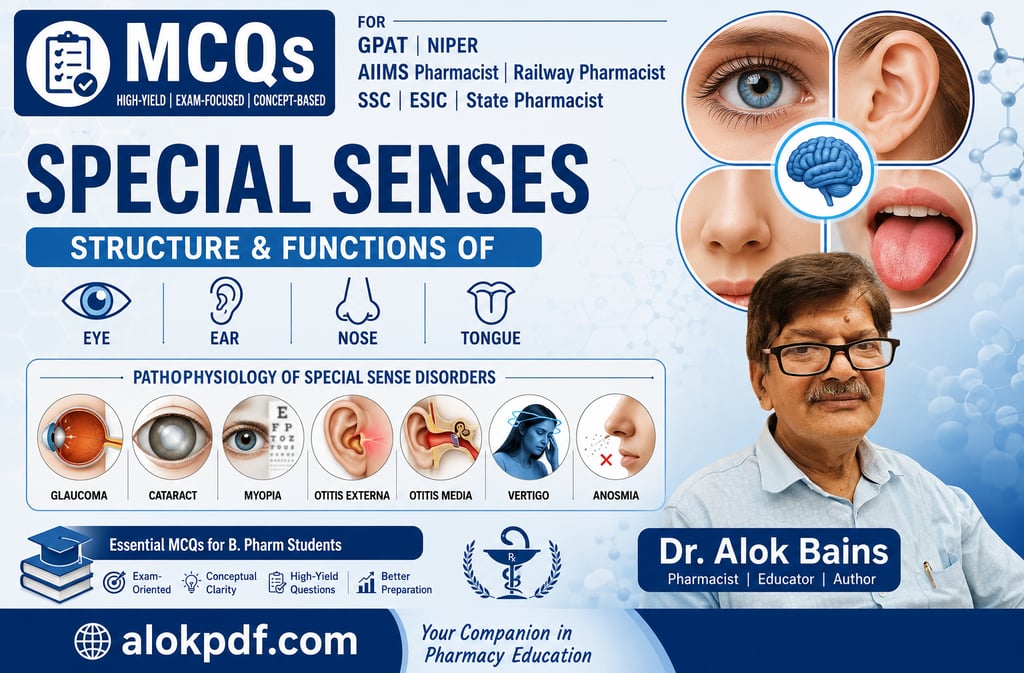
High-Yield Conceptual MCQs on Special Senses. GPAT, NIPER, AIIMS Pharmacist, Railway Pharmacist. SSC, ESIC, State Pharmacist Exams.
1. Which layer of the eyeball is primarily responsible for nourishing the outer retina?
A. Sclera
B. Choroid
C. Cornea
D. Iris
Answer: B
Explanation: The choroid is highly vascular and supplies nutrients and oxygen to the outer layers of the retina.
2. The blind spot in the human eye corresponds to the area where:
A. Rods are absent
B. Cones are absent
C. Optic nerve exits the eyeball
D. Lens attaches to the ciliary body
Answer: C
Explanation: The optic disc lacks photoreceptors because it is the site where the optic nerve leaves the eye.
3. Which retinal cells generate action potentials that are transmitted through the optic nerve?
A. Rods
B. Cones
C. Bipolar cells
D. Ganglion cells
Answer: D
Explanation: Ganglion cells are the first retinal neurons to generate action potentials.
4. A patient can distinguish colors but has poor night vision. Which cells are most likely affected?
A. Bipolar cells
B. Ganglion cells
C. Rods
D. Cones
Answer: C
Explanation: Rods function in dim light and are responsible for night vision.
5. Which structure changes its curvature during accommodation?
A. Cornea
B. Retina
C. Lens
D. Iris
Answer: C
Explanation: The crystalline lens becomes more convex during accommodation for near vision.
6. Parasympathetic stimulation of the eye produces:
A. Mydriasis
B. Cycloplegia
C. Miosis
D. Increased aqueous humor production
Answer: C
Explanation: Parasympathetic fibers contract the sphincter pupillae causing pupillary constriction.
7. Increased intraocular pressure in glaucoma mainly damages
A. Lens
B. Cornea
C. Optic nerve
D. Iris
Answer: C
Explanation: Progressive optic nerve damage causes irreversible visual field defects.
8. Which factor directly contributes to aqueous humor drainage?
A. Canal of Schlemm
B. Macula lutea
C. Vitreous chamber
D. Choroid
Answer: A
Explanation: Aqueous humor drains through the trabecular meshwork into the Canal of Schlemm.
9. A cataract primarily involves
A. Increased intraocular pressure
B. Retinal degeneration
C. Lens opacity
D. Corneal ulceration
Answer: C
Explanation: Cataract is characterized by clouding of the crystalline lens.
10. In myopia, the image is focused
A. Behind the retina
B. On the retina
C. In front of the retina
D. At the optic disc
Answer: C
Explanation: Excessive refractive power or an elongated eyeball causes images to focus anterior to the retina.
11. Which lens corrects myopia?
A. Convex
B. Cylindrical
C. Concave
D. Bifocal
Answer: C
Explanation: A concave lens diverges incoming light to shift the focal point onto the retina.
12. Hyperopia is corrected using
A. Concave lens
B. Convex lens
C. Cylindrical lens
D. Plano lens
Answer: B
Explanation: Convex lenses converge light before entering the eye.
13. The receptor cells responsible for hearing are located in the
A. Semicircular canals
B. Organ of Corti
C. Oval window
D. Tympanic membrane
Answer: B
Explanation: Hair cells within the Organ of Corti convert sound vibrations into nerve impulses.
14. Which structure transmits vibrations from the tympanic membrane to the inner ear?
A. Cochlea
B. Vestibule
C. Auditory ossicles
D. Eustachian tube
Answer: C
Explanation: Malleus, incus, and stapes amplify and transmit sound vibrations.
15. The smallest bone in the human body is
A. Malleus
B. Incus
C. Stapes
D. Hyoid
Answer: C
Explanation: The stapes fits into the oval window.
16. Which cranial nerve carries hearing impulses?
A. Trigeminal
B. Facial
C. Vestibulocochlear
D. Glossopharyngeal
Answer: C
Explanation: Cranial nerve VIII transmits auditory and vestibular information.
17. The Eustachian tube primarily functions to
A. Produce earwax
B. Equalize middle ear pressure
C. Detect sound frequency
D. Produce endolymph
Answer: B
Explanation: It connects the middle ear with the nasopharynx.
18. Which ear disorder commonly follows upper respiratory tract infection?
A. Otitis externa
B. Otitis media
C. Otosclerosis
D. Ménière disease
Answer: B
Explanation: Infection spreads through the Eustachian tube.
19. Swimmer's ear refers to
A. Otitis media
B. Otitis externa
C. Labyrinthitis
D. Mastoiditis
Answer: B
Explanation: It is an inflammation of the external auditory canal.
20. Vertigo usually results from dysfunction of the
A. Cochlea
B. Semicircular canals
C. Tympanic membrane
D. Auditory cortex
Answer: B
Explanation: Semicircular canals detect rotational movement.
21. Which inner ear fluid has a high potassium concentration?
A. Perilymph
B. Endolymph
C. Cerebrospinal fluid
D. Plasma
Answer: B
Explanation: Endolymph resembles intracellular fluid.
22. Which receptor detects rotational acceleration?
A. Macula
B. Organ of Corti
C. Crista ampullaris
D. Taste bud
Answer: C
Explanation: Crista ampullaris is present in the ampulla of the semicircular canals.
23. The receptors for smell are located in the
A. Inferior nasal concha
B. Olfactory epithelium
C. Maxillary sinus
D. Nasopharynx
Answer: B
Explanation: Olfactory receptor neurons are located in the olfactory epithelium.
24. Which cranial nerve mediates olfaction?
A. I
B. II
C. VII
D. X
Answer: A
Explanation: The olfactory nerve is Cranial Nerve I.
25. Anosmia means
A. Loss of hearing
B. Loss of smell
C. Loss of taste
D. Loss of balance
Answer: B
Explanation: Anosmia is the complete absence of smell sensation.
26. Taste buds are primarily located within
A. Filiform papillae
B. Fungiform papillae
C. Lingual frenulum
D. Soft palate only
Answer: B
Explanation: Fungiform, circumvallate, and foliate papillae contain taste buds.
27. Filiform papillae are unique because they
A. Contains numerous taste buds
B. Lack taste buds
C. Detect bitter taste
D. Detect umami
Answer: B
Explanation: They provide mechanical support without taste receptors.
28. Which cranial nerve supplies taste sensation from the anterior two-thirds of the tongue?
A. V
B. VII
C. IX
D. XII
Answer: B
Explanation: The facial nerve via the chorda tympani carries taste fibers.
29. Taste from the posterior one-third of the tongue is carried by:
A. Facial nerve
B. Glossopharyngeal nerve
C. Hypoglossal nerve
D. Vagus nerve
Answer: B
Explanation: Cranial nerve IX supplies this region.
30. Which taste modality is commonly associated with glutamate?
A. Sweet
B. Sour
C. Umami
D. Bitter
Answer: C
Explanation: Umami receptors respond to amino acids, especially glutamate.
31. Which retinal region has the highest visual acuity?
A. Optic disc
B. Peripheral retina
C. Fovea centralis
D. Ora serrata
Answer: C
Explanation: The fovea contains densely packed cones.
32. Which statement regarding rods is CORRECT?
A. Responsible for color vision
B. Maximum concentration at the fovea
C. Highly sensitive in dim light
D. Responsible for the highest visual acuity
Answer: C
33. Which disorder causes irreversible vision loss if untreated due to optic nerve damage?
A. Cataract
B. Myopia
C. Glaucoma
D. Presbyopia
Answer: C
34. Which structure is mainly responsible for dynamic equilibrium?
A. Cochlea
B. Utricle
C. Saccule
D. Semicircular canals
Answer: D
35. Static equilibrium is mainly detected by the
A. Crista ampullaris
B. Macula of utricle and saccule
C. Organ of Corti
D. Tympanic membrane
Answer: B
36. A patient complains of a spinning sensation while changing head position. Which system is primarily affected?
A. Visual system
B. Vestibular apparatus
C. Cochlea
D. Auditory cortex
Answer: B
37. Which disorder is characterized by inflammation of the middle ear cavity?
A. Otitis externa
B. Otitis media
C. Labyrinthitis
D. Otosclerosis
Answer: B
38. The receptor potential in hair cells is initiated by
A. Sodium influx
B. Potassium influx from endolymph
C. Chloride influx
D. Calcium efflux
Answer: B
39. Which combination is correctly matched?
A. Cataract – Optic nerve degeneration
B. Glaucoma – Lens opacity
C. Myopia – Image focused anterior to retina
D. Vertigo – Loss of smell
Answer: C
40. Which one of the following is NOT considered a special sense?
A. Vision
B. Hearing
C. Taste
D. Touch
Answer: D
Explanation: Touch is a general somatic sensation, whereas vision, hearing, smell, taste, and equilibrium are special senses.
Exams (Frequently Tested)
Blind spot: Optic disc: No photoreceptors.
Highest visual acuity: Fovea centralis: Only cones.
Night vision: Rods.
Color vision: Cones.
Glaucoma: Increased intraocular pressure and optic nerve damage.
Cataract: Lens opacity.
Myopia: Image in front of retina: Corrected by a concave lens.
Hyperopia: Image behind retina: Corrected by a convex lens.
Organ of Corti: Hearing receptor.
Semicircular canals: Dynamic equilibrium.
Utricle & Saccule: Static equilibrium.
Otitis externa: External auditory canal ("Swimmer's ear").
Otitis media: Middle ear infection.
Anosmia: Loss of smell.
Taste (anterior 2/3 of tongue): Facial nerve (CN VII).
Taste (Posterior 1/3 tongue): Glossopharyngeal nerve (CN IX).
Smell: Olfactory nerve (CN I).
Hearing & Balance: Vestibulocochlear nerve (CN VIII).