Tablet Evaluation MCQs for Pharmacist Exams/GPAT: with Answers for HSSCE, AIIMS, ESI
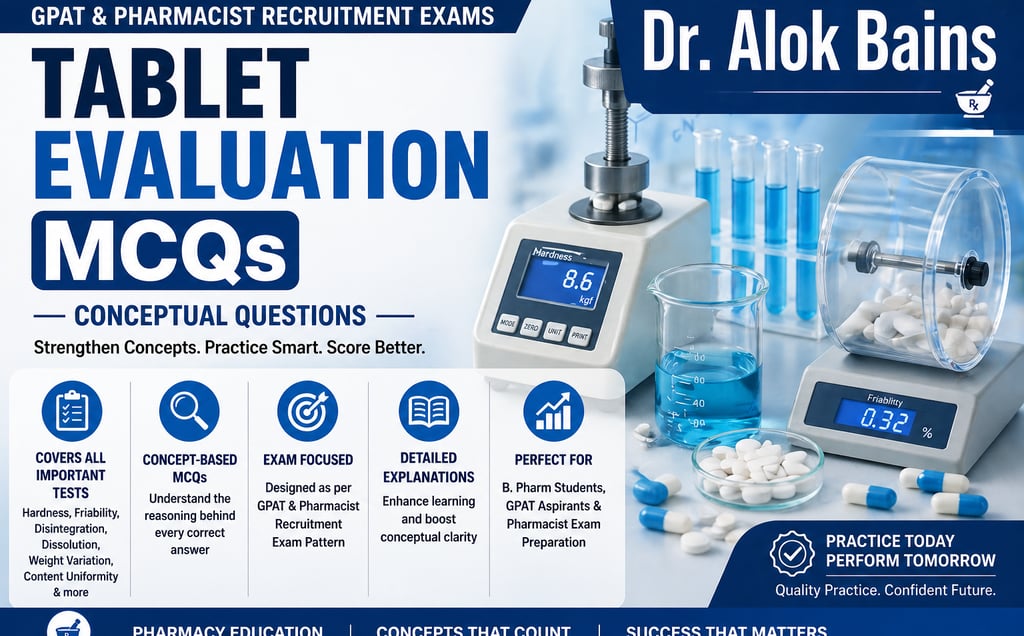
Understanding tablet evaluation is essential for cracking GPAT and pharmacist recruitment exams. This blog post provides carefully designed Tablet Evaluation MCQs that focus on building strong concepts rather than rote learning. It covers important quality control parameters such as hardness, friability, disintegration time, dissolution, weight variation, and content uniformity—topics frequently asked in competitive exams. Each question is crafted to match the latest exam pattern and is supported with clear, concise explanations. This helps you not only identify the correct answer but also understand the logic behind it. Whether you are revising key topics or testing your preparation level, these MCQs serve as an effective self-assessment tool. With a strong emphasis on conceptual clarity, exam-oriented practice, and GPAT-level difficulty, this resource is ideal for B. Pharm students and pharmacy aspirants aiming to improve accuracy and confidence.
Dr. Alok Bains
4/25/20263 min read
Pharmacist/GPAT-focused MCQ set on Tablet Evaluation Parameters
1. Which test is primarily used to measure the mechanical strength of a tablet?
A. Friability test
B. Hardness test
C. Disintegration test
D. Dissolution test
Correct Answer: B
Explanation: A hardness test measures the force required to break a tablet.
2. The acceptable limit for tablet friability as per the pharmacopoeia is:
A. Not more than 0.1%
B. Not more than 1%
C. Not more than 5%
D. Not more than 10%
Correct Answer: B
3. Which apparatus is used to determine friability?
A. Monsanto tester
B. Roche friabilator
C. Disintegration apparatus
D. Paddle apparatus
Correct Answer: B
4. The disintegration test for uncoated tablets is generally performed at:
A. 25 ± 2°C
B. 30 ± 2°C
C. 37 ± 2°C
D. 45 ± 2°C
Correct Answer: C
5. Which parameter directly influences the bioavailability of a drug from a tablet?
A. Hardness
B. Thickness
C. Dissolution rate
D. Friability
Correct Answer: C
6. The weight variation test ensures uniformity of:
A. Drug release
B. Tablet hardness
C. Drug content (indirectly)
D. Tablet color
Correct Answer: C
7. According to IP, the number of tablets typically used for friability testing is:
A. 5
B. 10
C. 20
D. 50
Correct Answer: C
(Remember, the frability test is not official in IP, but usually examination question paper setters ask this type of question.)
8. Which of the following is used in dissolution testing of tablets?
A. Monsanto tester
B. Pfizer tester
C. USP Apparatus II (Paddle)
D. Friabilator
Correct Answer: C
9. Excessive hardness of tablets may lead to:
A. Increased friability
B. Faster disintegration
C. Delayed disintegration
D. Improved flow
Correct Answer: C
10. Which test evaluates the ability of a tablet to withstand abrasion during handling?
A. Hardness test
B. Friability test
C. Dissolution test
D. Disintegration test
Correct Answer: B
Quick Revision Table (Exam Booster)
Parameter Purpose
Hardness: Mechanical Strength,
Friability: Resistance to Abrasion
Disintegration: Break-up time,
Dissolution: Drug release rate
Weight Variation: Dose uniformity
GPAT/Pharmacist Competitive Examinations often ask apparatus-based + limit-based questions
Focus on IP/USP conditions (temperature, time, limits)
Understand interrelation: hardness ↔ disintegration ↔ dissolution
Test your understanding of tablet definitions and classifications.
A 25-question, full-length MCQ test on tablets (definition & classification) designed in a previous-year HSSC/ESIC-style pattern—a mix of direct, conceptual, and tricky questions.
Full Test: Tablets (25 MCQs)
Questions
Q1. Tablets are solid dosage forms prepared mainly by:
A. Filtration
B. Compression or molding
C. Distillation
D. Sublimation
Q2. Which of the following is NOT a tablet characteristic?
A. Unit dose form
B. Accurate dosing
C. Always uncoated
D. Contains excipients
Q3. Tablets intended for systemic effect via the oral route are:
A. Buccal tablets
B. Conventional tablets
C. Vaginal tablets
D. Implant tablets
Q4. Which tablet is designed to disintegrate in the mouth slowly?
A. Effervescent tablet
B. Lozenges
C. Enteric-coated tablet
D. Sublingual tablet
Q5. Tablets placed under the tongue are
A. Buccal
B. Sublingual
C. Chewable
D. Effervescent
Q6. Which of the following tablets bypasses first-pass metabolism?
A. Enteric-coated
B. Sublingual
C. Chewable
D. Conventional
Q7. Tablets that are dissolved in water before administration are
A. Buccal
B. Effervescent
C. Enteric
D. Implant
Q8. Enteric-coated tablets are designed to:
A. Release the drug in the stomach
B. Prevent gastric irritation
C. Increase taste
D. Enhance color
Q9. Tablets intended to be chewed are
A. Dispersible
B. Effervescent
C. Chewable
D. Buccal
Q10. Tablets placed between the cheek and gum are
A. Sublingual
B. Buccal
C. Lozenges
D. Implant
Q11. Tablets that release a drug over a prolonged period are:
A. Immediate release
B. Sustained release
C. Effervescent
D. Dispersible
Q12. Which of the following is NOT based on the route of administration?
A. Buccal tablet
B. Vaginal tablet
C. Film-coated tablet
D. Sublingual tablet
Q13. Film-coated tablets differ from sugar-coated tablets in that they:
A. Are thicker
B. Use polymer film
C. Are always enteric
D. Are uncoated
Q14. Which tablet produces CO₂ on contact with water?
A. Chewable
B. Effervescent
C. Sublingual
D. Buccal
Q15. Tablets intended for vaginal use are called:
A. Troches
B. Pessaries
C. Buccal tablets
D. Lozenges
Q16. Implantation tablets are used for:
A. Oral use
B. Skin application
C. Subcutaneous insertion
D. Nasal route
Q17. Dispersible tablets are:
A. Swallowed whole
B. Dissolved/dispersed in water before use
C. Chewed
D. Implanted
Q18. Which tablet provides a rapid onset of action?
A. Sustained release
B. Enteric-coated
C. Sublingual
D. Film-coated
Q19. Which of the following is NOT a modified-release tablet?
A. Sustained release
B. Delayed release
C. Immediate release
D. Controlled release
Q20. Sugar-coated tablets are mainly used to:
A. Increase hardness
B. Mask taste
C. Reduce weight
D. Increase disintegration
Q21. Lozenges are also known as:
A. Troches
B. Pessaries
C. Caplets
D. Implants
Q22. Which tablet type avoids gastric degradation of the drug?
A. Effervescent
B. Enteric-coated
C. Chewable
D. Conventional
Q23. Buccal tablets are mainly used for:
A. Slow dissolution in the cheek
B. Rapid swallowing
C. Dissolving in water
D. Injection
Q24. Which is NOT a classification based on use?
A. Chewable tablet
B. Effervescent tablet
C. Sustained-release tablet
D. Film-coated tablet
Q25. Tablets prepared by molding are usually:
A. Harder than compressed tablets
B. Softer and porous
C. Coated only
D. Enteric only
Answer Key
B
C
B
B
B
B
B
B
C
B
B
C
B
B
B
C
B
C
C
B
A
B
A
D
B
Difficulty Level Analysis
Easy: 10 questions (direct theory)
Moderate: 10 questions (concept-based)
Tricky: 5 questions (confusing classification)
This mix closely matches the Haryana Pharmacist exam trend/GPAT.
How to Use This Test
Score 20+ = Safe zone
Score 15–19 = Needs revision
Score < 15 = Relearn classification
Dr Alok Bains