Tablet Formulation MCQs for Pharmacist Exams: Conceptual Questions with Answers for HSSCE, AIIMS
Prepare smarter for government pharmacist exams with this concise collection of Tablet Formulation MCQs for Pharmacist Exams, tailored for HSSCE, AIIMS, ESI, and similar competitive tests.
Dr. Alok Bains
4/23/20262 min read
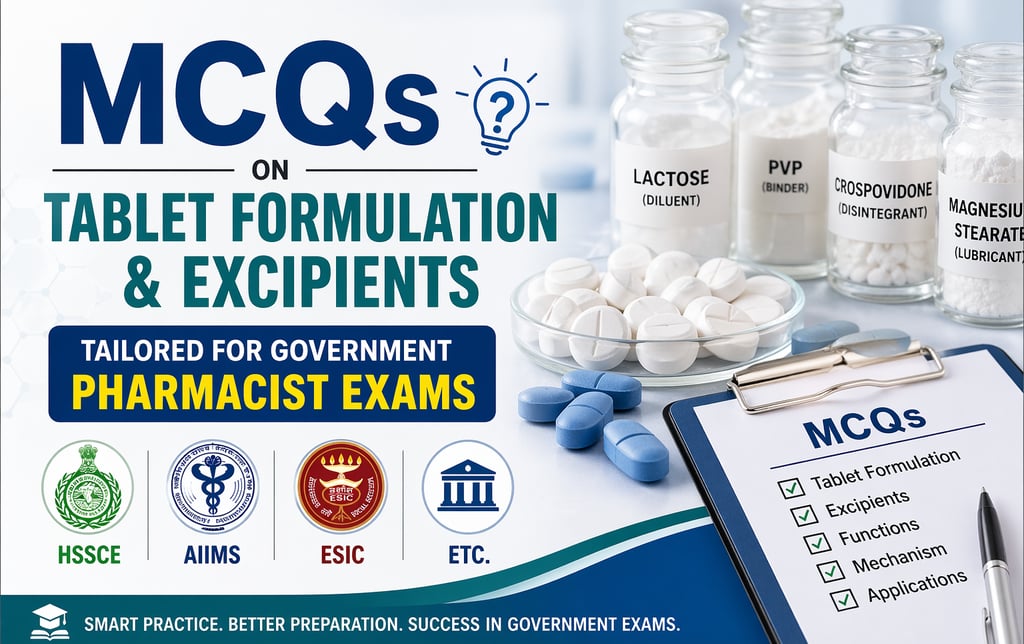
MCQs on Tablet Formulation & Excipients are tailored for government pharmacist exams (HSSCE, AIIMS, ESI, etc.).
1. Which of the following is NOT a diluent used in tablet formulation?
A. Lactose
B. Microcrystalline cellulose
C. Magnesium stearate
D. Dicalcium phosphate
Correct Answer: C
Explanation: Magnesium stearate is a lubricant, not a diluent.
2. The primary role of binders in tablets is to:
A. Improve dissolution
B. Increase hardness
C. Promote granule formation
D. Enhance flow
Correct Answer: C
Explanation: Binders provide cohesion to form granules.
3. Which excipient acts by swelling to promote tablet disintegration?
A. Talc
B. Starch
C. Lactose
D. Gelatin
Correct Answer: B
4. Superdisintegrants include:
A. Starch
B. Sodium starch glycolate
C. Gelatin
D. PEG
Correct Answer: B
5. Which of the following is a hydrophobic lubricant?
A. Talc
B. Magnesium stearate
C. PEG
D. Starch
Correct Answer: B
6. Excess lubricant may lead to:
A. Increased hardness
B. Decreased dissolution rate
C. Faster disintegration
D. Improved bioavailability
Correct Answer: B
7. Which excipient improves powder flow?
A. Binder
B. Disintegrant
C. Glidant
D. Sweetener
Correct Answer: C
8. Talc is mainly used as
A. Binder
B. Glidant
C. Disintegrant
D. Diluent
Correct Answer: B
9. Direct compression requires excipients with:
A. Poor flow
B. Good compressibility
C. High moisture
D. Low density
Correct Answer: B
10. Which method involves forming granules using a liquid?
A. Dry granulation
B. Direct compression
C. Wet granulation
D. Lyophilization
Correct Answer: C
11. Which excipient is commonly used as a binder in wet granulation?
A. PVP
B. Talc
C. Magnesium stearate
D. Lactose
Correct Answer: A
12. Capping in tablets is due to:
A. Excess moisture
B. Air entrapment
C. High binder concentration
D. Low compression force
Correct Answer: B
13. Which of the following is a water-soluble diluent?
A. Lactose
B. Talc
C. Magnesium stearate
D. Calcium phosphate
Correct Answer: A
14. Disintegrants are added to:
A. Increase tablet hardness
B. Promote the breakup of the tablet
C. Improve flow
D. Reduce weight
Correct Answer: B
15. Which excipient is used for coating?
A. HPMC
B. Lactose
C. Talc
D. Starch
Correct Answer: A
16. Which is an example of a plastic material in compression?
A. Lactose
B. MCC
C. DCP
D. Talc
Correct Answer: B
17. Which property is essential for tablet compression?
A. Color
B. Flowability
C. Odor
D. Taste
Correct Answer: B
18. Friability test measures:
A. Hardness
B. Weight variation
C. Resistance to abrasion
D. Disintegration
Correct Answer: C
19. Which instrument is used for hardness testing?
A. Monsanto tester
B. Disintegration apparatus
C. Friabilator
D. pH meter
Correct Answer: A
20. Which problem results in the splitting of a tablet into layers?
A. Sticking
B. Lamination
C. Picking
D. Mottling
Correct Answer: B
21. Assertion (A): Magnesium stearate reduces tablet dissolution rate
Reason (R): It forms a hydrophobic film around particles
A. Both A and R are true, and R explains A
B. Both true, but R not an explanation
C. A true, R false
D. A false, R true
Correct Answer: A
22. Assertion (A): Wet granulation improves flow properties
Reason (R): It increases particle size
Correct Answer: A
Dr Alok Bains