Urinary system anatomy and physiology MCQs
Prepare for Urinary system anatomy and physiology MCQs GPAT, NIPER, AIIMS Pharmacist, Railway Pharmacist, SSC, ESIC, and State Pharmacist exams with notes on urinary system anatomy, kidney physiology, nephron function, RAAS, and urine formation, plus MCQs.
Dr. Alok Singh
7/7/20266 min read
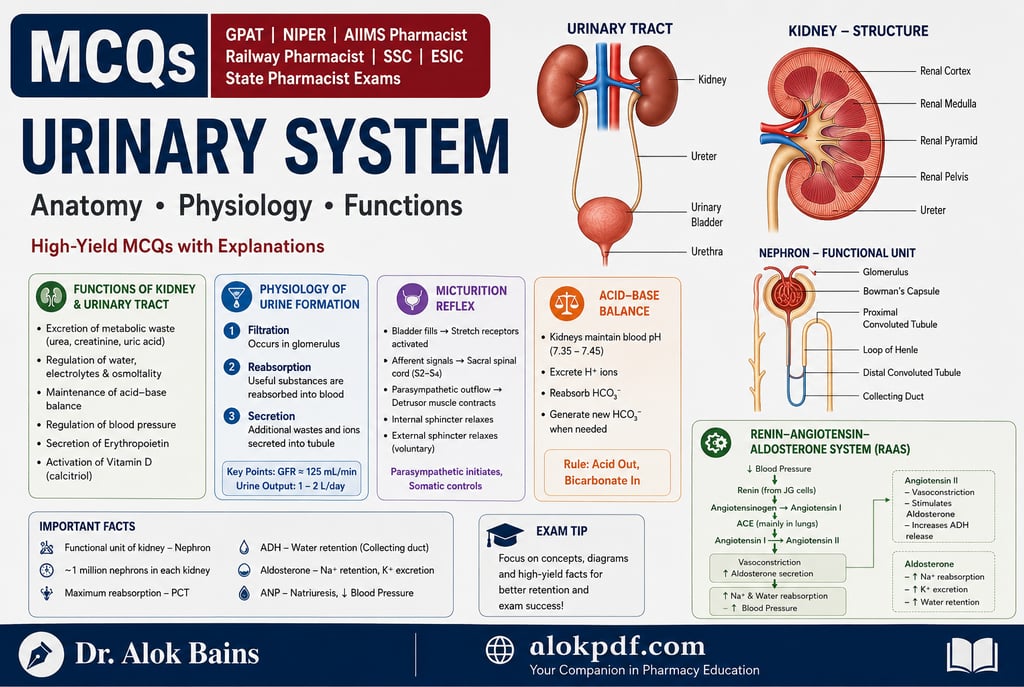
Multiple-choice questions (MCQs) prepared according to the PCI B. Pharm syllabus and MCQs on the Urinary System (Kidney Physiology)
Quick Revision Notes: Urinary System
1. Anatomy of the Urinary Tract
Remember the Path of Urine
Kidneys → Ureters → Urinary Bladder → Urethra
Functions
Kidneys: Filter blood and produce urine.
Ureters: Carry urine to the bladder.
Urinary bladder: Temporarily stores urine.
Urethra: Expels urine from the body.
Exam Fact
Normal urine output: 1–2 L/day
Mnemonic: KUBU
Kidney → Ureter → Bladder → Urethra
2. Kidney Anatomy
Each kidney is:
Bean-shaped
Reddish-brown
Located behind the peritoneum (retroperitoneal)
Protected by the lower ribs
Parts of the Kidney
Cortex: Outer region; contains glomeruli.
Medulla: Inner region; contains renal pyramids.
Renal pelvis: Funnel-shaped collecting chamber.
Hilum: Entry and exit point for renal artery, renal vein, ureter, lymphatics, and nerves.
Exam Fact
Right kidney is slightly lower than the left because of the liver.
Mnemonic: Come Meet People
Cortex → Medulla → Pelvis
3. Nephron – Functional Unit of the Kidney
Each kidney contains about 1 million nephrons.
Parts of a Nephron
Glomerulus
Bowman's capsule
Proximal convoluted tubule (PCT)
Loop of Henle
Distal convoluted tubule (DCT)
Collecting duct
Easy Function Table
Part Main Function
Glomerulus Filtration
PCT Maximum reabsorption
Loop of Henle Concentrates urine
DCT Hormonal regulation
Collecting duct Final water reabsorption
Mnemonic:
Good Boys Prefer Long Daily Coffee
Glomerulus
Bowman's capsule
PCT
Loop of Henle
DCT
Collecting duct
4. Functions of the Kidney
The kidneys perform several vital functions:
Remove metabolic waste products
Maintain water balance
Regulate electrolytes
Control blood pressure
Maintain acid–base balance
Produce erythropoietin
Activate vitamin D
Mnemonic: WE BAE
Water balance
Electrolytes
Blood pressure
Acid–base balance
Erythropoietin (and active vitamin D)
5. Urine Formation
Urine formation occurs in three steps:
Step 1 – Glomerular Filtration
Blood is filtered through the glomerulus.
Step 2 – Tubular Reabsorption
Useful substances return to the blood:
Water
Glucose
Amino acids
Sodium
Step 3 – Tubular Secretion
Additional wastes and excess ions are secreted into the tubule:
H⁺
K⁺
Ammonium
Drugs
Mnemonic: FRS
Filtration → Reabsorption → Secretion
6. Important Hormones Acting on the Kidney
ADH (Antidiuretic Hormone)
Acts on the collecting ducts.
Increases water reabsorption.
Produces concentrated urine.
Aldosterone
Acts mainly on the distal tubule and collecting duct.
Increases sodium reabsorption.
Increases potassium excretion.
ANP (Atrial Natriuretic Peptide)
Promotes sodium and water excretion.
Lowers blood pressure.
Mnemonic: ADA
ADH → Adds water
D (Aldosterone) → Drives sodium retention
ANP → Allows sodium loss
7. Micturition Reflex
The micturition reflex is the process of urination.
Sequence
Bladder fills
→ Stretch receptors are activated
→ Sacral spinal cord (S2–S4)
→ Detrusor muscle contracts
→ Internal sphincter relaxes
→ External sphincter relaxes voluntarily
→ Urination occurs
Exam Fact
Parasympathetic nerves initiate micturition.
External urethral sphincter is under voluntary control.
Mnemonic: Fill–Stretch–Spinal–Squeeze–Urinate
8. Kidney in Acid–Base Balance
The kidneys help maintain normal blood pH (7.35–7.45) by:
Excreting hydrogen ions (H⁺)
Reabsorbing bicarbonate (HCO₃⁻)
Producing new bicarbonate when needed
Easy Rule
Acid out
Bicarbonate in
9. Renin–Angiotensin–Aldosterone System (RAAS)
Sequence
↓ Blood pressure
→ Kidney releases Renin
→ Angiotensinogen → Angiotensin I
→ ACE converts Angiotensin I → Angiotensin II
→ Blood vessels constrict
→ Aldosterone is released
→ Sodium and water are reabsorbed
→ Blood pressure increases
Mnemonic: RAAS = Raise Arterial Pressure
Renin
Angiotensin II
Aldosterone
Sodium & water retention
10. Exam Facts
Functional unit of kidney = Nephron
Number of nephrons per kidney ≈ 1 million
GFR ≈ 125 mL/min
Normal urine output = 1–2 L/day
Filtration occurs in the glomerulus
Maximum reabsorption occurs in the PCT
ADH acts mainly on the Collecting duct
Aldosterone increases Na⁺ reabsorption and K⁺ excretion
Micturition center = S2–S4
ACE is mainly present in the lungs
Renin is released by juxtaglomerular cells
Blood pH = 7.35–7.45
One-Line Revision
Kidneys filter blood and form urine.
The nephron is the functional unit of the kidney.
Urine formation = Filtration → Reabsorption → Secretion.
PCT performs maximum reabsorption.
The loop of Henle concentrates urine.
ADH conserves water.
Aldosterone conserves sodium.
Parasympathetic nerves control urination.
Kidneys maintain acid–base balance by excreting H⁺ and conserving HCO₃⁻.
RAAS increases blood pressure by promoting vasoconstriction and sodium–water retention.
MCQs
1. The urinary system consists of:
A. Kidneys, ureters, urinary bladder, and urethra
B. Kidneys, liver, bladder, and urethra
C. Kidneys, spleen, ureters, and bladder
D. Kidneys, pancreas, bladder, and urethra
Answer: A
2. The functional unit of the kidney is
A. Alveolus
B. Neuron
C. Nephron
D. Glomerulus
Answer: C
3. An adult human kidney contains approximately
A. 10,000 nephrons
B. 100,000 nephrons
C. 1 million nephrons
D. 10 million nephrons
Answer: C
4. The right kidney is slightly lower than the left because of the
A. Spleen
B. Stomach
C. Liver
D. Pancreas
Answer: C
5. The outer region of the kidney is called
A. Medulla
B. Cortex
C. Pelvis
D. Hilum
Answer: B
6. Which structure carries urine from the kidney to the urinary bladder?
A. Urethra
B. Renal artery
C. Ureter
D. Renal vein
Answer: C
7. The renal pelvis is formed by the union of
A. Nephrons
B. Major calyces
C. Minor calyces
D. Collecting ducts
Answer: B
8. The hilum of the kidney transmits all EXCEPT
A. Renal artery
B. Renal vein
C. Ureter
D. Inferior vena cava
Answer: D
Anatomy of the Nephron
9. Filtration of blood occurs in the
A. Collecting duct
B. Loop of Henle
C. Glomerulus
D. Distal convoluted tubule
Answer: C
10. The Bowman's capsule surrounds the
A. Loop of Henle
B. Glomerulus
C. Collecting duct
D. Proximal tubule
Answer: B
11. Maximum reabsorption of glucose occurs in the
A. Distal convoluted tubule
B. Collecting duct
C. Proximal convoluted tubule
D. Loop of Henle
Answer: C
12. The descending limb of the loop of Henle is mainly permeable to
A. Sodium
B. Chloride
C. Water
D. Potassium
Answer: C
13. The ascending limb of the loop of Henle is impermeable to
A. Sodium
B. Chloride
C. Potassium
D. Water
Answer: D
14. Juxtaglomerular cells secrete
A. ADH
B. Renin
C. Aldosterone
D. ANP
Answer: B
15. The macula densa is located in the
A. Bowman's capsule
B. Proximal convoluted tubule
C. Distal convoluted tubule
D. Collecting duct
Answer: C
Functions of the Kidney
16. Which is NOT a function of the kidney?
A. Regulation of blood pressure
B. Erythropoietin secretion
C. Insulin production
D. Acid-base balance
Answer: C
17. Erythropoietin stimulates
A. Platelet formation
B. RBC production
C. WBC production
D. Plasma protein synthesis
Answer: B
18. Active vitamin D is formed in the
A. Liver
B. Kidney
C. Skin
D. Pancreas
Answer: B
19. The kidneys regulate blood pressure primarily through
A. ADH only
B. RAAS
C. Insulin
D. Thyroxine
Answer: B
20. The normal daily urine output in adults is approximately
A. 100–300 mL
B. 500–800 mL
C. 1–2 L
D. 4–5 L
Answer: C
Physiology of Urine Formation
21. Urine formation occurs in
A. Two steps
B. Three steps
C. Four steps
D. Five steps
Answer: B
22. The three processes involved in urine formation are
A. Filtration, digestion, secretion
B. Filtration, reabsorption, secretion
C. Filtration, absorption, excretion
D. Reabsorption, diffusion, excretion
Answer: B
23. Glomerular filtration rate (GFR) in healthy adults is approximately
A. 30 mL/min
B. 60 mL/min
C. 125 mL/min
D. 250 mL/min
Answer: C
24. The filtration membrane consists of all EXCEPT
A. Fenestrated endothelium
B. Basement membrane
C. Podocytes
D. Smooth muscle layer
Answer: D
25. Most sodium is reabsorbed in the
A. Distal tubule
B. Collecting duct
C. Proximal tubule
D. Loop of Henle
Answer: C
26. Glucose appears in urine when blood glucose exceeds the renal threshold of approximately
A. 80 mg/dL
B. 120 mg/dL
C. 180 mg/dL
D. 250 mg/dL
Answer: C
27. ADH primarily acts on the
A. Bowman's capsule
B. Collecting duct
C. Proximal tubule
D. Glomerulus
Answer: B
28. Aldosterone increases
A. Sodium excretion
B. Potassium reabsorption
C. Sodium reabsorption
D. Water secretion
Answer: C
29. The micturition reflex is mainly controlled by:
A. Sympathetic nerves
B. Parasympathetic nerves
C. Somatic nerves
D. Cranial nerves
Answer: B
30. The spinal center for micturition is located in
A. Cervical cord
B. Thoracic cord
C. Sacral cord (S2–S4)
D. Lumbar cord
Answer: C
31. During urination, the detrusor muscle
A. Relaxes
B. Contracts
C. Remains inactive
D. Becomes rigid
Answer: B
32. The external urethral sphincter is under
A. Involuntary control only
B. Voluntary control
C. Hormonal control
D. Reflex control only
Answer: B
33. The kidneys regulate blood pH mainly by
A. Excreting bicarbonate only
B. Excreting H⁺ and reabsorbing bicarbonate
C. Producing hydrochloric acid
D. Secreting carbon dioxide
Answer: B
34. Which condition is compensated primarily by increased bicarbonate reabsorption?
A. Respiratory acidosis
B. Respiratory alkalosis
C. Metabolic alkalosis
D. Hyperglycemia
Answer: A
35. The normal blood pH is
A. 6.8–7.0
B. 7.0–7.2
C. 7.35–7.45
D. 7.8–8.2
Answer: C
Renin–Angiotensin–Aldosterone System (RAAS)
36. Renin is released when
A. Blood pressure increases
B. Blood pressure decreases
C. Blood glucose increases
D. Plasma calcium increases
Answer: B
37. Renin converts
A. Angiotensin I to Angiotensin II
B. Angiotensinogen to Angiotensin I
C. Aldosterone to renin
D. ACE to angiotensin
Answer: B
38. Angiotensin-converting enzyme (ACE) mainly converts
A. Renin into aldosterone
B. Angiotensin I into Angiotensin II
C. Aldosterone into cortisol
D. Angiotensin II into renin
Answer: B
39. ACE is predominantly present in the
A. Liver
B. Kidney cortex
C. Lungs
D. Spleen
Answer: C
40. Angiotensin II causes
A. Vasodilation
B. Vasoconstriction
C. Bradycardia
D. Increased glucose uptake
Answer: B
41. Aldosterone is secreted from the
A. Adrenal medulla
B. Adrenal cortex
C. Pituitary gland
D. Thyroid gland
Answer: B
42. Aldosterone increases
A. Sodium excretion
B. Potassium retention
C. Sodium and water reabsorption
D. Calcium excretion
Answer: C
43. ACE inhibitors lower blood pressure primarily by
A. Increasing renin secretion
B. Blocking formation of Angiotensin II
C. Increasing aldosterone release
D. Increasing ADH secretion
Answer: B
44. Which part of the nephron is most susceptible to ischemic injury?
A. Bowman's capsule
B. Proximal convoluted tubule
C. Distal convoluted tubule
D. Collecting duct
Answer: B
45. Glomerular filtration depends mainly on
A. Osmotic pressure of urine
B. Net filtration pressure
C. Blood glucose concentration
D. Plasma protein synthesis
Answer: B
46. Which hormone increases water reabsorption without directly increasing sodium reabsorption?
A. Aldosterone
B. Renin
C. ADH
D. ANP
Answer: C
47. The major nitrogenous waste excreted in human urine is:
A. Uric acid
B. Creatinine
C. Urea
D. Ammonia
Answer: C
48. The hormone that opposes the action of the RAAS is
A. ADH
B. ANP
C. Renin
D. Cortisol
Answer: B
49. Creatinine clearance is commonly used to estimate
A. Urine pH
B. Renal plasma flow
C. Glomerular filtration rate
D. Tubular secretion
Answer: C
50. Which of the following is the correct sequence of urine flow?
A. Kidney → Ureter → Bladder → Urethra
B. Kidney → Bladder → Ureter → Urethra
C. Kidney → Urethra → Bladder → Ureter
D. Kidney → Ureter → Urethra → Bladder
Answer: A
Exam Tips
These topics are frequently tested in GPAT, NIPER, AIIMS Pharmacist, ESIC, SSC, Railway Pharmacist, and State Pharmacist examinations:
Anatomy of the nephron and kidney
Functions of different nephron segments
Glomerular filtration rate (GFR)
Tubular reabsorption and secretion
Hormonal regulation (ADH, Aldosterone, ANP)
Renin–Angiotensin–Aldosterone System (RAAS)
Micturition reflex (S2–S4 spinal center)
Acid–base regulation by the kidneys
Creatinine clearance and renal physiology
Clinical applications of ACE inhibitors and RAAS physiology
Dr. Alok Singh